a new way of thinking about time and space ~ ~ ~ ~ ~ ~ ~ ~ ~ ~ by Rob Bryanton
--author and research scientist David Jay Brown says: "one of the most brilliantly-conceived and mind-stretching books that I've ever encountered".
--science fiction author Greg Bear says: "a fascinating excursion into the multiverse - clear, elegant, personal and provocative"
As I mentioned in Dr. Mel's 4D Glasses: one year ago, editor Tom Huston of EnlightenNext magazine (which, until recently, was known as What is Enlightenment? magazine) conducted a telephone interview with me intended for the magazine's WIE Unbound website. Now, with the kind permission of Tom Huston, and of the publishers of that magazine, the raw recordings of that interview have been released to me. The above video takes our interview and provides some additional text overlays and graphics, which I hope you will find adds some useful layers to the discussion. If you prefer the audio-only version of this interview, then here it is again:
You can listen to this file right now using the above embedded player. Also, an mp3 of this interview is available for download from archive.org under a Creative Commons Attribution Noncommercial Share-Alike license - click here to download the file, which you should then be able to play in your iPod or other audio devices.
Whether you prefer to watch the streaming video version, the streaming audio version, or if you prefer to download the file for your own use, you are basically getting the same content, but as I said, the streaming video version does provide some additional text commentary and graphics. I'd like to make special note of a letter I quote in the video version only, this is a letter I recently received from "Dina" in Maine, USA. Dina had a particularly touching message for me:
Dear Rob Bryanton,
Just taking the opportunity to tell you how much I enjoyed reading your book. It is challenging reading yet also 'just right' for anyone who wants to better understand the concept of timeand the lack of it, and allows us to imagine the universe beyond what we see in front of our nose.
Additionally, I read it a few months after I lost my most wonderful husband. I was lucky enough to have shared withhim the last 7 years of his life. Towards the end of the book you talk about life, about free choice, decisions and paths we take, the limitation of it, and our place in the universe.
This chapter felt like it was written directly for me. It was also the right prescription for me while going through mourning him and dealing with the huge void he had left me with. In a way it really helped me see things in perspective, and allowed me to look more philosophically at what had happened to us.
I do thank your for this, and the interesting reading that had enlarged life's scope for me. I recommended your book to several of my friends.
Thanks again. Wishing you many years of productive and creative thinking and writing.
Dina,
Maine, USA.
And thank you, Dina, your kind words mean so much to me. When I feel like I'm banging my head against the wall, moments like the one when I first read your uplifting message are what make me believe that what I am doing here has some worth.
And to everyone out there who has been following along as we discover more and more connections: thank you for your support. Enjoy the journey!
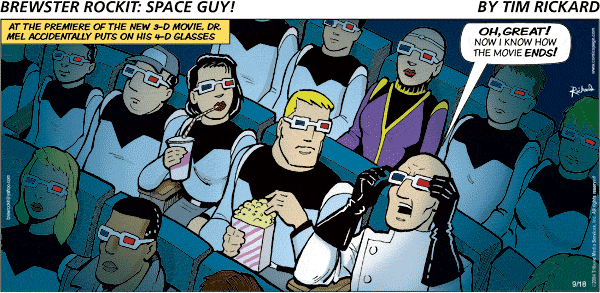
(In case you have trouble reading the text, the comic says "At the premiere of the new 3-D movie, Dr. Mel accidentally puts on his 4-D glasses", and Dr. Mel says "Oh great! Now I know how the movie ends!") :D The above comic was forwarded to me by my buddy John, from a link on photobucket: http://img.photobucket.com/albums/v45/cosier/ltmrkt050918.gif. You can subscribe to this comic strip, Tim Rickard's "Brewster Rockit: Space Guy" at this link: http://www.gocomics.com/brewsterrockit/. Thanks for thinking of me, John!
One year ago, editor Tom Huston of EnlightenNext magazine (which, until recently, was known as What is Enlightenment? magazine) conducted a telephone interview with me intended for the magazine's WIE Unbound website. Unfortunately, that interview has never been released, as the WIE Unbound team feel that the discussion Tom and I got into would be too difficult to follow for persons not already familiar with my animation or my book. This is a shame, because I thought Tom did a great job of leading the interview along and pulling things back if he felt I was going too fast for persons unfamiliar with the concepts. But now, I'm thrilled to be able to tell you that the publishers of that magazine, as of just a couple of days ago, have kindly consented to release the raw recordings of that interview for me to be able to publish it here. Our plan is to have this 45-minute interview available in this blog entry, and as a downloadable mp3 for people wanting to play it on their iPods and audio players... if everything went according to plan you should be able to do that from the links below.
You can listen to this file right now using the above embedded player. The mp3 for this interview is available for download from archive.org under a Creative Commons Attribution Noncommercial Share-Alike license - click here to download the file.
One of the first questions Tom asked me was about a topic I had not thought about for years: the Trafalmadorians, a fictional race from Kurt Vonnegut's writing, featured prominently in his wonderful novel "Slaughterhouse-Five". Tom wondered how the unique point of view of this alien race could be related to my way of visualizing the dimensions. Like Dr. Mel in the above cartoon, these fanciful creatures were, according to Vonnegut's tale, able to see time the way we see 3D space - with the past and future stretching out like a mountain range into the distance. It's interesting to think of that idea in the context of Dr. Mel's special "4D glasses" from the above comic - all elements of the movie Dr. Mel is about to watch are locked in and predetermined, so the ending that would be approaching within the next couple of hours would be clearly defined, with no possible ambiguity, and would therefore be easily seen by Dr. Mel's special 4D spectacles.
Likewise, in entries like Hypercubes and Plato's Cave, we've talked about visualizing four dimensional shapes. Dr. Mel's glasses would have no problem showing the additional spatial dimension of a hypercube (a four-dimensional cube, with its additional spatial dimension being at an additional "right angle" to the length, width, and depth of the third dimension), because, just like a movie's pre-determined ending, a hypercube's shape would be locked in and unchanging when viewed from the fourth dimension. Also, in my entry "The Past is an Illusion" I talked about a fun little flash game called "Z-Rox" which allows you to guess shapes from the lower dimensions, and the idea that this game can only be played because the shapes you're looking at don't change until you guess correctly.
Thinking about walking around with these 4D specs on in real life, though, would be another matter entirely: since real life is not a movie or a hypercube, there are many possible futures and pasts, so the 4D shapes would be fluid and constantly changing. With this project, I've been insisting that the probability space of those possible branches is really in the fifth dimension, and the fact that Einstein also embraced the idea that our reality is defined at the fifth dimension seems to be a confirmation which, mysteriously, few people ever talk about (except me! :D ).
Is there one "most likely outcome" that could happen one minute from now? Then that would be part of what you see with Dr. Mel's 4D glasses, or with the perspective of the Trafalmadorians. If some new random event or deliberate choice right "now" changed what was most likely to happen one minute into the future, then that would become part of the new landscape seen from this constantly evolving 4D perspective.
Which leads us back to Feynman's "sum over histories" approach to quantum mechanics (also known as the "path integral formulation", interestingly enough), and the Deutsch team's proof that our quantum and macro realities are both part of the same continuum. From the 4D perspective, we could look at the path from the beginning to the end for our universe and say that there is one path that is more likely than all the others to take place, simply by averaging all the possible paths together. Now, would that be the path actually taken? When you think about it, that's really highly unlikely. That, after all, is the nature of taking averages - there will naturally be parts of the data which fall well outside the norm, but all of those large deviations will cancel out in the biggest picture of all. And in order to the see the "ray" of all possible pasts and futures that could be taken by a subatomic particle, or a human being, or by the universe as a whole, Dr. Mel would have to put away his 4D specs and pull out the 5D ones!
For more about the ideas of the most likely paths for our universe and how that relates to the universe we are actually observing, you might want to check out "Unlikely Events and Timelessness" or "Randomness and the Missing 96%". Next blog, we're going to talk a little more about the difference between the fourth and fifth dimensions with a fun entry entitled "Predicting the Future (Here Come the Aliens)".
To close, here's one of my songs about trying to visualize the biggest picture of all, where Everything is Forever and Everything Fits Together: what if you were to somehow change your perspective so that you could see the universe simultaneously, right from its beginning to its end? The song is called "Big Bang to Entropy".
Over three million unique visitors have now visited the tenth dimension website. Thank you tenth dimension fans around the world!
In science, a physical picture is often more important than the mathematics used to describe it. - Michio Kaku, in his book Physics of the Impossible
With this quote, Michio Kaku was summing up the work of Michael Faraday (1791 - 1867), who, with very little mathematical or scientific training but a strong visual imagination, came up with a way of describing the waves of electromagnetic energy that underlie our universe, and created the cornerstone for much of the twentieth century's discoveries about the nature of our reality. Since my project is also about a powerful way of visualizing how our reality is constructed, and incorporates the idea of patterns and waves across the dimensions as being key to that process, Dr. Kaku's quote struck quite a chord for me. With that in mind, this time around I'd like to talk a little more about dark energy and dark matter.
In Dark Matter, Dark Energy, Dark Information, we looked at the astonishing fact that 96% of our universe is invisible and undetectable dark energy and dark matter. What a strange situation science is caught in right now! Some have expressed hopes that the Large Hadron Collider at CERN, which is scheduled to go online this summer, may reveal evidence of extra dimensions or the source of dark matter and energy: but the astonishingly huge amounts of data (15 trillion gigabytes per year!) the LHC will be collecting means it will still be a while until that evidence is analyzed and the findings revealed.
We have two poll questions currently running that ask visitors' opinions on what the LHC is going to find, please be sure to cast your vote. In the meantime, let's talk a little more about how the way of visualizing reality that we're playing with here might be used to portray the missing parts of our universe. Coincidentally, the current edition of What is Enlightenment? magazine interviews five prominent physicists about dark matter and dark energy. Here's a couple of quotes from that article:
If you add up all the matter and energy in the universe, it comes to just four percent of all that drives cosmic expansion. So we're clueless... with no idea about what occupies the remaining ninety-six percent of the universe. - Neil de Grasse Tyson, astrophysicist, author, and director of New York's Hayden Planetarium
I've been interested...whether or not the dark energy could come from extra spatial dimensions...where a kind of vibration in those multidimensional spaces creates this energy that's felt everywhere in the universe. Now with dark matter, it would be nice if it connected to dark energy in some way, and it wasn't just a completely separate, random piece of information about the universe. It would be nice if it were somehow a different side of the same coin... - Janna Levin, theoretical cosmologist, author, and professor of physics and astronomy at Barnard College of Columbia University
With my way of visualizing how our reality is constructed, we are looking at a way to explain dark energy and dark matter, and how they are both related to the mainstream physics idea that gravity is the only force which exerts itself across the extra dimensions. So let's go back and look at the original Imagining the Tenth Dimension animation in a little more detail.
How is One Dimension Related to Another? In Flatlanders On a Line we talked through the logic of this project's visualization tool more deeply, and how the "ray" of the fifth dimensional probability set from any current "now" is (of course) much more complex than the simple line/branch/fold that I'm using to build our image of the extra dimensions. This relates back to the ideas Edwin Abbott was introducing us to with his original "Flatland: A Romance of Many Dimensions": using what we know of the limitations and inter-relationships of the lower dimensions can help us to build a concept of the additional dimensions. Abbott talked about the imaginary worlds of the Linelanders (living on a one-dimensional line), the Flatlanders (living on a two-dimensional plane), and the Spacelanders (which would be three-dimensional creatures like us).
Most people have drawn the conclusion that Abbott's concept of the befuddled 2D Flatlander trying to imagine a fantastically improbable world of three dimensions is useful for us as three dimensional creatures trying to imagine the fourth spatial dimension. The idea that we've arrived at with this project, though, is that it's even more valuable for us to think of the one-way-arrow of time (as one of the two possible directions in the fourth dimension) as being like the limited one-dimensional world of the Linelander.
Living On a Line In What Would a Linelander Really See, we tried to visualize the highly limited viewpoint of a creature living on a one-dimensional line. Now, let's imagine our 3D universe as a sphere, and a one dimensional line passing someplace within that sphere. If you were a point on that line, in what direction would you perceive the 3rd dimension to be? Clearly, it would be all around you, pulling equally on you from every "side". Of course, as a point on a line someplace within that sphere, the source of whatever was pulling on you from that 3D world would be very mysterious indeed, as you wouldn't even have a name for the direction that this mysterious force was coming from.
Now what if your one-dimensional line was really a part of a 2D plane, and there were a large object nearby on that plane? Two things would happen - from the point of view of the first dimension the gravity of that object would tend to be more localized, and would tend to bunch things together rather than pull things apart. In fact, because the object was only one dimension away, it would be almost like there was an invisible gravitational material or an invisible force pulling together on a part of your one-dimensional line.
Do you see where I'm going with this? Now let's go back to us as "4D Linelanders". Cosmologists are now mapping dark matter throughout the universe, and finding evidence of higher and lower concentrations of this invisible matter based upon its gravitational signature. Imagining the fifth dimension as being like the 2D plane our 1D Linelander was being influenced by shows us how dark matter really could be in the fifth dimension, with higher and lower concentrations that are part of the neighboring bits of the multiverse that are "just around the corner", at that additional right angle that the fifth dimension would be to the fourth: creating areas of higher gravity that, by virtue of their existence in the fifth dimension, have become part of the dark matter that has kept our universe from flying apart as quickly as cosmologists would have expected it to.
And what about the mysterious force of dark energy, which now drives our universe apart, uniformly in every direction? If you're following along here, I hope you can see the logic of my conclusion: dark energy has to be from above the sixth dimension, and is much like the "pulling in every direction" that a 1D Linelander would experience as the 3D sphere of our universe pulled him from directions that he's incapable of perceiving, or even conceiving of.
My song "The Unseen Eye" talked about Dark Matter as well:
And the missing dark matter that binds the universe The mysterious mass that science cannot find Is in the many worlds of possibility That are just around the corner in time
Will the LHC find evidence of extra dimensions? Will, as I have predicted with this project, Kaluza's fifth dimension be proven to be the source of dark matter, a gravitational force from Everett's parallel universes that are nearby to our fourth-dimensional line? And will, as I've also predicted, dark energy be shown to be gravitational attraction from the sixth dimension and above, where we can find the "pulling apart" to other completely different expressions of matter and energy that are found within the surrounding regions of the omniverse? These are exciting times for thinking about the nature of reality, and I can't wait to see what we discover in the upcoming few years.
Enjoy the journey!
Rob Bryanton
Related blog entries:
How the extra dimensions are "compactified" from our perspective:
(Update: an additional blog entry listing more reviews from Amazon.com can be read in this May 2008 blog entry, and author/scientist David Jay Brown provided a very favorable review which you can read in this August 2008 entry.)
Despite a growing audience of visitors to the tenth dimension website (which is now at over two million hits per month!), this project continues to fly under the radar of the mainstream press. The only exception to that so far is the article several months ago in "What Is Enlightenment?" magazine by associate editor Tom Huston: here is a link to a downloadable pdf of that article.
Meanwhile, here in the world of the internet, millions of people have seen and enjoyed the introductory animation, which is based upon chapter one of the book. Since much of the book is based upon the concept of memes (ideas that rise and fall and connect across time and space) and how that relates to the reality we are experiencing, it's been interesting to track the memes that have risen and fallen over the last year and a half since this project vaulted to popularity as a result of a couple of thousand diggs in July 2006, and again in December 2006.
Here's a snapshot of the memes that have risen and fallen around this project since it was launched: - July 2006 - website and book become popular around the world. Most common memes are "this is mind blowing", and "this is not what mainstream science teaches" (both of which I believe are valid) - September 2006 - Lee Smolin's "The Trouble With Physics" and Peter Woit's "Not Even Wrong" become popular. In the mainstream press it becomes fashionable to dismiss any discussion of higher dimensions, since they are unimaginable and undetectable. Interest in this project plateaus for a few months. - December 2006 - website becomes popular on digg a second time, audience for the project grows. - February 2007 - John Brownlee, in his blog at Wired.com, calls our animation "absolutely fargin' incredible" (thanks John!). Interest in the book and the project take another leap forward. - March 2007 - some negative reviews of the book appear at Amazon.com . This book, called "Imagining" the Tenth Dimension, "a new way of thinking" about time and space, and described in the accompanying text as "not about mainstream science, but rather a mind-expanding journey that will change the way you view the incredible universe in which we live", receives these negative reviews because it is not about the current teachings of mainstream science. Huh? Despite the book having at least as many positive reviews as negative, visitors to Amazon have given more "helpful" votes to the negative reviews (not surprisingly), so those are the ones you are now first shown by Amazon. - April 2007 - the extremely positive review of this book and the project appears in the April-June issue of "What Is Enlightenment?" magazine. - June 2007 - Clive Thompson, in his gaming blog at Wired.com, gives us a nice mention in an article about games that stretch reality. As with previous mentions by websites such as Entertainment Weekly, Network World, and Dvorak Uncensored, new people are introduced to the site. - July 2007 - the project launches a new chat page which, after a month or two of experimentation, settles upon a format incorporating live or recorded video of the author and guests using UStream.tv, a chat room associated with UStream visitors, and a second Meebo chat room which includes the ability to share URLs and YouTube movies in a thumbnail-ordered viewer, with the text from the Meebo chat room being also added to the live or recorded video from UStream, using a wonderful (and free) program for the Mac called CamTwist. Persons wanting a simpler (non-interactive) experience can watch at tenthdimension.tv . - August to December 2007 - month after month, the audience coming to the Tenth Dimension website grows. Due to popular demand, the project opens a Digital Items store, offering high-resolution versions of the animation which continues to blow minds around the world, plus mp3s of some of the songs associated with the project, plus a pdf of the book. All materials are released under a Creative Commons license: because, despite what the naysayers say, this project is not a scam to try to get you to buy a book or a t-shirt: it's about a new set of ideas that are rising in popularity around the world.
The animation speaks for itself - people love it (or hate it), but a growing number of people continue to be attracted to it. The songs are available as videos for free from revver.com or on youtube, or higher quality versions can be purchased as mp3s from our digital items store. The book, on the other hand, does not speak for itself so easily, despite being easily searchable on Google Books. Here, then, is a compendium of brief quotes from various places around the net about this book.
"A fascinating excursion into the multiverse--clear, elegant, personal, and provocative" - Hugo and Nebula award-winning author Greg Bear
"Brilliant and unexpected... written in an easy to read style... gets your mind expanding in all the most satisfying directions." D. Richards, review on Amazon.com
"It is refreshing to read a book that is about considering a variety of perspectives - 'scientifically proven' or not." LJB, review on Amazon.ca
"In an easily readable style he has boldly taken us past the fourth dimension through to the tenth employing an understandable logic based on geometric considerations. There is no mind-boggling mathematics and there is a distinct absence of the crank/crackpot style; each step along the way is carefully developed in a sequential manner accompanied by readily understandable diagrams." Richard Ruff, review on Amazon.com
"There are times when those in academia are right to be critical of poorly conceived ideas but there are also times when such criticism only inhibits new ways of seeing. This book conveys a very different and unique way of looking at the universe." Joseph Moore, review on Amazon.com
"the simplicity of Bryanton's ten-dimensional model is striking... purely speculative... but built on logical consistency..." Tom Huston, in What is Enlightenment? magazine
"Your view of time as the dimension above the one from which one is viewing is very compelling." Coert van Gemeren, on the tenthdimension.com forum
"Excellent structured bridge between geometry and metaphysics. Read it, it's good for ya." W. Kasper, review on Amazon.com
"an imaginative and strangely 'musical' way of imagining superimposed dimensions... it is also pleasurable to read." K. Flekkoy, review on Amazon.com
"I highly recommend this book to anyone that is interested in learning about some of the most complex concepts in modern science in a fun and revolutionary way. You will not be disappointed." David Levy, review on Amazon.com
"Without being too technical, he correlates properties of the unfolding dimensions with predictions and outcomes of modern physics, especially quantum mechanics. Philosophical implications are explored along the way." Richard Ruff, review on Amazon.com
"freshly imaginative, entertaining and challenging... caused me to move beyond my comfort zone..." David J. Zimmer, review on BarnesAndNoble.com
"Many people in academia initially shy away from this kind of new approach, but the way the dimensions expand then fold back inward into an indefinite point is consistent with holographic enfoldment ideas from people such as the famous physicist David Bohm and science writer Micheal Talbot." Joseph Moore, review on Amazon.com
"Imagining the Tenth Dimension is a wonderful book that helped me thinking 'outside of the box' and taught me many complex concepts in a fun and easy to understand way. Bryanton's way of thinking is easy to follow and his explanations make a lot of sense to to scientists, philosophers and to the average reader alike." David Levy, review on Amazon.com
"This book is excellent for a reader looking to expand their horizon on something more than what is in front of them. It gives you an opportunity to think of all the possibilities you have in life. " C. Leonard, review on Amazon.com
"...covers alternate dimensions/realities, interesting read, very smooth and eye opening." livejournal entry by spaminator3000
"If you are a practicing mainstream physicist this book may well be frustrating in its easy embrace of unconventional notions..." LJB, review on Amazon.ca
"it's expanding worldviews, blowing minds, and provoking plenty of philosophical and spiritual inquiry as well." Tom Huston, in What is Enlightenment? magazine
"Having just finished your book, I must say you have managed to present the material in a uniquely fresh way." Coert van Gemeren, on the tenthdimension.com forum
"For the more mathematically and physics-minded amongst you, the challenge is to subject Rob Bryanton's ideas to scrutiny - he has an excellent blog site for such feedback and discussion." Richard Ruff, review on Amazon.com
"a philosophical journey into what multidimensional space can mean to the 3 dimensional self... a book that will open your mind..." D. Richards, review on Amazon.com
"I just got done reading your book. I have to say it was awesome... parts literally made me stand up out of my chair." 16 year old Nick K, on the tenthdimension.com forum
"Bryanton appears to be one very scientifically and philosophically astute musician who knows a lot of stuff about a lot of things." LJB, review on Amazon.ca
"the method of synthesizing every conceivable universe into a final tenth dimension wields considerable strength." Joseph Moore, review on Amazon.com
"...manages to make sense out of more mysteries than any one theory should justly be able to handle." Tom Huston, in What is Enlightenment? magazine
"Imagining the Tenth Dimension: A New Way of Thinking About Time and Space has at long last provided a framework in which the bigger picture, for me at least, makes intuitive and scientific sense. Stick with the logic and you too should be rewarded with an "Ahah!" experience. I felt the dots were joined and the gaps filled in my own personal ponderings on higher dimensions and the sense of satisfaction was not just restricted to the scientific side of me. My background is in the physical sciences and having read the book twice, I am yet to find any weaknesses in the proposals." Richard Ruff, review on Amazon.com
Again, if someone is confused about whether I'm pretending to be a physicist after all this, then I'm afraid you're just not paying attention! I'm a composer, who has written a large number of songs and a book, all built around a "new way of thinking about time and space" which we're playing with in this project: and while there are many ideas taken from mainstream physics and cosmology, this is better thought of as a creative exploration that blends together science, philosophy, spirituality, and metaphysics. Part of its problem, I believe, is that it is such a wide-ranging exploration that it is hard for the mainstream press to decide how to describe what's happening here. Even just within the science world, it blends too many competing schools of thought together: for instance, David Deutsch doesn't believe his bush-like branching structure is in the fifth dimension, even though that fits so nicely with the "branching" idea from the fourth to the fifth dimension as I portray it. Quantum physics doesn't require higher dimensions, it just requires an unobserved fabric of "information", which is how I describe the tenth dimension in isolation from the others. String theorists don't believe our universe is a "point" in the seventh dimension, although they do say our universe is the result of a seven-dimensionsal brane interacting with a three dimensional brane. String theory doesn't equate the bush-like branching structure of probabilistic outcomes with the fifth dimension's "curled up at the planck length" description they use... again, even though imagining that our 4D line of time is being constructed from available branches one planck length at a time allows us to easily visualize how such a thing could be possible.
And of course, many mainstream scientists are dismissive of any way of describing reality that also incorporates other more metaphysical/spiritual ideas into the equation, which are the parts of this discussion we haven't even touched upon here.
In the meantime though, the internet continues to be its own universe, and the number of people being drawn to this site from around the world, through their connections to each other, through the ideas we're exploring here, and the growing feeling that our world is changing, is very exciting. Enjoy the journey!
Last blog, in an entry titled "Addictive Personality", I talked about the negative patterns that can cause people to make the same mistakes over and over. Developmental psychologists like to talk about impulse control, and how this faculty is different in a child's mind, the adolescent mind, and the adult mind.
So, the child's stolen candy bar, the adolescent's silly risk taken, or the adult who decides they can get away with an Enron scam would all be examples of an impulse control (or rather, the lack thereof!) that allowed an individual to choose a path that might best not have been taken: but in a universe of free will, bad choices have to be just as allowable as good ones. To think of this another way, the child who was sexually abused and grows up to become a sexual abuser is yet another example of negative repeating patterns across time and space, and the person who ultimately overcomes the impulse to repeat that sad tale will have finally found their way to a different part of the multiverse and its "bush-like branching structure" that represents all possible outcomes for our universe.
I'd like to quote a comment posted to my last blog entry by Tom Huston. Regular readers of this blog will recall that Tom wrote an article praising my book which appeared in the spring issue of What Is Enlightenment? magazine. By the way, I'd like to invite you to check out Tom's personal blog at KosmicTom.com.
Humanity's karmic momentum is indeed strong, and I can't see why it wouldn't be dominating about 99.999% of what's happening along humanity's timelines (potential or actual), at least at our current "position" in time and cultural development... But I think there's probably at least a 0.001% interjection of free will, or true creative freedom, at play in the "system" at any given moment that can break the momentum of any trajectory and change things for the better. And it's up to us to choose if we're going to help make that percentage a little larger, through freeing our own consciousness, more and more and more...
Thanks for your insightful comments, Tom. Personally, I hope that your .001% estimate is low, but I agree with you completely about trajectories and how they can be changed or not changed. A few months ago I posted a blog entry called "Your Sixth-Dimensional Self". That entry discusses the idea of choices taken/not taken in the big picture of timelessness. This time around I'd like to run with the idea Tom presents us with of "karmic momentum", while we discuss a more linear image of what could be happening within timelessness.
There has been renewed interest this year in cosmological theories which present a cyclical scenario for our universe: rather than just the single "big bang" physicists have been imagining, perhaps there are endlessly repeating cycles of expansion and contraction that start from/end with something approaching (but never achieving) a singularity, and each time the universe expands back out into another iteration of itself (I should note here that "brane collisions" are often being advanced as a possible explanation for this repeating cycle, but this time around we're going to stay away from thinking about all this "extra dimensions" stuff).
So. What if this cycle has been/will be repeated an infinite number of times? Then we could leave everything about our universe in the fourth dimension of spacetime, and forget about all these crazy notions of needing any further dimensions to express the big picture. We could just lay every possible timeline end-to-end, one after another, in an infinite "line of time".
Here we go again with another of those mind-boggling ways of imagining our already infinite universe in an infinite number of timelines. If our universe were to repeat infinitely (with each repetition representing a different set of throws of the quantum dice, so to speak) then that would have to include the repetition where everything about the universe was the same as now, except for the differences in impulse control that in a different iteration of the universe kept me from taking that candy bar as a child, or driving recklessly as a teenager, or caused me to make an unwise business decision for which I'm now doing time!
Naturally, in an infinitely repeating universe, there would also be a great many scenarios which are completely different from the one we are currently in: you and I were never born, dinosaurs were never wiped out, life never progressed past single-celled organisms, matter never coalesced into stars, and on and on. With the luxury of infinite repetitions, we can get to every single possibility that could have arisen from chance and circumstance eventually.
But the versions of this cycle that interest us the most, obviously, would be the different scenarios that are almost the same as our current one. In terms of karmic momentum, then, we could think of this cycle as being what happens when the endlessly repeating version of ourselves is presented with a set of choices, and yet no matter how often a bad/dishonest choice is presented in this endless wheel of an infinitely repeating universe, there are choices that some of us will never take.
In some cases, this is going to be just a matter of convenience: I never stole money because a big bag of somebody else's money never appeared on my doorstep. But what if it had? Perhaps the real test for sainthood should not be how exemplary a person's life was, but how many opportunities that person was presented with to make bad choices which that person's impulse control and karmic momentum caused them, again and again, through every iteration of the universe, to do good instead.
I'd like to finish off with another of the songs from the end my book, this one presents another way of thinking about the endless iterations that might be possible from the beginning to the end of our universe. First of all, here's how I introduce the idea of this song back in chapter five:
Graham Hancock, in his book “The Mars Mystery”, tells of a system of mirrors that were left behind on the moon by the Apollo astronauts. From 1973 to 1976 researchers used a 107-inch telescope to direct more than 2,000 laser beams at these mirrors. These laser beams allowed extremely precise measurements to be made and revealed a 15-meter oscillation of the lunar surface about its polar axis, with a period of about three years. Astronomer David Levy suggested that the moon is behaving “just like a huge bell after it has been clanged”. Scientists proposed that this must be the result of a relatively recent major impact, and that this ringing will die out after 20,000 years or so. Imagine, now, that you are somehow able to slow down your awareness to the point where you are able to hear the ringing of that bell.
Admittedly this all starts to sound like a Zen koan, and in some ways the goal is the same–we are trying to free ourselves from a limited viewpoint of the universe and the nature of time.
BIG BANG TO ENTROPY words and music (c) by Rob Bryanton (SOCAN)
I slowed down Till I heard the moon I heard the moon ringing Ringing like a bell
I slowed down Till I felt the earth I felt the plates sliding: Skaters on a pond
And I finally felt the long groove moving underneath Births and deaths of galaxies pounding out the beat And I finally heard the whole song at once: Big Bang to Entropy Big Bang to Symmetry Big Bang to Everything
I slowed down Till I saw the sun I saw the sun spinning On a pinwheel’s arm
And I saw the long chain of our DNA Stretching back to the beginning for so long And I saw the mighty ocean that surrounds and sustains Connecting us together in a song
I slowed down Till I saw the song Was only one of many One of many more
And I finally felt the long groove moving underneath Births and deaths of galaxies pounding out the beat And I finally heard the whole song at once: Big Bang to Entropy Big Bang to Symmetry Big Bang to Everything
It begins as nothing, silence at the end Every song’s the same after or before But the parts in between, there are so very many forms More than we could ever hope to know
One of the things that has made my eleven minute animation so popular is that it gives the general public a way to imagine the extraordinary implications of quantum physics, and the multiverse, something that many would have thought impossible. Having worked their way through these ideas gives some people a new sense of wonder about the incredible universe in which we live. On the other hand, others have reacted with knee-jerk outrage, dismissing the entire project as "new age What the Bleep hippie crap".
From the outset, I have made it very clear that this is a work of creative exploration and intuition from a non-scientist. Hoping to get over the label of "crackpot" so that we can discuss these unique ideas in their proper context, I have embraced the term: in the scientific community, a crackpot is one who advances ideas even though they have no formal training in the area they are speaking about, and that is a fair description. What I have created is not a theory, it is a framework for discussion, and the almost two million unique visitors who have flocked to the tenth dimension site show that these ideas have strong resonances for a great many people from around the world.
Does acknowledging that I am a composer, not a physicist, make this an easy target for naysayers assuming that this is some sort of a scam, or that my ideas must automatically be wrong? Would I have been smarter to conceal my background and let people assume that this new way of imagining the dimensions is already accepted by mainstream science? My feeling was that these ideas showed too much promise to be discarded, and I have made every effort to be forthright from the outset of this project about my qualifications.
In the current issue of "What Is Enlightenment?" magazine, senior associate editor Tom Huston had some very kind words to say about this project. From a 2 1/2 page article entitled "Your 3-D Universe is So Passé", here are some of his comments:
"...the highlight of the site is a delightfully lucid Flash animation... explaining how each successive dimension builds and expands on the dimensions below it.... and by the time we arrive at the tenth dimension, which comes across as a kind of Teilhardian Omega Point encompassing absolutely every possible timeline of every possible universe, 'there's no place left to go'." "...the simplicity of Bryanton's ten-dimensional model is striking, and he points out at the beginning of his book that what he's proposing has little to do with the incredibly intricate mathematical formulas comprising the theories espoused by Greene, Randall, and other professional physicists. His multiple dimensions are purely speculative and built on logical consistency, requiring nothing more than a basic grasp of high school geometry to understand." "His argument hangs together surprisingly well, testifying to the more than two decades of thought he put into his model before revealing it to the world. In chapters with such diverse titles as "The Quantum Observer", "The Paradoxes of Time Travel", and "Memes, Music and Memory", Bryanton's multidimensional matrix manages to make sense out of more mysteries than any one theory should justly be able to handle." "Some forum participants have remarked on the similarity between Bryanton's model and the ten sefirot of Kabbalah, which represent the hierarchical gradations of divine creation, while others have suggested that the whole thing is just a novel elucidation of the paradoxical wisdom of Zen" "Bryanton's Imagining the Tenth Dimension is conveying the concept of alternate dimensions to an audience that might never pick up a book on cosmology, string theory, or quantum geometry. And judging from some of the comments it has been garnering in the blogosphere, it's expanding worldviews, blowing minds, and provoking plenty of philosophical and spiritual inquiry as well".
This project is about the interesting ways that physics and philosophy seem to be traveling towards agreement as to the nature of reality. I have compared it to an amazing science fiction book I read as a child, Madeline L'Engle's "A Wrinkle in Time". That book awakened my eight-year-old brain to the possibilities of there being much more to our reality than what we see before us, in the same way that Imagining the Tenth Dimension is doing so for a new generation of thinkers and dreamers. Teachers who have shown my animation to their students have used it as a jumping off point for discussions of multidimensional topology, political theory, philosophy, and cosmology.
As a way to awaken curiosity and challenge narrow thinking, this project has proven to be very effective. As one fan wrote to me, "this isn't string theory, but it's right" (my blog entry about Intuition is, in a way, a response to those kind words). Anyone who has wrestled with the challenging implications of quantum physics, entanglement, the multiverse, and the role of the observer should come away with a sense that we are only beginning to understand how rich and strange our reality and our place within that reality really is. Please check out the book " Quantum Enigma" by Bruce Rosenblum and Fred Kuttner, two physics professors from the University of Santa Cruz, for a level-headed discussion of consciousness and its relation to quantum mechanics.
The simultaneous wave/particle nature of reality means that many things that appear to us as particles are waves just being observed in a certain state. By the time we have arrived at the tenth dimension as the enfolded timeless whole (as explained so well by Gevin Giorbran), we have finally reached what some people think of as God, or a state of enlightenment (as referred to in Tom Huston's article about this project in the current issue of What Is Enlightenment?, or the ultimate theory of everything.
In Imagining the Tenth Dimension, I spend a lot of time talking about triads, insisting that all dualities have a third option, which can be both, neither, or no choice. Our physical world interacts with a world of memes and spirit, and the third option that results can be life as we know it, or it can be just the timeless whole that represents every possibility contained within the multiverse. But the dualities of one order pushing against another as we move along our line of time (a line that is actually created by a series of slices, here we go again with that simultaneous wave/particle stuff) allow us to see that this instant in time is a slice of a waveform, and that waveform is reflected in the beautiful and complex universe that we see around us.
Waveforms are interesting, because one waveform can incorporate many different frequencies simultaneously. So, a simple single line drawn from the big bang to the end of the universe can be overlaid with the many different waveforms representing the many possible expressions of reality, and the organizing dynamics that push against each other to create the preference for one kind of reality over another in different parts of the multiverse.
One of the reviewers for my book on Amazon.com has this to say:
"The present exposition is an imaginative and strangely "musical" way of imaging superimposed dimensions--not surprising perhaps, since the author among his achievements also is a musician. Still, the treatise has relevance for physicists. It is also pleasurable to read."
(thanks for the kind words!).
I suppose, since I spend a lot of my work day staring at waveforms, thinking of reality as being a complex waveform precipitated from potentials contained within the higher dimensions doesn't seem like much of a leap to me. Once you arrive at this idea, you have a way of explaining entrainment (how like attracts like, how attitude affects outcome, how eating live veggies imparts healthful vibrations, how charismatic or depressed personalities can immediately impart their "vibe" to a room full of people, how "Sync" as described by Steven Strogatz can cause order to arise out of chaos, how thoughts become things, and so on).
Thinking of our reality as a waveform also shows how there are always certain sets of "you can't get there from here" points in our physical reality (both past and future), but how a reality of memes and spirit can move more freely across time and space. This week in the blog dedicated to lucid dreaming, "Dreaming Life" , host Ben Q. published an interview with me where we discuss some of those ideas. I encourage you to check out this fascinating blog on a regular basis.
One of the most unusual and convincing examples of how reality could be constructed from waveforms, and the possiblity that the mind can be used to change our reality came to me a few months ago from Deena Zalkind Spear, whose lovely book "Ears of the Angels" tells a story most of us would have thought unbelievable, had it not been collaborated by so many intelligent and sensitive classical musicians. Told with a self-deprecating sense of humor, Deena's book is a pleasure to read, and I recommend it highly if you're looking for something that will challenge your limited worldview of physical reality.
Finally, while we're talking about vibrations and waveforms, we have now posted my song "Everything Fits Together" to a site called "JamGlue", which allows you to remix all of the instrumental and vocal parts to the song in whatever way that pleases you (click on the Remix button to see the song as six sets of waveforms, and you may want to work through the tutorials on the site to see what the possibilities are). These "stems" (as we call them in the audio industry) can also be downloaded from Amie Street, so if you have an audio sequencer of your own, I invite you to cut and paste this material to your heart's content. And please, email me mp3s of any of your mashups of this song you think are worth listening to (rob at tenthdimension dot com), and I will post them at a future date. These songs are released under a Creative Commons license, basically this says you are free to play with and re-edit this material as long as you give me credit as the original composer, and do not sell your remixes.
Enjoy the journey,
Rob
PS: The blog in which I originally published the lyrics to this song can be found here. And three videos of "Everything Fits Together" are below, just for fun:
In an ideal world, every interface should be able to be boiled down to a simple interplay between only two currently available choices, so that even a very limited input device (one operated by a physically challenged person, for instance) can navigate, right from the very first yes or no. Finding what the most basic choice is can be the hardest part of designing an interface!
Some people are not comfortable with the idea of "Thoughts Become Things", because it feels so counter-intuitive to the observed physicality we see around us. Is everything just vibrations and constructive interference patterns? Is a person's consciousness and our physical reality all just a reflection of a complex vibration across the dimensions? In the model proposed in "Imagining the Tenth Dimension", we begin by talking about the geometric concept of a point. Later in the book, it becomes clear that this "starting point" can be in any dimension we choose to imagine it (if it's in the third dimension it could be at position x,y,z; in the seventh dimension it could be at position t,u,v,w,x,y,z; and so on). If the tenth dimension encompasses all aspects of indeterminacy, then no matter which of the nine dimensions you choose to place that first "point", its position collapses out a particular reality from the multiverse... in other words, it becomes the first yes/no, and by its selection it is already reducing the available options to a certain subset of the indeterminate whole.
I would argue that no matter what dimension you place that first point, the first thing that point defines is the value (or range of values) for gravity in the universe (or universes) that you are selecting. Physicists tell us that gravity is the only force that travels across all dimensions. Therefore, even if the information is irrelevant to the discussion at hand, any reality (ours included) can't have an indeterminate value for gravity. What do I mean when I say this information could be irrelevant? Well, for instance, if I define a set of co-ordinates in the third dimension to create a cube, I can determine the volume of that cube. Whether that cube exists in our universe or in some other universe with a different value for gravity, I can still determine its volume. But as soon as I am imagining a cube that physically exists, I am defining it as being in a real three-dimensional universe, which means that even though I am only assigning the x,y,z co-ordinates and values for this cube, its existence as a real object necessitates that it also be part of an implied subset drawn from the wave of quantum indeterminacy: a reality defined from the ninth down to the first dimensions. If gravity is everywhere, then any subset of reality must be limiting the available choices for gravity.
What if the point I'm thinking about is in the seventh through ninth dimensions? Then we can imagine our point, because it is of indeterminate size, as encompassing multiple values for gravity. Whether it would actually be possible to create a three-dimensional reality from a seventh-dimensional point encompassing a range of values for gravity is a science fiction question, a challenge for the imagination.
The second thing that can be locked in is the value for how close one point can be to the next in the reality we are choosing to examine. For our universe, this value is known as the planck length, and its value tells us why nothing in our universe can travel faster than the speed of light, and why our reality breaks down into quantum indeterminacy when we try to examine things that are closer to each other than the planck length - it's because "time" is not continuous, it is granular. Time gives us this illusion of being a continuous fourth-dimensional line, but it's actually being created by a series of three-dimensional points each representing our universe in a particular state-space, and each of those points is one planck length away from the next. While it's entirely possible to imagine a universe constructed from points that are closer together or further apart than the one we live in, they would be part of some other subset of the multiverse.
But how can something as complex as physical reality be boiled down to just a vibration across the dimensions? Here's an analogy: think about a sound wave. Using the interplay of only two factors, amplitude and frequency, we can create something as simple as a sine wave, or as harmonically complex as the human voice, or as dynamic as a thunderstorm. In the digital realm, the degree of accuracy with which a sound can be represented is reflected by the number of bits used to represent the amplitude, and the sampling rate used to represent the frequency. Once the bits and sampling rate are high enough (and any audio geek will tell you these numbers should therefore be much higher than the 16 bits and 44.1K sample rate of a CD), any sound imaginable can be properly represented.
The speed of light, then, shows us the "sample rate" for our universe, which determines what frequencies can be properly represented in the waveform of our physical reality. As we approach the speed of light or the planck length, reality breaks down, it can no longer be properly represented.
Consciousness, in its own way, can be boiled down to an interplay between gravity and light, but consciousness is not confined to the physical world, so those words can easily be used metaphorically. Still, an idea can have a certain gravity (or lack thereof), and a frequency (or mix of multiple frequencies) which, like the amplitude and frequency of any other waveform, allows us to create any idea imaginable. In Imagining the Tenth Dimension, I argue that the clouds of memes and spirit that exist across time are part of what we take on to become a unique personality, and because those factors are not rooted in the limited physical realm, they can be transmitted across generations, and also be responsible for simultaneous inspiration or the sudden ascendency of new memes. The biggest-picture-of-all memes which have existed since the beginning of our universe have such a long waveform that they could easily be represented by a much lower sample rate - but since time is really an illusion, what we are really talking about here is just another way of viewing our slice of the multiverse.
Enjoy the journey,
Rob
P.S. - the new "Utopia" issue of What Is Enlightenment? magazine is now hitting the newsstands. Please flip to page 26 and read the fantastic article by Senior Associate Editor Tom Huston about the Imagining the Tenth Dimension project.
Since this project was launched, I have always been careful to describe this as a "new way of thinking" rather than an established scientific theory. As it says on the back cover of my book, it is "not about about mainstream physics. Rather, Imagining the Tenth Dimension is a mind-expanding exercise that could change the way you view this incredible universe in which we live".
I have always liked the idea that the best scientific theories seem to have an inherent elegance or "rightness" to them that allows the general public to have at least some intuitive understanding, even if they can't do the heavy math or analyze the deep theories behind the science. As we move towards a time where we have philosophers and scientists seeming more and more to agree on what's happening out there in the timeless multiverse, we begin to feel that both factions really and truly are talking about the underlying structures of reality. As I said a few blog entries ago, it's like gophers popping their heads out of their burrows and catching sight of each for the first time.
I am very pleased to note that the upcoming issue of "What is Enlightenment?" magazine is doing a feature article on my Imagining the Tenth Dimension project. Senior Associate Editor Tom Huston has written a two and half page article, "Your 3-D Universe Is So Passé" which will be part of their issue entitled "Searching for Utopia". This magazine is on newsstands at stores like Borders, Barnes & Noble, Chapters, Whole Foods, etc., and I invite you to pick up a copy.
My song Everything Fits Together, for me, sums up the concept of enlightenment - the idea that there is an underlying order to the universe which we can intuitively understand and relate to is key, as well as the idea that there is an inner peace we can all strive to achieve once we perceive that underlying order.
Here again, and for the new visitors to this blog from What Is Enlightenment, are three videos for that song: Everything Fits Together. Here also are two links to previous blogs about this song: one which prints the lyrics, and one which gives a bit more discussion about the ideas behind the song.
All around the world, a new group of thinkers and dreamers are popping their heads out of their gopher holes and catching sight of each other for the first time. Scientists and philosophers, it would seem, are being drawn towards a common set of central truths as to the nature of reality, and what is really happening behind the scenes when we use words like consciousness, spirit, time, and entropy.
The eleven minute animation that vaulted Imagining the Tenth Dimension to popularity continues to draw new fans on a daily basis. Although I must continually point out that the ideas in this animation originate from a non-scientist (me), and are not what you will be taught today in a physics class, I am also gratified at the number of people who have thanked me for what is most commonly being referred to as a new and mind-blowing experience.
As an inquisitive eight-year-old, I was introduced to some of the basic ideas of dimensions and the folding of spacetime through Madeleine L'Engle's transcendent children's book "A Wrinkle in Time". Did L'Engle get all of her science right? No. Does that matter? To the extent that this wonderful book (as it did for countless other fans, I'm sure) expanded my young mind's perception of the universe to want to know more about these topics, those approximations and tiny liberties she took in creating her work of imagination matter very little. Previous generations to mine might have been drawn to the writing of H.G. Wells, or that granddaddy of creative books about dimensionality, Edwin Abbott's 1884 classic “Flatland: A Romance of Many Dimensions” (from which came my use of the concept of two-dimensional Flatlanders).
More recently, books by science fiction visionaries like Greg Bear and Stephen Baxter, and movies as diverse as The Matrix or Groundhog Day are really about the same ideas that I have been exploring all my life: that our reality is being created from branching possibilities that already exist across the dimensions. This idea, I believe, finds a useful balance between hard determinism and free will, showing how there are certain outcomes which appear to be inevitable based upon the trajectories and choices already taken within the "sum over histories" that got us to this moment, but how each of us still has a great deal of control over our own version of reality from any particular moment forward.
Last blog I mentioned The Secret. Someone wrote to me and suggested that Imagining the Tenth Dimension is a more well-balanced, less simplistic representation of the same ideas as are advanced by Rhonda Byrne and her team: a fact that I find fascinating since I did not hear about The Secret until well after my book was published. Likewise, I have been contacted by fans of Neale Donald Walsch's "Conversations With God" series of bestselling books, telling me that the ideas I present are completely compatible with Neale's, and perhaps even offer an explanation for how the processes he describes could be manifesting themselves. How do coincidences of thought like this occur when I had never read any of Neale's work? Must be spring, hello all you other gophers!
Right now I'm reading an exciting new book by Gevin Giorbran called "Everything Forever: Learning to See Timelessness". This beautifully illustrated book is a gold mine for anyone interested in a cataloguing of the many ways that science (and philosophy!) have shown us that time can be thought of as much more than the limited one-way-arrow that we experience. Gevin has some remarkable insights into the underlying dynamic tensions that create the reality we are witness to, and I'm sure I will be talking about this book more in upcoming blogs.
One email I received a couple of weeks ago had this to say about Imagining the Tenth Dimension: "this isn't string theory, but it's right!". That feeling of something clicking, of seeing new ideas and having a little "A-ha!" light of recognition come on, is one of the things I have heard most from fans of this project. Is my eleven minute animation the "Wrinkle in Time" for up-and-coming minds of the twenty-first century? To the extent that I believe that my "new way of thinking about time and space" can be a useful step towards a more enlightened view of reality, I would be very proud if that was how this project someday grew to be remembered.





 Posts
Posts