a new way of thinking about time and space ~ ~ ~ ~ ~ ~ ~ ~ ~ ~ by Rob Bryanton
--author and research scientist David Jay Brown says: "one of the most brilliantly-conceived and mind-stretching books that I've ever encountered".
--science fiction author Greg Bear says: "a fascinating excursion into the multiverse - clear, elegant, personal and provocative"
Over the last few weeks we've been looking at entries based upon a list of questions given to me by high school senior Jim Evins for a paper he was writing about my project. We'll conclude with three more questions.
"In chapter 3 of your book you discuss the possibility of an alien race that moves backwards in time. If they were to show up in the year 3000 and attain victory over earth, and we attain victory in our flow of time, would we not just destroy one another’s history and reverse the reality of who showed up first on our planet?"
The accepted definition for anti-matter is that it’s matter which is moving backwards in time. That underlying “sea of information” that we looked at in the first question is ultimately symmetrical, a balanced whole, where every positive and negative can exist simultaneously, and our universe or any other is defined in part by how it breaks that symmetry: this is why our universe is made primarily of matter rather than anti-matter. Physicist Sean Carroll talks about how the existence of our universe means there should be a corresponding universe made up primarily of anti-matter, and in that universe time’s “arrow” would be in the opposite direction to ours.
But if matter and anti-matter interact, they destroy each other. So the reverse time aliens I’m describing in the thought experiment you’re referring to are made of the same matter as us, but they perceive time to flow in the opposite direction. How could that be possible? In my book I describe how for us, time appears to flow in one direction only because we derive our energy from chemical processes which obey the thermodynamic laws of entropy, and many physicists talk about the fact that our universe started with extremely low entropy and will end with extremely high entropy. But physicists also talk about “time reversal symmetry” which means any process viewed in one direction of time should make just as much sense when viewed in the opposite direction. So with the scenario I was describing, these aliens derive their energy from some other process which moves in time’s opposite direction, and hence they perceive time to move in the opposite direction to ours. I propose that it would be possible for both races to destroy each other, and yet both could survive within their own perceived version of reality. How? Because quantum mechanics tells us there are many possible pasts and many possible futures. So just as Everett’s Many Worlds Interpretation tells us the universe must exist where I lost my leg as a child, that universe has nothing to do with the one I’m observing, it has no effect on my reality.
Again, if you believe there is only one possible past, present and future for our universe then conversations such as these would be fraught with paradox. But this deeper understanding of how we move within a constantly evolving probability space, and how the probability space I had one minute, one year, or one decade ago is not the same probability space as I’m within right “now” allows us to see how this thought experiment would work: the aliens could destroy us, we could destroy the aliens, but those two universes do not directly affect each other because they are part of our universe’s 6D phase space.
"Are you aware of 4 dimensional objects such as tesseracts, pentatopes, and rotatopes, and if so how are they incorporated (if at all) into your view of the fourth dimension?"
In a nutshell: there’s a difference between a concept such as cube, and a physical cube. Likewise, there’s a difference between tesseract as a concept, and a physical object that is in the shape of a tesseract. What do I mean by this? A 3D cube as a concept can be freely discussed as an idea, but if a cube had length, width and depth within 3D space but no duration within 4D space-time it would be impossible for us to view such an object. Likewise, a 4D hypercube or tesseract can be discussed as a concept, but it would be impossible for us to view such an object unless it had a duration within the fourth dimension. When we look at animations of rotating tesseracts, then, we are looking at a visualization of how cross-sections of that object would appear within the third dimension, one frame after another, and we’re not really viewing the tesseract in its entirety.
"Do you feel it’s possible to reverse our sense of time and flow the opposite way, or do we have to maintain the flow we were born into?"
With our physical bodies, we are stuck with our “arrow of time” because of those thermodynamic processes I spoke of above. The only way that we can currently perceive these extra dimensions, or time flowing in the opposite direction, is with our minds and the power of imagination.
One of the things some people wrestle with as they look at my approach to visualizing the dimensions is this: isn't "time as the fourth dimension" a separate concept from 4D geometries such as hypercubes and hyperspheres? The above video is a blend of two previous text blog entries: Mandelbulbs and How to Time Travel. I find it really interesting to contemplate how our observed reality might be derived from extra-dimensional shapes and patterns as we look at these wonderful "Mandelbulb" images, which can be found at http://www.skytopia.com/project/fractal/mandelbulb.html .
Roger tells me he's a long time fan of Imagining the Tenth Dimension. This game allows you to manipulate a four-dimensional hypercube, and if go to Apple's Apps Store, you'll see it's available free in a basic version, with additional levels available for purchase. You'll also see in the description that Roger suggests we could use this game as a way of thinking about how our universe is finite but unbounded (as opposed to infinite), a concept we've talked about in previous blogs like Are We a 3D Sphere on a 4D Hypersphere and Life is But a Dream. In fact, there's a poll question running here at the tenth dimension blog right now that asks whether you support that idea or not.
Music and sound effects for Roger's game are by Cromo.Sonica. I've just downloaded the free version and it's quite the brainbuster, really a fine way to force your brain into thinking about how the shadows of extra dimensional objects behave as you manipulate them. We're going to talk about hypercubes next week again in an entry called Dancing on the Timeline: and one of my more popular blog entries from a couple of years ago called Hypercubes and Plato's Cave also shows my suggestion for a way of visualizing how we could exchange the word "duration" for "length" in imagining the fourth spatial dimension. As we can see in this game, there is no way for us to appreciate the shape of this hypercube when it's static and unchanging. Only by using "time" to manipulate the object can we begin to visualize how, just like with a 3D cube, with this 4D cube every edge is the same length, and each side is at a 90 degree right angle to the next.
Here's another game for you to play online: a 4D Rubik's Cube called Magic Cube 4D. Superliminal Software has a number of interesting links on their pages, check 'em out. The above video shows the 4D cube being solved automatically by the program, it would of course take much, much longer for a human being to solve this crazy-looking puzzle, but there are definitely people out there who have mastered such a feat!
And if you get the hang of this 4D version, then go one further with Magic Cube 5D!
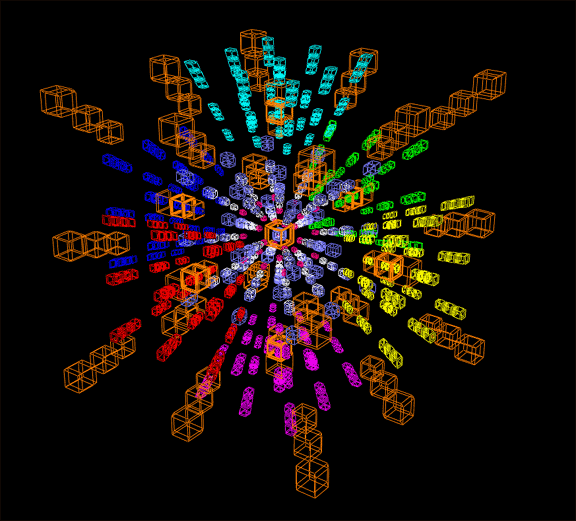
This image is from the web page for Magic Cube 5D, which is posted at Gravitation3D. I love what they say in the text above this image:
In the spirit of taking things too far, here is a fully functional 5-dimensional analogue of Rubik's cube.
"In that blessed region of Four Dimensions, shall we linger on the threshold of the Fifth, and not enter therein?"
I hope you enjoy playing Hipercubo and these extra-dimensional Rubik's Cube puzzles! Next time we're going to keep things on the lighter side with something that ties back to our last entry: "I'm You From the Future".
"g is for genes, another branching tree from a root in the past to a huge diversity seeing this from timelessness we learn the connection of all living things -- through time in each direction"
"h is for hypercube, a way for us to see a higher dimension than our usual three watch as it turns and try to imagine a shape in four dimensions, moving through time 3D sections, all in a line to make a 4D object, like a spime"
Bruce Sterling coined the word "spime" to refer to the data set representing an object's existence in space and time - Wal-mart, for instance, is famous for being able to keep such detailed information about everything in their inventory across all their stores, so the data representing a pair of pants on a shelf in a specific store would include the record of when and where those pants were created, how and when and through what path they were transported, and so on... and that entire data set would represent that pair of pants as a space-time object - a "spime". Visualizing the connection between hypercubes (a 4D cube), each of us as a "long undulating snake", and Bruce Sterling's concept of the "spime" is an important key to thinking about our reality. Which leads us to our next letter.
"information and reality equal each other, can this be?
if information (a word that starts with i) equals reality, try to visualize how patterns and shapes that flow within and behind and around create what we're in energy or mass, genes, memes or spimes waves and shapes, fractals and lines
i is also for indeterminacy the unobserved state that underlies reality where all possible states enfold together and find their balance -- in perfect symmetry"
By now I hope it's clear to everyone that these poems are the text equivalent of a fugue - themes keep restating themselves, recombining with other themes, creating an overall structure that is larger than the single elements used in its construction. When I first saw quantum physicists using the phrase "information equals reality" I immediately embraced it - it sums up the way of visualizing reality we're playing with in the project, and the field of Digital Physics definitely ties into this idea as well. My song "The Unseen Eye" expressed the same idea, although I wrote that song many years before I heard the phrase "information equals reality" which sums this large idea up so compactly. Here's a video for "The Unseen Eye":
and here's the first verse and chorus of this song, written back in 2002, and with many themes that connect strongly to what we've been talking about here as we work through our Omniverse Alphabet:
In the universe of all universes Anything is possible Everything has happened, and will happen again In the universe of all universes Grey and formless Till you choose a point, to become the first -- when You can think of it as data This dark and shapeless void Unrealized potential In the static and the noise Till in the universe of all universes The unseen eye Opened and collapsed the wave, and we entered on in
Now we know it’s the act of observation That gives the world its how and why So the big bang is just an illusion It’s just the opening of the unseen eye
"j is for John Wheeler, a famous physicist who drew a strange eyeball looking at its tail as a way to imagine how some branches or our line might be changed in the past as we look back from today so the branching tree that extends from now is even more surprising: it branches either way!"
Last time, in "A Hug From Another Dimension", we returned to Edwin Abbott's imaginary 2D creatures, the flatlanders, and the idea that a 3D person passing through the flatlander's plane would appear very strange indeed to the flatlander. It has been rightly pointed that in my original 11 minute animation I show the flatlander world not as they would see it, but as we would see it viewing from "above" their plane. While that perspective is boggling enough, the "lines all in the same plane" that a flatlander would really see is even more difficult for people new to these concepts to try to imagine.
Why do we talk about flatlanders? Because with this project we're talking about spatial dimensions: the ways that our 3D reality relates to the flatlander's 2D reality gives us some useful clues to the relationship between any spatial dimension and the next. Since the extra dimensions beyond spacetime that physicists talk about are all spatial dimensions (or "space-like" as some prefer to say), thinking about how the simplest spatial dimensions relate one to another gives us tools for imagining the more complex ones. The key to remember with all this is that each additional spatial dimension is at "right angles" to the one before: so each new dimension allows an observer to see "around the corner" in a way that was unattainable from the previous dimension. This time, let's work through the dimensions with that idea in mind.
0
We start with a point of indeterminate size. We can imagine this point to be any size we choose, and it can exist in any dimension. Let's say that's all you really are - a point. What will it be like for you to exist within each of the spatial dimensions?
1
You are a point on a one dimensional line. You can look in either direction on your line, but whatever's nearest to you obscures your ability to see anything beyond. If there were nothing else on your line to get in the way, you would be looking towards infinity in either direction.
What if you wanted to see what lies beyond any nearby objects on your line? You would need a way to move on your line. For you, "time" would be a direction in the second spatial dimension, and it would be what you use to change from state to state, from position to position, which would allow you to see "around the corner" to what lies beyond. Think about what the third dimension would be like for you on this one dimensional line - it would be omni-directional, all around you.
2
Now you're a point on a two-dimensional plane. You can look in four directions on your plane, and the new directions are at "right angles" to the previous ones. If there were nothing else on your plane, you would be looking towards infinity in four directions.
What if there were nearby objects that were obstructing your view and you wanted to see around them? You would need a way to move within your plane. For you, "time" would be a direction in the third spatial dimension, and it would be what you use to change from state to state, from position to position, which would allow you to see "around the corner" to what lies beyond. Think about what the fourth dimension would be like for you on this two dimensional plane - it would be omni-directional, all around you.
3
Now you're a point within a three-dimensional space. You can look in six directions from within your space, and the new directions are at "right angles" to the previous ones. If there were nothing else within your space, you would be looking towards infinity in six directions.
What if there were nearby objects that were obstructing your view? Since we're already living in a 3D world, this is the easiest for us to picture. If that object were a building, for instance, and you wanted to see what was on the other side of the building, you would need a way to move within your space. For you, "time" would be a direction in the fourth spatial dimension, and it would be what you use to change from state to state, from position to position, which would allow you to see "around the corner" to what lies beyond. Think about what the fifth dimension would be like for you within this three dimensional space - it would be omni-directional, all around you.
Up to now this has been fairly simple to visualize, because we're so familiar with these dimensions from our basic day-to-day experience. But this logic continues to work all the way up. Understanding what that means to us is an important key to understanding the connections between the quantum world, Everett's Many Worlds Interpretation, and the multiverse landscape.
4
Now you're a point within a four-dimensional "hyperspace". You can look in eight directions from within your hyperspace and the new directions are at "right angles" to the previous ones. If there were nothing else within your hyperspace, you would be looking towards infinity in eight directions.
What if there were nearby objects that were obstructing your view and you wanted to see around them? You would need a way to move within your hyperspace. For you, "time" would be a direction in the fifth spatial dimension, and it would be what you use to change from state to state, from position to position, which would allow you to see "around the corner" to what lies beyond. Think about what the sixth dimension would be like for you within this four dimensional hyperspace - it would be omni-directional, all around you.
If we think of the quantum wave function for our spacetime as existing within the fourth spatial dimension, we are in one of the "worlds" of Everett's Many Worlds Interpretation, and another phrase for what obstructs our view beyond our spacetime would be the cosmological horizon. For people who believe there is nothing more than the fourth dimension, it can be easy to assume that free will does not exist and that there is only one "world", one inevitable version of our universe which exists from its beginning to its end. If there's really nothing more beyond the fourth dimension then we are all like riders on a train, unable to change whatever we're about to observe. What if we wanted to get off that train track and see what lies beyond, see what other "parallel universe" versions of our universe are out there? The same logic continues to apply, so that's the fifth dimension. Because those other worlds are causally connected to our current one by the probabilities of the quantum wave function along with the choices that are made, let's call the fifth dimension our "probability space".
5
Now you're a point within a five-dimensional probability space. You can look in ten directions from within your probability space and the new directions are at "right angles" to the previous ones. If there were nothing else within your probability space, you would be looking towards infinity in ten directions.
What if there were nearby objects that were obstructing your view and you wanted to see around them? You would need a way to move within your probability space. For you, "time" would be a direction in the sixth spatial dimension, and it would be what you use to change from state to state, from position to position, which would allow you to see "around the corner" and see what lies beyond. Think about what the seventh dimension would be like for you within this five dimensional probability space - it would be omni-directional, all around you.
So what does "obstructing your view" mean when we're in a five dimensional probability space? Here's a couple of examples. Because the probabilistic outcomes for our universe's wave function of possible state are causally connected, no matter where we are in the fifth dimensional version of our universe there are going to be parallel universe versions which are "around the corner" and can't be seen from our current position. For instance, the version of our universe where it's 2010 and Elvis is still alive must exist within the set of all possible states, but no amount of choice or chance will allow us to see that version from here - it's just like our inability to see what lies on the other side of a building, we need to use the next dimension up to move to a different position if we want to be able to see that version of our universe. Also, quantum physicists talk about the wave function of our universe including the possibility of extremely unlikely events -- like one of us now disappearing here and reappearing on the moon. Why do we never see such events? Because they are like seeing the other side of a building: we need to move through the sixth dimension to be able to see that version of our universe, because those events lie outside of our cosmological horizon.
For we spacetime creatures our actual "now" is always really a point in the fifth dimension, being observed one planck frame at a time. This is why physicists suggest that the fifth dimension is "curled up at the planck length": not because the fifth dimension is small, but because the granular nature of spacetime only allows us to view the fifth dimension through our tiny little planck-length window. We look around us and see what feels like a solid, continuous reality, but physicists are now proving that this is an illusion. The fact that our spacetime reality is divided into planck-length "frames" is also part of the recent theories suggesting that our 4D universe is actually the shadow of a 5D hologram!
Now, as we move on to think about the sixth dimension we are thinking about the wave function for All Possible States for our particular universe. This wave function includes all the possible states for our universe, including those which are not causally connected to each other: the version of universe where it's 2010 and dinosaurs aren't extinct should have some possibility of existing, but that version is not connected to our own version of 2010. Because both chance and choice are participants in choosing what version of the universe we observe, this 6D space for our universe also would include versions of the universe that each of us would never choose to observe (like the one where I go crazy and kill my neighbors). And as we said, it also includes the states which we can't observe because the event is so unlikely it would take longer than the existence of the universe for the event to occur (like the version where one of us now disappears from here and reappears on the moon).
6
Now you're a point within a six-dimensional wave function space. You can look in twelve directions from within your wave function space and the new directions are at "right angles" to the previous ones. If there were nothing else within your wave function space, you would be looking towards infinity in twelve directions.
What if there were nearby objects that were obstructing your view and you wanted to see around them? You would need a way to move within your wave function space. For you, "time" would be a direction in the seventh spatial dimension, and it would be what you use to change from state to state, from position to position, which would allow you to see "around the corner" and see what lies beyond those nearby obstructions. Think about what the eighth dimension would be like for you within this sixth dimensional wave function space - it would be omni-directional, all around you.
What's outside of our wave function space? By the time we've imagined every possible state for our universe, no matter how unlikely some of those states might be, haven't we got everything covered? In other words, what's hidden from view within a point in the sixth dimension? Now we're starting to think about the multiverse landscape of other universes with different basic physical laws from our own. Up to now, no matter how we twisted and turned in the dimensions we were in, we were always confined to our universe, with its specific value for gravity, its specific planck length and speed of light. To look "around the corner" and see one of those other universes, we need to move through the seventh dimension.
7
Now you're a point within a seven-dimensional multi-universe space. You can now look in fourteen directions, and the new directions are at "right angles" to the previous ones. If there were nothing else within your multi-universe space, you would be looking towards infinity in fourteen directions.
What if there were nearby objects that were obstructing your view and you wanted to see around them? You would need a way to move within your space. For you, "time" would be a direction in the eighth spatial dimension, and it would be what you use to change from state to state, from position to position, which would allow you to see "around the corner" and see what lies beyond. Think about what the ninth dimension would be like for you within this seventh dimensional space - it would be omni-directional, all around you.
String theory suggests that our universe is embedded in a seventh-dimensional "brane". What if you moved to a different seventh dimensional brane to observe a completely different universe? Would that be the same as moving to a different 7D "point" within this way of visualizing the dimensions? That's what I'm suggesting. A different "point" might define a universe with a different strength for gravity, or a different speed of light. So once we defined any arbitrary second "point" there would be a line that passes through our point and this second one, but there would still be a huge number of other universes that would not be on the unique line we had just created. To get to those other universes not on our 7D "line" (a line that exists within a space defined by 7 pairs of directions all at right angles to each other!) would require us to travel through the 8th dimension. By the time we get to the 8th dimension, then, we are able to consider all possible universes that could have a physical expression, so what we're talking about by now is also sometimes called the "multiverse landscape".
8
Now you're a point within an eight-dimensional multiverse space. You can look in sixteen directions from within your multiverse space and the new directions are at "right angles" to the previous ones. If there were nothing else within your space, you would be looking towards infinity in sixteen directions.
What if there were nearby objects that were obstructing your view and you wanted to see around them? You would need a way to move within your space. For you, "time" would be a direction in the ninth spatial dimension, and it would be what you use to change from state to state, from position to position, which would allow you to see "around the corner" and see what lies beyond. Think about what the tenth dimension would be like for you within this eight dimensional space - it would be omni-directional, all around you.
Although Garrett Lisi's E8 rotation is not usually described as being a way to represent actual spatial dimensions, I think it's fascinating that his theory also suggests that interlocking 8 dimensional patterns would be able to describe any particle in our universe. What do we need to go beyond the 8th dimension for? Because there are still other ways of organizing the information that becomes reality that don't actually become physical realities (for more about the "Information Equals Reality" concept, look up digital physics).
That's why it's useful to think of the ninth dimension as being our information space.
9
Now you're a point within a nine-dimensional information space. You can look in eighteen directions from within your information space and the new directions are at "right angles" to the previous ones. If there were nothing else within your information space, you would be looking towards infinity in eighteen directions.
What if there were nearby objects that were obstructing your view and you wanted to see around them? You would need a way to move within your space. For you, "time" would be a direction in the tenth spatial dimension, and it would be what you use to change from state to state, from position to position, which would allow you to see "around the corner" and see what lies beyond. But because there are no actual physical objects within this nine-dimensional space, only information patterns, things are much more open-ended here, and in that sense the tenth dimension is also all around, and omni-directional to the ninth dimension.
In this way of visualizing the dimensions, we sometimes talk about the ninth dimension as being where the "big picture memes" reside: these would be the general organizing patterns that could result in a universe as specific as ours, or it could be an organizing pattern that expresses a preference towards one kind of order over another, or one kind of universe over another. Michael Shermer, well-known editor of Skeptic Magazine, has said that he is quite willing to accept this as a new way of thinking about what "God" could really be - an organizing pattern that chooses one kind of universe over another.
10
Now you're a point of indeterminate size in the tenth dimension, which some people call the Omniverse. As soon as you try to move, or observe any aspect of the Omniverse, you are spilled back into the dimensions below. In that sense, the tenth dimension is the infinity that all of our other directions were pointing towards, no matter what direction and no matter what dimension we were considering.
The tenth dimension as described in this way of visualizing the dimensions is "outside the system" in the sense that Gödel used the phrase. It's the unobserved wave function of all possible information states, all patterns, all universes, and it's the enfolded symmetry state that exists both "before" and "after" our universe or any other, as physicist Sean Carroll likes to say. As Gevin Giorbran described it, it's also like a big, beautiful, perfectly balanced "zero" which is not empty, but full of all the other possible states. This means that our universe, like any others, is just a temporary deviation from that symmetry, and symmetry breaking is what makes any universe more interesting than this unobserved whole.
I hope you've enjoyed our tour of the ten dimensions, a logical presentation of ideas that I believe will one day be embraced by mainstream science. In the meantime, even though this is not what you would currently be taught in a university physics class, the five million unique visitors who've been to the tenth dimension website show me that a great many people see resonances and connections between this approach and their own understanding of how reality works, and for that I'm truly grateful.
Thanks and enjoy the journey!
Rob Bryanton
PS - here's a classic clip from Carl Sagan showing us his introduction to the Edwin Abbott concept of 2D flatlanders.
Last blog, in "An Expanding 4D Sphere", we talked about how tricky it can be to imagine extra dimensions. I mentioned the recently proved Poincaré Conjecture (which would now more correctly be known as the Poincare Theorem), which says our universe is a 3D sphere on the surface of a 4D hypersphere! That's not an easy image to hold in the mind. These ideas and the above videos are all related to the study of topology: and since all of the extra dimensions are spatial, looking at topology as a way to help us imagine extra-dimensional shapes and patterns makes perfect sense.
The wikipedia article on Knot Theory takes these ideas about n-dimensional shapes and patterns even further, if you're interested in the explorations above please read that article.
For me, the point of looking at these extra-dimensional shapes is it helps us to imagine how extra-dimensional patterns representing memes, genes, and spimes could rise and fall in the same way that a hypercube would grow, mutate, and shrink as it passed through our 3D world. In one of my most-discussed blogs of all time, Hypercubes and Plato's Cave, I showed an animation of a rotating 4D hypercube, check that blog out if you're not familiar with those kinds of visualizations. How would our own reality look if you could see more than just 3D? Watch this interesting video and think about how similar it is to watching a rotating hypercube.
Have you got 10 minutes to just meditate on some interesting images that tie into these ideas about imagining shapes that are outside of our normal spacetime? This video was created by a youtube user called 77GSlinger, and it is related to Walter Russell's idea of twin opposing vortices that create our observed universe and its underlying patterns.
Imagining the rotating helix used for my project's logo as incorporating these ideas is something I talked about in my blog entry on Nassim Haramein: while the other dimensions are involved in the creation of more specific patterns, at the core of this image is a line joining the zero to the ten, and we can think of the zero as representing the drive towards the infinitely small and the ten as representing the drive towards the infinitely large. Everything else is just cross sections, interference patterns created by those two interlocking patterns. Though neither of these gentlemen are talking about extra dimensions, Nassim Haramein and Walter Russell appear to be talking about similar ideas to mine in that regard: and in The Holographic Universe, we took a look at an example of just how far this idea of our reality coming from interference patterns can be taken.
77GSlinger attaches the following note to the above video:
The physics of Russell's Cosmology also explains the Free Energy Implosion Technologies of the great Austrian Water Wizard, Viktor Schauberger. Schauberger invented Implosion Turbines in the 30's and 40's in Austria and Germany.
This implosion physics defies academic physics and makes academic theory provably obsolete and the professors pushing these socially engineered lies as well.
For a detailed account of the free energy technologies of Viktor Schuaberger and Walter Russell, Implosion Physics, Bio-mimicry, Scalar Mechanics and the many types of Free Energy Technologies currently in existence please see:
As regular readers of this blog know, I wrote 26 songs to accompany this project about ways of imagining how our reality is created. To finish, let's look at my most popular youtube music video: this one is about conspiracies, and the patterns that underlie our universe. As I've said elsewhere: when we're looking at these complex interactions, sometimes it can be hard to extricate what is really a conspiracy and what is "just a bunch of stuff that happened".
And likewise, sometimes it can be very difficult to say when a knot is not a knot. What's keeping you from getting to the best possible you that already exists within the multiverse?
Last blog, we talked about the scientific fact that our universe is non-local: since this project is about imagining the patterns that exist outside of the "now" of this moment in spacetime, non-locality is a key idea to the puzzle of thinking about our universe from a timeless perspective.
With those two videos, we used an amazing networked screen saver created by Scott Draves, called Electric Sheep. We used the program's fluid, fractal, recursive images as a visual aid to help us imagine how the omniverse could contain all these random fluctuations, and yet within all that randomness and noise a selection pattern could arise which would view that pattern of information from just the right angle, and voilà, the wave function representing a spacetime universe and all of its probabilistic outcomes could spring into being: not with a big bang, but with a causal tree that exists timelessly, with all possible timelines already existing as per Everett's Many Worlds Interpretation. This means that what looks from our perspective to be the "big bang", "now", and the "end of the universe" are all already-existing subsets of the underlying symmetry state which I've been calling The Omniverse.
Did I lose you there? Okay then, try this. Here's a delicious little game that was just pointed out to me by guidewire.
Last time, in Slices of Reality, we talked about interference patterns. This time we're going to talk about holograms, and if you look that word up in wikipedia you'll see that holograms are created using interference patterns.
I've been receiving a lot of email in the last week or two from people interested in the idea that our universe is really a hologram. In my book and this blog I've talked before about the connection between the way of visualizing reality I'm proposing here and the idea of the Holographic Universe, a connection that has also been noted in a few of the reviews of my book. Now, here's a link to a recent story in New Scientist magazine that shows why people's excitement about this idea has been re-ignited: the article, written by Marcus Chown and published January 15 2009, is about new discoveries just announced by the GEO600 experiment. GEO600 is a German project that has been looking for gravitational waves for the past seven years. Here's some excerpts from the article:
GEO600 has not detected any gravitational waves so far, but it might inadvertently have made the most important discovery in physics for half a century.
For many months, the GEO600 team-members had been scratching their heads over inexplicable noise that is plaguing their giant detector. Then, out of the blue, a researcher approached them with an explanation. In fact, he had even predicted the noise before he knew they were detecting it. According to Craig Hogan, a physicist at the Fermilab particle physics lab in Batavia, Illinois, GEO600 has stumbled upon the fundamental limit of space-time - the point where space-time stops behaving like the smooth continuum Einstein described and instead dissolves into "grains", just as a newspaper photograph dissolves into dots as you zoom in. "It looks like GEO600 is being buffeted by the microscopic quantum convulsions of space-time," says Hogan.
If this doesn't blow your socks off, then Hogan, who has just been appointed director of Fermilab's Center for Particle Astrophysics, has an even bigger shock in store: "If the GEO600 result is what I suspect it is, then we are all living in a giant cosmic hologram."
The idea that our reality is not continuous, but granular, broken down into planck-unit-sized "grains" of spacetime is something I've been saying since I launched my project. The idea, though, that proving the existence of this granularity would be direct evidence that our universe is a hologram is a not a connection I've talked about before. This New Scientist article goes on to describe the groundbreaking work in the 90's of such physicists as Jacob Bekenstein, Leonard Susskind, Gerard 't Hooft, and Juan Maldacena, some of which I've talked about in my book, and in previous blogs like Why Stop at Ten Dimensions, Hypercubes and Plato's Cave, and Why Do We Need More Than 3 Dimensions?. Here's a few more excerpts from the article:
What's more, work by several string theorists, most notably Juan Maldacena at the Institute for Advanced Study in Princeton, has confirmed that the idea is on the right track. He showed that the physics inside a hypothetical universe with five dimensions and shaped like a Pringle is the same as the physics taking place on the four-dimensional boundary.
According to Hogan, the holographic principle radically changes our picture of space-time. If GEO600 really has discovered holographic noise from quantum convulsions of space-time, then it presents a double-edged sword for gravitational wave researchers. On one hand, the noise will handicap their attempts to detect gravitational waves. On the other, it could represent an even more fundamental discovery.
More importantly, confirming the holographic principle would be a big help to researchers trying to unite quantum mechanics and Einstein's theory of gravity. Today the most popular approach to quantum gravity is string theory, which researchers hope could describe happenings in the universe at the most fundamental level. But it is not the only show in town. "Holographic space-time is used in certain approaches to quantising gravity that have a strong connection to string theory," says Cramer. "Consequently, some quantum gravity theories might be falsified and others reinforced."
Hogan agrees that if the holographic principle is confirmed, it rules out all approaches to quantum gravity that do not incorporate the holographic principle. Conversely, it would be a boost for those that do - including some derived from string theory and something called matrix theory. "Ultimately, we may have our first indication of how space-time emerges out of quantum theory." As serendipitous discoveries go, it's hard to get more ground-breaking than that.
Regular readers of this blog will note the important idea that our universe actually comes from the fifth dimension, another drum that I've been beating from the outset, and which I've talked about in a number of blogs, such as Time is a Direction, The Fifth Dimension Isn't Magic, and Flatlanders on a Line. Speaking in terms of spatial dimensions, this article's comment that we live in a universe with five dimensions and shaped like a Pringle is extremely important.
Is Our Universe Flat or Curved? In our four-dimensional universe, it appears that space-time is essentially flat. If it were truly flat, then parallel lines would never meet and our universe would have no boundaries in any direction. NASA's WMAP project has returned results showing that the universe is flat within a 2% margin of error. What does this mean? It means that for most intents and purposes our universe is truly flat. But in the largest picture of all, I believe that the above two ideas are going to be shown to be equivalent - our universe is very close to flat, but there is still a very slight curvature, and the 13.7 billion year "boundary" that cosmology shows us as being our line of time back to the big bang will still show that we are only witnessing a tiny region of a much larger whole, an idea that is central to this project and which we've talked about in recent entries like Dreaming of Electric Sheep and Imagining the Omniverse. So, in the same way that Euclidean geometry makes sense in our local frame of reference--a square building really is constructed from lines at 90 degree angles and parallel lines don't ever meet--if we look at the entire planet we can see that a square that encompasses a hemisphere must have angles that are slightly larger than 90 degrees and parallel lines really can meet each other as they traverse the globe. That "pringles potato chip" shape they are referring to, then, is like the horizon we see all around us as we are in the middle of the ocean: all we need to do is widen our frame of reference beyond the boundaries of 4D space-time to see how that horizon is created by a very subtle curvature that for any local observations is so small as to be inconsequential, but in the biggest picture of all it gives us a way to visualize how the holographic information that defines our universe from the fifth dimension is "just over the horizon" of our 4D spacetime.
You are a Hologram The cover of this New Scientist issue we're quoting from here sums it up this way - "YOU ARE A HOLOGRAM - projected from the edge of the universe". While this phrase gives us one way to think about the fifth dimension as coming from just beyond the boundary of our 4D spacetime, I've talked many times about other ways of visualizing how each additional dimension is "around" or "outside" the previous one - so rather than thinking about the hologram that creates our universe as being something that is far far away, I think it's more useful to think about the hologram as being "just around the corner in time" - which is the phrase I use in my song "The Unseen Eye".
As we discussed in "What Would a Linelander Really See", the term "extra dimensions" is often used by physicists rather than "higher dimensions" when talking about the dimensions beyond spacetime: I think this is a useful distinction, because saying "higher" somehow sets the idea up in our minds that we should be gazing skyward as we think about these additional dimensions. In blog entries like Unlikely Events and Timelessness and Time in 3 Dimensions, we've talked about how "events that are so unlikely they will talk longer than the life of the universe to occur" is another useful way of visualizing how we can derive the information that represents dimensions beyond 4D space-time, another useful branch to this discussion.
Information Becomes Reality Are we embedded in a fifth-dimensional hologram which is at right angles to the fourth dimension? Imagining what the phrase "at right angles to the fourth dimension" means has been one of the main goals behind this project. If you've been following along, I hope that by now you have grown more used to thinking about the fifth dimensional probability space as it relates to Everett's Many Worlds Interpretation, the universe as a hologram, and the digital physics concept that information equals reality - I believe these ideas will eventually be shown to all fit together in the big picture of timelessness.
To finish - one of the videos for my song "The Unseen Eye".
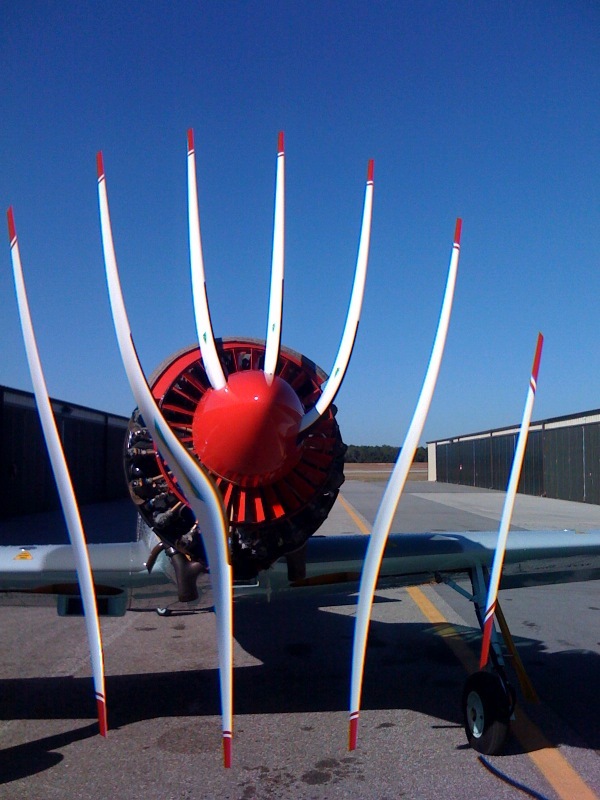
This stunningly surreal shot of an airplane's spinning propeller was taken using an iPhone, which has the unique property of working more like a scanner than a traditional still camera: on an iPhone the image is assembled using sequential vertical "slices" moving from the left side to the right side of the image, a very rapid process that in most cases would give you a completely normal-looking photograph, but in situations like these it gives you something quite extraordinary. Clearly, this is the tip of the iceberg, and now that that this has been noticed we should soon be seeing lots of artistic shots like this one of various fast moving objects. Would a hummingbird's wings become deconstructed in a similar way? I have no idea what will work and what won't (and since I don't own an iPhone I'm not going to find out any time soon), but I was immediately drawn to this picture in the context of my project.
One of the basic ideas from Imagining the Tenth Dimension is that reality is not continuous: what we think of as our "line of time" is actually being assembled one planck length after another from a wave function, a probability space, which I propose exists within the fifth dimension and above. Thinking about waves and patterns from the extra dimensions which manifest themselves down here in spacetime is something we've talked about many times, in entries like Hypercubes and Plato's Cave and The Flipbook Universe: but trying to visualize how interlocking oscillations and patterns in the higher dimensions could manifest as separate particles, physical objects, and living creatures within the physical reality we're part of is still not an easy thing to do. Can you see that the strange shapes representing the spinning propeller in this photograph are an interference pattern, created by the "slices" of the camera's picture-taking process interacting with the rotational spin of the prop? In the same way, the "slices", or quanta, of our line of time are an important part of the processes that create our reality.
In the concluding chapter of my book, I focused on constructive interference patterns as a way to imagine how our reality and the mysterious spark of life are akin to the dancing moiré patterns that happen when repeating patterns of information are interacting with each other - and the important concept I've spoken about before, "that which ceases to change ceases to exist" is tied to that idea as well. Thinking of "life" as something that springs into being through the interference patterns of memes (selection patterns from the extra dimensions) and spimes (space-time objects, which would include genes and the DNA helix in the case of life on Earth) is one of the more "out there" conclusions I've reached with this project, and I haven't spent much time talking about that idea in these blogs because it's quite a stretch for most people to visualize how such a thing could be possible.
More metaphysical/spiritual ideas of imagining an extra dimensional meme-space that connects us all together and yet gives us each our unique experience as individuals is also something I've talked about, in entries like I Know You, You Know Me, and You are Me and We are All Together. But a picture can speak a thousand words, and I think this amazing iPhone picture gives us a very useful visualization tool for all of the above ideas. I would like to give credit where it's due, but... The above iPhone picture has been making the rounds for the last week or so, but I'm not sure who created the original shot. I found it at http://www.globalnerdy.com/2009/01/13/cheap-camera-interesting-shot/#, and in that blog entry the picture's creator is not named but a link is provided to monkeydyne.com, which currently only shows a drawing of a windup toy monkey (perhaps links have been temporarily pulled down because of a sudden and expensive spike in traffic to the site?). I would love to know more about this picture and how it was taken, just how fast the propeller was spinning, etc., but this is all I have to go on at the moment.
In any case, I hope you enjoyed looking at this picture while thinking about interference patterns and the nature of reality.
Here's another way of describing the Imagining the Tenth Dimension visualization that answers a commonly asked question: when we look around we see a three-dimensional world. Why do we need to think about any more than that? Isn't every dimension past those first three unnecessary? This time around we'll discuss that question.
So. Why do we need more than 3 dimensions? Because the third dimension is filled by the universe in its current state. We need to add a fourth dimension to get to the universe in some other state. The combination of these four dimensions is commonly called "space-time", but this project says that "time" is just one of the possible directions in the fourth dimension, and the accepted concept of time-reversal symmetry shows us that time's opposite direction is just as scientifically valid.
Then why do we need more than 4 dimensions? Because the fourth dimension is filled by the time line (or "world line" as physicists sometimes call it) representing our universe from its beginning to its end. We need to add a fifth dimension to get to the bush-like branching structure of possible futures and pasts that extend out from our universe in its current state. After spending two years pondering the idea of our observed reality being defined in five dimensions, Albert Einstein come out in full support of Theodor Kaluza's startling proof of that idea way back in 1921. This project uses its own logic to arrive at the same conclusion: our observed reality comes from the fifth dimension.
Then why do need more than 5 dimensions? Because the fifth dimension is filled by the world lines that are logically compatible with our universe in its current state, right from its beginning to its end. We need to add a sixth dimension to get to all of the events that physicists tell us are part of the over-all wave function for our universe but which are so unlikely they take longer than the beginning to the end of our universe to occur. This includes the version where one of us pops out of existence right now and reappears on the moon, and it also includes the version where it's 2008 and Madeleine L'Engle (the author of one of my favorite books from childhood, "A Wrinkle in Time") is still alive. A theory devised by German physicist Burkhard Heim was recently brought to my attention, and the original formulation of that theory was based on the idea of our four dimensions of spacetime being augmented by two more "timelike dimensions". To be clear, Heim Theory now has extended versions created by his associates which postulate 8 and even 12 dimensions, but as we discussed in a postscript to my blog entry "Time in 3 Dimensions" the idea of a scientific theory based upon dimensions four through six as being different parts of a wave function representing "time" in all of its possible expressions seems like a noteworthy connection for further exploration.
Okay. Why, then, do we need more than 6 dimensions? Because the sixth dimension is filled by all the world lines for all possible versions of our universe. We need to add a seventh dimension to get to the other universes that are completely decoherent to our own, that have a completely different fine structure constant and initial conditions. Once we get to one of those other universes, each will have its own unique expression within the first six dimensions, filling those six dimensions up with their own unique wave function patterns which will be completely inaccessible and decoherent to our own universe's wave function - much like tuning in a radio station, all of those other patterns continue to exist out there within timelessness, but each universe will be tuned into their own "channel", their own starting/ending position within the omniverse that creates their unique patterns in the dimensions below.
Then why do we need more than 7 dimensions? Because the 7th dimension is filled by all of the possible universes that, like our own universe, have locked-in fine structure constants. There are even more exotic universes possible, though, and that would be those strange and unlikely universes built from oscillating or gradually changing fine structure constants. In that sense, the eighth dimension can become like "time" for the seventh dimension: much as the fourth dimension gives the third dimension a way to change from one state to another, the eighth dimension can give a way for a point within the seventh dimension to change to (or within) different states. Garrett Lisi's E8 rotation also shows some interesting connections in that regard, as it appears an 8-dimensional geometry may be what provides an underlying structure that defines all possible subatomic particles for the universe we are in.
Then why do we need more than 8 dimensions? Because the eighth dimension is filled by all the possible physical expressions of matter and energy that could ever be expressed. We need to add a ninth dimension to get to the organizing patterns in the information that cannot be expressed as matter or energy, and the patterns that could become a reality but which exist only as potentials. Quantum physicists sometimes talk about a continuously burbling "quantum foam"as being the underlying structure for all reality, and that would be another way of thinking about the ninth dimension. This project has called those patterns that spring into existence in the ninth dimension the "big-picture memes" that can be used to define or select one pattern over another in the dimensions below.
Then why do we need more than 9 dimensions? Because the ninth dimension is filled by all of the organizing patterns and random fluctuations that could or could not become universes or coherent structures of any kind in the dimensions below. We need to add a tenth dimension to get to the enfolded symmetry state where all of those potentials are summed together and balance each other out, which gives us a logical and natural way to understand where our universe or any other universe or any other organizing pattern naturally comes from. In that sense, the tenth dimension is the Omniverse, or what Gevin Giorbran (in his acclaimed book Everything Forever) referred to as the Set of All Possible States for our universe, or for any other universe. As we discussed in my blog entry Time in Either Direction, physicists like Sean M. Carroll have shown us how this underlying symmetry state can be used to imagine how our universe (or any other universe) is really just a temporary deviation away from that perfectly balanced symmetry that exists both "before" the big bang, and "after" the end of the universe: a return to enfolded symmetry, the absolute zero that our universe's accelerated expansion is now moving us towards more and more quickly.
In entries like Hypercubes and Plato's Cave, we've talked about how the reality that we are witnessing down here in spacetime can be thought of as the shadows of higher dimensional shapes and patterns. As we've discussed here today, we can see how we move from the very general choices that are made from a starting point in the highest dimensions. Then, we can see how the patterns and shapes of each dimension below brings the shadows of those patterns into more and more specific focus, until we arrive at the sharply delineated reality which is the beautiful 3D universe we are witnessing in each quantum frame, one planck length after another. Fractals and helix shapes of the natural world, the universe as a hologram, the Poincaré Theorem's proof that our universe is the 3D surface of a 4D hypersphere, the Deutsch team's proof of the bush-like branching structure of parallel universes created through chance and choice being equivalent to the quantum wave function... these ideas and many more can be tied into this way of visualizing reality. And when you add in the mysteries of how consciousness, memes and spirit are also part of the specific observation of our 3D reality, the "now" that each of us is uniquely traveling within at this very instant, you have arrived at a very big idea indeed!
Why do we need more than 3 dimensions? To hold all of those possibilities. 3 dimensions are simply not big enough to hold the timeless whole of enfolded symmetry that our reality ultimately comes from.
A direct link to this video can be found at: http://www.youtube.com/watch?v=V4FpPp8MPIQ In Twisted Dimensions, we talked about a way of imagining how our 3D world is constrained by a D3-brane and a D7-brane, and how that relates to the way of visualizing reality that we've been playing with here. In entries like You Can't Get There From Here and What Would a Linelander Really See? I've tried to describe in more detail how there might be conceptual similarities between one group of dimensions and another. In my book I suggested that our reality can be broken down into what I called self-similar "triads", and this basic concept is encoded into the helix I had created for this project: The repeating line, branch, fold metaphor that we use with this project gives us a powerful way to keep imagining one spatial dimension stacked upon another. If we look at the helix diagram, we see that the one, the four, and the seven are connected, as are the two, five, and eight, and as are the three, six, and nine, and this is part of the mental trick we use to allow ourselves to imagine many more spatial dimensions than most would have thought possible. This time I'd like to talk more about the idea that "time" (which is not a dimension but a direction) is part of an enfolded structure that encompasses the fourth through sixth dimension, and this structure shares many of the characteristics that we are familiar with from our experience of 3D space. Please note, though: when we talk about the third dimension, we are automatically talking about the second and first dimension: in other words, a 3-dimensional object has length, width, and breadth, so the first and second dimension are automatically included in a discussion of the third dimension. Likewise now, when we speak of the sixth dimension, this means we are then automatically considering the fourth and fifth dimension which are part of the sixth (and by extension, the first through third as well).
And why do I insist that all of the different possible timelines for our universe are not just in the fourth dimension, where science has traditionally allocated them? I believe this relates to the quantum physics idea of every possible aspect of our reality being represented by a wave function.
Events that are so unlikely they are outside spacetime Here is a quote I have used before from recognized physics expert Michio Kaku, which represents the established viewpoint of quantum mechanics:
"... if we could "see" the wave function of a person, it would look remarkably like the person himself. However the wave function also gently seeps out into space, meaning that there is a small probability that the person can be found on the moon. (In fact, the person's wave function actually spreads out throughout the universe.) " - Theoretical Physicist Michio Kaku, from his book "Parallel Worlds"
With this project, I'm proposing that our reality comes not from the fourth dimension, but the fifth, which is where Kaluza proved and Einstein eventually agreed that the field equations for gravity and light for our universe are resolved. What I have often suggested in the past is that the "wave function of all possibilities for our universe" that quantum mechanics experts like Dr. Kaku talk about must come from the sixth dimension rather than the fifth, and that the often-used "small probability of appearing on the moon" example is much easier to understand when we see that this is true. After all, if every completely unlikely event exists as part of the wave function of our reality, then even if the likelihood of those events is astonishingly small, the number of those unlikely events is also astonishingly large: surely the two factors must balance each other out somewhat, in which case there should be events each of us have witnessed within our lifetimes which should fall within that astronomically unlikely realm of "nearly impossible" events for our universe, and many of those would be even stranger than people popping out of their homes and reappearing on the moon.
Everett's Many Worlds Interpretation and Unlikely Events A similar argument is often used for the evidence of extraterrestrial life: even if the odds of some other race having risen to dominance in the universe are astonishingly small, the universe is astonishingly large, so why are we not constantly being bothered by alien visitors? One possible answer is that we are but that information is somehow being hidden from us. Here's another more likely answer: that particular possibility does indeed exist within the wave function of all possible outcomes for our universe, but it is not part of the wave function that you or I are currently observing. This brings to mind the Anthropic Principle, which is central to my project, and which coincidentally is receiving renewed interest now that there are more mainstream scientists willing to consider the following idea which is central to my project: all of the other different-initial-conditions universes--and all of the other parallel universes resulting from chance and choice for our own universe--do exist within the multiverse (or ultimately, the omniverse), and are just as real as our own.
But why can't we see them? Why aren't people reappearing on the moon, why don't we wander into other universes where gravity has a different value, why aren't we part of the universe where alien invaders have destroyed the planet, or where it's 2008 and Elvis is still alive?
"Time" as a Sphere The answer, I believe, is within my way of visualizing how our reality is constructed: in a sense, time is 3-dimensional, and the fifth dimensional reality we are witnessing is like the 2D image we see on a screen. If I look at a picture, it seems completely normal to me that I can't see through walls or around objects: unless we start moving around in 3D dimensions, which then allows us to see "behind" and "around" the objects on the screen. If we imagine time as a sphere, then we can suppose that our 3D reality as we're experiencing it at this very instant is at the south pole, and the timelines of possibility extend out northward. All of the possible (entropy-driven) futures that could extend from "now" are visible to us, up to the equator. But the other half of the sphere, from the equator and northward, are hidden from view. They exist as part of the sphere, but there's no path visible to us to see how to get to those other points that exist as part of our sphere: it's like they're on the dark side of the moon.
Imagining what's at "right angles" to the 3rd dimension Does this metaphor work completely? I believe that it does within Dr. Elliot McGucken's Moving Dimensions Theory, which expands our minds with the knowledge that our 3D universe is already moving through a 4th dimension which is effectively expanding one planck length at a time at the speed of light. If we can imagine that each one of those new quanta, or frames, that represent our 3D universe are the south pole of a new 3D time sphere, we can see how that constantly revised sphere can ultimately encompass the wave function of all possible states within the entirety of that "time-sphere", but this visualization explains why only a certain subset of those possible states are accessible to us from our current position within spacetime.
To be clear, though, that 3D "time-sphere" we are imagining is much more mind-boggling than just a round ball: because that south pole point we have imagined is at the center of a hypersphere, extending out in the fourth dimension and beyond! For more about that idea, please read my entries Hypercubes and Plato's Cave, and Time in Either Direction.
To wrap this entry up, here, for fun, are the karaoke versions of three of the 26 songs I have created for this project, and these are relevant to the discussion we've just had: the songs are "The Anthropic Viewpoint", "The Unseen Eye", and "Everything Fits Together".
PS - for further exploration of the idea that "some events are so unlikely that they will take longer than the life of the universe to occur" must place those events in the sixth dimension, read Unlikely Events and Timelessness. For the surprising connections between this project's use of "triads" as a concept and the Kabbalah, read Jake Kotze and Mystical Numbers. And for more explanation of why this project insists that our reality comes from the fifth dimension rather than the fourth, read entries like The Fifth Dimension Isn't Magic, or Your Fifth-Dimensional Self.
PPS - yesterday on the tenth dimension forum, member "nimblesquirrel" mentioned Heim Theory, which started out based upon our four dimensions of spacetime, plus two additional time-like dimensions: another way of connecting to what we've just talked about in this blog. Heim Theory was then extended to eight dimensions, which I have talked about here in this blog as being the highest dimension where any physical expressions of reality might occur. The theory has also been extended to a 12-dimension version - whoops, no correlation there, but interesting to read about nonetheless.







 Posts
Posts


