a new way of thinking about time and space ~ ~ ~ ~ ~ ~ ~ ~ ~ ~ by Rob Bryanton
--author and research scientist David Jay Brown says: "one of the most brilliantly-conceived and mind-stretching books that I've ever encountered".
--science fiction author Greg Bear says: "a fascinating excursion into the multiverse - clear, elegant, personal and provocative"
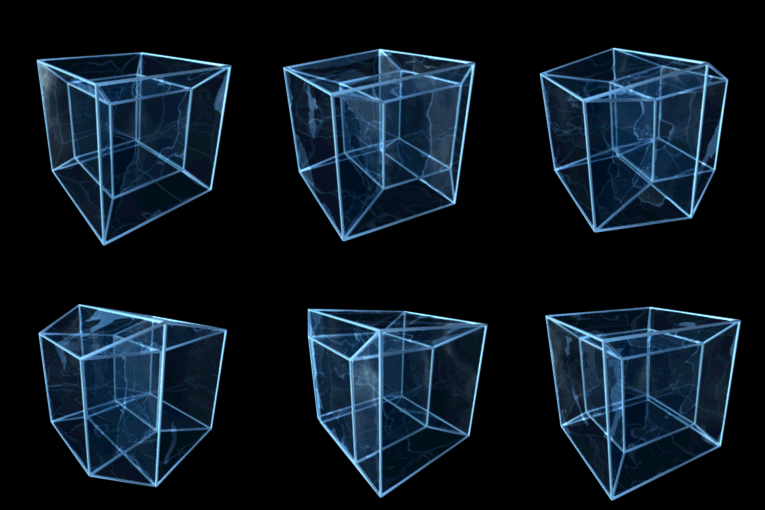
(This beautiful animation of a rotating four-dimensional "tesseract" comes from the wikipedia article on hypercubes.) With Imagining the Tenth Dimension, we're talking about how our reality springs from ten spatial dimensions. Some cosmologists have claimed that the tenth dimension is beyond our comprehension, that it's impossible for anyone to actually imagine such a thing. With this project, we've used logical puzzles to help us to do so, building one layer, one concept upon another. Really, this is the basic process of all learning: we start from simple concepts, and we grow from there.
Remember: we're talking about spatial dimensions here, and that means that each spatial dimension is at right angles to the one before. Let's use a paper and a pencil to visualize what that means.
Start with a piece of paper. If you have a piece of paper on your desk and you stand a pencil straight up on it, that pencil is at right angles to the paper.
So a single point on the paper would be like the "zero" we start from in my animation, and if, right on top of that point, we were to stand the pencil on the paper, the pencil would be like the first dimension. A simple line on that paper can represent the first dimension, in which case the pencil would be like the second dimension. Or a square on that paper is like the second dimension, and the pencil would be in the third dimension. A picture of a cube on that paper is like the third dimension, in which case the pencil is like the fourth. A picture of a tesseract represents the fourth dimension, and so the pencil is like the fifth. And so on! Obviously, this gets harder and harder to visualize as the number of edges increases with each additional dimension, but the logic keeps working. If our paper had a picture of an enneract on it (a nine-dimensional hypercube), then it would be like our pencil was in the tenth dimension!
But what's all this about "tesseracts" and "enneracts"? If you go to the wikipedia article on hypercubes, you'll see that the point we started from can be called a "zero-cube", the 1D line can be called a "one-cube", and so on. Here's the whole list:
0-cube a point
1-cube a line
2-cube a square
3-cube a cube
4-cube a tesseract
5-cube a penteract
6-cube a hexeract
7-cube a hepteract
8-cube an octeract
9-cube an enneract
10-cube a dekeract
We're about to look at diagrams of orthographic projections of these multi-dimensional objects, this is what they would like projected onto a 2D surface like a piece of paper or a video screen. To imagine what we're looking at here, let's start with an easy one - the cube. Do you see how the 3-cube seen at the left here corresponds to the solid cube on the right? The projection at the left would be what we'd see if our cube was made out of wire, and the shadow it casts would show all the different edges of the cube. With a solid 3D cube like the one on the right, we know those other edges are there, but they're hidden from our view.
So with our "pencil visualization", the 3-cube we're looking at here is projected onto a flat surface, and we can use our pencil to imagine what the "next dimension up" would be when we stand the pencil on end on that surface. Think about a cube, then look at the 4D hypercube animation we started this entry with. Do you see how there are 3D cubes within the shape, and how there are additional edges that are extending out at four-dimensional "right angles" to create a 4D hypercube? This logic continues all the way up - the new lines we see in each of the following drawings come from a new "corner", a new 90-degree angle, that was unavailable in the previous dimension. Think about that as you look at these projections:
Have you watched What's Around the Corner? It explains these concepts using a somewhat similar approach. Here's that video again to close this entry:
Back at the end of June, 2006, we put up tenthdimension.com and showed it to a few people. Initial response was generally very favorable, and we congratulated ourselves on a site that looked like it was going to do all right for itself. But we really had no idea what was about to happen!
On July 2 2006, the site got 2346 hits from 160 unique visitors, not too shabby. Then, some time later in the day on July 3rd, people started sharing the site with each other in a much bigger way, and we were thrilled to see a twelve-fold jump - 30,116 hits from 2,196 unique visitors. Cool! But by the end of the day, we were starting to learn about something known as the digg effect. So many people were trying to access our website simultaneously that some visitors were getting error messages, while others were having to wait minutes for the pages to load. Even with those delays, July 4th 2006 was an amazing day - 451,954 hits from 25,075 unique visitors.
With the support of users on digg and also on stumbleupon, the site saw over five million hits that first month, and that was from almost 282,000 unique visitors. Unbelievable! Five years later, where are we at?
Traffic continues to be steady to the main site, and stumbleupon and digg both continue to bring in new visitors. By now the website tenthdimension.com has seen almost 100 million hits from almost seven million unique visitors! The video which drew so much attention to the project in the first place has been seen millions of times by viewers on revver, youtube, and numerous other streaming video websites, and my YouTube channel, "10thdim" currently features almost 400 videos created to help explore the ideas behind the project. That channel has also been quite popular, with well over five million upload views and we're now approaching 19,000 subscribers!
Regrettably, one change I made not long ago at the main site is that I was forced to close my website's forum to new members, as it was the target of so much daily spam (much of it offensive and pornographic) that I couldn't afford the time to keep cleaning it up. There are lots of other ways that people stay in touch with me though, not just through this blog and through my YouTube channel, but through my twitter feed ("10thdim") and my facebook page (rob.bryanton).
One thing I'm noticing lately at my main website is a lot more traffic from pearltrees.com, which is a "social curation community". As they say on their site, "it's the place where you can organize, discover and share the stuff you like on the web." I was particularly taken with the metaphor they're using for how things are connected to each other because it reminds me of the animated opening we've created for my video blog. This project has been around for a while, but based upon the traffic I'm seeing from it, Pearltrees may be reaching some sort of critical mass right now. Here's a demo video that shows the concept:
So is Imagining the Tenth Dimension a meme that is still on the rise? In this blog, I've been tracking the slow move within mainstream science towards the ideas I've promoted with this project for the last five years. We've moved through the "Not Even Wrong" meme which sprang up about string theory a few months after my book was published, and we're mostly through the "there are really 11 dimensions" meme, as more and more physicists are stating nowadays that it's actually ten spatial dimensions plus one of time. Since my project is about using the logic of spatial dimensions to imagine all ten, and I've been insisting that time is not a dimension but a direction within the spatial dimensions, I'm glad to see the return to the discussion of ten dimensions within the mainstream. Over at my YouTube channel, if we don't include the versions of the original animation, here are the top ten videos based upon total views:
Can you picture it? Somebody should make a möbius strip roller coaster, where the cars are zipping around on both the top side and underside of the track! You'd be upside down much of the time of course, so it wouldn't be for the faint of heart. Could be quite a spectacle! Does such a thing already exist or have I stumbled upon a new idea here?
This idea occurred to me as I was answering a question posted to me on YouTube about whether a "flatlander on a möbius strip" is kind of like looking out at the track in front of a roller coaster. With the 2D flatlander example, he's twisting and turning in the next dimension up, but unaware of this additional motion. But what is the corresponding "next dimension up" for we human beings? Here's the answer I gave.
Yes, we're made out of 3D atoms and molecules, but we can't move without using time, so you and I are really in the fourth dimension, traveling in a specific direction which we call "time". My point is that as we travel in the fourth dimension we would be like the flatlander on the möbius strip - we can think we are traveling in a straight line, but we're really branching and twisting in the fifth dimension.
But wait, doesn't that mean the flatlander can't move without using the third dimension? And if we live in "spacetime", is the flatlander really in "planetime" or some such term? That's certainly true. As I've always said with this project, it's quite useful to say that "time" can be thought of as a direction in the next dimension up to whatever spatial dimension you're considering, but saying those words doesn't always clear things up for people. These are the kinds of language traps we can fall into when we're talking about "time" in the context of spatial dimensions. Am I a 3D creature or am I a 4D creature? Depends upon the frame of reference you're using, either is true in its own way.
But I'd still like to see somebody build a Möbius Strip Roller Coaster!
This new video accompanies one of my favorite blog entries of 2010, Light Has No Speed. This one has already generated a lot of interest and discussion over at my YouTube channel.
We talked about one of the central ideas in the above entry last week in At Right Angles to Spacetime, where I showed you two intersecting arrows. Here's that diagram again, this time with a little more explanatory text added:
(you can click on the above picture for a higher resolution version)
Understanding that our reality is actually a continually evolving series of "points" in the fifth dimension, representing the intersection between the above two lines, is key to understanding my approach to visualizing the extra dimensions. Think about these ideas:
From a photon's point of view, there is no space, no time. The "time" it takes for light from a distant star to reach our eye does not exist for a photon - from its perspective it took no time to reach us. In that sense, thinking of this photon's path is like thinking of the "long undulating snake" we think of in my project, or the "spime" concept that Bruce Sterling likes to talk about - it's a data-set that connects the past to the future, viewed from outside of spacetime.
If that photon had not reached our eyes, it could have continued on into the future, traveling from that distant star many light years away with the light that from our perspective is already from many years ago: but even from the perspective of a photon coming from the very beginning of our universe traveling to the very end of our universe, this would still all happen simultaneously: for such a photon, the entire life of our universe would be one single event.
This reveals the contradiction in believing in free will and believing that there is nothing beyond our 4D spacetime: from this photon's perspective, then, there is only one single past, one single future, and everything is inevitable: including the dogged insistence that the free will we believe we're experiencing is real, when in fact it's only an illusion.
But thinking of our spacetime universe as having only one path from its beginning to its end leaves us with no easy way of understanding non-locality or quantum entanglement: these effects seem mysterious, unfathomably weird. This "photon's perspective" we're talking about here doesn't have room for such "spooky actions" (as Einstein referred to them) to occur, and yet quantum theories have been confirmed through experimentation to a higher degree of accuracy than any other theory about the underlying structures of our reality.
In Time's Illusions, we talked about the two kinds of "now" that are shown in my above diagram, and we started a poll question to see which kind of "now" people think of as applying to our space-time reality. Then, with At Right Angles to Spacetime I started another poll question, asking if people agree with that blog's title as a definition of light.
Here's the kicker - in both cases, there's a third "all of the above" answer I should have provided, but chose not to because it would have been so easy for people to select it without thinking about the other options. That answer, as I hope I've made clear with my blog entries this month, is that our spacetime "now" is in the fifth dimension, not the fourth, so both versions of "now" are correct depending upon your perspective. And because both light and gravity push against each other to create our reality, whether you think one or the other is at right angles to spacetime also depends upon your frame of reference. As I've said before, it's the same with the third dimension - calling the directions added by the third dimension up/down, or forward/backward, or left/right, or whatever doesn't change what you're adding, because these are just labels that are defined by the frame of reference already established.
Likewise, what we call the additional degree of freedom afforded by the fifth dimension can change depending upon your frame of reference, or which of the two "now" arrows pictured in the above diagram, you choose to assign to the fourth dimension.We'll talk about how our reality is defined at the fifth dimension through constructive interference more next time, with Cymatics.
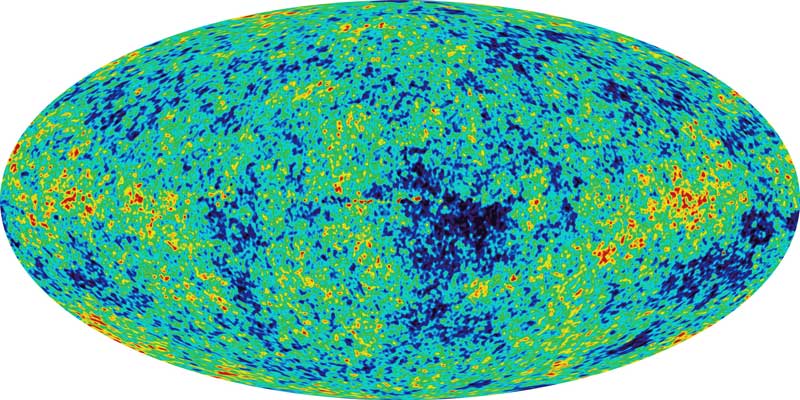
Here's an image generated by data from WMAP, the Wilkinson Microwave Anisotropy Probe. According to WMAP's results, our universe is flat to within a 2% margin of possible error. Is our universe really flat? I believe that it isn't.
Remember this: our universe is not just space. If you are traveling in space you are really traveling in spacetime, unless you've discovered some way to instantly transport to a distant star using no time whatsoever.
Here's one way I saw the concept of a perfectly flat universe within the multiverse explained.
If spacetime is absolutely flat, then if you were to set off in a rocket ship and travel in a single direction, you would eventually get to the universe that's just like the one you're in now, but where you got up an hour later this morning, or where Michael Jackson is still alive. And if you continued on this journey, eventually you would start getting to the other universes with basic physical laws, the other universes of the multiverse.
So. There is evidence that spacetime is close to flat, but I still feel certain that it will be proved that there is a certain very small curvature to spacetime, which is why our universe is not really infinite, it's finite but unbounded. It's like the old video games where going off the top of the screen gets you to the bottom, or going off the left gets you to the right (or traveling on the equator eventually gets you back to where you started). To continue the analogy, our observed spacetime universe and its cosmic horizon would be a tiny dot in the middle of that video game screen: we've talked about this in entries like Finite But Unbounded and An Expanding 4D Sphere, how some cosmologists say that if this dot representing our observable universe were the size of a quarter, this "video game screen" we're thinking about here would be the size of planet Earth.
Now, in a finite but unbounded universe with a slight curvature, if you were to set off in a rocket ship and travel in one direction, you would traverse the finite but unbounded hypersphere of spacetime, and eventually end up back where you started. Or with a slight change in trajectory, you could end up in the universe where you got up an hour later this morning, or where Michael Jackson is still alive... or any of the other possible versions of our universe that are part of the wave function of outcomes which could have or will have occurred for our particular universe with its locked in fine structure constant.
The other "perfectly flat spacetime" explanation we looked at above has its supporters, I think, because it still allows the viewpoint that free will is an illusion and everything is inevitable. If you eventually get to that universe where Michael Jackson is still alive using flat spacetime, then where you get to is really completely unrelated and causally unconnected to our own version of spacetime! No wonder some people who are shown this theory reject the idea of parallel universe versions of our universe even existing. And where that model breaks down further for me is that we have to eventually encounter an "edge" to our spacetime universe where the basic physical laws become fuzzy, and we somehow transition into the spacetime "edge" of a different universe with a different fine structure constant.
The slightly curved spacetime model works better for me because it seems much more likely that the universe where you got up an hour later this morning is directly connected to the universe we're in, and that the spacetime tree of possible outcomes connected to "now" has its branches within the fifth dimension. It also explains why no matter how far out into spacetime we look, we're never going to see other universes with different physical laws - because getting to those other universes would require extra dimensional movement within the seventh dimension and above (or to use the string theory perspective, it would require us to break out of the D7 brane our universe is embedded within), and arriving at a new "point" within that multiverse landscape would reveal some other universe that is apparently infinite within its version of spacetime, but is really just as finite but unbounded as our own.
Next time, we'll be looking at the video for one of my favorite blog entries from 2010, "Light Has No Speed" in a new entry called Photons and Free Will. Enjoy the journey!
Here I go again, ticking off the people who would like this project to be about hard science only! What's with me? Why do I work so hard to present myself as a serious explorer of new ideas, and then delve into subjects like "out-of-body experiences" (OBEs) which make it so easy for people of a certain mindset to dismiss me as a crackpot?
Sure, I've had the occasional vivid dream where it seemed as if I was flying through the air, or I was some place else in the world right "now", but I've never thought of those as being "out-of-body" experiences. Still, the above recently published YouTube vlog, which accompanies a blog entry from earlier this year called Entangled Awareness and OBEs, finds ways to blend these ideas of out-of-body experiences and lucid dreaming into the big pictures we've been exploring with this project.
Meanwhile, November has been a good month for new revelations about extra dimensions:
Here's a Wired Magazine article about a new scientific experiment intended to prove once and for all that our reality is not continuous, and that it's a shadow of a 5D hologram.
Here's a Reuters article suggesting that extra dimensions could be proven to exist by the LHC in early 2011.
This article from physorg.com suggests that new gravity detection methods will prove the existence of extra dimensions.
Here's a UK Telegraph article about the CERN team's recent capture of atoms of anti-matter, a breakthrough predicted by Dan Brown's Angels and Demons.
Finally, here's a video about a book that might interest any geometry fanatics on your shopping list this year. Thanks to my friend Pete Chema for pointing out Naked Geometry, an artsy book of human figures posed in various shapes from geometry, fractals, M.C. Escher-style tilings, and even hypercubes, with accompanying text to explain the interesting facts and folklore connected to these shapes.
Poll 70 Poll 70: "New research suggests that the Internet is rewiring our brains to make us jump from topic to topic, not learning deeply about any one idea. Does reading a book allow you to commit concepts to long-term memory more easily than web pages full of hyperlinks?" Poll ended August 22 2010. 61.8% agreed, while 38.2% did not.
Back in early 2008 I published a blog entry called Visualizations, which discussed various approaches to picturing underlying patterns. At that time I had just come across an interesting site called Webpages as Graphs that lets you see how a certain website is connected: just enter any URL and watch what happens. Click on this link if you'd like to see a real-time animation demonstrating how this Imagining the Tenth Dimension blog is currently linked... it's fun to watch the program evolve the image as it searches out all the internal hyperlinks, and to compare the patterns of connectedness from one website to another. For the Tenth Dimension Blog you'll eventually end up with a picture that looks somewhat like this:Coming across the study this poll is referring to, then, did rock my world a little bit. I have spent the four years since this project launched building an online web of connected links that allow people to wander from one idea to another, and see how ideas that many have thought to be completely unrelated could have deeper connections. The same is true with my YouTube channel - with about 350 videos posted now, a great many of them include on-screen buttons linking to other videos, which some people find very useful, and a few people say they find to be distracting.
Similar studies have shown that people trying to work with noise around them are less likely to be productive, and that includes people who listen to music while they work. A great many people swear that listening to music helps them focus, but these studies appear to contradict that notion.
Is the internet causing us to be more superficial? With facebook groups and twitter feeds, people see an interesting headline and forward the link on to their friends and associates. How many people actually read the story, and how many just glean what the story is probably about from the headline and quickly move on to the next headline, the next tweet, the next posting to their wall?
This is a tricky one. More connectedness, to my way of thinking, has to be a good thing, an important part of our mutual growth as a species. But clearly there are opposing patterns here of which we also need to be aware.
In the above video, I say that I'm talking about some new scientific research that moves beyond what I had been previously thinking about with this project. Nonetheless, a number of people commenting on this video at YouTube appear to be assuming that this is some wild new flight of fancy I've concocted from my own imagination. Let's be really clear here - this video, which is based upon my blog entry of the same name (Magnets and Morality, published this past April), reports on a serious medical study indicating that when magnetic pulses were focused on the junction between the temporal and parietal lobes in test subjects, those people seemed less likely to be able to apply moral judgment to observed outcomes.
Imagine this: if you and I were watching a boy scout help an old lady cross the street, and the old lady stumbled and fell, then a person with impaired moral judgment might assume that the boy scout did not have good intentions towards the old lady. Likewise, if we were watching a business man carry large bags of money to the bank, then a person with impaired moral judgment might not care how the businessman got the money: with this more limited viewpoint, the only thing that matters is the outcome.
Is this a modern malaise? And could the number of people in large cities, bathed in increasingly large amounts of electromagnetic energy twenty-four hours a day be suffering (to lesser or greater degrees) some symptoms related to the above study? This is an issue worthy of further consideration.
Last week, in 10-10-10: Look Before You Leap, I asked people to set aside a moment tomorrow on the tenth day of the tenth month in the tenth year of this century to think about their own participation in the reality they are helping to create. How's your moral compass? It's always good to do a little self-evaluation from time to time, to make sure you're heading in the right direction, and who knows what you might find?
I'd like to thank George Peterson, who in the comments for that previous entry reminded me that 101010 in binary translates to 42: the number Douglas Adams suggested was the "Ultimate Answer to the Ultimate Question of Life, The Universe, and Everything". Too much pressure to put on tomorrow? I agree. And as regular readers of this blog know, my own ultimate answer is simply that we should always try to enjoy the journey!
When I was contacted at my tenth dimension forum by "redmirian" (Nigel Evans. a science teacher -head of chemistry- at a Bloxham School in Oxfordshire in the UK, I told him I would love (with his permission) to develop an animated presentation showing how his approach fits with my own way of visualizing the extra dimensions.
After several attempts at creating something more complex, I ended up doing what you see here in an easy-to-use program called Anime Studio Pro. Using the stock cartoon trees that come with the program, I built a forest one tree at a time and then animated my camera motion through the forest to help portray Nigel's analogy. I hope you enjoy the results!
This video for my entry "Time and Schizophrenia" did generate some controversy when it went up on YouTube a couple of weeks ago. Some people simply could not get used to the "echo" laid in to demonstrate the concept we're talking about in this video. Why do I have "echo" in quotes? Because that's not quite what's happening here. In addition to my voice, there are five other copies of my voice, each one offset a different amount, and if you watch the five shadowy mouths that are around my head you will see that each is also offset in the same way: starting at the bottom left mouth and working around the semi-circle clockwise, the first one you're seeing/hearing is one second early, the second is .5 seconds early, the third is .5 seconds late, the fourth is 1 second late, and the fifth is - you guessed it - 1.5 seconds late.
As I pointed out in the comments section at YouTube, these echoes do, of course, tie directly into what I'm talking about in this particular video and that's why they're there. If you, like some of the viewers on YouTube, find them too distracting, the answer is simple - turn your speakers down a bit. Because the main voice is 20 dB louder than the echoes, you'll still be able to hear what I'm saying but the echoes will be less noticeable. Same goes for the people who wish the echoes were louder, just turn your speakers up more and the echoes become more noticeable. :)
In this blog entry (Time and Schizophrenia), we looked at studies suggesting that schizophrenic symptoms could be related to the brain not properly "time-stamping" incoming information - a schizophrenic could be watching television, thinking about certain products, then within seconds seeing those products advertised. Did the TV read this person's mind? No. Their subconscious is seeing the products being mentioned, but other parts of their mind are lagging behind, giving them the disturbing impression that the TV knows what they are thinking and is responding to their thoughts!
Another of the things discussed in this blog entry was an experiment reported in a New Scientist article on Schizophrenia written by Douglas Fox. Here's two paragraphs from that article again:
In one experiment, healthy volunteers learned to play a video game in which they had to steer a plane around obstacles. Once people became used to the game, the researchers modified it to insert a 0.2-second delay in the plane's response to volunteers moving the computer mouse. After the modification, the players' performance initially worsened; but in time their brains compensated for the delay, to the extent that they actually perceived the movement of the mouse and the movement of the aircraft to take place simultaneously.
But the subjects' strangest experience occurred then the experimenters removed the delay and set the timing back to normal. Suddenly, the players were perceiving the plane to be moving before they consciously steered it with the mouse (Psychological Science, vol 12, p 532). That's uncannily similar to how people with schizophrenia describe feelings that they are somehow being controlled by another being.
The next day after the above video was posted, a YouTube user named Alexander, who calls himself WASDsweden on Youtube, posted a simple but effective java game he had just created to demonstrate what it would be like to play a video game where your input is delayed by .2 second. If you have java on your computer (most computers do) then you'll be able to play it right away: just click on this link to download the game. bit.ly/db01k6
Here's a screen shot from the game:
You are the red ship at the bottom of the screen, and you use your mouse to move back and forth across the screen trying to avoid collisions with the green aliens. A check-box at the bottom, when turned on, introduces a .2 second delay in the way the ship responds to the mouse. Try it!
I suspect you would have to play this game for quite a while in .2 second mode before the effect noted in the article above would come in to play, but this is really great that Alexander took it upon himself to create this demonstration. Bravo, WASDsweden!
To finish this entry, let's look at one more just-published video that ties into this conversation: it's based upon my text blog entry, "Time and Music". In this entry, we look at a split-screen video of the classic Canadian rock band Lighthouse, performing with different band members in different geographically-separated studios. My friend Paul Hoffert, keyboard player for the band, sent me this vintage clip and described how he had to play roughly 200 milliseconds ahead of the music he was hearing from the rest of the band (coincidentally, the same .2 seconds we're talking about here) in order to compensate for the latency introduced by the digital hookup that was available for this experimental performance. Trust me! This is not an easy thing to do, and I am fascinated every time I watch Paul playing in this video.
After having released well over three hundred videos on YouTube, I'd say the above vlog entry comes closest to re-creating the graphic approach to visualizing the dimensions of my original Imagining the Tenth Dimension animation. As we celebrate the fourth anniversary of the launching of my project this month it does seem like an interesting idea to return to that style once again. Fans of the original animation will note that I didn't add sound effects, and that is certainly one thing I wrestled with creatively - the first video has been viewed millions of times on sites like revver and YouTube, but it has also had some people saying they found the sound effects distracting: so this time around I'm showing some of the same or conceptually similar graphics from the original, but with voiceover only. If you're among the contingent who loved the original version's sound effects and feel like they're missing this time around, please feel free to make them yourself as you watch along! :)
Last time, in "Vibrations" we returned to the idea that if our reality is defined by extra-dimensional patterns, then some of these will be repeating or oscillating, and the subject of vibrations follows naturally from that idea.
Another idea that comes up regularly when talking about the nature of reality is fractals. Thinking about fractals as recursive, repetitive patterns also gives us a way to think about how a fractal pattern could be thought of as a vibration.
Does this talk seem too nebulous? Here's a youtube movie demonstrating a fascinating program called Photosounder which turns pictures into sound, and sound into pictures. Check it out!
I'm particularly fascinated with moments like these:
0:27 - this is a picture (turned on its side) of a waterfall. At this moment, when the player passes over the water we change to a completely different "glassy" audio texture 1:36 - this image is a representation of DNA, it's what is called a "DNA gel". Ever wonder what your DNA "sounds" like? 1:44 - I love the vaguely industrial connection between the visual and the sound on this image 2:42 - the strangely beautiful "song" of a spider's web
The above movie is really only the tip of a much larger iceberg. The Photosounder channel at youtube and the Photosounder Blog give you lots of additional demonstrations of what's possible with this powerful program, which is available from Photosounder.com (and hey, I'm not affiliated with the company, I just think this is cool software!).
Here's the opening few paragraphs of an amazing article published at MSNBC on March 29th. The article, written by Eric Bland, is entitled "Study: Magnets Can Alter Morality":
Magnets can alter a person's sense of morality, according to a new report in the Proceedings of the National Academy of Sciences.
Using a powerful magnetic field, scientists from MIT, Harvard University and Beth Israel Deaconess Medical Center are able to scramble the moral center of the brain, making it more difficult for people to separate innocent intentions from harmful outcomes. The research could have big implications for not only neuroscientists, but also for judges and juries.
"It's one thing to 'know' that we'll find morality in the brain," said Liane Young, a scientist at MIT and co-author of the article. "It's another to 'knock out' that brain area and change people's moral judgments."
Please read the whole article, this study reaches some surprising conclusions.
As regular readers of this blog know, I love to propose new ideas for how my approach to visualizing the dimensions might reflect back upon the reality we see around us. But every now and then I come across new ideas like the one above which take these ideas in new directions I simply hadn't foreseen but still seem to have a logical connection.
Let's step back for a minute.
In my book, I talked about how some people seem to be able to entrain the thoughts and feelings of others, a sign of a good salesman, an effective politician, or a charismatic leader. Are some persons more likely to be transmitters of strong vibrations which allow them to entrain the thoughts and feelings of those around them, while some others are more likely to become followers because they are more attuned to receiving rather than transmitting?
In Information Equals Reality, we talked about how easy it can be to change your energy, and I described a very simple visualization tool for increasing your alertness that a number of people have told me they found surprisingly effective. In Crossing Your Arms to Change Your Trajectory, we looked at a study which demonstrated that people who cross their arms are more likely to continue to try to solve a difficult problem: more evidence of the strong connections between the mental and the physical. But these connections go surprisingly deep! In entries like Placebos Becoming More Effective?, Placebos and Nocebos, The Placebo Effect, Changing Your Genes, and Changing Your Genes Part 2, we've explored various studies that indicate that not only can changes in attitude and lifestyle change your health (the most obvious result), but this can also change which genes are expressed, and even influence which genes are passed on to your offspring!
Interestingly, up until the seventeenth century, everyone thought that magnets had souls. The magnet was believed to have a soul, which was how it attracted and repelled other magnets at a distance. In fact, what's happened in science is the old idea of souls has been replaced by fields. The magnetic soul became the magnetic field.
So here we are now with a new scientific study that indicates magnetic pulses applied to a specific position within the brain can disrupt a person's sense of morality: the test subjects appear to be more likely to look at outcomes rather than the moral reasons a person might pursue one path of action over another. Morality seems like one of those high-level functions that should be distributed throughout the mind, but this study appears to reveal that it resides at the junction between the temporal and parietal lobes. I find that to be amazing!
How much concern should we all have about this discovery that a magnetic field can disrupt moral judgment? How big of a worry should this be for those of us in particular who live in big cities where we are continually bathed in increasingly high levels of electromagnetic energy? Definitely, this is a concern worthy of further scientific study.
Last week, in Fourth Spatial Dimension 101, I suggested that our extra-dimensional selves would be an ornate web of interacting patterns, something much more complex than the "long undulating snake" that we start off with in the original animation. Visualizing the energy field that represents a person's physical presence, and their consciousness, and how that might interact with a magnetic field, adds yet another layer of complexity that it appears we now need to consider if we're looking at the whole picture.
Next week we're going to get a little more metaphysical again as we continue this exploration of vibrations and energy: the entry is called "Vibrations".
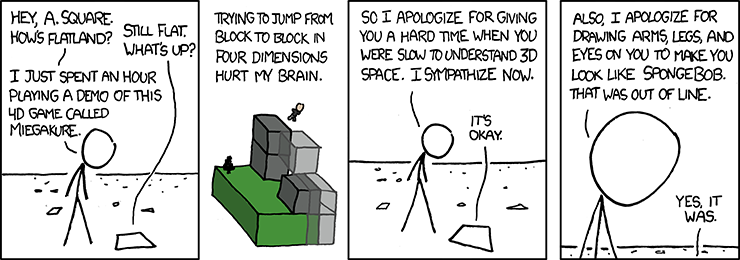
This comic is from xkcd.com, a lovely bunch of thought provoking comics are found there. A direct link to this particular one is at http://xkcd.com/721/ . Thank you to my facebook friend Jeffry Sommer for forwarding this one on to me!
Most of the daily emails, facebook messages, and tweets I get surrounding this project are from fans, wanting to discuss the ramifications of all this or just wanting to thank me for opening their minds to new possibilities. In addition, every few weeks I get interesting comments from the occasional teacher. For instance, three weeks ago I heard from Mitchell Daar, a Middle School Math Teacher at Bernard Zell Anshe Emet Day School in Chicago. Mitch had this to say:
"...your video has been an excellent catalyst for real, poignant, outside the box conversations in my classroom... the conversations that your movie sparked were some of the best I have ever experienced as a teacher."
Then, at the end of March a visitor to the tenth dimension forum, calling themselves "Redmirian", posted a very nice analogy for visualizing the enfolded nature of spatial dimensions, with each new dimension affording a new degree of freedom that was unavailable from the one before. I emailed Redmirian asking for permission to quote the analogy in this blog and possibly produce an animation of it some day. I received this message back and discovered that "Redmirian" was the handle for yet another teacher, this one from England:
"Thanks for the email and the comments about my analogy.
I would be flattered if you used it in a blog entry and I am quite happy for you to quote it and discuss it and included references to me.
My actual name is Nigel Evans. I am a science teacher (head of chemistry) at an independent co-ed boarding school in Oxfordshire in the UK. The school is Bloxham School.
I have been fascinated by the physical sciences all my life and in particular the ideas of multi-dimensionality. I saw your video on youtube and then visited your website. I found the video truly enlightening as it brought the 10 dimensions to life in a new way. I was discussing it with my wife and children which is how the analogy of forest came about."Here's the analogy Nigel came up with, see what you think. And once you're done reading this, you can go to his entry at the tenth dimension forum where you'll see that he has proposed some other interesting analogies as well.
The first 3 dimensions are easy for people to understand but then we need some assistance. To imagine the 4th dimension, we think of walking in a forest along a footpath. That could be thought of as being our experience with the footpath being the 4th dimension of duration. We walk along the footpath as we age from the past to the future. We cannot back-track along the path. As we walk along we see there are other paths along the footpath which branch off and we have to make decisions about which route to follow. Once we have passed a junction we cannot go back and choose another path. This is our reality.
The junctions along our path lead to alternative 'parallel' places and so these are in the 5th dimension. We cannot reach these parallel places once we have passed the junction but if we could back-track then we could return to a junction and branch off. Alternatively, it is possible to leave our foot path and walk through the forest directly to the parallel places. These routes through the forest are in the 6th dimension and allow us to travel directly to the alternative parallel places at the end of the paths which branched off from our path.
So if we can travel in the 4th dimension we can only move along one path in one direction.
If we could travel in the 5th dimension we could back track to a junction and change a decision and head off on another path.
If we could access the 6th dimension then it would be like having a map of the forest which showed us all the paths and where they lead to. This would allow us to move freely through the forest from place to place and get to places which are not directly connected to where we are on our path by using the 6th dimension.
The 7th dimension is our entire forest and through the 7th dimension we connect to other forests via other paths. If we were able to access the 7th dimension we could stand at the edge of our forest and see paths leading to other forests. We follow one path heading for another forest and we are traveling in the 7th dimension. We pass other paths leading off our path which lead to still more forests but we cannot see exactly where they are heading and which forest we are going to. These other paths branching off and leading to the other forests are the 8th dimension.
If we were able to see a much larger map of all the forests and where they were in relation to each other and how to get from one to another directly that would be the 9th dimension. A 9th dimensional being could move to anywhere on the 'map' at will. The 10th dimension would be all the forests and all the paths all taken as one. I guess a 10th dimensional being would exist in all parts of all the forests simultaneously.
Thank you Nigel for this delightfully simple analogy. And thank you to all the teachers I've heard from in the almost four years since I've launched this project who have enjoyed the "philosophy of physics" discussions with their students that my project has been able to stimulate.
The above video makes it very clear in its description at youtube that its author believes this has nothing to do with our concept of 4D as spacetime. Nonetheless, it shows multiple visual examples that apply to the "long undulating snake" concept I've talked about with my project from the outset. Am I a 3D shadow of my 4D self? And is that 4D self projected from a 5D hologram that includes many other possible versions of myself? That's the conclusion that seems to align with multiple theories of cosmology, while leaving room for more metaphysical discussions as well.
It's interesting to see how many comments there are on youtube from people suggesting that this video shows a way to understand how ghosts can appear and disappear, or pass through walls, or come from another time and place, another position with the 4D continuum. I suspect that such suggestions do not sit well with the creator of this video, but I of course have discussed similar possibilities from time to time.
But for me, I have to keep returning to this important point. I agree with this video! The fourth dimension is not time. Time is a direction, not a dimension. Saying that "time" is the fourth dimension would be like saying "forward" is the third dimension: both are directions, and both could be thought of as directions in any spatial dimension. "Forward" has its backward, "time" has its anti-time, and when you pair the two opposing directions you are thinking about a full spatial dimension using arbitrary labels.
Is the third dimension made from length, width, and depth? Sure, those labels work together. So do pitch, yaw, and roll. So could east/west, north/south, up/down: as long as you come up with three ways of thinking that are at right angles to each other, you're on the right track. But because these dimensions enfold one another, it's not really relevant to say that "forward" is only a direction in the third dimension: depending upon your frame of reference you could apply "forward/backward" to any spatial dimension, including the fourth. That goes for any spatial manipulation terms you can think of, which is why "branching" and "folding" have their usefulness in these discussions but they're only part of many ways of thinking about all this.
So. Some people think discussions of fourth-dimensional spatial objects like hypercubes have nothing to do with discussions of the fourth dimension as spacetime. In Playing Games in Extra Dimensions, we looked at a lovely iPhone/iPod app called Hipercubo. This game was created by Brazil's Roger Sodré, of Studio Avante. While Roger tells me he is a long-time fan of Imagining the Tenth Dimension, he is also another person who thinks spatial 4D is a separate concept from spacetime 4D. Here's one way of blending these two ideas together.
Try to imagine a 4D hypercube as viewed from the fifth dimension. The shape will be static and unchanging, the hypercube is always a hypercube. Now imagine the shape representing a human being from birth to death as viewed from the fifth dimension. That "long undulating snake" imagery we've used really is a gross oversimplification - the complex web of atoms and molecules, water and energy, choices taken and not taken, and all the potential "worldlines" representing a single person is a vastly more complex shape than a simple hypercube. In both cases, that extra dimensional pattern casts a shadow into the third dimension which moves in specific ways: but a rotating hypercube casts a much more predictable and essentially unchanging shadow than the 3D shadow cast by a living and breathing human being!
Let's close this entry by looking at the following video, which is my second most popular on youtube (after the three versions I've posted of my original Imagining the Tenth Dimension animation). It discusses the confusions surrounding 4D as four spatial dimensions that have nothing to do with time. It is built around the M-Theory claim that there are 11 dimensions, ten of which are spatial and one of which is "time": it's called "Aren't There Really 11 Dimensions?".
For the last month or so we've been keeping things lighter, looking at some extra-dimensional games, a Japanese anime about the multiverse, a humorous video about time travel, and some songs of mine recorded with my friends Roberta Nichol and Bob Evans. Let's finish off this series by talking about a new Augmented Reality visual toy we've just launched here at Talking Dog Studios: "expandAR". You can try it out yourself at expandar.com.
"expandAR" is a visual toy that uses face tracking and augmented reality for some hilarious and mind-altering effects. Once you've made note of the keyboard combinations for the effects you like you can call them up whenever you like. You can also play with this toy with more than one person - with practice you can play "ExpandAR Pong" and throw the effect from one face to another and back again.
Share your best expandAR photos with us! Just email your pictures to us and we'll put them in our gallery of crazy pictures made with this site. And once a month, the person who sends in our favorite picture will win a prize!
If you watch the above video for a few seconds at the 0:45 mark, you'll see an effect that's reminiscent of the video feedback effects we've used in quite a few of my video blogs. This one in particular reminds me of the effect we used in Randomness and the Missing 96 Per Cent.
The subtitle for expandAR says "Expand Your Reality". Since Imagining the Tenth Dimension is all about visualizing the hidden patterns that connect things together, this toy does seem to have some resonances with this project. There are also some effects within expandAR that temporarily alter your perception of the world around you in ways similar to the "waterfall illusion", which we discussed in Illusions and Reality.
But first and foremost, what we're looking at is an open-ended plaything, something to stimulate your creativity and let you explore the possibilities. So have fun with expandAR, and enjoy the journey!
We've asked this question before - what would the 3rd dimension look like if you could observe it from outside of the limited "now" of our arrow of time perspective? Here's a trippy video that (in a way) plays with that idea. Check out "Dancing on the Timeline":
In When's a Knot Not a Knot, we looked at the following video and I made this comment: "How would our own reality look if you could see more than just 3D? Watch this interesting video and think about how similar it is to watching a rotating hypercube."
In Playing Games in Extra Dimensions, we talked about a new iPhone/iPod game called Hipercubo that asks you to manipulate a hypercube (or "tesseract"). And in Hypercubes and Plato's Cave we looked at a classic animation of a rotating hypercube. Now, here's a new, better quality rotating hypercube animation put up by a techno artist calling themselves f(x), the soundtrack for this animation is a cut from their new album. The description for this animation says:
The tesseract is a four-dimensional object, and is rotating on the Y and W axes in this animation. Even though it looks like it is morphing, all the edges are the same length, and all angles are 90 degrees. (Thanks to Jason Hise for the image!)
A direct link to the above video is at http://www.youtube.com/watch?v=u4BbHBBZ3hU The youtube channel this clip comes from is Kyodo8, I'm sure you could contact them if you're interested in purchasing their f(x) music tracks.
Finally, speaking of buying music, here's the new video again for my song Crop Circles, but this version has lyrics superimposed. If you'd like to buy a high-quality mp3 of this song, as performed by Rob Bob and Roberta, it's part of a 10 song package available for download from the Tenth Dimension Digital Items Store.
PS - Thanks to my friend Frank, who suggested I go to CropCircleResearch.com to see what some of the "Crop Circles are Real" researchers have to say about the topic.
Roger tells me he's a long time fan of Imagining the Tenth Dimension. This game allows you to manipulate a four-dimensional hypercube, and if go to Apple's Apps Store, you'll see it's available free in a basic version, with additional levels available for purchase. You'll also see in the description that Roger suggests we could use this game as a way of thinking about how our universe is finite but unbounded (as opposed to infinite), a concept we've talked about in previous blogs like Are We a 3D Sphere on a 4D Hypersphere and Life is But a Dream. In fact, there's a poll question running here at the tenth dimension blog right now that asks whether you support that idea or not.
Music and sound effects for Roger's game are by Cromo.Sonica. I've just downloaded the free version and it's quite the brainbuster, really a fine way to force your brain into thinking about how the shadows of extra dimensional objects behave as you manipulate them. We're going to talk about hypercubes next week again in an entry called Dancing on the Timeline: and one of my more popular blog entries from a couple of years ago called Hypercubes and Plato's Cave also shows my suggestion for a way of visualizing how we could exchange the word "duration" for "length" in imagining the fourth spatial dimension. As we can see in this game, there is no way for us to appreciate the shape of this hypercube when it's static and unchanging. Only by using "time" to manipulate the object can we begin to visualize how, just like with a 3D cube, with this 4D cube every edge is the same length, and each side is at a 90 degree right angle to the next.
Here's another game for you to play online: a 4D Rubik's Cube called Magic Cube 4D. Superliminal Software has a number of interesting links on their pages, check 'em out. The above video shows the 4D cube being solved automatically by the program, it would of course take much, much longer for a human being to solve this crazy-looking puzzle, but there are definitely people out there who have mastered such a feat!
And if you get the hang of this 4D version, then go one further with Magic Cube 5D!
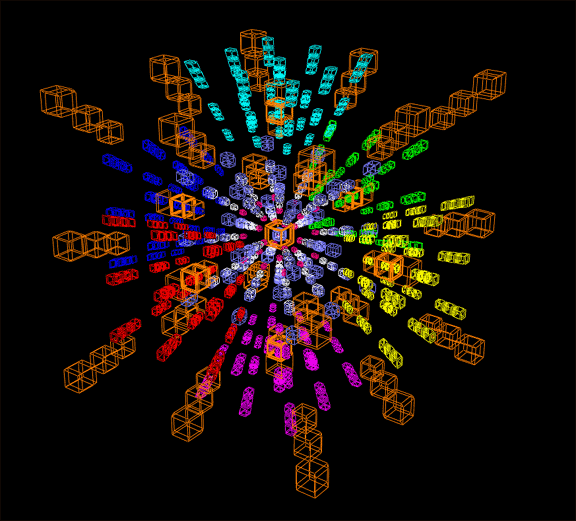
This image is from the web page for Magic Cube 5D, which is posted at Gravitation3D. I love what they say in the text above this image:
In the spirit of taking things too far, here is a fully functional 5-dimensional analogue of Rubik's cube.
"In that blessed region of Four Dimensions, shall we linger on the threshold of the Fifth, and not enter therein?"
I hope you enjoy playing Hipercubo and these extra-dimensional Rubik's Cube puzzles! Next time we're going to keep things on the lighter side with something that ties back to our last entry: "I'm You From the Future".
A couple of weeks ago we looked at a concept called "Flow": being in the moment, in the groove, completely centered, a very internal idea connected to the nature of consciousness and our interface with reality. This time we're going to look at a very different and much more external concept from cosmology called "Dark Flow". The illustration below is credited to NASA and comes from an article published a few months ago in New Scientist magazine, entitled "Mystery 'dark flow' extends towards edge of universe". The article, written by Marcus Chown, begins with these paragraphs:
SOMETHING big is out there beyond the visible edge of our universe. That's the conclusion of the largest analysis to date of over 1000 galaxy clusters streaming in one direction at blistering speeds. Some researchers say this so-called "dark flow" is a sign that other universes nestle next door.
Last year, Sasha Kashlinsky of the Goddard Space Flight Center in Greenbelt, Maryland, and colleagues identified an unusual pattern in the motion of around 800 galaxy clusters. They studied the clusters' motion in the "afterglow" of the big bang, as measured by the Wilkinson Microwave Anisotropy Probe (WMAP). The photons of this afterglow collide with electrons in galaxy clusters as they travel across space to the Earth, and this subtly changes the afterglow's temperature.
The team combined the WMAP data with X-ray observations and found the clusters were streaming at up to 1000 kilometres per second towards one particular part of the cosmos (The Astrophysical Journal Letters, vol 686, p L49).
Many researchers argued the dark flow would not turn up in later observations, but now the team claim to have confirmed its existence. Their latest analysis reveals 1400 clusters are part of the flow, and that it continues to around 3 billion light years from Earth, a sizeable fraction of the distance to the edge of the observable universe (arxiv.org/abs/0910.4958). This is twice as far as seen in the previous study.
What does Mr. Chown mean when he says this force is coming from "beyond the edge of the universe"? Is he talking about a concept we explored in The Statistical Universe? Here's the new video for that previous entry:
In that entry we looked at a Seed magazine article by Raphael Bousso, a theoretical physicist at The University of California, Berkeley. The image he painted for us of the multiverse is that if we were to head off in a particular direction in our universe, we would eventually (after traveling for a very very very long time!) get to some other universe with different basic physical laws. This might seem to imply that we need no more than 4D spacetime, but also then presents us with a difficult to imagine process where once we got to the "edge" of our universe with its unique physical laws, we would encounter some kind of a difficult transition to another universe that has its own unique physical laws.
In You are the Point we talked about the cosmological horizon, and the idea that no more matter where you go in our universe you will ultimately observe yourself to be at the center. Doesn't Dr. Bousso seem to be opposing this viewpoint? Isn't this like claiming the world is flat and that if we travel far enough we will fall off the edge? One might get that impression. But since Dr. Bousso is a string theorist, I would say that what he's really telling us is that we would need to be moving through the extra dimensions to make such a journey to another different-initial-conditions universe, an idea that would then connect much better with my approach to visualizing the dimensions. We looked at similar concepts in The Holographic Universe, here's the video for that one again:
A direct link to the above video is at http://www.youtube.com/watch?v=hMLVjFrtq6Q Coincidentally, in this video we looked at another New Scientist article written by Marcus Chown, and at about the 1:14 mark we show the cover of the issue that article came from, which has the headline "You are a Hologram Projected from the Edge of the Universe". At the 5:55 mark, I show some animations demonstrating some of the ways I'm proposing it's more useful to think about what the "edge of the universe" really is. This takes us back to the spatial dimensions that our reality comes from, and the important concept that each additional dimension is at "right angles" to the previous one. "What's Around the Corner" has turned out to be one of my more popular recent blogs showing how we can work through this logic one dimension at a time, please check it out if you still have questions about the validity of my approach and see if it helps to convince you.
Magnets and Flatlanders Here's a visualization: imagine that our 4D spacetime is like the 2D plane that is home to our old friend, the flatlander. What would happen if we moved a magnet near that plane? In the flatlander's world, he would see objects moving towards the magnet's location, but have no way to see the magnet itself. That magnet is, in a sense "beyond the edge of the flatlander's world", in that it is in the third dimension rather than the second, at and additional right angle that is beyond his perception and perhaps even his ability to conceive.
Likewise, when cosmologists are suggesting that the observed evidence of "dark flow" is evidence for "universes next door" I would say the same analogy holds: this dark flow would be evidence of gravitational attraction coming from an additional dimension, one that is "outside" of our 4D spacetime in the same way that magnet was "outside" of the flatlander's 2D world.
"Dark flow" is still somewhat controversial, and even those scientists who accept its existence as a phenomenon have a variety of opinions on what its source might be.
As you'll see if you read the whole article, one theory is that this is evidence of certain regions of our universe having quantum entanglement with other universes, and if that turns out to be the case I would refer back to a recent entry I called The Fifth Dimension is Spooky. It seems that dark flow is very similar in nature to the dark energy that accelerates our universe's expansion and the dark matter that has held our universe together: I am proposing that all would appear to be evidence of different kinds of gravitational attraction from additional dimensions. Regular readers of this blog will recognize that this is not a new concept for me, but is rather one of the central ideas from my book. Another blog entry that explores this concept of how dark energy and dark matter are evidence for the existence of extra dimensions is Dark Gravity Across the Dimensions. Here's the video for that entry again:
A direct link to the above video is at http://www.youtube.com/watch?v=ZhGOgKIWBaQ I was surprised to recall now that this blog entry looks at yet another article written by Marcus Chown: clearly I'm a fan!
Enjoy the journey,
Rob Bryanton
Next: When we talk about dark flow, dark energy, and dark matter we're talking about something that is undetectable except for indirect evidence. Next time we'll take another tangential leap from that idea with an entry called "Nothing is Real".
 With Imagining the Tenth Dimension, we're talking about how our reality springs from ten spatial dimensions. Some cosmologists have claimed that the tenth dimension is beyond our comprehension, that it's impossible for anyone to actually imagine such a thing. With this project, we've used logical puzzles to help us to do so, building one layer, one concept upon another. Really, this is the basic process of all learning: we start from simple concepts, and we grow from there.









 Posts
Posts


