Showing posts with label general semantics. Show all posts

Sunday, February 20, 2011

Language and the Mind


A direct link to the above video is at http://www.youtube.com/watch?v=hO-F3OVWO4k


"Research has been uncovering how language shapes even the most fundamental dimensions of human experience: space, time, causality and relationships to others."

- Lera Boroditsky, writing in the February 2011 issue of Scientific American, article "How Language Shapes Thought".


Last time, in Changing Your Brain, we explored whether it's possible for Imagining the Tenth Dimension's "new way of thinking about time and space" to actually re-wire people's brains. This time, let's explore the idea of how each of us have brain structures that make us unique individuals, and how those structures are influenced by our experiences, and by our language.

In entries like The Map and the Territory, Jumping Jesus, and Nothing is Real, we've looked at the ideas of Alfred Korzybski, who developed the science of General Semantics, which explores the relationship between our observed reality and the abstract constructs of language. There have been a number of articles I've come across which show some interesting tie-ins to these ideas, today we'll be looking at some of those links.

First, here's an article published last summer in the Wall Street Journal, about how different languages cause people to see the world differently: for instance, people who speak Japanese versus Spanish have a different sense of the concept of "blame".

A New Scientist article from around the same time talks about the notion advanced by Noam Chomsky in the 1960s that the brain is naturally wired for communication, and that language works as an extension of that ability. After five decades of pursuing that paradigm, researchers are now coming to terms with the fact that the opposite is true: language shapes the way the brain communicates, and different languages create different connections within the brain.

The current issue of Scientific American has an article on this subject as well, "How Language Shapes Thought", and that's where the illustration and quote that started off today's entry come from. Here's the opening paragraphs from that article, which was written by Lera Boroditsky (Lera is an assistant professor of cognitive psychology at Stanford University and editor in chief of Frontiers in Cultural Psychology. Her lab conducts research around the world, focusing on mental representation and the effects of language on cognition).
I am standing next to a five-year old girl in pormpuraaw, a small Aboriginal community on the western edge of Cape York in northern Australia. When I ask her to point north, she points precisely and without hesitation. My compass says she is right. Later, back in a lecture hall at Stanford University, I make the same request of an audience of distinguished scholars—winners of science medals and genius prizes. Some of them have come to this very room to hear lectures for more than 40 years. I ask them to close their eyes (so they don’t cheat) and point north. Many refuse; they do not know the answer. Those who do point take a while to think about it and then aim in all possible directions. I have repeated this exercise at Harvard and Princeton and in Moscow, London and Beijing, always with the same results.

A five-year-old in one culture can do something with ease that eminent scientists in other cultures struggle with. This is a big difference in cognitive ability. What could explain it? The surprising answer, it turns out, may be language.
Reading these articles makes one appreciate the gargantuan task Google Translate is attempting to tackle - being able to correctly translate one language to another, interpreting and even using idiomatic phrases, is so much more than just saying "this word in this language equals that word in that language". And yet, here's an article published last month about the latest demonstrations of Google Translate's "Conversation Mode", which will allow a person to speak into their phone and have the phone speak their words in another language, or to have the other person they want to speak with be able to use the device to translate their sentences into English.

Discussions of what happens when the brain is damaged add to the texture of this conversation. Here's a news article from a few years ago about people who suffer brain traumas and suddenly start speaking their native language with an accent. I've remarked before (in You Have a Shape and a Trajectory) that I thought it was interesting to watch my son Mark learning to speak different languages - the timbre of his voice changes, even his face changes somewhat, because of the different ways he positions his mouth and tongue whether he's speaking English, French, or Serbian. In a sense, he becomes a different person as he speaks these different languages.

Respected neuroscientist Dr. Adrian Owen, formerly of Cambridge and recently recruited to the University of Western Ontario (along with five of his research staff), headed up a team who were the first to communicate with patients in a persistent vegetative state using brain imaging. He also made a stir last year when he published a study showing that the popular "brain training videogames" do not, in fact, make people smarter. Dr. Owen is one of the most respected neuroscientists in the world, please keep that in mind as you watch him in this video called "Science of the Soul".


A direct link to the above video is at http://www.youtube.com/watch?v=-fD7Pu40qeI

So. Becoming fluent in another language gives us a window into another way of interfacing with reality, a different one from our own. Learning new things isn't just about broadening our horizons: it's about re-awakening our sense of wonder, which enhances our enjoyment of life. We're going to talk more about this next time with an entry called Novelty.

Enjoy the journey!

Rob Bryanton

Monday, January 18, 2010

Nothing is Real

Do you remember Alfred Korzybski? We've talked about him in past blogs such as The Map and the Territory and Jumping Jesus. Korzybski was responsible for creating general semantics as a new approach to thinking about the relationship between language and our perceptions of the world around us.

One of the youtube video channels I like to watch is "ProfessorAnton". It features Corey Anton, who is an Associate Professor of Communication Studies at Grand Valley State University and (perhaps not so coincidentally) is on the Board of Trustees for the Institute of General Semantics. Most of Professor Anton's videos are simple in design, just him talking into the video camera about ideas, but here's one he just put up which plays with low-resolution images and occasional overlapping of sound in ways that really appealed to me. Check out "Nothing is Real":


A direct link to the above video is at http://www.youtube.com/watch?v=qefA-xrA5EU

If you enjoyed the ideas presented in this video check out the rest of Professor Anton's channel. Since we could say this blog entry uses a Beatles lyric for its title, you might also see some interesting tie-ins between this and the ideas we explored in You are Me and We are All Together, I Know You, You Know Me, Scrambled Eggs and Happy Birthday Paul.

Enjoy the journey!

Rob

Next: Monkeys Love Metallica

Saturday, October 24, 2009

Jumping Jesus


A direct link to the above video is at http://www.youtube.com/watch?v=y1drvP3Y3E8

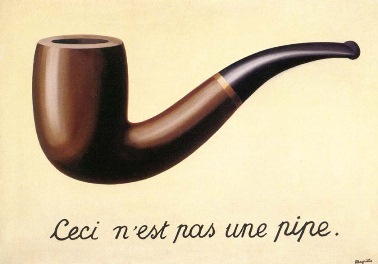
Image from wikipedia:Belgian surrealist René Magritte's famous painting, subtitled "This is not a pipe"

In The Map and the Territory, we looked at this thought-provoking painting, and we talked about Alfred Korzybski, who gave us this simple but profound quote: "the map is not the territory". He is responsible for a science he called General Semantics, which wikipedia sums up as follows:
Korzybski's work held a view that human beings are limited in what they know by (1) the structure of their nervous systems, and (2) the structure of their languages. Human beings cannot experience the world directly, but only through their "abstractions" (nonverbal impressions or "gleanings" derived from the nervous system, and verbal indicators expressed and derived from language). Sometimes our perceptions and our languages actually mislead us as to the "facts" with which we must deal. Our understanding of what is going on sometimes lacks similarity of structure with what is actually going on. He stressed training in awareness of abstracting, using techniques that he had derived from his study of mathematics and science. He called this awareness, this goal of his system, "consciousness of abstracting". His system included modifying the way we approach the world, e.g., with an attitude of "I don't know; let's see," to better discover or reflect its realities as shown by modern science. One of these techniques involved becoming inwardly and outwardly quiet, an experience that he called, "silence on the objective levels".
Korzybski's work has influenced a number of deep thinkers, including Robert Anton Wilson, who we'll get to shortly. It was Wilson who coined the term "the Jumping Jesus Phenomenon".

In Computers and Consciousness, we talked about the conundrums we are bound to encounter as computers become more and more powerful - if a computer is able to map and seamlessly re-create all of the mental processes of a human being, is that computer conscious? Here's the video for Computers and Consciousness:

A direct link to the above video is at http://www.youtube.com/watch?v=BRiYQuisqPM

As you're watching this video, you're seeing scenes from a movie which in YouTube has been called The Singularity is Near. But after further research I see that the scenes are actually from a 2006 three-part documentary series on the notion of transhumanism by Belgian visual artist and filmmaker Frank Theys, called TechnoCalyps. Here's what it says on his website:
The accelerating advances in genetics, brain research, artificial intelligence, bionics and nanotechnology seem to converge to one goal: to overcome human limits and create higher forms of intelligent life and to create transhuman life.

Frank Theys conducts his enquiry into the scientific, ethical and metaphysical dimensions of these technological developments. The film includes interviews by top scientists and thinkers on the subject worldwide, including Marvin Minsky, Ray Kurzweil, Hans Moravec, Terence McKenna, Bruce Sterling, Robert Anton Wilson, Margaret Wertheim, Rael, the Dalai Lama and many more.
This looks like it would be a great DVD set to own, but it appears the program is not available in a format that will play on North American players - too bad! Still the entire series is available on Google Video, so here's all 3 parts. Each of these clips is over 50 minutes long, so make sure you're comfortable!

Here's a direct link to the above video - Part One.


Here's a direct link to the above video - Part Two.


Here's a direct link to the above video - Part Three.

We've talked about the transhuman movement a few times now, in Suffering in the Multiverse and in Computers and Consciousness. And we've talked about the idea that our reality is accelerating in ways that seem entwined with our awareness in numerous entries, including Tens, Google and the Expanding Universe, Google and the Group Mind, The Stream, Evolution's Fast Lane and Boredom and Consciousness. The images I showed behind me in my video for Computers and Consciousness come from Part Two of Technocalyps, which after some shots of scientists working in clean room suits, shows a visualization of our history as a moving landscape - from fire, to agriculture, the wheel, and so on, we start with the innovations very far apart, but as we move through the landscape they become closer and closer together. Futurist/novelist Robert Anton Wilson appears and talks about this concept:
"The Jumping Jesus Phenomenon is my name for the acceleration of information throughout history. I first heard of that through Alfred Korzybski, a Polish mathematician who invented a scientific discipline called General Semantics. Korzybski noted that information was doubling faster and faster, every generation. And he said we've got to be prepared for this, we've got to train ourselves to be less dogmatic and more flexible so that we can deal with change. He took the year 1 A.D. as his basic unit to calculate how long it took for the information available to human beings to double, and it took 1500 years... which brought us up to the Renaissance. Leonardo Da Vinci was in his forties, and the Renaissance was at its height.

I decided to call this unit a "Jesus": so, in 1 A.D. we had "one Jesus", in 1500 we had "two Jesus". The next doubling only took 250 years, so already you can see the acceleration factor, and by 1750 we had "four Jesus". The next doubling took a hundred and fifty years and by 1900 we had "eight Jesus". The next doubling only took fifty years and by 1950 we had "sixteen Jesus". In 1960 in only ten years we had "thirty-two Jesus", by 1967 we had "sixty-four Jesus", and by 1973 we had "128 Jesus", and the latest estimate I've seen is by Dr. Jacques Vallee, a computer scientist who says that knowledge is doubling every year. But I heard that estimate, oh, five or six years ago. I saw something on the net recently, somebody estimated it's doubling about twice a year now."
How can we possibly deal with such an overwhelming deluge of new information? I've talked about the need for quieting our "narrator voice" in a number of previous blogs, including Logic vs. Intuition, Daily Parrying, Are Animals and Kids More Fifth-Dimensional, in my book, and in my song "Automatic". Korzybski's work seems to have an interesting connection to the idea that we do better when we can achieve "silence on the objective levels", and it seems clear that the goals of meditation and mindfulness training, as ways of dealing with the dizzying amount of change we are now experiencing, can be tied together into Korzybski's theories of General Semantics.

Quiet your mind, stop the needless loops, and enjoy the journey!

Rob Bryanton

Next: O is for Omniverse - New Book!


A direct link to the above video is at http://www.youtube.com/watch?v=AjR69ddBK78

Saturday, August 1, 2009

The Map and the Territory


A direct link to the above movie is at http://www.youtube.com/watch?v=7OR7meRm71w

Image from wikipedia: René Magritte's famous painting, subtitled "This is not a pipe"

Chuck Salyers pointed me towards a fascinating wikipedia article on "The Map Territory Relation". Here's a few excerpts from the article, but please do read the whole thing:

The expression "the map is not the territory" first appeared in print in a paper that Alfred Korzybski gave at a meeting of the American Association for the Advancement of Science in New Orleans, Louisiana in 1931:
  • A) A map may have a structure similar or dissimilar to the structure of the territory...
  • B) A map is not the territory.
The Belgian surrealist artist René Magritte illustrated the concept of "perception always intercedes between reality and ourselves" in a number of paintings including a famous work entitled The Treachery Of Images, which consists of a drawing of a pipe with the caption, Ceci n'est pas une pipe ("This is not a pipe").

This concept occurs in the discussion of exoteric and esoteric religions. Exoteric concepts are concepts which can be fully conveyed using descriptors and language constructs, such as mathematics. Esoteric concepts are concepts which cannot be fully conveyed except by direct experience. For example, a person who has never tasted an apple will never fully understand through language what the taste of an apple is. Only through direct experience (eating an apple) can that experience be fully understood.

Lewis Carroll, in Sylvie and Bruno Concluded (1893), made the point humorously with his description of a fictional map that had "the scale of a mile to the mile." A character notes some practical difficulties with such a map and states that "we now use the country itself, as its own map, and I assure you it does nearly as well."

In a sort of counterpoint to Lewis Carroll, the University of Cambridge economist Joan Robinson (1962) emphasized the disutility of 1:1 maps and other overly detailed models: "A model which took account of all the variegation of reality would be of no more use than a map at the scale of one to one."

Last blog, in "What's South of the South Pole?", we discussed the difficulty of envisioning things that are not part of the system we are within. With "the map and the territory", we have a way of thinking about how any representation of the system we are within is more useful if it finds ways to distill the elements, to avoid the uselessness of a map drawn to a scale of 1 to 1.

This is the power of the way of visualizing our reality as coming from ten dimensions as I've been portraying them - we have an intuitive way of encapsulating concepts that are much too big, much too all-encompassing, for us to be able to process without using representational maps. Which is not to say there is no value to the calculations physicists use to prove how our reality comes from the fifth dimension (as we explored in "The Holographic Universe"), or to deny the string theory idea that the potential for 10 to the power of 500 possible universes is contained within ten spatial dimensions (see "Does the Multiverse Really Exist?"): but rather, to return to the quote we've looked at before (in "Aren't There Really 11 Dimensions?") from physicist Michio Kaku:
In science, a physical picture is often more important than the mathematics used to describe it.
- Michio Kaku, in his book Physics of the Impossible
As we've said before, in recent entries like Logic vs. Intuition, Computers and Consciousness, Do Shamans See Other Dimensions?, and Our Non-Local Universe: with Imagining the Tenth Dimension, we are using intuition to hold concepts in our mind that by all rights are really much too large to fit. Using Alfred Korzybski's analogy, we can say that's because this project is looking at an abstract representation: and looking at a map can be much more productive than looking at this unfathomably large territory that we're exploring.

Enjoy the journey,

Rob Bryanton

Next: Just Six Things: The I Ching

Tenth Dimension Vlog playlist