A direct link to the above video is at http://www.youtube.com/watch?v=3Kke6VFVZhE
Next: Why Can't We Stop at the Fifth Dimension?
Showing posts with label timelessness. Show all posts
Showing posts with label timelessness. Show all posts
Monday, April 23, 2012
New video - Timelessness and the Ultimate Ensemble

Tuesday, May 17, 2011
Poll 76 - No Space, No Time, No Mass
A direct link to the above video is at http://www.youtube.com/watch?v=NyXLYckyoF8
 Poll 76:"From a photon's point of view there is no space, no time, no mass. Light does not exist within the world of spacetime and matter."
Poll ended January 8, 2011. 70.2% agreed, and 29.8% disagreed.
As you can probably tell as we look at this current crop of poll questions, I became quite fascinated with the ramifications of my Light Has No Speed entry, and each of these poll questions are looking at the same idea from a number of different perspectives. Where am I heading with this? In 2011, I've been repeatedly showing the following diagram, which is a way of thinking about how gravity and light interact to create our constantly evolving "now" within the fifth dimension. And as I keep returning to, Einstein himself eventually agreed with the proposition that the field equations of gravity and light for our reality are resolved when they're calculated in the fifth dimension. Coincidence? I think not.

One of the most important ideas that spring from this diagram might be that it's more accurate to think of light and our universe's duration as residing within the fifth dimension. Does that mean time is a direction in the fifth dimension? In a way it does, but since we're already calling the first four dimensions spacetime, does that make any sense?
My answer to that conundrum is that words like "time" are the same as words like "up" or "forward". They represent directions, not specific dimensions. Time is a way of describing change from state to state, and those changes make just as much sense whether they're viewed from the direction of "time" or "anti-time". Is "up" a direction in the 3rd dimension, or is it "forward"? Either could be true, it depends upon your frame of reference. And can the direction of "up" point at only one thing? Likewise, can the direction of "time" point at only one thing? Again, what these directions are pointing at depends upon your frame of reference.
But as we discussed with the above poll question, the photon's ability to travel at the speed of light puts it within a specific space where there appears to be only one possible set of states from the beginning to the end of the universe, which would be at "right angles" to our spacetime, where the star ten light years away emitting a photon and that photon hitting your eye are, from the photon's point of view, simultaneous.
This takes us back to the hard determinist viewpoint that there is really only one world line for our universe, and our free will is only a useful illusion, nothing more. In the past I've said that's the difference between the "one world line" that seems to be the fourth dimension, and the "fifth dimension probability space" that we are really navigating within.
So. Is "time" a direction in the 5th dimension, or is time in the 4th? Either can be true, it all depends upon your frame of reference.
Next week, we'll continue this discussion as we look at a new video - The Quantum Observer. Coming up next - Are We Each in Our Own Filter Bubble?
Enjoy the journey!
Rob Bryanton
Monday, September 20, 2010
Light Has No Speed
A direct link to the above video is at http://www.youtube.com/watch?v=ksTngIWRnWs
From light's point of view there is no space, no time, no mass. Light does not exist within the world of spacetime and matter.
 All observers experience the speed of light to be the same. The revolutionary thing that came out of that is that space and time are not constant, but vary with the speed of the observer. Space and time are not fixed.
 So: when a stationary observer observes a ray of light going by, it goes 186,000 miles in one second. Somebody moving at 87% of the speed of light (this is just the way the mathematics work out) would see half that amount of distance, and half that amount of time: but the speed would still be the same (93,000 miles in half a second is the same as 186,000 miles in a second). Someone moving at 99.5% the speed of light sees a tenth of that: 18,600 miles in a tenth of a second. It's still the same speed.
 What Einstein realized is there's something called the spacetime continuum, out of which both space and time appear. The spacetime continuum is not like space, it's not like time, it's not a mixture of the two, it's something we don't know and can't describe.
What we do know is the space and time that it gives rise to. But it never gives rise to the same amounts of space and time: different observers see differing amounts of space and time so space and time vary.
What Einstein showed is there's something in spacetime called the interval. It is like the equivalent of distance or seconds, but the interval is actually the subtraction of the square of space and time (s^2 - t^2), it's actually the square root of that. And that turns out to be constant. So in spacetime there is a constant, and the "distance" in spacetime never changes... although what we experience in space and time changes.
So this led to some more weird things about light.
 What happens if you travel at 100% of the speed of light? If you look at the way things are going with our equations here, you'll see that light experiences itself traveling no distance in no time. From light's point of view, light does not exist within space-time: for a photon, birth and death are the same moment.
Light doesn't experience itself traveling through space and time. There is no non-locality for light because it's one phenomenon within one moment: this is light's point of view.
 So. The reason for this is that the spacetime interval in the spacetime continuum for light is always zero: always zero. So from light's point of view there is no space, no time, no mass. Light does not exist within the world of spacetime and matter.
 So what do we make of this thing called "c", this constant "speed"? I put speed in quotes deliberately because what we observe as speed, I don't think is speed at all. When I observe a light beam traveling from the back of the room to my eye, in spacetime the beginning and end of that light beam are the same: spacetime is bent so they are the same. In my frame of reference I stretch out that zero interval into space and time, and I always stretch out 186,000 miles of space for every second of time. If I'm traveling very fast I stretch out a smaller amount, very slow I stretch out a much larger amount, and so on.
 So I don't think "c" is a speed at all. Rather, it's the constant ratio of the manifestation of space and time. For every 186,000 miles of space that appears, 1 second of time appears.

Immanuel Kant was on to this two hundred years ago. He said "Space and time are the framework within which the mind is constrained to construct its experience of reality".
The above presentation returns us yet again to the important idea that our reality is not continuous, and that when we look up into the sky at night we are looking back into time. From the photon's point of view, it took no time whatsoever for it to travel from that distant star to my retina. Isn't that an amazing concept to consider?
Enjoy the journey!
Rob Bryanton
- theoretical physicist and author Peter Russell
A direct link to the above video is at http://video.google.com/videoplay?docid=7799171063626430789#
 Here's an interesting video, just over an hour long, featuring a presentation by theoretical physicist and author Peter Russell. At about the 46:25 mark he makes a point that I thought was particularly useful for the way it relates to my project. Here's what he says about Einstein's Special Theory of Relativity and the speed of light:
 Here's an interesting video, just over an hour long, featuring a presentation by theoretical physicist and author Peter Russell. At about the 46:25 mark he makes a point that I thought was particularly useful for the way it relates to my project. Here's what he says about Einstein's Special Theory of Relativity and the speed of light:
 All observers experience the speed of light to be the same. The revolutionary thing that came out of that is that space and time are not constant, but vary with the speed of the observer. Space and time are not fixed.
 So: when a stationary observer observes a ray of light going by, it goes 186,000 miles in one second. Somebody moving at 87% of the speed of light (this is just the way the mathematics work out) would see half that amount of distance, and half that amount of time: but the speed would still be the same (93,000 miles in half a second is the same as 186,000 miles in a second). Someone moving at 99.5% the speed of light sees a tenth of that: 18,600 miles in a tenth of a second. It's still the same speed.
 What Einstein realized is there's something called the spacetime continuum, out of which both space and time appear. The spacetime continuum is not like space, it's not like time, it's not a mixture of the two, it's something we don't know and can't describe.
What we do know is the space and time that it gives rise to. But it never gives rise to the same amounts of space and time: different observers see differing amounts of space and time so space and time vary.
What Einstein showed is there's something in spacetime called the interval. It is like the equivalent of distance or seconds, but the interval is actually the subtraction of the square of space and time (s^2 - t^2), it's actually the square root of that. And that turns out to be constant. So in spacetime there is a constant, and the "distance" in spacetime never changes... although what we experience in space and time changes.
So this led to some more weird things about light.
 What happens if you travel at 100% of the speed of light? If you look at the way things are going with our equations here, you'll see that light experiences itself traveling no distance in no time. From light's point of view, light does not exist within space-time: for a photon, birth and death are the same moment.
Light doesn't experience itself traveling through space and time. There is no non-locality for light because it's one phenomenon within one moment: this is light's point of view.
 So. The reason for this is that the spacetime interval in the spacetime continuum for light is always zero: always zero. So from light's point of view there is no space, no time, no mass. Light does not exist within the world of spacetime and matter.
 So what do we make of this thing called "c", this constant "speed"? I put speed in quotes deliberately because what we observe as speed, I don't think is speed at all. When I observe a light beam traveling from the back of the room to my eye, in spacetime the beginning and end of that light beam are the same: spacetime is bent so they are the same. In my frame of reference I stretch out that zero interval into space and time, and I always stretch out 186,000 miles of space for every second of time. If I'm traveling very fast I stretch out a smaller amount, very slow I stretch out a much larger amount, and so on.
 So I don't think "c" is a speed at all. Rather, it's the constant ratio of the manifestation of space and time. For every 186,000 miles of space that appears, 1 second of time appears.
Immanuel Kant was on to this two hundred years ago. He said "Space and time are the framework within which the mind is constrained to construct its experience of reality".
The above presentation returns us yet again to the important idea that our reality is not continuous, and that when we look up into the sky at night we are looking back into time. From the photon's point of view, it took no time whatsoever for it to travel from that distant star to my retina. Isn't that an amazing concept to consider?
Enjoy the journey!
Rob Bryanton
Next: Cymatics, Gravity and Light
Friday, September 18, 2009
Polls Archive 46 - Big Bang an Illusion?
 Poll 46: "Many of the great physicists have said that "time is an illusion". In the same sense, does that mean the big bang is an illusion?" 47.9% agreed, while 52.1% disagreed. Poll ended August 20, 2009.
One of the quotes I've used most often with this project was this one from Einstein: " this separation between past, present, and future is only an illusion". Did Einstein accept that time was an illusion, and that there is a way of viewing our reality "outside" of time where everything happens simultaneously? You bet!
As regular readers of my blog will know, I was entrusted with the care of Gevin Giorbran's book "Everything Forever: Learning to See Timelessness" after his untimely death last year. Here's a blog from Gevin's website, everythingforever.com (which I am now paying to keep running as a tribute to Gevin's great ideas) which explores Einstein's attitude towards timelessness in much more detail:
Albert Einstein and the Fabric of Time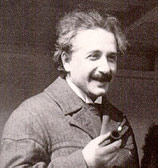
Surprising as it may be to most non-scientists and even to some scientists, Albert Einstein concluded in his later years that the past, present, and future all exist simultaneously. In 1952, in his book Relativity, in discussing Minkowski's Space World interpretation of his theory of relativity, Einstein writes:
Since there exists in this four dimensional structure [space-time] no longer any sections which represent "now" objectively, the concepts of happening and becoming are indeed not completely suspended, but yet complicated. It appears therefore more natural to think of physical reality as a four dimensional existence, instead of, as hitherto, the evolution of a three dimensional existence.
Einstein's belief in an undivided solid reality was clear to him, so much so that he completely rejected the separation we experience as the moment of now. He believed there is no true division between past and future, there is rather a single existence. His most descriptive testimony to this faith came when his lifelong friend Besso died. Einstein wrote a letter to Besso's family, saying that although Besso had preceded him in death it was of no consequence, "...for us physicists believe the separation between past, present, and future is only an illusion, although a convincing one."
Most everyone knows that Einstein proved that time is relative, not absolute as Newton claimed. With the proper technology, such as a very fast spaceship, one person is able to experience several days while another person simultaneously experiences only a few hours or minutes. The same two people can meet up again, one having experienced days or even years while the other has only experienced minutes. The person in the spaceship only needs to travel near to the speed of light. The faster they travel, the slower their time will pass relative to someone planted firmly on the Earth. If they were able to travel at the speed of light, their time would cease completely and they would only exist trapped in timelessness. Einstein could hardly believe there were physicists who didn’t believe in timelessness, and yet the wisdom of Einstein's convictions had very little impact on cosmology or science in general. The majority of physicists have been slow to give up the ordinary assumptions we make about time.
The two most highly recognized physicists since Einstein made similar conclusions and even made dramatic advances toward a timeless perspective of the universe, yet they also were unable to change the temporal mentality ingrained in the mainstream of physics and society. Einstein was followed in history by the colorful and brilliant Richard Feynman. Feynman developed the most effective and explanatory interpretation of quantum mechanics that had yet been developed, known today as Sum over Histories.
Just as Einstein's own Relativity Theory led Einstein to reject time, Feynman’s Sum over Histories theory led him to describe time simply as a direction in space. Feynman’s theory states that the probability of an event is determined by summing together all the possible histories of that event. For example, for a particle moving from point A to B we imagine the particle traveling every possible path, curved paths, oscillating paths, squiggly paths, even backward in time and forward in time paths. Each path has an amplitude, and when summed the vast majority of all these amplitudes add up to zero, and all that remains is the comparably few histories that abide by the laws and forces of nature. Sum over histories indicates the direction of our ordinary clock time is simply a path in space which is more probable than the more exotic directions time might have taken otherwise.
Other worlds are just other directions in space, some less probable, some equally as probable as the one direction we experience. And some times our world represents the unlikely path. Feynman's summing of all possible histories could be described as the first timeless description of a multitude of space-time worlds all existing simultaneously. In a recent paper entitled Cosmology From the Top Down, Professor Stephen Hawking of Cambridge writes; “Some people make a great mystery of the multi universe, or the Many-Worlds interpretation of quantum theory, but to me, these are just different expressions of the Feynman path integral.”
(below is not in book)
What is still not quite resolved in modern physics is how to properly combine Quantum theory with Einstein's Relativity Theory. It appears evident that time is purely a direction in space but how then do we explain the uncertainty of quantum mechanics? Why does it appear that God plays dice with the world. The two theories, each having been proven by their usefulness, do of course tell the same story about this one universe, but we just haven't learned yet to hear the story right. The best modern theory going is probably the No Boundary Proposal, put fourth by Stephen Hawking and Jim Hartle. This theory introduces a second reference of time which has been inappropriately named Imaginary time. Hawking, writes of the no boundary proposal, "The universe would be completely self contained and not affected by anything outside itself. It would neither be created nor destroyed. It would just BE."
In my book Everything Forever, and here at my website, I explain how fourth dimensional spatial directions travel through a series of independent three dimensional block-like spaces, which in science we call states, but they can also be thought of simply as patterns. Hawking has already proposed that imaginary time can be found at right angles to ordinary time. I further explain that it is possible in an objective way to understand the universe to be like a book or a movie film. Each moment is a separate universe just like each frame of a movie or page of a book is separate. Yet those separate states simultaneously form the larger whole of the movie or the book. Seeing each moment as a continually existing place sheds light on why particles would then travel as a quantum wave, rather than linearly from point a to point b. This is explained better elsewhere, but if each moment of ordinary time is a solid, static, "block of now", or field of space, then time each new moment is a distinctly different universe. What we call time is a spatial direction that travels through many static three dimensional universes.
In such a model, what we call time is created purely out of space. Special directions in space travel through each static three dimensional space, therein producing a new realm of space beyond three dimensions, which we call time. The interesting quality this produces, is how the inhabitants of this fourth dimension of space travel a linear path from past to future, but the surrounding environment of each path is shifting from one pattern to the next. This sends particles from one position in four dimensional space to the next without moving linearly. As a result, each individual observer in the fourth dimension experiences a continuous linear time, even though everything in their immediate environment is moving sequentially from place to place. Hence each temporal environment of four dimensional space is constructed relative to each independent observer.
One can imagine oneself smoothly traveling a direct and interconnected path through time, but in looking around at one's environment, one sees that all other directions of time are broken, causing particles to appear to sequentially leap from one place to another. Paradoxically, everyone observes their own path and experience of time to be linear, while all else around them is sequential. In fact, when we explore time as a direction through many 3D spaces, we find qualities of curvature, time dilation, and spatial contraction, precisely as relativity describes those qualities within our own spacetime.
There is one quote I have found from Einstein which is more or less a contemplative mental thought about the notion of infinite spaces, which doesn't directly relate to my own approach of describing a shape to all possible spaces, but it does at least open up the subject of an infinite number of spaces to speculation. And it also shows the open minded nature of Einstein's thoughts about empty space, which some have thought were closed.
When a smaller box s is situated, relativity at rest, inside the hollow space of a larger box S, then the hollow space of s is a part of the hollow space of S, and the same "space," which contains both of them, belongs to each of the boxes. When s is in motion with respect to S, however, the concept is less simple. One is then inclined to think that s encloses always the same space, but a variable part of the space S. It then becomes necessary to apportion to each box its particular space, not thought of as bounded, and assume that these two spaces are in motion with respect to each other...
Before one has become aware of this complication, space appears as an unbounded medium or container in which material objects swim around. But it must be remembered that there is an infinite number of spaces, which are in motion with respect to each other...
The concept of space as something existing objectively and independent of things belongs to pre-scientific thought, but not so the idea of the existence of an infinite number of spaces in motion relatively to each other. This latter idea is indeed unavoidable, but is far from having played a considerable role even in scientific thought.
I can testify that Einstein's speculations revealed here concerning infinite spaces in motion do at least carry us in the right direction in how they suggest space might have an unseen and possibly infinite content. Similar ideas were introduced by David Bohm, who claimed there are two kinds of order in nature, what he called explicate order and implicate order. Implicate order for Bohm was a way of acknowledging how quantum mechanics reveals a hidden order where our world is influenced by the whole of all possible states. However, that order is much more visible than Bohm ever realized, as explained in part two.
Unfortunately it wasn't until Einstein died that scientists began to consider the Many Worlds Theory in science. It's safe to say that in Einstein's time we were still getting used to the idea of the Big Bang, adjusting to the ever more visible vast sea of other galaxies, and the possibility of alien life on other planets. The universe and reality were still primarily considered purely solid and material based. Quantum theory, which eventually led to the theory of many worlds, had not yet fully withstood the test of time. Einstein even rejected its implications, saying "God does not play dice" with the world, even as he himself established that there is more to the universe than a single evolving moment of now.
In my explorations of timelessness I reveal that ordinary space is not merely full of other empty spaces, but empty space is actually the whole of all physical realities; all the universes of the many worlds theory. Profound as it may be, if the theories I propose are correct, space is full, rather than empty. Material things are less than the fullness of space. In fact, it may be that space must include all possibilities in order to seem empty to us. So in summary, the universe we see is just a fragment nested in a timeless (everything) whole, rather than a single material world magically arisen above some primordial nothing. All universes exist without beginning or end in the ultimate arena of time, and each moment we experience exists forever.
Find out more about timelessness at:
Gevin's words still carry a lot of weight for me, and regular readers of my blog will recognize how connected Gevin's ideas are to my own. If you'd like to buy a copy of Gevin's book, it's available at online book sellers, or I have it at my tenth dimension store. I also have a downloadable pdf version of it available at the tenth dimension digital items store. Profits from the sale of Gevin's book will go to the Gevin Giorbran Memorial Fund.
Enjoy the journey.
Rob Bryanton
Next: Polls Archive 47 - In Science, are Pictures More Important Than Mathematics?
Wednesday, August 5, 2009
Just Six Things: The I Ching
A direct link to the above movie is at http://www.youtube.com/watch?v=EbplSTSK3mY
In Alien Mathematics, we talked about the work of cosmologist Martin Rees, who proposed that there are only six basic structures underlying our reality. A few entries later, in The Map and the Territory, we looked at the difficulties in trying to map the extra dimensional patterns that create our reality, because a map becomes less useful when it tries to represent too much. A map with a scale of 1 to 1, for instance, should be able to faithfully capture absolutely every detail about a landscape, but a much smaller map is going to be significantly more useful as a guide.
Think about this, then. What if there were an ancient mapping system which boiled down our current position within the multiverse to only six parameters? This takes us, tangentially, to a territory that some readers of this blog won't be comfortable with, but which has enough connections to the big picture ideas we've been playing with that I believe it's worthy of consideration: this ancient system of mapping our reality is called the I Ching. Victor Robin, a student of the I Ching from California, explained it to me this way:
This is the Ancient Chinese way of viewing the Universe as energy, or Qi, moving through us and everything around us. (sounds familiar, huh?)Here's a few quotes from the wikipedia article on this subject:
The Yi Jing (I Ching) is a compilation of centuries of ascetic observation put into a format that intentionally invites the participation of present timespace. The most common way people use the Yi Jing is by tossing coins to determine which verses are appropriate for the user to read at his point in "time." The user prepares to throw the coins by mentally focusing on a "question" for the Yi Jing to "answer."
I love how those three ideas sum up trying to think of our universe of genes, memes, and spimes from a perspective which is "outside" of our spacetime, a running theme in this project (see Information Equals Reality, You Have a Shape and a Trajectory, and The Big Bang is an IllusionThe I Ching is a "reflection of the universe in miniature." The word "I" has three meanings: ease and simplicity, change and transformation, and invariability. Thus the three principles underlying the I Ching are the following:
- Simplicity - the root of the substance. The fundamental law underlying everything in the universe is utterly plain and simple, no matter how abstruse or complex some things may appear to be.
- Variability - the use of the substance. Everything in the universe is continually changing. By comprehending this one may realize the importance of flexibility in life and may thus cultivate the proper attitude for dealing with a multiplicity of diverse situations.
- Persistency - the essence of the substance. While everything in the universe seems to be changing, among the changing tides there is a persistent principle, a central rule, which does not vary with space and time.
for a few examples). The I Ching also fits nicely with another subject we've touched on in this blog a number of times, sacred geometry. Here's more from that wikipedia article:
Thinking of the I Ching as a road map of our available probability space, then, leads to its use for divination:Richard S. Cook reported that that the I Ching demonstrated a relation between the golden ratio (aka the division in extreme and mean ratio) and "linear recurrence sequences" (the Fibonacci numbers are examples of "linear recurrence sequences") :
...the hexagram sequence, showing that its classification of binary sequences demonstrates knowledge of the convergence of certain linear recurrence sequences ... to division in extreme and mean ratio... that the complex hexagram sequence encapsulates a careful and ingenious demonstration of the LRS(linear recurrence sequences)/DEMR (division in the extreme mean ratio relation), that this knowledge results from general combinatorial analysis, and is reflected in elements emphasized in ancient Chinese and Western mathematical traditions.
The I Ching has long been used as an oracle and many different ways coexist to “cast” a reading, i.e., a hexagram, with its dynamic relationship to others. In China the I Ching had two distinct functions. The first was as a compendium and classic of ancient cosmic principles. The second function was that of divination text. As a divination text the world of the I Ching was that of the marketplace fortune teller and roadside oracle. These individuals served the illiterate peasantry. The educated Confucian elite in China were of an entirely different disposition. The future results of our actions were a function of our personal virtues. The Confucian literati actually had little use for the I Ching as a work of divination.
 John Thomas Bryant (who you will recall from his fascinating Astrotometry project), pointed out this hexagram, number 24, to me. Here's one version of the descriptive text for that hexagram: "A movement is accomplished in six stages and the seventh brings return".
The idea that our universe has six degrees of freedom, which are then constrained at the seventh dimension, seems very related to all this. There are, of course, many other systems of divination, and I realize how easy it is for people to dismiss all this as superstition. Like many other aspects of Imagining the Tenth Dimension, though, I'm willing to entertain the possibility that ancient wisdom may have figured some things out about our reality which science has yet to catch up to. As more and more physicists embrace the idea of a multiverse, and as Everett's Many Worlds Interpretation of quantum mechanics also sees increasing support, we see that ultimately everything about our universe exists simultaneously as a wave function that is outside of space and time. If so, then connections such as those explored thousands of years ago by Chinese scholars may not be as much of a stretch after all.
Have you ever had your palm read, or a tarot card reading, or a personal astrology analysis done? Was it all absolute bunk? If so, then the rest of this blog will be of no interest to you. On the other hand, if you have ever had the experience that many people around the world have had, where the reader seemed to know things, have insights, even specific knowledge that surprised you with its details, then you may be willing to consider that this is more than just lucky guesses that we're talking about here. Clearly, some people who do readings like these have strong intuitive capabilities, and regardless of the system of divination they use, that intuition helps them to be more effective at telling people's futures. I would say, then, that dismissing such events as coincidence, or worse still the deliberate deceptions of scam artists is too harsh a judgment: if we really are navigating our way through a probability space of unique outcomes that are available from our current "now", and those outcomes already exist within a timeless set of states that exist outside of our spacetime, then I don't think it's that hard to imagine that some people are more able to intuitively "see" the map of that upcoming information space than others.
We'll continue even further with this discussion about divination and superstition in an upcoming blog where we look at some fascinating reports from Norway, that entry will be called Norway's "Reverse Deja Vu". To close, here's a video for one of the 26 songs that go along with this project, a song about our ongoing quest to figure out the secrets of the universe: "What I Feel For You".
A direct link to the above video is at http://www.youtube.com/watch?v=w06IRgChaMY
Enjoy the journey,
Rob Bryanton
Next: Roger Ebert on Quantum Reincarnation
Related blogs:
Poll 40 - Now vs. the Future
The Holographic Universe
Predicting the Future (Here Come the Aliens)
Dr. Mel's 4D Glasses
We're Already Dead (But That's Okay)
Unlikely Events and Timelessness
Poll 12 - Possible and Impossible Outcomes
Poll 7 - Can We Predict the Future?
Your Sixth-Dimensional Self
What Do You Want to Change?
Intuition
Remembering the Future
Tuesday, July 28, 2009
What's south of the south pole?
A direct link to the above video is at http://www.youtube.com/watch?v=qkGlig_wqYs
What's south of the south pole? The same thing that's north of the north pole. This really relates to how each additional spatial dimension allows you to get to a state which is impossible to get to from the current dimension - no matter what dimension you're discussing, adding another dimension must add another degree of freedom, allow you to get somewhere that you couldn't get to from your current dimension.
What's before the big bang? The same thing thing that's after the end of the universe. Again, the meaning of the words requires you to think of something that doesn't exist within the dimension you're examining. The words really have no meaning within the current context, which is why we often use quotes in these questions. What's "before" the beginning? What's "south" of the south pole? Nothing. You can't get there from here.
What we have to get to is understanding that saying nothing is "before" or "after" our universe requires us to abandon the limits of our current dimension - in this case sequential spacetime, the fourth dimension. We have to imagine a dimension which enfolds our spacetime entirely, where before and after have no meaning because in that dimension everything happens at the same time. When we visualize such a state, we can see that even thinking of the big bang as a beginning is a limited way of thinking about what really happened - because from that dimension's perspective, all possible states for our universe, right from its beginning to its end, already exist.
Such thinking sometimes leads people to conclude this means free will doesn't exist, because the past, present, and future have already been decided and we're like passengers on a train, observing the scenery but with no way to change what we're going to see next. Understanding that we still have a certain amount of control requires us to accept a multiverse, and the parallel universes of Everett's Many Worlds Interpretation, which says that at this instant we are each observing one state out of many possible states that already exist simultaneously.
What's south of the south pole? What's outside of our system? Simultaneity. Timelessness. A perfectly balanced symmetry state, enfolded together into a big beautiful zero. Getting "outside" of our 4D spacetime allows us to see how our universe is a temporary deviation from symmetry, as physicist Sean Carroll said in Scientific American last year. This is an idea I've been explaining to any friends who will listen for the last twenty-five years, and have been presenting to the world since Imagining the Tenth Dimension launched in 2006.
Enjoy the journey,
Rob Bryanton
Related blogs:
The Long Undulating Snake
The Big Bang is an Illusion
Does the Multiverse Really Exist?
The Holographic Universe
What's Before and After?
Gevin Giorbran - Everything is Forever
Time in Either Direction
The Big Bang and the Big Pie
Next: The Map and the Territory
Friday, January 9, 2009
Polls Archive 29 - Do Electrons Have No Size?
A direct link to the above video is at http://www.youtube.com/watch?v=gxfyCiieubE Poll 29 - "An electron is a point-like particle. This means, just like the "point" we start the tenth dimension visualization with, an electron is 'of no size, no dimension'." Poll ended December 16 2008. 41% agreed while 58% disagreed.
This poll question relates to some blog entries that were published around the same time: "We Start With a Point", "A Point Within the Omniverse", and "Elvis and the Electrons".
Here's a link to the wikipedia article on electrons. As it says in the article: "Electrons are believed to be point particles with no apparent substructure. They are identical particles that belong to the first generation of the lepton particle family."
So: all electrons are identical, and all electrons are point particles. Here's the first couple of sentences from the wikipedia article on point particles:
"A point particle (or point-like particle, often spelled pointlike particle) is an idealized object heavily used in physics. Its defining feature is that it lacks spatial extension: being zero-dimensional, it does not take up space."
Thinking of an electron as having no size and being zero-dimensional, then, is the correct approach as far as modern physics is concerned. And yet, conceiving of an electron in those terms is not an easy thing for us to wrap our heads around, as 58% of the people responding to this poll showed us.
"We Start With a Point"
My animation, which has now been seen by millions of people around the world, starts with these five words: "we start with a point". Building one idea upon another, we end up with a way to visualize all aspects of reality as contained within the ten dimensions, a mind-blowing journey that makes people want to watch this animation over and over again. When author David Jay Brown called my book "brilliantly conceived and mind-stretching", he was celebrating the large cloud of ideas that spring from the starting point of this way of visualizing reality. Here in this blog, there are a great many tangents that we've explored, all of them stemming from the point of indeterminate size that the original animation both begins and ends with.
Envisioning that the entire universe really contains only one electron, then (a fanciful idea from celebrated physicist Richard Feynman which we discussed most recently in Poll 27) requires us to stretch our minds even further. And, as we just discussed in Poll 28, stacking on top of that the idea that our perceived reality is being created through the pattern-recognition powers of our minds builds a conceptual tower which some are still not willing to climb!
To those of you who are not ready to embrace the more "out there" notions that this project sometimes gets into, I'm fine with that. At the core of these discussions, though, is what I believe to be an essential truth about the nature of reality, and as each of us come with our pre-conceived notions and our own experiences which frame our worldview, this project is about ways of showing how we are all connected together: in a very real way, we are like Feynman's single electron, existing simultaneously within a reference frame which is completely outside of time, outside of space. Think of this: the spark within each of us that some call consciousness, and some call "soul", or "spirit", is like a point-like particle when perceived within each "frame" of space-time, but it's also part of a much larger wave function which exists across timelessness. As I've said before: "you are the point".
To finish, here's my song "Connections", which ties these ideas together in its own way.
A direct link to the above video is at http://ca.youtube.com/watch?v=J25WhT8WZQ4
Enjoy the journey,
Rob Bryanton
Tuesday, December 23, 2008
Aren't There Really 11 Dimensions?
(In some ways you could consider this a sequel to the original animation that started it all, which you can view here.)
A direct link to the above video is at http://www.youtube.com/watch?v=UfhOBevrN2U
In science, a physical picture is often more important than the mathematics used to describe it.
- Michio Kaku, in his book Physics of the Impossible
One of the most often-asked questions related to this project is "Aren't There Really 11 Dimensions?". This question relates to the basic idea of what we're talking about here, which is a way of visualizing spatial dimensions. We've talked before about the point-line-plane postulate, which you can look up in wikipedia: it uses a very similar logic to what my way of visualizing dimensions uses, and this postulate states that it can be used to imagine any number of spatial dimensions. Here's how the point-line-plane postulate works:
We start with a point. We can place a point within any specific spatial dimension, and then place another point in that same dimension. The line that passes through those two points can be thought of as having any number of divisions along its length, but ultimately the line extends to infinity in either direction. To define an additional dimension, all we have to do is find a point that isn't on any of the lines we could possibly have just created within the constraints of our current dimension. That additional point can then be used to define a plane that extends to infinity in all four directions within that plane, and this is how we imagine an additional spatial dimension. And finally, to define yet another dimension up from that one, all we have to do is find a point which is not within any of the planes we could possibly have just created.
Right angles to right angles
Using this logic, we can continue to build one spatial dimension upon another. How does this work? It's because each additional spatial dimension is at "right angles" to the one before, and the tricky part for we 3D creatures is trying to find ways to allow our brains to conceive of what "right angles" means as we try to imagine each additional spatial dimension beyond the three with which we're so familiar. The point/line/branch/fold imagery that my project uses is another very similar way of helping us to visualize additional spatial dimensions, using a logical consistency which works no matter what spatial dimension you choose to start from.
When string theory talked about spatial dimensions, for a while there it was nine spatial dimensions plus one of time. When physicist Edward Witten introduced a way to unite five different versions of string theory into what became known as M-Theory, he was describing ten spatial dimensions plus one of time. Because of that shorthand way of saying it, some people jump to the conclusion that this means physicists are saying "time" is the eleventh dimension, but it's not that simple.
"Time" overlaid upon "Space"
What science has traditionally visualized is three dimensions of space, and an additional quality called "time" which is overlaid on space to create the familiar concept of "space-time". In that way of thinking, "time" is not really a full dimension, which is why it sometimes gets counted separately. So with M-Theory's 11 dimensions, it's like we're imagining an eleven-story building, but the fourth floor is somehow not as real as the other floors: no wonder some people are unwilling to accept the existence of additional spatial dimensions when this building looks like it could collapse at any moment!
String theory relies upon extremely complicated math to arrive at its portrayal of reality. My animation is a visualization tool, which provides a comparatively easy window into imagining the extra spatial dimensions, and also has many interesting connections to other ideas from physics and cosmology - for instance, the idea that the fifth dimension is curled up at the planck length because we're experiencing it one planck frame at a time, and the idea that our 3D universe is "constrained" by a seven-dimensional brane can be seen in my "new way of thinking about time and space".
Imagining the Tenth Dimension is a Visualization Tool
What I've created, then, is an intuitive, rather than a mathematical way of visualizing the spatial dimensions. As physicist Michio Kaku says in the opening quote to this entry, sometimes finding a way to visualize a problem is more important than the math used to solve a problem: but saying that in no way diminishes our respect for the difficulty of the rigorous mathematical concepts physicists dealing in cosmology and extra dimensions must use to properly study these ideas.
So here we are with our eleven-story building, somehow managing to stay up even though its fourth floor is not as solid as the others. What's wrong with this picture? If the first three dimensions are spatial, and the fifth dimension and above are spatial (or "space-like" as some physicists prefer to say), and each additional spatial dimension is defined by the one before, then I would say that we have to find a way to agree that the fourth dimension is a full spatial dimension just like the others or the leap from the third spatial dimension to the fifth spatial dimension simply doesn't make sense. We need to show how there is a continuum, from the first dimension to the second, from the second to the third, and so on all the way up to the top of our building.
Many Worlds Leads to Many Dimensions
Here's another continuum that I believe ties in to this way of visualizing. In 2007, a team of scientists at Oxford, under the direction of physicist David Deutsch published a proof demonstrating that there is a direct continuum from the probabilistic outcomes of the quantum world to the macro world of parallel universes resulting from chance and choice (Everett's Many Worlds Interpretation).
If every decision I make, every decision someone else makes, and every random outcome where no one made a choice but something just happened are all creating different versions of our universe, this seems like a mind-boggling amount of universes for us to be asked to imagine. And yet, the Many Worlds Interpretation is gaining ground amongst serious scientists because it answers so many other questions about how our universe works. So, while Everett's MWI still has its detractors, as cosmologist Max Tegmark of the Massachusetts Institute of Technology has been quoted to say,
The critique of many worlds is shifting from 'it makes no sense and I hate it' to simply 'I hate it'.Here's the intuitive leap my project takes on all this: if there are multiple branching timeline versions of our universe being created by chance, choice, and the actions of others, and yet we somehow can't get to those other universes once a certain outcome has been observed, we are talking about the point-line-plane postulate again: we define a line in a spatial dimension, and we find a point that is not on that line, and that's how we visualize the next dimension up. In other words, with my project I'm contending that the versions of our universe that we can't get to are being defined within additional dimensions, and this aligns with the most basic definition of spatial dimensions.
What's Not On Our Line?
As we discussed recently in Elvis and the Electrons, one of the commonly used examples of a universe we're not in, or a point that is not on our line, is that Everett's MWI says there must be a version of our universe where it's 2009 and Elvis is still alive. In other words, I am insisting that these branching choices, as per the definition of spatial dimensions, come from the next dimension up above our spacetime, a constantly evolving "probability space" which is the fifth spatial dimension. The fact that Kaluza convinced Einstein that the equations for gravity and light for our universe are resolved in the fifth dimension also ties in nicely with this idea.
But in order to get to that conclusion, we still have to fix our ghostly fourth floor. This project does so by insisting that "time" as we experience it is just one of the two possible directions in the fourth spatial dimension. Most scientists are willing to agree with the concept of time reversal symmetry, which says that time's opposite direction is just as valid as the "arrow of time" that we are experiencing within our universe. As per the point-line-plane postulate, my way of visualizing the dimensions uses time reversal symmetry for its reasoning - if we define a point in the fourth dimension, let's call it "now", then we can define a second point any arbitrary amount of time before or after "now" which creates a line that extends to infinity in either direction. Those two directions are "time" and "anti-time", and those two directions combined create a full spatial dimension.
Talking about "time" without acknowledging "anti-time" is like talking about "up" without acknowledging "down". Here's another analogy: if I were to tell you that our 3D physical world is made from length, width, depth, and "forward", you would ask why I was counting "forward" separately. Isn't "forward" already one of the possible directions within our 3D space of length,width, and depth? Of course it is. We reach the same conclusion with the fourth spatial dimension: "time" as we experience is just one of the two possible directions that make sense within that dimension, but it does not belong in a list of length, width and depth: this is why I suggest that the fourth spatial dimension be referred to as "duration".
Which means, then, that by the time we have counted ten spatial dimensions, we have already considered "time" as being one of the possible directions within those spatial dimensions so there's no need to count it separately. To be clear, though, this conclusion is unique to this project, so anyone taking a university class on M-Theory will continue to be told to count time separately.
Like wormholes, or anti-matter, some people jump to the conclusion that because they learned about "time as the fourth spatial dimension" from science fiction (the H.G. Wells novel "The Time Machine" for instance) that means the idea is incorrect, just a figment of overactive imaginations. In fact, the controversy over whether time is part of a full spatial dimension is at the core of many people's criticism of this project. Time, some critics say, is a temporal dimension and thus any additional dimensions based upon my description of the fourth dimension must also be temporal, and not the spatial dimensions that physicists dealing with extra dimensions are thinking about.
Because the idea that "time" is a direction, not a dimension, is so central to my project, I have spent a great deal of time discussing it. Here, to close, are some of the other blog entries where I have explored this idea that time is just one of the two possible directions in the fourth spatial dimension.
Hypercubes and Plato's Cave
Time is a Direction
Time in Either Direction
Scrambled Eggs
Dr. Mel's 4D Glasses
The Big Bang and the Big Pie
Enjoy the journey,
Rob Bryanton
Next: Google and the Group Mind
Friday, November 28, 2008
Imagining the Omniverse
A direct link to the above video is at http://ca.youtube.com/watch?v=V6D3CgF8_qk
Frank Wilczek, winner of the 2004 Nobel Prize in Physics, has just published a new book on the latest thinking in physics and cosmology called "Lightness of Being". To quote from the recent review of this book in New Scientist Magazine:
Again and again, new revelations come from the scientific community that confirm the basic ideas I've been putting forth - that there is a place where everything fits together, where every state exists simultaneously outside of our 4D spacetime, an enfolded zero or "nothing", and that is where our universe or any other comes from. As Wilczek suggests, and I have been saying as well, this is also where the missing 96% of our universe, the dark matter and dark energy which pervade our reality, comes from as well....if the Higgs boson is not responsible for most of the mass around us, what is? The answer, Wilczek tells us, is empty space.
Still, the idea that all familiar mass - our desks, chairs, bodies - comes from energy crystallized out of nothing is rather mind-bending. And it leads Wilczek to wonder...is space and time themselves a condensate that similarly crystallized from nothingness in the earliest moments of the big bang?
So this time around, I'd like to continue with ideas introduced in my previous blog, "Dreaming of Electric Sheep".
Here we are, out in timelessness, the underlying fabric that is "outside the system": the place where past, present and future have no meaning. This is the perfectly balanced symmetry state that physicists talk about as being where our universe comes from - and the phrase they commonly use is that our universe came about as a result of the breaking of that symmetry. As we mentioned in "The Big Bang and the Big Pie", the 2008 Nobel Prize in Physics is about to be awarded to scientists who described the mechanism for how our universe spontaneously arose from this broken symmetry. Symmetry-breaking is often used to explain why our universe is composed mainly of matter rather than antimatter, and the fact that our universe is so far out of balance in this way is often described as being one of the major unexplained mysteries of modern science.
What does symmetry mean, exactly? It means that things are balanced. Every possibility has an opposite possibility. Every plus has a minus. What may not be immediately evident about symmetry, though, is that when you take all of those positives and negatives contained within perfect symmetry and add them together, you end up with a big, beautiful number - zero.
Zero, then, is not empty, it's full - full of every other possibility, perfectly balanced and assembled in that underlying symmetry that our universe or any other universe comes from - zero is where it all starts, and zero is where it all ends. Because it's the source of everything else, that zero has many names in many different ways of thinking - but right now, let's call that zero the "omniverse".
What happens within this omniverse, this zero, when things become out of balance? Most of the time, the results are quite inconsequential, and balance is soon restored. Down at the quantum level, physicist John Wheeler described how there's a constantly bubbling chaos, a random noise of particles and energy that continually pop in and out of existence - a "quantum foam", as he called it, and this quantum foam continues to be part of the background for our universe or any other.
But as we travel around within all the different variations contained within this zero--this underlying set of all possible states where past, present and future all exist simultaneously--occasionally we'll come across a surprisingly large deviation, where the information that is contained within this zero is pushed in a very interesting way in one direction or another, creating a large move away from the perfect balance of where we started. Here's something amazing then: from this perspective, out here within the timeless background of the omniverse, when we look at one of these interesting deviations we're looking at the entire life of a universe as one simultaneous shape. This could be a universe where nothing much ever happens, or it could be a universe that quickly flies apart into maximum entropy. It could be our universe, with its unique values for gravity and the speed of light; or it could be some other universe with a completely different value for its fine structure constant. It could even just be an interesting pattern of information, an idea, that doesn't actually coalesce into a universe at all! Still, no matter what we're looking at, it's something that defines a shape that represents a break from symmetry at one extreme, and a return to symmetry at the other.
Now let's think about this in terms of our own universe. That break from symmetry, from down here in spacetime, looks in one direction to be our highly ordered big bang, and in the other direction looks to be the end of the universe. Right at this very instant, we're someplace within that shape, and all of the other possible positions within that shape represent all of the possible timelines that could have or will have occurred for our universe right from one edge of its existence, right from one edge of this shape, to the other.
(And what's "before" the big bang, and "after" the end of our universe"? Thinking about timelessness, we can see that both are the same thing - in either case, we're talking about being back within that beautiful enfolded "zero", that perfectly balanced symmetry, the omniverse.)
But still, what does all this have to do with something as complex as our own universe? What would cause a larger, more complex deviation to occur? There needs to be some sort of logical pattern, an ordered causality that moves from one state to another, creating steps that allow us to move further and further away from the balancing point. For our own universe, that logical causality happens because our universe is constrained by a set of locked-in physical laws that allow these different states to be stacked upon each other, moving us far away from that underlying perfectly balanced symmetry state, all the way out to that very first yes/no selection pattern that quantum computing expert Seth Lloyd invites us to think of as the beginning of our universe.
Here's a way to think about that: let's dive right into that forest of all possible states for all possible universes contained within the omniverse. No matter where we begin, the most likely result is that the place we start to observe will appear to be random information, and we won't be able to see very far at all. But as we move around and look at this data from different angles and starting positions, every now and then we'll see places where the "trees" within our forest happen to align, and we'll be able to see further, or we'll see coherent patterns. For something as complex as our own universe, we're talking about an exceedingly unlikely set of alignments to take place within the data: but because we're talking about underlying selection patterns that exist outside of time and space, the word "unlikely" ceases to have much meaning. No matter how unlikely a pattern might be, if it's a pattern that could possibly exist at all, then that pattern already exists within the timeless background of the omniverse.
Let's go back to that perfectly balanced zero that we started from. We can think of this as a vast plain representing every possible expression of matter, energy, and information. That "quantum foam" we talked about, then, is really the quantum equivalent of a series of coin tosses: tiny little deviations one way or the other, particles and antiparticles, waveforms that are pushing towards the positive or the negative. Baby universes that quickly pop in and out of existence, then, would be (on a much larger scale, or course) like those areas of grouping and symmetry order that we would see within 100 tosses of a coin.
Traveling around within this omniverse of all possibilities, we'll occasionally find coherent structures that represent a potential universe, and if we then look more closely at the dimensions below, we'll find the wave function for that particular universe and all of the possible states for that particular universe, and each universe will have unique characteristics as defined by its position within the omniverse.
Our own universe, then, is constrained by its basic physical laws, which appear to not have changed over the life of our universe. Physicists talk about the big bang as being the "most ordered state" for our universe, and how everything from there on has been a move from more order to more entropy. Now, we've just been looking at a way to see how our universe is the result of a push towards a large amount of grouping order, and the arrow of time that we are experiencing now is the result of a return to symmetry order - but here's the hardest part to wrap our minds around: where this is all occurring is outside of time and space, and it all occurs simultaneously.
A number of the great minds of the twentieth century tried to get us all to visualize this place where, as Einstein liked to say, "the distinction between past, present and future is meaningless". As we're imagining the omniverse, what we're thinking about is the timeless place where our universe, and all of the possible parallel universes resulting from chance and choice for our universe, and all of the other possible universes and their own wave function of possible expressions all enfold together - into a beautifully balanced zero which is not empty, but full, of all the other possibilities.
To finish, here's a video for one of the 26 songs I've attached to this project: this is me sitting at my old piano in my living room, singing a song about the extra dimensional patterns that create our reality, and how sometimes we might be able catch a glimpse of those patterns in our day-to-day life. The song is called "From the Corner of My Eye".
A direct link to this video is at http://ca.youtube.com/watch?v=2f8IBDXv_xI
Enjoy the journey,
Rob Bryanton
Edit: A few months later another related blog was published: Imagining the Omniverse - Addendum
Next: New stuff at the store
Tuesday, November 18, 2008
The Big Bang and the Big Pie
A direct link to the above video is at http://ca.youtube.com/watch?v=kiP12-u2GYY
Alfred Nobel, the inventor of dynamite, used the large fortune he amassed to institute the Nobel Prizes, and the latest Nobel Laureates were announced a few weeks ago. ...the big bang, dynamite, there's a joke in there somewhere, make one up if you want.
In You are Me and We are All Together, I quoted this fascinating bit of information from Michio Kaku's book The Physics of the Impossible:
...Feynman revealed the true secret of antimatter: it's just ordinary matter going backward in time. This simple observation immediately explained the puzzle that all particles have antiparticle partners: it's because all particles can travel backward in time, and hence masquerade as antimatter. (This interpretation is still the explanation currently accepted today.)Antimatter, like wormholes, is one of those concepts some of us have learned about through science fiction, which might lead us to believe that it's a fictional concept. Watch out for that wormhole! Activate the antimatter drive! Blast 'em with the antimatter gun! It turns out, though, that the issue of why our universe has so very little antimatter in it is one of the great unsolved mysteries of cosmology.
North has its South, Time has its Anti-Time
In entries like Scrambled Eggs and Time in Either Direction, we've talked about the mainstream science concept that there could be other universes where time flows in the opposite direction to what we're experiencing. Think about what Feynman is telling us, then: if a conscious observer were traveling within our own universe in time's opposite direction, they would be faced with a universe which is made up of an unexplainably large number of antiparticles and antimatter, and almost no matter! From their perspective, the fact that our universe is so asymmetrical would be an equally unsolved mystery.
In a few weeks, the 2008 Nobel Prize recipients will travel to Oslo and Stockholm to receive their awards. You can click on this link to read about the Physics prize, or you can click here to download an 8 page pdf with some nicely presented background information. This year the Physics prize is being awarded in pieces - half went to Yoichiro Nambu of the University of Chicago, IL, USA,
"for the discovery of the mechanism of spontaneous broken symmetry in subatomic physics"
and the other half was awarded jointly to Japan's Makoto Kobayashi and Toshihide Maskawa
"for the discovery of the origin of the broken symmetry which predicts the existence of at least three families of quarks in nature"
Our universe is a temporary deviation from symmetryTo sum up their discoveries very briefly, these scientists have demonstrated that there is an underlying symmetry that our universe comes from (a concept I have talked about many times here), and because of that underlying symmetry, at the origin of our universe there should have been an equal number of matter and antimatter particles. The fact that our universe has so many fewer antimatter particles, then, must be because there were more particles than antiparticles back then - so, while most of the opposing particles and antiparticles obliterated each other, there were (according to these scientists) about one extra particle of matter for every ten billion particles of antimatter, and that one out of ten billion particles are the ones that remain to create the astonishingly huge universe we find ourselves to be in right now. Another mind boggling concept to wrap our heads around!
Thinking about Timelessness
Now let's add one more even more mind-boggling concept on top of all that. If it's the accepted definition of antimatter that it's just matter that is traveling backwards in time, how are there any naturally occurring antimatter particles at all in our universe right now? If those particles were created within the big bang, they're going in the wrong direction to be part of our universe. How can this be? It's because the big bang is an illusion. In "The Past is an Illusion", we quoted this famous phrase:
This separation between past, present and future is only an illusion…... and this is where it takes us. Richard Feynman showed us that antimatter particles are coming from the future and heading towards the past. So, if we're talking about symmetry being broken to create our universe, we're not just talking about an event that happened 13.7 billion years ago: we're talking about a broken symmetry which occurred to simultaneously create our universe and all of it possible timelines, right from the big bang to the final moment of our universe, in a place that is "outside of time". In this project, that place is a "point" within the seventh dimension and above. That "point" is a selection pattern, which chooses our universe and its basic physical laws from out of an enfolded background state where all possible universes and their possible timelines exist simultaneously. Gevin Giorbran called that underlying state "Timelessness", and in my project I call that the indeterminacy of the tenth dimension in its unobserved state.
- Albert Einstein
The Big Bang and the Big Pie
Saying "the big bang is an illusion" is a way of saying that the big bang's effects are only one way of looking at the information that becomes our reality. In the biggest picture of all, the big bang--just like time itself--becomes irrelevant, because we are talking about the place where everything happens all at the same time. Our "now" that we are observing at this instant, then, as amazing and beautiful and complex as it might be, is still only the tiniest of slices of that much larger pie that represents every possible state for every possible universe, and every possible way of organizing the information that could potentially create any of that.
So: enjoy the journey on your tiny slice of pie!
To close, here's one of the videos for my song which includes the lyric "the big bang is just an illusion": the song is called "The Unseen Eye".
A direct link to this video is at http://www.youtube.com/watch?v=oK29fTLXEf0
Rob
Next: Top Ten Tenth Dimension Blogs, November Report
Wednesday, November 12, 2008
Tenth Dimension Polls Archive 21 to 25
Click here for the archive of polls 1 to 10.
Click here for the archive of polls 11 to 15.
Click here for the archive of polls 16 to 20.
Click here for the archive of polls 26 to 30.
POLL 21
A direct link to the above video is at http://www.youtube.com/watch?v=YymBvChrcTc Poll 21 - "This project uses lines, branches, and folds as a way to visualize the relationship between dimensions. A "wormhole" can be thought of as a dimensional folding." Poll ended August 22, 2008.
The image below is from the wikipedia article on "wormholes", and it appears to visually confirm what most visitors to this blog are willing to agree with - 97% agreed that a wormhole can be thought of as a dimensional folding.
It's interesting how some of the greatest minds of the twentieth century - Einstein, Wheeler, Feynman, Hawking, etc. - tried to get everyone to perceive that in the big picture the distinctions between past, present and future are meaningless, because ultimately there is an underlying fabric in which all of those states exist simultaneously. The concept of wormholes, then, which is not just from science fiction but which has been seriously explored by modern physicists such as Kip Thorne and Stephen Hawking, shows us what might happen when that fabric is "folded". My own project also asks people to use "folding" as one of the ways to visualize the dimensions, and in fact when any dimension is folded it must be folded through the dimension above. This is easy to picture with a flat piece of paper - if that paper were two-dimensional we could fold it through the third dimension to allow instantaneous transportation from one position to another.
So, as Gevin Giorbran so ably demonstated, "timelessness" is another way of describing that simultaneous underlying fabric that Einstein and those that came after him were trying to get us to imagine. I've been waving a large flag to point out that Einstein eventually agreed with Kaluza that the field equations for gravity and light are resolved in the fifth dimension, and if we are imagining that our 4D spacetime is being bent or folded, what is it being folded through? The fifth dimension. For some reason, that's an idea whose time has not come yet, but when it does I believe many of the mysteries of quantum entanglement, "spooky action at a distance" and other more metaphysical questions will have an answer - it's because our 4D reality comes from a fifth dimensional probability space.
In my blog entry "Wormholes", I played with this idea further - since my way of visualizing the dimensions assigns unique characteristics to each dimension, then that would mean that wormholes through one dimension or another would have different effects. To close, here's the video for that blog entry.
A direct link to this video is at http://www.youtube.com/watch?v=mi2Nh_C8Pzk
POLL 22
A direct link to the above video is at http://www.youtube.com/watch?v=Gbz-CefzT-g Poll 22 - "Why stop at ten? There are really an infinite number of dimensions." Poll ended September 6, 2008. Votes were split right down the middle, half agreed while half disagreed.
This is one of those polls that could probably have used an "I Don't Know" option - until confirmed evidence comes forward to prove that anything more than the third or fourth dimension is real, how can any of us say for sure?
"After that, it's turtles all the way down"
No matter how many dimensions we care to imagine, I believe there needs to be an ultimate state that, in the same sense that Godel's Incompleteness Theorem uses the phrase, is "outside the system". Otherwise you're stuck in endless repetitions, because no matter where you stop, someone can then ask "but where did that come from". The phrase "turtles all the way down", then, comes from a story demonstrating this concept of "infinite regression", which is one of the ways of thinking about infinity.
Ah, infinity. This is one of the questions that comes up sometimes after people watch my animation about visualizing the dimensions: "infinity" is one of those words, like "universe", that seems to have a contradiction built into its definition. How can there be more than one universe when the word was intended to define all that there is? Likewise, how can there be more than one infinity? How can there be infinite divisions between zero and one, an infinite set of numbers from the sequence starting one, two three, and yet another infinite set of numbers from the sequence starting two, four, six? I've come to love the phrase "there are many roads to infinity".
Directions within the Omniverse
In my blog entry "Infinity and the Boltzmann Brains" I talked about the idea my friend Michel from Norway reminded me about: parallel lines meet at infinity. This is more than just a useful device for drawing pictures in proper perspective! This is what really happens. Two parallel lines meet at infinity... and not just once but in either direction.
And this is where I have pointed to the work of physicist Sean Carroll, who a few months ago in Scientific American advanced a very similar idea - time makes sense in either direction, and once you get "outside" time you are in the same enfolded symmetry state that some call the "omniverse", which would be the same both "before" the big bang and "after" the end of the universe.
Infinite in All Directions
So, what it comes down to is that with the way of visualizing the dimensions we're talking about here, every single dimension extends to infinity within its own set of possibilities. The first dimensional line... travels to infinity in both directions. The second dimensional plane... infinite in four directions. And so on, all the way up.
As with "turtles all the way down", some people argue that you could keep adding dimensions forever, until you reach an infinite number of dimensions, at which point you've reached the same idea that I'm talking about - those infinite dimensions, viewed as a whole, would be the thing that just "is", the thing that is "outside the system".
Each piece is connected to the whole
We've talked in my book and in this blog before about physicist Juan Maldacena's theory that our universe is really a hologram. I believe this concept is easily imagined within the construct - because every single dimension already extends to infinity, the idea that each "point" you observe contains/is connected to the whole is already in there. Here's what it comes down to for me: whether you believe there are three dimensions, four, seven, ten, twenty-six, or even an infinite number of dimensions, at the place you stop you need to be able to say "now I have defined the background state from which everything else is derived". For me, my way of visualizing the dimensions achieves this at the tenth dimension. But regardless of what you prefer to call it, what we are talking about here is the underlying, unobserved fabric from which we can generate all other possible expressions of matter, energy, and information: Gevin Giorbran called it timelessness.
Here's the Point
The "point" of indeterminate size, then, becomes an amazingly powerful idea because no matter where you place that point, and no matter what dimension you place that point within, it is at the center of infinity! Here's a way to think about that idea: no matter where you place a point on an infinite line, there are values extending to infinity and "negative infinity" in either direction which cancel each other out... in other words all of those possible values on either side of the point always add up to zero.
Everything Fits Together
Which gets back to the dangerous idea of "zero". When you add every possibility for reality together, what does it add up to? Zero. All states enfold together, and our universe doesn't spring from "nothing", it springs from "everything". As Gevin Giorbran liked to say, the zero (the enfolded symmetry state that is outside the system) is the pie, and our universe is a tiny slice of that pie.
And that's a powerful idea.
Related blog entries:
What Does Infinity Plus Infinity Equal?
Positive Infinity and Negative Infinity
Forward to Giorbran's Acclaimed Book
Everything Fits Together in the Zero at the End
Why Do We Need More Than 3 Dimensions?
The Omniverse
POLL 23
A direct link to the above video is at http://www.youtube.com/watch?v=UVxaYk3CBJk Poll 23 - "Why is it impossible to exceed the speed of light? Because our universe is being created one planck length at a time, at the speed of light." Poll ended September 20th, 2008. 66% agreed while the rest disagreed.
I wonder if some people disagreed with the above statement because of my choice of the word "created": terms like this can be confusing when the universe we're imagining is really just being observed one planck length after another from out of a wave function of probably outcomes. As Everett's Many Worlds Interpretation has it, and as this project also has it, the other possible universes continue to exist out there within timelessness, they're just not the version that we're observing at this "now" within spacetime. In quantum mechanics, then, references to "collapsing" the wavefunction through observation are really just talking about "observing" the wavefunction: according to this way of thinking, whether you use one term or another, you are really talking about the same process.
The Speed of Light Cannot Be Exceeded within Spacetime
In my book I talk about the speed of light being an independent constant: no matter how fast you travel, no matter how close to the speed of light you get, light continues to travel at the speed of light away from you. In my book I suggested that this is because of our reality is really being created (or observed) by quanta, "slices" of the universe that each exist one planck unit of spacetime away from the next. I also described how this effect would be the same not only with your speed but your direction in time: and in a fanciful mental exercise, we imagined some "reverse time aliens" constructed from the chemical processes that make just as much sense in time's opposite direction. Those reverse-time creatures, then, would also experience the speed of light as an independent constant, and even if they were to travel at close to the speed of light in time's opposite direction, they too would find that the speed of light didn't change and it would continue to move away from them at the same speed.
The October issue of Scientific American has an article on Loop Quantum Gravity, which talks about a concept called "atoms of spacetime". While atoms is an unfortunately confusing term to use in this discussion, it is the same idea that my way of visualizing the dimensions uses: our reality, and our experience of time and space, appears to be continuous, but in fact it is created by a mesh of quanta, or "atoms" of spacetime that are each one planck length away from the next: my entry "The Flipbook Universe" is one of a number of blog entries that talk about this idea.
Plus or Minus
According to Michio Kaku in his thought-provoking "Physics of the Impossible", Einstein's most famous equation is not accurately represented: rather than E = mc squared, the more correct representation is E = ±mc squared. In "You Are Me and We Are All Together" I also talked about the idea that physicists generally agree that antimatter is just matter traveling in time's reverse direction. All of these ideas tie together into a deeper understanding that our experience of time's arrow is really not the full picture of reality, and this is something I've discussed in blog entries like "Time is a Direction" and "Time in Either Direction".
One of my most popularly viewed blog entries in the last couple of months here has been "Moving Dimensions and Synchromysticism", in which I talk about the mind-bending work of Jake Kotze, and the mind-bending Moving Dimensions Theory (MDT) of Dr. Elliott McGucken, the brief summation of which I will quote again here:
This idea is easily related to my way of visualizing the dimension, I believe, and gives us an intuitive way to understand the quandary of why the speed of light doesn't change, no matter what direction in space you travel, and no matter whether you're traveling forward or back in time. Bravo, Elliot McGucken!The only way to stay stationary in the fourth dimension is to move at the speed of light. Ergo the fourth dimension is expanding at the rate of "c" relative to the three spatial dimensions.
To close, here's the video blog for another entry which talks about Moving Dimensions Theory. A direct link to this video is at http://www.youtube.com/watch?v=kzlRuygMGHY
POLL 24
A direct link to the above video is at http://www.youtube.com/watch?v=mfDBW1Smu58
 Poll 24 - "The Deutsch team at Oxford have proved that parallel universes resulting from chance and choice really exist. In a number of those, each of us have already died." Poll ended October 4, 2008. 79% agreed, while the remainder disagreed.
The critique of many worlds is shifting from 'it makes no sense and I hate it' to simply 'I hate it'.If you're familiar with Everett's Many Worlds Interpretation of Quantum Mechanics, then I'm hoping that you recognized that concept when I used it in my original Imagining the Tenth Dimension animation. The idea that there are many possible outcomes from any particular "now" is easy to understand, everyone deals with that idea every minute of their life. What if I had stepped out in front of that car? What if I had won that lottery? What if I had talked to that person I recognized rather than pretending I didn't see them? Our lives are continually about a mix of choice, chance, and the actions of others.
- Cosmologist Max Tegmark of the Massachusetts Institute of Technology
What Everett's theory proposed is that each of those other possible branches really do exist out there within the quantum wave function, and that we are merely observing one reality out of the many that continue to exist: the important part of this idea is that those other universes continue to exist, they're just not within the part of the wave function that we're currently observing. Everett presented this concept way back in 1957, and although great minds like Everett's thesis advisor John Wheeler liked the idea, many others within the scientific mainstream ridiculed it and the theory ending up languishing for many decades. Within the last few years though, Everett's Many Worlds theory has received much more attention, and (as I've said many times now in this blog) the Deutsch team's 2007 proof confirms that my use of the Many Worlds idea in my animation and my book is now more solidly based in science than it was when my project was first introduced to the world.
The quote above comes from the September 21 2007 article in New Scientist Magazine about this proof: written by Zeeya Merali, the article is entitled "Parallel Universes Make Quantum Sense". Click here for that article. You will see that that article talks a lot about Everett's Many Worlds, and the article takes the new Oxford team's proof very seriously. So seriously, in fact that a few months later when New Scientist was doing a roundup of the most important science stories of 2007, this proof ended up in the list, and you can click here for that article.
As you'll see in this second article, thinking about branching parallel universes that make sense for our universe can be fun. I've often given examples like "the version of our universe where it's 2008 and Elvis is still alive" or "and dinosaurs still walk the earth". But this idea also has a serious side: if the Everett interpretation and the Deutsch team's proof are to be believed, then the conclusion proposed in this poll question must be true - there must be versions of the universe where it's 2008 and I, or you, dear reader, are already dead. In my blog entry "We're Already Dead (But That's Okay)", we talked more about what that could mean to each of us as the "non-dead" versions of ourselves within the many possible parallel universes that exist for our universe.
In Randomness and the Missing 96%, and Unlikely Events and Timelessness, we also talked about the amazing set of unlikely circumstances that have resulted in the world you or I are witness to right now. This is the conclusion I reached at the end of chapter one of my book as well:
In any dimension lower than ten, all that can be viewed of reality is cross sections. But that is what makes our existence so interesting: not the infinite “white noise” of possibilities; but that out of all those possibilities that could be, we are in this very specific one, right here, and right now.As the quote from Max Tegmark indicated at the start of this entry, the Many Worlds Interpretation elicits a strong and sometimes visceral response: even when there is evidence that Everett's Interpretation actually reflects how our reality comes into being, there are some people who react strongly against this idea. One of my most popular blog entries over the last couple of months has been "Daily Parrying" which talks about why negative reactions like this can happen.
POLL 25
A direct link to the above video is at http://www.youtube.com/watch?v=Ddj360e4sZk
 Poll 25 - "The placebo effect is real - people who think they are getting medicine are more likely to get better. This demonstrates that we have more control over our health than we realize." Poll ended October 18, 2008
This has been one of the central ideas behind the Imagining the Tenth Dimension project. If I were more interested in marketing this project and less interested in being true to these ideas, I would be telling everyone that my book shows people a secret way of understanding reality, and all they have to do is visualize the Ten Dimensions and all of their deepest wishes will be realized.
This project is not about easy answers, though,because what we're talking about is a complicated interaction between choice, chance and circumstance. Nonetheless, with blog entries like Crossing You Arms to Change Your Trajectory, Changing Your Genes, Changing Your Genes 2, Magnets and Souls, Everyone Has a Story, and The Placebo Effect we've talked about the surprising scientific evidence that we each have much more control over our own well-being than we have traditionally been led to believe.
Is there a certain power in understanding why things are the way they are, and understanding that change from our current trajectory is easier than we might realize within a many-worlds universe of branching options? Unquestionably. And since so many visitors to this blog were willing to agree with the idea that we have more control over our individual health than we've traditionally been led to believe, it sounds like this idea is not that big a stretch for people to wrap their minds around.
Enjoy the journey,
Rob Bryanton
Next - Poll 26 - Are we moving not from order to entropy, but from grouping to symmetry?
Subscribe to:
Posts (Atom)




 Posts
Posts


