Showing posts with label fractals. Show all posts

Friday, November 19, 2010

Poll 71-73 - More Tangential Thinking

Poll 71
Poll 71: "In the June issue of Scientific American, it said this: 'A function of space plays the role of time. So even though the system as a whole is timeless, the individual pieces are not'. Do you agree with this statement?" Poll ended Sept 14 2010 73.3% were in agreement, while the remaining 26.7% were not.

It's interesting to me that this phrase was accepted by such a large percentage of visitors to this blog, while similar or related proposals in past poll questions have appeared to be more contentious. This dichotomy between thinking of time as a direction, a way of describing change from state, within a larger realm of timelessness is at the center of my approach to visualizing the dimensions. Last week, in Bees and Tangential Thinking, we talked about Stephen Hawking's proposal that there is another kind of time that is at "right angles" to our spacetime. I agree with that idea but again and again I'm confronted with people who are confused about time, spacetime, and how that relates to the fourth spatial dimension. The word "time" has many interpretations! This Scientific American quote that we looked at in this poll question is one way to ease people into the idea that time is a direction, not a dimension, and that time's opposite direction, anti-time, is just as valid within the underlying fabric of reality.

As I like to say, thinking of time without anti-time is like thinking of up without down or forward without backward: you need to consider the two opposing directions to be thinking about a spatial dimension, and thinking about what's beyond the fourth spatial dimension requires tangential thinking.

Poll 72
Poll 72: "Simulism: would you live your life any differently if you knew the reality you're seeing around is really just a gigantic virtual simulation?" Poll ended October 3 2010. 59.4% said yes, and 40.6% said no.

Another completely different example of tangential thinking. People love to play with these "nested Russian dolls" concepts: what if my reality is a dream of some other reality? What if our universe comes from a black hole in another universe, which comes from another black hole, and so on?

In my blog entry on Nassim Haramein, we looked at similar recursive ideas. As part of one of his presentations, Nassim shows clips from a couple of movies: the opening sequence of "Contact", and the ending of "Men in Black", both of which give us graphic ways of visualizing a universe that is embedded in other universes. I've remarked in my book and my blog that the "universe embedded in a rose in an abandoned parking lot" idea from Stephen King's Dark Tower series is another interesting fictional portrayal of this recursive/fractal idea.

But with Simulism, we're generally talking about something that is a more deliberate construct, as opposed to something that just "happened" as a result of the naturally occurring fabric of reality. In chapter four of my book I said this:

From the binary viewpoint, the tenth dimension becomes like the hugest computer memory in the world, containing every possible “0” and “1” that could be combined together to describe every possible universe. The “holodeck” of Star Trek: The Next Generation fame started out as a “simple” virtual reality simulator, but as the writers developed the series, its power appeared to grow to the point where entire universes could be created within its walls. How would a person’s life inside such a world be different from a life in the real world? The somewhat confusing Matrix Trilogy started out with the same clear and profound concept–our experience inside a system capable of simulating every aspect of reality would, to our senses, be indistinguishable from the experience of actual reality.
Which leads us back to the poll question: if you were shown incontrovertible proof today that you are living in a simulation, a virtual world, would you change the way you behaved? 59% said they would change. Fascinating! I want to know more, so a new poll question is running here now to ask people how they would change.

Poll 73
Poll 73: "It turns out that in a certain way the 'Geocentric Model' really was correct - in a very real sense, each of us is an observer at the exact center of our very own version of the space-time universe." Poll ended October 24, 2010. 85.3% agreed, and only 14.6% disagreed.

Think about this question in terms of the previous poll question. If you are an observer, piloting your focused consciousness attached to this collection of atoms and molecules that you call your body as you ride the entropy-driven arrow of time, how much control do you have?

The answer, I hope you'll agree, is more than most of us have been trained to believe. In Changing Reality, we looked at some of the new scientific evidence to support this idea. Here's the video for that entry:


A direct link to the above video is at http://www.youtube.com/watch?v=zCJLRrFTX3Q

Enjoy the journey!

Next: Polls Archive 53 to 73

Monday, April 19, 2010

Vibrations and Fractals

Last time, in "Vibrations" we returned to the idea that if our reality is defined by extra-dimensional patterns, then some of these will be repeating or oscillating, and the subject of vibrations follows naturally from that idea.

Another idea that comes up regularly when talking about the nature of reality is fractals. Thinking about fractals as recursive, repetitive patterns also gives us a way to think about how a fractal pattern could be thought of as a vibration.

Does this talk seem too nebulous? Here's a youtube movie demonstrating a fascinating program called Photosounder which turns pictures into sound, and sound into pictures. Check it out!


A direct link to the above video is at http://www.youtube.com/watch?v=W8MCAXhEsy4

I'm particularly fascinated with moments like these:

0:27 - this is a picture (turned on its side) of a waterfall. At this moment, when the player passes over the water we change to a completely different "glassy" audio texture
1:36 - this image is a representation of DNA, it's what is called a "DNA gel". Ever wonder what your DNA "sounds" like?
1:44 - I love the vaguely industrial connection between the visual and the sound on this image
2:42 - the strangely beautiful "song" of a spider's web
The above movie is really only the tip of a much larger iceberg. The Photosounder channel at youtube and the Photosounder Blog give you lots of additional demonstrations of what's possible with this powerful program, which is available from Photosounder.com (and hey, I'm not affiliated with the company, I just think this is cool software!).

Other blogs where we've talked about fractals, Sierpinski Triangles, Koch Snowflakes, the Golden Ratio, and sacred geometry include Nassim Haramein, Monkeys Love Metallica, The Invariant Set, Just Six Things: the I Ching, and Dreaming of Electric Sheep.

Enjoy the journey!

Rob Bryanton

Next: Imagining the Tenth Dimension, the Audiobook, on YouTube

Tuesday, December 1, 2009

Mandelbulbs


A direct link to the above video is at http://www.youtube.com/watch?v=1BscaUbwVR0

We've looked at this video before: it's called "A Mandelbrot the Size of the Known Universe". According to the description at youtube for this three and a half minute long movie, if the final frame were the size of your screen, the full set would be larger than the known universe!

A direct link to the above video is at http://www.youtube.com/watch?v=ATWrMlIKRBk


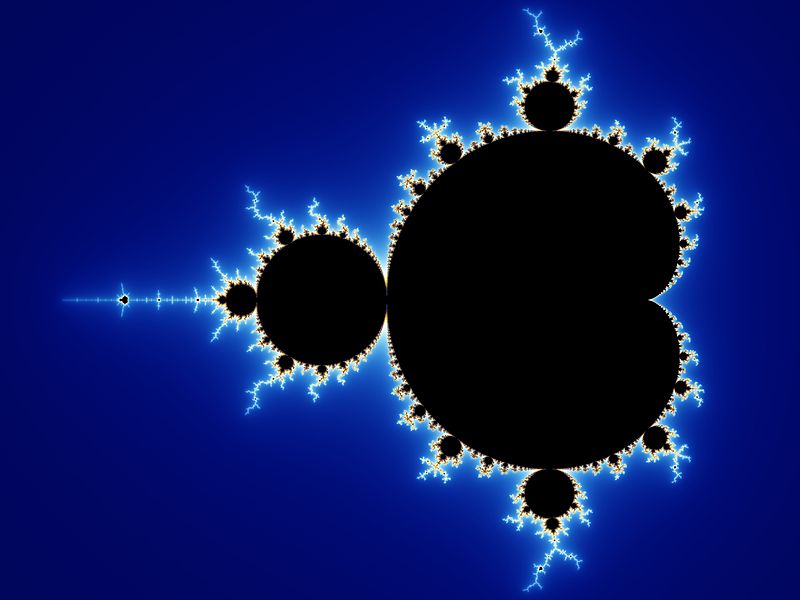
We've talked a number of times, in blog entries like How to Make a Universe, Dreaming of Electric Sheep, The Invariant Set, Nassim Haramein, and A 3D Sphere on a 4D Hypersphere, about how the concept of infinite recursion keeps coming up again and again, both in discussions of consciousness, and in discussions of the underlying structures of our universe. The Mandelbrot Set is a famous example of a fractal set which can be endlessly zoomed in on, continually revealing more and more detail, and the above image from wikipedia shows the initial starting state of a zoom sequence into this fascinating structure. Now take a look at this:

This computer-generated image is part of a stunning new exploration of the Mandelbrot Set where the underlying equations have been transformed to generate 3D objects. I invite you to go to this link:
http://www.skytopia.com/project/fractal/mandelbulb.html
and enjoy many more jaw-dropping examples of this exciting new process which really, I think, helps us to see how fractal recursion is such an important part of the natural structures of our world, and of the universe. Once you're done there, then go check out these stunning fractal creations my friend Chuck Salyers just pointed out to me:
http://205.243.100.155/frames/lichtenbergs.html

Enjoy the journey!

Rob Bryanton

Next - How to Time Travel

Friday, June 5, 2009

Nassim Haramein


A direct link to the above video is at http://www.youtube.com/watch?v=4OZj1XAjcTY

We've talked in previous blogs about fractals, sacred geometry, water and its connection to life and inspiration, and how the "zero" and the "ten" in my way of visualizing the dimensions are really two complimentary ways of looking at the same thing: perceiving the underlying perfectly balanced symmetry state that our universe or any other springs from. One thing I've remarked upon before is that the "zero", as a point, represents the push towards the infinitely small, and the "ten" represents the push towards the infinitely large, but both are part of the same continuum (and are represented as such in the graphic created for this project - the zero and ten are on a line, and the other dimensions are "outside" of that line). Within my way of visualizing the dimensions, then, the zero and ten are of indeterminate size, and the other dimensions represent ways of slicing up infinity to get to more specific subsets of reality, including a universe such as our own.

A number of people have remarked to me that physicist Nassim Haramein has a Unified Field Theory which seems to connect in some interesting ways to the ideas I've been talking about. If you're in a hurry, start listening to the video below at about 7:45, because pretty well everything up to that point is preamble. At 7:45 he begins to talk about there being much more to our reality than what we see around us, and that he (like me) had an intuition about this at the age of seven which he became fascinated with.


A direct link to the above video is at http://www.youtube.com/watch?v=pPgII_4ciFU

By the end of this first clip, you can see him starting to describe the same way of visualizing spatial dimensions which I talk about in my original animation, and as I've remarked previously in entries like We Start With a Point, A Point Within the Omniverse, and Aren't There Really 11 Dimensions?, this is known as the point-line-plane postulate. In the following video, you'll see that he says the first and second dimension don't really exist, and then he says by that logic the third dimension doesn't exist, since it's made out of things that don't exist!


A direct link to the above video is at http://www.youtube.com/watch?v=-TV3a09vFYI

To solve this quandary, he goes back to the zero that we start from, the point of indeterminate size, and posits that the fractal nature of our reality tells us that everything is constructed from points, each point recursively/infinitely embedded within all other points, and therefore all points are connected to each other. He tells us that his theories are now being peer-reviewed at several American universities.

He points out that this idea may seem similar to the theory of the big bang, which says our universe sprang from a "dot" the size of Planck's length. But in Nassim's theory, all "dots" contain the potential for a universe, because they are all connected together. In the following video he shows clips from a couple of movies: the opening sequence of "Contact", and the ending of "Men in Black", both of which give us graphic ways of visualizing a universe that is embedded in other universes. I've remarked elsewhere that the "universe embedded in a rose in an abandoned parking lot" idea from Stephen King's Dark Tower series is another interesting fictional portrayal of this recursive/fractal idea.

A direct link to the above video is at http://www.youtube.com/watch?v=kRWeyCfCE1M

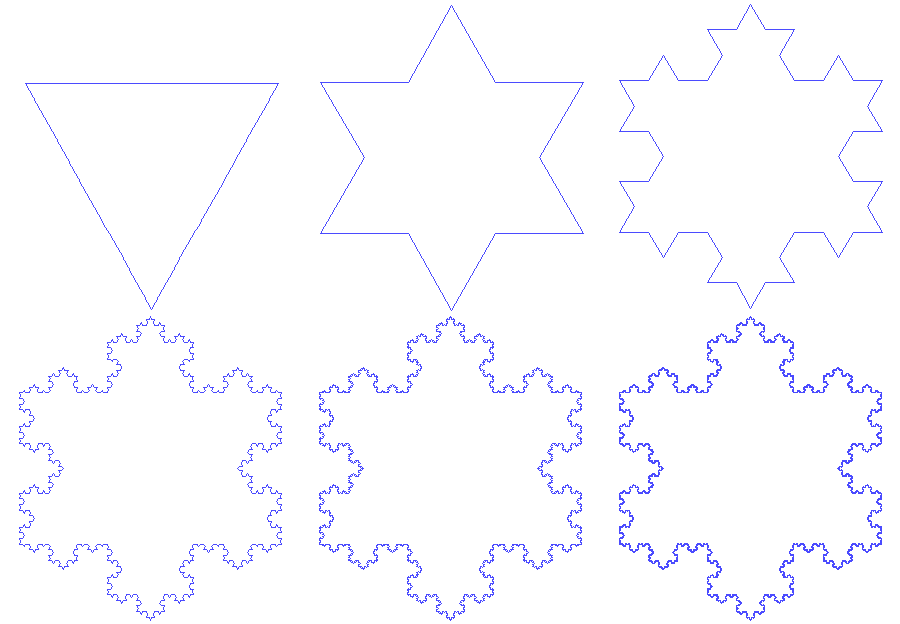
The universe is infinite. How do you fit infinity within a finite space? Fractals. In the above video he shows how this could possibly be imagined through infinite recursion, watch the video and you'll see what I mean. Or check out the following two animations from the wikipedia article on fractals: the object at the left is known as a Sierpinski Triangle, and to the right is a Koch Snowflake.

If you were to imagine drawing a circle on a piece of paper, then fitting either of these shapes within that circle, you would see a very similar idea to what he's talking about here. Although both of these animations only show the first ten steps or less, in both cases the process we are seeing could be repeated forever, as each new step proceeds down to a smaller scale than the one before. In the following video he continues this idea:

A direct link to the above video http://www.youtube.com/watch?v=s-RjjNgBDyk

.. and here's how he sums it up (I've edited him a bit here):

"Although I can place an infinite amount of triangles in a circle, I will never exceed the first boundary I made for myself. Never. I just showed you how infinity fits in a so-called finite space: because you can divide to infinity within a circle!

"What does that mean? Let me give an example for physics: we build faster and faster accelerators that cost billions of dollars, to get smaller and smaller. If we were to understand this principle of fractals, we would see very quickly that you can always keep dividing: so we would give up the search for some fundamental particle that's going to end the search. And we would start to understand that what we need to discover is the dynamic of the division, the dynamic of the quantization... rather than continuing to see how much further we can keep going down into infinity."
If you've followed him this far, you will now start to hear him say things about our connectedness, and our interface with reality that very strongly connects to the things I talk about regularly with my project. Here's one thing I want to make absolutely clear: Nassim is not promoting a worldview that comes from ten spatial dimensions, but he is promoting a very similar concept to what I portray as being the tenth dimension: an infinite "set of all possible states" that contains all possible expressions of matter and energy, all enfolded together into an underlying whole, a zero which is "full rather than empty" as Gevin Giorbran explained so well in Everything Forever. When you read blog entries like The Invariant Set, Imagining the Omniverse Addendum, Google and the Group Mind, Dreaming of Electric Sheep, and Why Do We Need More than 3 Dimensions?, you'll see fractals discussed from various approaches. The thing that we should all be clear about here is that fractals are often defined as having "non-integer" dimensions: and as you'll see if you read the wikipedia article on Hausdorff Dimensions, that Sierpinski fractal (which we looked at above) has a dimensionality of approximately 1.585. By the time we are imagining reality coming from ten dimensions but when those dimensions can contain any number of "fractional" dimensions, it really does seem like my description of the ten dimensions allows for us to include an infinite number of vectors within that set: as Nassim says, this is another way of thinking about how an infinite set could be contained within a so-called finite space.

The word "multiverse" has come to have multiple definitions. When someone uses that word, are they talking about the set of parallel universe outcomes for our own universe as described by Everett's Many Worlds Interpretation, or are they talking about the ten to the power of 500 universes with different initial conditions from our own universe which are predicted by string theory? Often, the definition of this word depends upon who you are talking to. Because my way of visualizing the dimensions provides a way to enfold and relate both of those concepts into a hierarchy, I have come to prefer to use the omniverse as the word that combines all of those possible states into one.

If you'd like to hear more from Nassim Haramein, please go to this youtube channel, iiisis2, where all forty-five videos that make up the presentation we're looking at here are posted.

Enjoy the journey!

Rob Bryanton

Next: Augmented Reality - 10thdim Music Videos

Thursday, April 2, 2009

The Invariant Set


A direct link to the above video is at http://www.youtube.com/watch?v=nrIhi2urqJ0

Gevin Giorbran called it SOAPS - the "set of all possible states". For our universe, I called it "a point in the seventh dimension", and for the omniverse of all possible universes and information patterns, I called it the tenth dimension in its unobserved state of perfectly enfolded symmetry. Now, here's some excerpts from an article in the March 30 2009 issue of New Scientist Magazine that explores a concept from physicist Tim Palmer called "The Invariant Set". I would say we're all talking about the same thing: viewing the universe from a timeless perspective.

Can fractals make sense of the quantum world?
New Scientist Magazine, 30 March 2009
by Mark Buchanan

QUANTUM theory just seems too weird to believe. Particles can be in more than one place at a time. They don't exist until you measure them. Spookier still, they can even stay in touch when they are separated by great distances.

...what if there were a way of showing how quantum theory might emerge from a deeper level of non-weird physics?

If you listen to physicist Tim Palmer, it begins to sound plausible. What has been missing, he argues, are some key ideas from an area of science that most quantum physicists have ignored: the science of fractals, those intricate patterns found in everything from fractured surfaces to oceanic flows (see What is a fractal?).

...Palmer's ideas begin with gravity. The force that makes apples fall and holds planets in their orbit is also the only fundamental physical process capable of destroying information. It works like this: the hot gas and plasma making up a star contain an enormous amount of information locked in the atomic states of a huge number of particles. If the star collapses under its own gravity to form a black hole, most of the atoms are sucked in, resulting in almost all of that detailed information vanishing. Instead, the black hole can be described completely using just three quantities - its mass, angular momentum and electric charge.

Many physicists accept this view, but Palmer thinks they haven't pursued its implications far enough. As a system loses information, the number of states you need to describe it diminishes. Wait long enough and you will find that the system reaches a point where no more states can be lost. In mathematical terms, this special subset of states is known as an invariant set. Once a state lies in this subset, it stays in it forever.

A simple way of thinking about it is to imagine a swinging pendulum that slows down due to friction before eventually coming to a complete standstill. Here the invariant set is the one that describes the pendulum at rest.

Because black holes destroy information, Palmer suggests that the universe has an invariant set too, though it is far more complicated than the pendulum.

Complex systems are affected by chaos, which means that their behaviour can be influenced greatly by tiny changes. According to mathematics, the invariant set of a chaotic system is a fractal.

Fractal invariant sets have unusual geometric properties. If you plotted one on a map it would trace out the same intricate structure as a coastline. Zoom in on it and you would find more and more detail, with the patterns looking similar to the original unzoomed image.

Gravity and mathematics alone, Palmer suggests, imply that the invariant set of the universe should have a similarly intricate structure, and that the universe is trapped forever in this subset of all possible states. This might help to explain why the universe at the quantum level seems so bizarre.

...The key is the invariant set. According to Palmer's hypothesis, the invariant set contains all the physically realistic states of the universe. So any state that isn't part of the invariant set cannot physically exist.

...In a paper submitted to the journal Proceedings of the Royal Society A, he shows how the basic idea can account for quantum uncertainty, contextuality and other quantum puzzles (www.arxiv.org/abs/0812.1148).
I've talked before about fractals and recursion, and how those relate to this way of visualizing reality. While Dr. Palmer is not talking about extra dimensions with his theory, it's very easy to use his "Invariant Set" concept in the context of my project: in entries like The Fifth Dimension Isn't Magic, Our Non-Local Universe, and Aren't There Really 11 Dimensions? I've talked about what's possible and impossible within this way of viewing reality, and how the logical progression from one spatial dimension to the next that I'm portraying gives us a way to see how the universe, the multiverse, and the omniverse are related to each other: each is a subset of the next, and all make more sense when we learn to view them from the perspective where (as Einstein liked to say) "the distinction between past, present, and future is meaningless".

I mentioned that with my system, I would say our own universe's "invariant set" is locked in at the seventh dimension: this can also be connected to the string theory idea that our 3D universe is constrained by a seventh-dimensional brane. Now, here's a lovely video by artist Charles Gilchrist that shows a connection between the number seven, fractals, infinite recursion, timelessness, and the forms of sacred geometry.

A direct link to the above video is at http://www.youtube.com/watch?v=sJ9OlPsndVs

Enjoy the journey!

Rob Bryanton

Edit: Here's a link to a story on Tim Palmer's Invariant Set Postulate published August 17th 2009 at physorg.com.

Next: Illusions and Reality

Saturday, March 28, 2009

Imagining the Omniverse - Addendum

A direct link to the above video is at https://www.youtube.com/watch?v=_MptYznkv14

Last blog, we talked about the scientific fact that our universe is non-local: since this project is about imagining the patterns that exist outside of the "now" of this moment in spacetime, non-locality is a key idea to the puzzle of thinking about our universe from a timeless perspective.

Here's two of my favorite video blogs from a few months back, Dreaming of Electric Sheep, and Imagining the Omniverse.


A direct link to the above video is at http://www.youtube.com/watch?v=ALkDA0mmZIA


A direct link to the above video is at http://www.youtube.com/watch?v=V6D3CgF8_qk

With those two videos, we used an amazing networked screen saver created by Scott Draves, called Electric Sheep. We used the program's fluid, fractal, recursive images as a visual aid to help us imagine how the omniverse could contain all these random fluctuations, and yet within all that randomness and noise a selection pattern could arise which would view that pattern of information from just the right angle, and voilà, the wave function representing a spacetime universe and all of its probabilistic outcomes could spring into being: not with a big bang, but with a causal tree that exists timelessly, with all possible timelines already existing as per Everett's Many Worlds Interpretation. This means that what looks from our perspective to be the "big bang", "now", and the "end of the universe" are all already-existing subsets of the underlying symmetry state which I've been calling The Omniverse.

Did I lose you there? Okay then, try this. Here's a delicious little game that was just pointed out to me by guidewire.

https://www.crazygames.com/game/coign-of-vantage
The game comes from a company called Bobblebrook, kudos to them. In the same way that thinking about What a Flatlander Would Really See, or how Time is a Direction, or how our Holographic Universe of 4D spacetime is really a shadow of a fifth dimensional pattern (which relates to discussions we've had in Hypercubes and Plato's Cave, Flatlanders On a Line and Aren't There Really 11 Dimensions?), I would say that this game from Bobblebrook can be used to give us an intuitive way of visualizing how what looks like randomness from one perspective could be, from another perspective, a selection pattern which chose our universe from out of the Omniverse.

And not only that, the game is fun to play!

Enjoy the journey,

Rob Bryanton

Next: Google Suggestions - March 09 Update

Saturday, December 27, 2008

Google and the Group Mind


A direct link to the above video is at http://www.youtube.com/watch?v=fbblBvi65Ok


A direct link to this video is at http://ca.youtube.com/watch?v=g94iWT2SIwI

With more and more people becoming connected to each other through the internet, not just superficially but through deeper and wider connections of shared interest and shared experience across the planet, are we witnessing the beginnings of a shift to a "group mind"? Could we be approaching some sort of global shift in consciousness, and could patterns that reside within the extra dimensions be a part of that process? That's what I'd like to talk about with this final entry of 2008.

Google recently published their 2008 Zeitgeist report, an interesting way to look back upon the year: http://www.google.com/intl/en/press/zeitgeist2008/index.html. I've been doing some google tracking of my own this year, keeping track of what words come up as the top suggestions for each single letter of the alphabet in the Google toolbar's results for the past twelve months: you can see the full list by clicking here, or click here for the report I created half way through the year on that list.

Two 10th Anniversaries in 2008
2008 was the tenth anniversary of the surprising announcement that the expansion of our universe is accelerating, an idea that seems counter-intuitive: if our universe started from high energy/high order (the big bang) and is moving towards low energy/low order (maximum entropy), that implies the image of a clockwork toy that's winding down, and that image doesn't fit with a universe of accelerating expansion.

2008 was also the tenth anniversary of Google, the search engine that has changed the way we interact with information more than any other invention in the history of mankind. "Don't be evil" is their unofficial motto, and that's a great one: the power of Google to inform and guide the general public's impression of what ideas are important and what ideas are popular is immense, and the on-going war from get-rich-quick scammers and spammers who try to manipulate Google's search results for their own profit is a huge part of that story.

Google is all about information, and this project is all about imagining the underlying information that becomes our reality. This is one of the things I talk about a lot with my way of visualizing reality: the idea from quantum physics experts like Seth Lloyd and Anton Zeilinger that information equals reality. With recent entries like Dreaming of Electric Sheep and Imagining the Omniverse, we've been playing with ways of imagining what it would be like to be an observer within the extra dimensions, moving our point of view around until the data aligns in a way that allows us to see a universe such as ours. This is an entertaining mind game, but it also speaks to the basic ideas any of us are asking when we wonder where our reality comes from: if information really equals reality, then absolutely everything about the universe we see around us can be thought of as being the shadows of higher-dimensional selection patterns, an idea that connects as much to cosmology as it does to spirituality. Subatomic particles, fractals, sacred geometry, life, consciousness, and our observed universe of seventy sextillion stars are all patterns that result from the flip-book of third-dimensional "now"s that we are stringing together from one frame of planck time after another. I've talked before about how these ideas can easily related to John Wheeler and Digital Physics, and I've also talked about how this relates to the connections of spirit and belief that tie us all together around the world.

Information and the Google Universe
What else has changed? For well over two years now, typing "tenth dimension" into Google and pushing "I'm Feeling Lucky" takes you to my project: something that I still find amazing and humbling. As our world is shifting, and the tenth dimension meme has continued to make its way through the world, are people's approaches to these ideas changing as well? Early this month the tenth dimension animation vaulted to popularity through Digg and Youtube once again, with almost 4500 diggs and 100,000 youtube views in a day - and while a certain amount of naysayers were there as usual to respond to the project's newfound popularity, there also seemed to be a substantially larger number of people who weren't just saying "that blew my mind", they were also giving the impression that they now understand the logic of this new way of thinking about time and space. The idea that our reality comes from a fifth-dimensional probability space, for instance, has definitely gained ground since I began promoting the idea in 2006. So, after two and half years of people talking and thinking about this set of ideas, there appear to be many more within the general public willing to adopt this shift in thinking about the processes that create our reality.

As things shift "now", so do the future - and the past
It seems self-evident that the possible future paths available to us change based upon the events happening at this very instant: but what we're talking about here is even more powerful than that. In The Past is an Illusion, I talked about the serious idea from quantum physics that current observations could also change things about the past; and a recent article in New Scientist magazine talks about quantum physics experiments that prove there are things about future measurements which can "leak" back into the present. In my blog a year ago, I suggested that the feeling that we live in times that are accelerating towards something larger, as a result of the rapidly accelerating meme-space we live in, might be connected to the same higher-dimensional effects that are causing our universe to accelerate its expansion as well: I believe both are eventually going to be shown to be the result and the proof of extra dimensions in the information that is creating our reality.

But where are we going with all this? One of the conclusions I've tried to work us towards over the past year, blog by blog and idea by idea, is that there is strong evidence out there already that we are all connected together in ways that many of us are only beginning to understand. To finish, here are the video versions of two of my favorite blog entries that talk about this conclusion: "I Know You, You Know Me" and "You are Me and We are All Together".

I Know You, You Know Me

A direct link to this video is at http://ca.youtube.com/watch?v=lfq5kKkA6pw

You are Me and We are All Together

A direct link to this video is at http://ca.youtube.com/watch?v=GbGAPR70tTY

Enjoy the journey,

Rob Bryanton

Next - Top 100 Tenth Dimension Blogs, 2008 Report

Monday, November 24, 2008

Dreaming of Electric Sheep


A direct link to the above video is at http://ca.youtube.com/watch?v=ALkDA0mmZIA

"Life is but a dream"
- English Nursery Rhyme, Row, Row, Row Your Boat
Ever hear of electricsheep.org? Let me quote from the website:
Electric Sheep is a free, open source screen saver created by Scott Draves. It's run by thousands of people all over the world, and can be installed on any ordinary PC or Mac. When these computers "sleep", the screen saver comes on and the computers communicate with each other by the internet to share the work of creating morphing abstract animations known as "sheep". The result is a collective "android dream", an homage to Philip K. Dick's novel Do Androids Dream of Electric Sheep?.

Here's a YouTube video by Scott Draves called "165 Star Oasis" which uses Electric Sheep images. If you'd like to buy a DVD of Scott's stunning animated imagery, click here.

A direct link to the above video is at http://ca.youtube.com/watch?v=JcOM-ZSabXQ

With this blog entry and the next one, we're going to talk about trying to visualize moving around within the place where, as quantum physicists like Zeilinger and Lloyd tell us, "Information Equals Reality": this is the place we were just trying to think about in "The Big Bang and the Big Pie". Now - try watching some of these Electric Sheep animations and imagine that it's you, as a free-floating observer, moving your viewpoint through this incomprehensibly large data set that we've been calling the omniverse. Try to visualize how a change in trajectory or reference frame can take what seems like noise and chaos, and cause shifting shapes and patterns to come into and move out of focus, and sometimes cause the data to coalesce into a very specific stable pattern. We're thinking here about how it's not the data that's changing, it's that you as an observer are changing the way you view different parts of the data. In that sense, what we're imagining ourselves doing is similar to Mandelbrot set animations like this one which we looked at in a previous blog, where we're zooming in on a fractal set, revealing more and more detail as we keep navigating through the data.

From the background of timelessness, where every possible universe and pattern exists simultaneously, it's this kind of shift in focus that would be how something as beautiful and complex as our universe can be distilled from the seemingly random "white noise" or "white light" of all possibilities, which Gevin Giorbran called the "Set Of All Possible States", and which in my way of visualizing is the tenth dimension. We've also been talking recently about how this "white light" of all possible states adds up to a big beautiful zero, which is not empty, but full, of all the other possible patterns that can result from the breaking of that underlying symmetry.

In my recent entry "Why Stop at Ten Dimensions?" we talked about the mind-blowing idea that if every dimension extends to infinity within the directions available for that particular dimension, then there's a way to think about how any point within any dimension is directly at the center - which also means, then, that if our universe is of infinite size, no matter where we are in the universe we're right at the center! This can also be related to the idea that, for each of us, our consciousness is a point moving within and connected to the entire wave function for our universe: we touched on this in "You are Me and We are All Together". But this seemingly crazy idea that we're each at the center of our own universe still has to find a way to be connected to the idea that our universe springs from a breaking of the symmetry that is found within the enfolded symmetry state that our universe or any other universe springs from.

Thinking about these Electric Sheep animations, then, as a visual metaphor for the idea that Information Equals Reality leads to this: once we arrive at one of these more coherent structures, we're looking at something that can be described as arising from a selection pattern - and that selection pattern can be thought of as being a naturally arising organizing force that prefers one kind of universe over another (and as we discussed in Tom Huston Interviews Rob Bryanton, the selection pattern that chose our universe from out of the omniverse has many different names depending upon who you talk to and what their own frame of reference might be). A selection pattern that prefers destruction over order, for instance, might select from a part of the omniverse that has a very low value for gravity, creating a universe that immediately flies apart into nothingness. Elsewhere within the omniverse, there could be a selection pattern that prefers stability over creativity. That particular pattern might select a universe with high entropy right from its beginning, where nothing much changes over the life of that particular universe (and physicist Lisa Randall explores very similar ideas about different regions of the multiverse establishing different universes with different constants in her book Warped Passages).

Each of those universes has a spacetime tree, a wave function of possible outcomes, and each of those universes and many many more exist within different regions of the multiverse, and all of those different regions considered at once are "outside the system" in the enfolded symmetry that we're navigating within.

How can what looks like randomness generate something as wonderful and complex as the universe we see around us? This is the idea that Gevin Giorbran explained so well in his book "Everything Forever - Learning to See Timelessness". There are patterns that arise as we navigate through all of the possibilities of the omniverse - and those patterns are really just ways of organizing the information that could become our reality or any other. To understand how these patterns could arise from the underlying state that exists "outside" of our time and space, we only need to think about two words -

grouping and symmetry.

If I were to toss a coin a hundred times, and get heads the first 50 throws, and tails the second 50 throws, I would have demonstrated perfect grouping order. If my results instead had happened to be heads, tails, heads, tails, alternating back and forth for all 100 throws, I would have achieved perfect symmetry order. Both of these scenarios are, of course, extremely unlikely to occur. What is much, much, more likely to happen is that I would get a random assortment of heads and tails - but if I were to look more closely at the entire list of results, I'd still find little pockets of grouping order, where I might have thrown heads three times, then tails three times; and I'd find little pockets of symmetry order where I might have thrown heads, tails, heads, tails, heads, tails at some point within my 100 throws. Around these pockets of grouping and symmetry order, I'd see regions with much more random and disorganized looking results.

In this way, even though we know that the background state of enfolded symmetry exists (just as the possibility of throwing heads 50 times then tails 50 times exists), the natural process is for that background to be continually bubbling away, with random fluctuations creating particles and energy, apparently out of nothing - and, like throwing dice, we know that there are going to be parts of the resulting outcomes that are inconsequential noise, a chaotic quantum sea of tiny outcomes that don't amount to much at all. As creatures living within an ordered universe, those aren't the parts of the omniverse that interest us - we are drawn towards patterns, and the idea that our universe is a pattern that just "happened", regardless of how you describe what caused such an outcome to occur, is what fascinates us. It's what we're good at - seeing the patterns within the noise. We're going to talk about our natural abilities to see patterns within noise in another blog entry coming up.

Finally, one of the things I like about these generated images from Electric Sheep is the recurring use of fractals, helix patterns, and waves, and the "organic" way these elements are constantly evolving as they're integrated into the animation - anyone familiar with the concepts of sacred geometry, biology, or cosmology is familiar with the importance of such patterns. With this project, I've been insisting that our observed reality is really just shadows of higher dimensional shapes and oscillations, and we are seeing those shadows down here in spacetime as we observe our universe and the amazing world we're living in right at this very instant.

Enjoy the journey,

Rob Bryanton

P.S. - Here's a short documentary from Scott Draves about his Electric Sheep projects, Scott is definitely thinking some thoughts that are easily related to my above discussion:

A direct link to the above video is at http://blip.tv/file/1233576/

P.P.S - The first three chapters of Gevin Giorbran's book can be previewed here, or purchased here, or a downloadable pdf can be purchased here. Everything Forever is also available from online booksellers like Amazon.

Next: Imagining the Omniverse

Saturday, September 27, 2008

Why Do We Need More Than 3 Dimensions?


A direct link to this video is at http://www.youtube.com/watch?v=kzlRuygMGHY

Here's another way of describing the Imagining the Tenth Dimension visualization that answers a commonly asked question: when we look around we see a three-dimensional world. Why do we need to think about any more than that? Isn't every dimension past those first three unnecessary? This time around we'll discuss that question.

So. Why do we need more than 3 dimensions? Because the third dimension is filled by the universe in its current state. We need to add a fourth dimension to get to the universe in some other state. The combination of these four dimensions is commonly called "space-time", but this project says that "time" is just one of the possible directions in the fourth dimension, and the accepted concept of time-reversal symmetry shows us that time's opposite direction is just as scientifically valid.

Then why do we need more than 4 dimensions? Because the fourth dimension is filled by the time line (or "world line" as physicists sometimes call it) representing our universe from its beginning to its end. We need to add a fifth dimension to get to the bush-like branching structure of possible futures and pasts that extend out from our universe in its current state. After spending two years pondering the idea of our observed reality being defined in five dimensions, Albert Einstein come out in full support of Theodor Kaluza's startling proof of that idea way back in 1921. This project uses its own logic to arrive at the same conclusion: our observed reality comes from the fifth dimension.

Then why do need more than 5 dimensions? Because the fifth dimension is filled by the world lines that are logically compatible with our universe in its current state, right from its beginning to its end. We need to add a sixth dimension to get to all of the events that physicists tell us are part of the over-all wave function for our universe but which are so unlikely they take longer than the beginning to the end of our universe to occur. This includes the version where one of us pops out of existence right now and reappears on the moon, and it also includes the version where it's 2008 and Madeleine L'Engle (the author of one of my favorite books from childhood, "A Wrinkle in Time") is still alive. A theory devised by German physicist Burkhard Heim was recently brought to my attention, and the original formulation of that theory was based on the idea of our four dimensions of spacetime being augmented by two more "timelike dimensions". To be clear, Heim Theory now has extended versions created by his associates which postulate 8 and even 12 dimensions, but as we discussed in a postscript to my blog entry "Time in 3 Dimensions" the idea of a scientific theory based upon dimensions four through six as being different parts of a wave function representing "time" in all of its possible expressions seems like a noteworthy connection for further exploration.

Okay. Why, then, do we need more than 6 dimensions? Because the sixth dimension is filled by all the world lines for all possible versions of our universe. We need to add a seventh dimension to get to the other universes that are completely decoherent to our own, that have a completely different fine structure constant and initial conditions. Once we get to one of those other universes, each will have its own unique expression within the first six dimensions, filling those six dimensions up with their own unique wave function patterns which will be completely inaccessible and decoherent to our own universe's wave function - much like tuning in a radio station, all of those other patterns continue to exist out there within timelessness, but each universe will be tuned into their own "channel", their own starting/ending position within the omniverse that creates their unique patterns in the dimensions below.

Then why do we need more than 7 dimensions? Because the 7th dimension is filled by all of the possible universes that, like our own universe, have locked-in fine structure constants. There are even more exotic universes possible, though, and that would be those strange and unlikely universes built from oscillating or gradually changing fine structure constants. In that sense, the eighth dimension can become like "time" for the seventh dimension: much as the fourth dimension gives the third dimension a way to change from one state to another, the eighth dimension can give a way for a point within the seventh dimension to change to (or within) different states. Garrett Lisi's E8 rotation also shows some interesting connections in that regard, as it appears an 8-dimensional geometry may be what provides an underlying structure that defines all possible subatomic particles for the universe we are in.

Then why do we need more than 8 dimensions? Because the eighth dimension is filled by all the possible physical expressions of matter and energy that could ever be expressed. We need to add a ninth dimension to get to the organizing patterns in the information that cannot be expressed as matter or energy, and the patterns that could become a reality but which exist only as potentials. Quantum physicists sometimes talk about a continuously burbling "quantum foam"as being the underlying structure for all reality, and that would be another way of thinking about the ninth dimension. This project has called those patterns that spring into existence in the ninth dimension the "big-picture memes" that can be used to define or select one pattern over another in the dimensions below.

Then why do we need more than 9 dimensions? Because the ninth dimension is filled by all of the organizing patterns and random fluctuations that could or could not become universes or coherent structures of any kind in the dimensions below. We need to add a tenth dimension to get to the enfolded symmetry state where all of those potentials are summed together and balance each other out, which gives us a logical and natural way to understand where our universe or any other universe or any other organizing pattern naturally comes from. In that sense, the tenth dimension is the Omniverse, or what Gevin Giorbran (in his acclaimed book Everything Forever) referred to as the Set of All Possible States for our universe, or for any other universe. As we discussed in my blog entry Time in Either Direction, physicists like Sean M. Carroll have shown us how this underlying symmetry state can be used to imagine how our universe (or any other universe) is really just a temporary deviation away from that perfectly balanced symmetry that exists both "before" the big bang, and "after" the end of the universe: a return to enfolded symmetry, the absolute zero that our universe's accelerated expansion is now moving us towards more and more quickly.

In entries like Hypercubes and Plato's Cave, we've talked about how the reality that we are witnessing down here in spacetime can be thought of as the shadows of higher dimensional shapes and patterns. As we've discussed here today, we can see how we move from the very general choices that are made from a starting point in the highest dimensions. Then, we can see how the patterns and shapes of each dimension below brings the shadows of those patterns into more and more specific focus, until we arrive at the sharply delineated reality which is the beautiful 3D universe we are witnessing in each quantum frame, one planck length after another. Fractals and helix shapes of the natural world, the universe as a hologram, the Poincaré Theorem's proof that our universe is the 3D surface of a 4D hypersphere, the Deutsch team's proof of the bush-like branching structure of parallel universes created through chance and choice being equivalent to the quantum wave function... these ideas and many more can be tied into this way of visualizing reality. And when you add in the mysteries of how consciousness, memes and spirit are also part of the specific observation of our 3D reality, the "now" that each of us is uniquely traveling within at this very instant, you have arrived at a very big idea indeed!

Why do we need more than 3 dimensions? To hold all of those possibilities. 3 dimensions are simply not big enough to hold the timeless whole of enfolded symmetry that our reality ultimately comes from.

Enjoy the journey,

Rob Bryanton

Next: The Omniverse Almanac

Sunday, November 18, 2007

Tens, Google and the Expanding Universe

Are we approaching some sort of global shift in consciousness, and could that be triggered from higher dimensions?

2008 will be the tenth anniversary of the surprising announcement that the expansion of our universe is accelerating, an idea that seems counter-intuitive: if our universe started from high energy/high order (the big bang) and is moving towards low energy/low order (maximum entropy), that implies the image of a clockwork toy that is winding down, and that image does not fit with a universe of accelerating expansion.

This month's Scientific American features a great article about "branes" and how the accelerating expansion of the universe may be proof of the existence of higher dimensions (I propose this as a possible explanation in my book as well). The article, by Cliff Burgess and Fernando Quevedo, is called "The Great Cosmic Roller-Coaster Ride": please check it out.

2008 is also the tenth anniversary of Google, the search engine that has changed the way we interact with information more than any other invention in the history of mankind. "Don't be evil" is their unofficial motto, and that's a great one: the power of Google to inform and guide the general public's impression of what ideas are important and what ideas are popular is immense, and the on-going war from get-rich-quick scammers and spammers who try to manipulate Google's search results for their own profit is a huge part of that story.

The Imagining the Tenth Dimension way of visualizing reality can be used to tie all these ideas together. "Information Equals Reality" has been the prime focus for my blog entries in the last few weeks: this basic idea from quantum physics shows us how "everything fits together", and the desire to find a unity within a diverse range of ideas is what this project is all about.

If Information Equals Reality, then absolutely everything about our reality can be thought of as patterns and shapes in the information that is the underlying fabric of quantum indeterminacy. Subatomic particles, fractals, life, consciousness, and our observed universe are all patterns that result from the flip-book of third-dimensional "now"s that we are stringing together from one frame of planck time after another.

In the Imagining the Tenth Dimension animation, sound is an important part of the information being conveyed: for instance, no matter what dimension we are exploring there is the arrow sound effect representing a particular point, a scrape indicating lines being constructed from joining one point to another, and the card-riffling sound effect to show that anything we think of as a continuous line is actually being constructed one point at a time, if we can only look close enough.

Burgess and Quevedo's article explains how our universe might be the result of the interactions of a three-dimensional brane with a seven-dimensional brane, with the ends of certain superstrings constrained by branes they are sliding around within. To use my flipbook analogy, then, we can see how the illusion of continuous reality that we are experiencing is actually a series of 3D states for our 3D universe interacting with a 3D brane, and each observed state is one planck length away from the next: each observed state can be thought of as a page in a gigantic cosmic flipbook. The flipbook from the big bang to "now" appears to be one specific set of flipbook pages (which we think of as the 4D line of time), but each "next available now" page that could possibly be selected for our flipbook comes from a fifth dimensional probability space, and the fifth dimension is where Kaluza proved our reality is defined. Every parallel universe that could have resulted from our big bang, whether it is observed or not, exists as a potential "flipbook" in the sixth dimension, and all of those possible states are locked together by the seventh-dimensional brane our universe is also interacting with.

The idea I advance of our universe's basic physical laws being a result of our specific "location" in the multiverse (as a "point" in the seventh dimension, or as a result of our interaction with a 7D brane), then, can be tied into this concept. As usual, though, I will take pains here to caution readers that I am not claiming my way of visualizing the dimensions is the explanation for string theory, any more than it is the explanation of Kabbalah, zero-point field theory, Japanese anime and videogame plots, metaphysics, or any of the other diverse range of belief systems which fans of the tenth dimension project keep pointing me towards as having interesting resonances with my way of visualizing reality.

From moment to moment, day to day, Google has been tracking the information that makes up our reality for almost ten years. Ideas that can be tracked across time and space are known as "memes", and physical objects that can be tracked across time and space are known as "spimes": which means that the flipbook of "now"s we have imagined from the big bang to today can be thought of as a spime that represents the story of our current universe from its inception... and that idea is a very powerful meme.

I've always marveled at the audacity of Google's "I'm Feeling Lucky" button: the idea that out of all the information in the world, Google might be able to show you the very best link of all still seems like mysterious magic to me, and I admit to never wanting to use that button because I like to have choices. Still, the Google toolbar's Suggestions window is a great example of the accelerating information space we live in now: try typing in just the letters of the alphabet one after another into that window, and read the top ten suggestions (there's that number again!) that come up for each. This gives you a snapshot in time of what is important, what is talked about, what is the dominant set of memes within our culture right now. Both memes and spimes are multi-dimensional shapes, each with a beginning and an ending someplace out there in the timeless multiverse.

The feeling that we live in times that are accelerating towards something larger, as a result of the rapidly accelerating meme-space we live in, might be connected to the same higher-dimensional effects that are causing our universe to accelerate its expansion as well: I believe both are eventually going to be shown to be the result and the proof of higher dimensions in the information that is creating our reality.

Enjoy the journey,

Rob Bryanton

Wednesday, July 25, 2007

Everything Fits Together in the Zero at the End

The poll is now ended and the results are in. 33% per cent say Imagining the Tenth Dimension's about physics, 20% say it's about philosophy, and 46% picked my personal fave, "all of the above". Fantastic! Great to know how many people are following the direction we're headed here.

Everything fits together in the zero physicists are now proving we are heading towards. Understanding the relationship between probability space and the physical realities each of us have come to exist within has some very profound implications... and the moral questions raised are not always comfortable ones to deal with.

There is good news at the end though: the fact you are here now means there are parts of you that are here forever, in the timelessness that most physicists agree our reality is carved out from. I have been using Julian Jaynes's marvelous ideas to show an important insight into all of this: the trick is to tune into those integrated bicameral-mind moments where you get your narrator voice to shut up for a sec and just "be". That's when you become more productive, more capable, and more at peace with the observer that is "you" within the fifth dimension. You also become more open to those forces from the future that are warning you about what's coming right at this very instant. Why is a troubled, negative mind in constant chaotic turmoil? And why, on the other hand, are those zen moments of ancient wisdom so clearly tied into the positive side of all this? Once you enter the mindset of timelessness, you are centred back on the unity of the observer and the observed, and you connect to the future that already exists for all of us as the goal we know we are headed towards.

Is this wacky set of ideas actually reflected in hard science? The jury's still out, but that's where I believe we're headed. Does this make it any less about eternal truths than any other piece of art or Joseph-Cambpell-sized meme-shapes in the higher dimensions? If reality and information are interchangeable concepts, then there is no reason that both ways of thinking shouldn't align out there in the meme-space and spime-space that are both so clearly part of that duality of information/reality we exist within.

Does that make you, or me, an idea in the Mind of God? Learning not to be afraid of that idea has been a hard journey for twentieth-century science. Think of the "wacky" ideas from the last hundred years which physics and cosmology have come to accept. Think of how many of these have been portrayed as "too strange to imagine" by the general press. Why is it not public knowledge that Kaluza proved and Einstein eventually agreed that our reality exists in the fifth, not the fourth dimension? Why is the zero-one-both state of subatomic particles portrayed as being so unimaginable, when seeing those three choices as a positive spin and a negative spin pushing against each other in the fifth dimension (the place where both can exist simultaneously) is really not that hard to do?

Why has there not been more made of the accelerated-expansion universe that Gevin Giorbran predicted years before it was observed? Because there are spiritual ramifications to this idea, and historically there has been an ingrained mistrust of anything spiritual amongst many of science's established edifices. Thankfully, that era is coming to an end now, if only because there are scientists now willing to accept that both viewpoints can co-exist without either denying the validity of the other.

Our universe is not without hope for the future, because our ultimate end is not a meaningless heat death. Attitude affects outcome, and being interested in "what happens next" is key. As negative forces pushing against positive forces create patterns in possibility space, grouping and symmetry give us fractals and fads, great and small truths, and life itself within the multiverse.

In fact, that future is what draws each of us forward right now: towards symmetry, the perfect balance, the beautiful but once much-maligned zero. If you've got all that straight in your head, then welcome to the tenth dimension! We've been waiting for you.

Enjoy the journey,

Rob Bryanton

Tenth Dimension Vlog playlist