A direct link to the above video is at http://www.youtube.com/watch?v=eTDdLFzlHVQ
I've talked before about Marcin Mały, who teaches English for Information Technology at the Technical University of Cracow, Faculty of Mechanical Engineering in Poland. Marcin supervised this new Polish translation by student Grzegorz Grybisz of an entry from my video blog that goes all the way back December 2007: "You Can't Get There From Here". Marcin has some other translations coming from some of his other students in the next while, I'm so grateful to him and his team for taking on this task and helping to introduce other people around the world to my "new way of thinking about time and space".
Next time, we're going to talk about the enthusiastic viewers over at YouTube who have made my channel there such a success - I'm currently at well over three million total views of my videos on YouTube, and the channel has well over 11,000 subscribers. I see a constant stream of comments from viewers there on the different videos - so next time we're going to look at some of the comments posted on my new video for Seeing Time, Feeling Colors, Tasting Light at YouTube.
Enjoy the journey,
Rob Bryanton
Friday, July 9, 2010
Polish Subtitles - You Can't Get There From Here

Monday, July 5, 2010
Rift

Here’s a completely shameless and self-serving proposition: “Imagining the Tenth Dimension” should be required reading for any writers planning on creating a story about time travel. The basic concepts from chapter one give a framework for how time can be manipulated, or moved within, and there are many ideas within the chapters that follow which could be excellent jumping off points for new fiction. Whether anyone chooses to play by these rules will, of course, be up to them (and Audrey Niffenegger would be an example of someone who probably would have chosen not to follow this book’s line of reasoning even if she had been shown it). Nonetheless, there could well be moments within the telling of a new time travel story where this book’s ideas could provide some useful input.Time travel is, of course, only one aspect of what we're talking about with this project - the parallel universes of Everett's Many Worlds, the multiverse landscape of string theory and cosmology, the 'spooky' world of quantum mechanics, and the information patterns that connect us all together in ways unseen are all part of this way of visualizing where our reality comes from.
A couple of weeks ago I received the following email from Blake Maloof:
Dear Rob,If you check out Blake's website, you'll see that he's a talented artist and has some interesting game designs already in the works. By all means, Blake, I wish you every success and would be happy to stay in touch as your work progresses. Here's a trailer for the game Blake and his team at the college put together, which went on to win Best Digital Game Prototype and Best of Show in Savannah College of Art and Design's annual Entellechy game design awards: "Rift".
I've been watching your videos for a few years now, and they have been very inspiring in the way that I perceive my existence and the universe. I just recently graduated from Savannah College of Art and Design with a degree in game design. For my final project I gathered a team to develop a prototype for a game I have been designing called Rift. The story involves beings from a parallel dimension experimenting with trans-dimensional manipulation. An experiment goes terribly wrong and ruptures the fabric of reality, causing dimensions in that location in space to bleed together and overlap. One of the affected dimensions was our own, located outside the house of a young boy. The player takes the role of this boy as he witnesses his home begin to collapse and reality as he knows it begin to merge with other dimensions.
I love the theories you propose as a way of imagining the complex universe we live in, but they are possibly even more fascinating as the basis for fiction. Your theories provide a scientific/philosophical explanation for travel and interaction across not only the 4th, 5th and 6th dimensions well explored by movies like Back to the Future, but travel across the 7th 8th and 9th dimensions where initial conditions differ from our own and therefore have different laws of physics.
I would love to talk with you about ways that your theories can be explored in games. I believe that along with 3 dimensional diagrams explaining travel across the higher dimensions, allowing players to interact with these concepts could help them better visualize the concepts of the higher dimensions which we can not directly observe.
A direct link to the above video is at http://www.youtube.com/watch?v=-e5n8K-BhtA
Four years ago, people around the world began embracing my "new way of thinking about time and space", and now talented individuals like Blake Maloof are incorporating these ideas into their own creative projects. Am I enjoying the journey? Absolutely!
Rob
Next: You Can't Get There From Here - with Polish Subtitles
Thursday, July 1, 2010
Love and Gravity
A direct link to the above video is at http://www.youtube.com/watch?v=Qkq3IIxUEjQ
Your body's natural inclination is to want to heal, to want to thrive.
There are forces outside of our reality which are trying to move us towards a better future.
New age ideas? Sure. Today, let's talk about how the force of gravity and Everett's Many Worlds Interpretation of Quantum Mechanics could be giving us clues to how the above ideas make sense.
In my book and this blog, we've talked about the fact that physicists tell us gravity is the only force that exerts itself across the extra dimensions.
The only force. Seems like a pretty significant statement, doesn't it?
 In Einstein's description of the universe, gravity is pictured as a bending of our 4D spacetime. Objects like stars bend the fabric more than you or I, and objects that are nearer to each other are more influenced by gravitational attraction than objects that are far away from each other.
But as we've discussed in entries like What's Around the Corner, the concept of "far away" takes on a whole different nature when we're talking about extra dimensions: and now that scientists at Oxford are giving support to my idea of the fifth dimension being our probability space (with The 5th Dimensional Camera Project), these ideas are moving closer to the mainstream.
 The image to the right, familiar to fans of this project as coming from the original eleven minute animation, is a simple depiction of a person's fifth dimensional probability space. Chance, choice and the actions of others move us along what we think of as our 4D line of time, but we're actually twisting and turning in the dimensions above. At the quantum level, random outcomes are happening continuously, one planck frame after another, and most of those balance each other out to the point of being inconsequential at the macro level. But every time a more significant event occurs, or someone consciously chooses one path over another, all those random quantum outcomes come along for the ride as we branch off into a new 5D path. In Entangled Neurons, we looked at a fascinating new theory which connects to this: for each of us, our memories are created by these fifth-dimensional branches and cusps.
In entries like You Have a Shape and a Trajectory, we've looked at how some outcomes are more likely than others for each of us based upon our current lifepath, or "world line" as some physicists prefer to say. But what happens when we incorporate gravity into this image? If we think of the parts of our probability space that are more likely to happen, then we can start to see how the fifth dimension would be much like the general relativity image (above) of the sun - there would be a central mass of the most probable past and futures, and the fifth-dimensional fabric of reality would be warped somewhat by the gravity of those more likely versions of our universe which, as Everett's Many Worlds Interpretation tells us, are not mere theoretical constructs, but just as real as the reality you and I are currently observing.
So let's look at our three "New Age"-y statements within the context of the above ideas.
The Universe Loves You
Ultimately (as Einstein and a number of the other great minds of the twentieth century have said), the distinction between past, present, and future is meaningless. This means that our universe's basic physical laws and locked-in fine structure constant have already created a set of versions of the universe that are each part of its wavefunction of all possible outcomes. From our spacetime perspective, this means that the version of our universe that lasts the longest already exists, while the version of the universe where some science experiment goes wrong tomorrow and destroys all matter is a much tinier part of that fabric. Which version exerts more gravity? Why, the one that has greater mass within the fifth dimension. The low probability science-gone-wrong scenario may exist, but it's not the one with the greater mass because it soon ceases to be part of our 5D spacetime tree, so to speak. In that sense, the universe that lasts the longest is the one that is drawing us forward just through the weight of its existence within Everett's Many Worlds.
Your body's natural inclination is to want to heal, to want to thrive.
Likewise, the version of you or I that dies tomorrow in a car accident must exist, but exerts very little influence compared to the versions that continue. With this project, we've talked a lot about addiction and negative loops, and how so many self-help systems work because they rely only upon a person's willingness to embrace the better version of themselves that already exists. Are you doing things to yourself that you know are keeping you from getting to the healthiest, happiest version of you? Then stop! It really is that simple, you just have to say to yourself "now is the time that I make the change" and the rest can follow. Meditation, positive visualization techniques, drinking more water, eating more fresh fruits and vegetables, getting more exercise - changes like these allow you to tap into the better version of you that already exists, and the science of epigenetics confirms that these changes are real right down to the way our DNA is expressed, and what DNA patterns we pass on to our offspring.
There are forces outside of our reality which are trying to move us towards a better future.
There are information patterns within the multiverse landscape of extra dimensions that have selected our unique universe from out of the omniverse of all possible universes. In God 2.0, we looked at the work of Stuart Kauffman, founding director of the Institute for Biocomplexity and Informatics at the University of Calgary, who has written a book called "Reinventing the Sacred" which finds ways to blend these ideas of science and spirituality together. Even well-known debunker Michael Shermer, editor of Skeptic Magazine, is willing to accept this "God 2.0" concept as a definition of what created our universe!
Does a force that moves you towards the best possible version of you, that forgives your mistakes and embraces your potential sound like a description of love? Does a selection pattern that has already created a version of the universe and a version of you that grows and thrives sound like the description of a benevolent "God 2.0"? If you see this as a possibility, then you are on your way to accepting that love and extra-dimensional gravity are two ways of describing the same thing.
In blog entries like Holograms and Quanta, Strength of Gravity, Speed of Light, and Gravity and Free Will, we've looked at an interesting new theory saying that gravitons (a theoretical particle which has never been observed) don't exist, and that the unique value for the strength of gravity we're experiencing here arises as a natural outcome of our position within the multiverse landscape. With today's entry, we could translate this to say that the amount of love in our universe is also something that just is, and that moving to other parts of the multiverse landscape would move you to other universes where the amount of love was lesser or greater than what we find ourselves to have in our own universe.
Can there be too much gravity? Absolutely. A universe with too much gravity would collapse back in on itself, and interesting structures couldn't be formed. Can there be too much love? Perhaps the same logic applies. Our universe has enough love to want the universe to thrive and continue, but not so much love that it removes our freedom and suffocates us.
Gravity and Love
In Gravity and Entrainment, we talked about how another New Age idea, the Law of Attraction, can also be tied into these discussions. The idea of equating love with gravity came up during my interview with Kerrace Alexander, which we posted a video for a few weeks ago. I've reposted the video again here, this time with it set to start playing from the moment where the topic came up in our interview.
A direct link to the above video is at http://www.youtube.com/watch?v=T2EnsWLMAr8#t=039m20s
If gravity and love are two ways of describing the same thing, then love is the only force that exerts itself across the extra dimensions. Does that thought put a smile on your face? It does for me.
Enjoy the journey!
Rob Bryanton
PS Happy fourth anniversary! On July 3rd 2006 this project suddenly became popular on the internet. The animation that started it all has been viewed millions of times on video sites like youtube and revver, and the tenth dimension website has now seen six million unique visitors and over 80 million hits. I am grateful to all the fans of this project from around the world who continue to be drawn to this exploration of the nature of reality. Next time we're going to talk about one of those fans.
Next: Rift
Monday, June 28, 2010
Top Ten Tenth Dimension Blogs - June Report
Previous lists:
. April 08 . May 08 . June 08 . July 08 . August 08
. September 08 . October 08 . November 08 . December 08 .
. Top 100 Blog Entries of 2008 . May 09 . June 09 . July 09
. August 09 . September 09 . October 09 . November 09 .
. December 09 . Top 100 Blog Entries of 2009 .
. January 10 . February 10 . March 10 . April 10 . May 10 .
Based upon number of views, here are the top blogs for the last thirty days. As always, the number in brackets is the entry's position in the previous month's report.
1. The 5th-Dimensional Camera Project (3)
2. Entangled Neurons (new)
3. Entangled Awareness and OBEs (new)
4. Changing Reality (new)
5. Three Becomes One (new)
6. Poll 61-64 - Gravity and Free Will (new)
7. Gravity and Entrainment (new)
8. Holodynamics (new)
9. Video - The Secret Powers of Time (new)
10. Video - Polls 45 to 52 (new)
And as of June 26th, 2010, here are the twenty-six Imagining the Tenth Dimension blog entries that have attracted the most visits of all time. Items marked in bold are new or have risen since last month.
1. Jumping Jesus (1)
2. What's Around the Corner? (3)
3. Creativity and the Quantum Universe (2)
4. Mandelbulbs (4)
5. An Expanding 4D Sphere (5)
6. Just Six Things: The I Ching (6)
7. Roger Ebert on Quantum Reincarnation (7)
8. Augmented Reality (8)
9. Poll 44 - The Biocentric Universe Theory (9)
10. The Holographic Universe (10)
11. Slices of Reality (11)
12. Poll 43 - Is the Multiverse Real? (12)
13. Alien Mathematics (13)
14. Seeing Time, Feeling Colors, Tasting Light (14)
15. How to Time Travel (18)
16. When's a Knot Not a Knot? (15)
17. The Quantum Solution to Time's Arrow (16)
18. Monkeys Love Metallica (20)
19. Beer and Miracles (19)
20. Consciousness in Frames per Second (22)
21. The Big Bang is an Illusion (17)
22. Poll 46 - Big Bang an Illusion? (21)
23. Dancing on the Timeline (25)
24. Norway's Reverse Deja Vu (24)
25. Poll 54 - Is Time Moving Faster? (new)
26. Urban Garden Magazine (23)
Which means that this worthy submission is leaving our top 26 of all time list this month:
Polls Archive 45 - Conscious Computers? (26)
By the way, if you're new to this project, you might want to check out the Tenth Dimension FAQ, as it provides a road map to a lot of the discussions and different materials that have been created for this project. If you are interested in the 26 songs attached to this project, this blog shows a video for each of the songs and provides more links with lyrics and discussion. The Annotated Tenth Dimension Video provides another cornucopia of discussion topics to be connected to over at YouTube. And as always, here's a reminder that the Tenth Dimension Forum is a good place to converse with other people about these ideas.
Enjoy the journey!
Rob Bryanton
Next: Love and Gravity
Saturday, June 26, 2010
Just Six Things
A direct link to the above video is at http://www.youtube.com/watch?v=6ICmPQFNGog
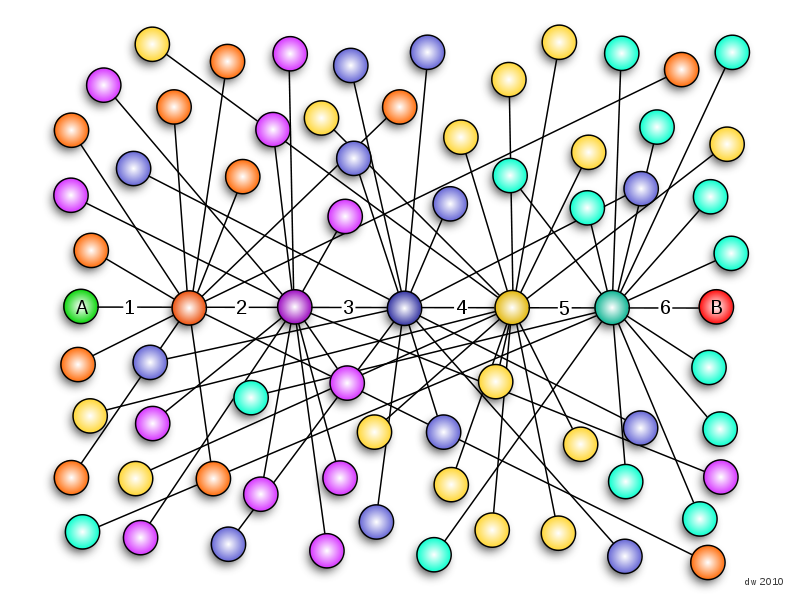 Image from wikipedia, depicting "six degrees of separation"
What if there were only six vectors needed to describe every aspect of our universe in its current state, and every possible version of our universe from its very beginning to its ultimate end? Last month, in Three Becomes One, we returned to the idea that all six dimensions become a "point" -- indicating a position within the multiverse landscape -- in the seventh dimension and above with my approach to visualizing the extra dimensions, and that's why the fine structure constant and basic physical laws stay locked in and unchanging for our particular universe. Last entry, in Are Bees More Sixth-Dimensional, we took a look at a variety of ideas related to six-sided shapes, six dimensions, and the mind-blowing theory that honey bees are using sixth-dimensional geometry to communicate the positions of new food sources to each other.
Six has been an important number to this project since its inception. In fact, back in 2006 I bought the domain name justsixthings.com, because I was thinking that might be a good name for my next book. I also bought just6things.com and 6things.ca because they were available and seemed like possibly useful variations. 6things.com was taken though, and as I mentioned last time, that's the new website that I'd like to talk about in today's entry.
The six degrees of separation concept is interesting in the way it ties into our discussions of connectedness and the nature of reality, but it has other uses as well: many different projects have found ways to use this idea as their launching pad. For instance, SixDegrees.com was an early social networking site that ran from 1997 to 2001, and at the peak of its popularity it had one million registered users. Six Degrees of Kevin Bacon is a trivia game that suggests no matter what actor you name, you should be able to use six steps or less to find a connection to Kevin Bacon. In 2007 Kevin Bacon started a charitable giving site called SixDegrees.org to show how this concept can be used to make people's lives better.
 Here's the logo for 6things.com. You'll see that the slogan here is recursive as you go round and around the circle: "six things you like from the six things you like from the..." and so on. 6things.com is a "relevance engine". Here's what they say about the project from a recent press release:
6things you like in 6 minutes Everyday.... 6things is a relevance engine, that is a perfect solution for information overload, without losing time.
6things.com is a non-linear innovation, in that it
* Provides 6things you like from 6,844,647 things
* Eliminates the need to maintain yet another account
* Improves signal-to-noise ratio by deducing your 'micro-interests'
* Reduces wasted time by kicking you off in 6 minutes
Even if the user did not share enough content, no worries. Simply press on one of the 6 Buttons up on top, that captures your interest.Passively discover curators with similar taste, without actively searching for them. Our Algorithms computes the 'taste distance' between you and others based on 'micro-interests'.
Passively consume real-time content that is your current object of attention, without actively searching for 6,844,647 things. Our Machine Learning Algorithm extracts your 'micro-interests' from your shared content.
You don't have to remember yet another password or have to signup. The product can be accessed from http://www.6things.com
Here's three twitter feeds for you: 6things (the project's feed), vasusrini (creator of the project), and samdida (co-creator and designer). I've not heard the term "relevance engine" before, but I do like the concept. Stumbleupon, for instance, could be thought of as a user-driven relevance engine, and that service continues to be one of the most popular ways for people to find my 11-minute animation about the ten dimensions. Likewise, I've talked a number of times about web 3.0 pioneer Nova Spivack and his brainchild twine.com, which uses a combination of user recommendations and the semantic web to filter out the signal from the noise for people trying to deal with The Stream. "The Stream" is what Mr. Spivack calls the oncoming deluge of information we're all having to deal with more and more each day.
In the early months of this blog (back in 2007) I was using the phrase "conceptual framing" a lot, which relates to these discussions. We tend to think in frames, we don't do so well imagining an atom and a galaxy at the same time, but if we take ideas one step at a time, one frame of reference connected to the next, we find it easier to process. Will 6things.com achieve its goal of providing relevant new links in an extremely timely manner? The project is just in beta right now, but it seems like a great idea and I look forward to watching them grow.
Here are six other past blogs where I've talked about the "Just Six Things" concept and the importance of the number six:
Just Six Things: The I Ching
E8 and the Semantic Web
What's Around the Corner?
The Statistical Universe
Alien Mathematics
Time in 3 Dimensions
Enjoy the journey!
Rob Bryanton
Next: Love and Gravity
Monday, June 21, 2010
Are bees more sixth dimensional?
A direct link to the above video is at http://www.youtube.com/watch?v=UTtGcNk7Rhs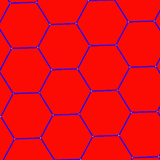
 Six is an interesting number that we haven't talked about as much recently with this project. Coincidentally, last week we looked at Philip Zimbardo's The Secret Powers of Time, where he suggested that there are six possible ways for people to interface with time: awareness tends to be oriented towards positive or negative versions of past, present, or future.
With my approach to visualizing the dimensions, our universe has six dimensions to express all possible versions of itself, and all of that becomes a single "point" in the seventh dimension: we looked at this most recently in "Our Universe as a Point". A couple of years ago here at the Imagining the Tenth Dimension blog, in an entry called Time is a Direction, I had this to say about the number six:


"Do a google search on the words 'six directions' and you will see how deeply embedded that concept is into various spiritual/metaphysical systems. Do a google search on 'six dimensions' and you will find an interesting mix of musings about business/social connections (the six degrees of separation concept), geometry/physics, and other discussions about the nature of reality from the viewpoint of ancient spiritual systems."

 In Three Becomes One, we looked at various geometric patterns that can be derived from the triangle, and the images we're looking at here come from the wikipedia article on hexagons, which are six-sided polygons. The image at left is a hexagram, created by superimposing two triangles. A six-sided hexagon appears in the middle of this shape, and can also be created if you draw new lines joining the six outer points of this shape.
As you'll see if you spend some time examining the different patterns shown above, the idea of triangles being pushed apart from a central point into a symmetrical pattern from which other shapes emerge can be seen time and again in these images, and of course all of this is old hat to fans of sacred geometry.

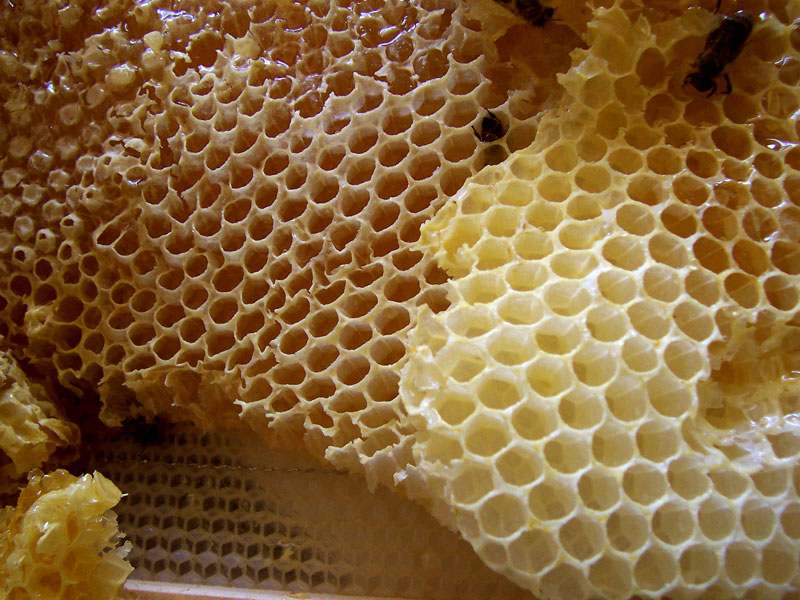 The six-sided hexagon is not just an abstract concept from your geometry class: it appears in nature as well. Here are some pictures demonstrating that.
First of all, one of the most obvious ones: the hexagons of a beehive's honeycomb. Then, the six-sided scutes of a turtle's carapace.

 Next, at left we see a North polar hexagonal cloud feature on Saturn, discovered by Voyager 1 and confirmed in 2006 by Cassini; and at right we see naturally formed basalt columns from Giant's Causeway in Ireland.
Hexagons also appear in snowflakes, and even at the molecular level in various compounds.
In Are Animals and Kids More Fifth-Dimensional?, we discussed something that can be connected to The 5th-Dimensional Camera Project, which is a more recent entry looking at one of the central ideas to my project which has now received some support from scientists at Oxford University: the fifth dimension can be thought of as our probability space. The wave function of potential pasts and futures that connect to our "now" is a pattern in the fifth dimension which we are potentially connected to through chance and choice, Everett's Many Worlds.
Being able to see fifth-dimensionally, then, would be to see all the possible world lines that are causally connected to a particular instant of our spacetime universe. And someone who is more connected to the past and future through intuition, inspiration, creativity, deja vu, clairvoyance, and so on, could be said to have a more fifth-dimensional awareness.
Seeing sixth-dimensionally, on the other hand, would be seeing all the possible versions of the universe you are within, including the versions that are not causally connected - like the one where you pop out of existence here and reappear on the moon, or the one where it's 2010 and Michael Jackson is still alive. The sixth dimension is the complete Quantum Field for our unique universe, including those outcomes which we acknowledge must exist as possible versions, but which would take longer than the existence of the universe for us to observe. Can any living creatures see sixth-dimensionally?
Here's an article sent to me by my friend Ian Reclusado of the always interesting blog Reclusland. The article is called Honeybees are Found to Interact with Quantum Fields.
In this article, we see a fascinating theory proposed by Barbara Shipman, a mathematician at the University of Rochester. Dr. Shipman analyzed the complex dance patterns bees use to indicate the position of new sources of food to each other. She discovered that the geometric patterns the bees use in the dance made sense if they were analyzed using a "sixth dimensional flag manifold", an analysis method also useful in solving some of the mathematical problems that arise in dealing with quarks. Please read the entire article, it presents some amazing insights.
According to many sources there are now 30% less honeybees in the world than there were in 2006. Are bees more sixth-dimensional? Perhaps they are. Why, then, have bees been disappearing from our planet in record numbers for the last four years? That's an intriguing question, and the subject of a number of books that have come out in the last year, including Fruitless Fall, The Hive Detectives, and A World Without Bees. Are bees our sixth-dimensional canaries in a coalmine, warning us about environmental catastrophes that we need to avoid, and that in some sixth-dimensional versions of our universe, have already not avoided?
We'll continue this exploration next time as we talk about a new company exploring the world of connected ideas, who are using a honeybee as their logo: 6things.com .
Enjoy the journey,
Rob Bryanton
Friday, June 18, 2010
Video - Rob on Bigfish Radio
A direct link to the above video is at http://www.youtube.com/watch?v=T2EnsWLMAr8
On May 26 2010, I was a guest on Kerrace Alexander's "Bigfish Radio", which you can listen to at blogtalkradio.com/bigfishradio. Kerrace's weekly show goes out live with telephone call-ins and chat room participation, and is then archived for listening any time you want.
Here's a quote from her bio:
"Kerrace Alexander is an inspirational speaker, facilitator, and creator of The RippleFX Manifestation System, a unique and powerful perspective on how the Law of Attraction works."
To find out more about Kerrace's work, follow her at twitter.com/Bigfishtweets or on her blog, bigfishstrategies.blogspot.com/.
The above video is an edited version of our show, to hear all 90 minutes go to blogtalkradio.com/bigfishradio
Thanks for the great interview, Kerrace! Some recent blogs that tie to the ideas we discussed in this interview include:
Changing Reality
Gravity and Entrainment
Gravity and Free Will
Entangled Awareness and OBEs
Entangled Neurons
The 5th Dimensional Camera Project
Enjoy the journey!
Rob Bryanton
Next: Are Bees More Sixth-Dimensional?


 Posts


