More and more people are becoming convinced that we are perched on a precipice, a tipping point, a convergence, an approaching singularity, a break from the old into the new. Back at the start of the year I posted this poll question: "With which prediction do you more agree? 1. 10/10/10 (October 10th 2010) is going to be a very significant date for our planet. Or 2. 10/10/10 will be an unremarkable day." In March we discussed the results of this poll in an entry called "Will 10-10-10 Be Significant?".
Now, as we're only ten days away from this curious date, I'd like you to think about setting aside a moment at the tenth hour, tenth minute, tenth second, on the tenth day of the tenth month in the tenth year of the century, to contemplate how much has changed, and how different our lives are now from ten years ago. Is your life better or worse now? Regardless of your evaluation, change is a significant part of our lives, more so all the time.
Nova Spivack has been talking lately about "The Now" becoming an increasingly dense and increasingly narrow focus in our collective experience. I've talked before about Nova's groundbreaking work in the semantic web and providing tools to help us navigate through the potentially overwhelming Stream of information entering our lives. Is the amount of information in the world really doubling at an exponential rate? Read this article featuring Google CEO Eric Schmidt, who says we are currently creating an amount of information every two days that equals the entirety of information created from the dawn of civilization until 2003!
How much longer can we keep up this acceleration? Where is this acceleration taking us? My song "The End of the World" suggests that people have always been suggesting that something significant is just about to happen, and in my book and this blog I've played with the idea that Everett's Many Worlds allows for the possibility that there are parallel worlds where those people turned out to be right, they're just not the version of the universe we currently happen to find ourselves in.
What do you think?
Do you believe we're approaching a tipping point? As more and more people become connected together like a gigantic "hive mind" of a tightly focused Great Big Now (as Nova Spivack calls it), will we collectively ascend to something greater? I would say that's the hope we all have to share. On 10-10-10, take a moment to think about whether you're helping to move this world to be better or worse than it was before you got here. And enjoy the journey!
A direct link to the above video is at
http://www.youtube.com/watch?v=S2Y9m34iJVY
Rob Bryanton
P.S.: The picture we saw at the start of this entry is part of a collection called "(Really) Stunning Pictures and Photos", check them all out at Smashing Magazine. The description attached to the picture when it was posted at Pixdaus says the shot was taken on Norway’s cliff Prekestolen (also known as Preacher’s Pulpit), but according to other people commenting on the picture it's actually found at Odda, Norway, and it's called Trolltunga (The Troll's Tongue). Either way, people insist this is not photoshopped, and is an actual geological formation found in Norway. How far out on the Troll's Tongue would most of us be willing to go?
Next: New Animation - The Forest
Friday, October 1, 2010
10-10-10: Look Before You Leap


Saturday, June 26, 2010
Just Six Things
A direct link to the above video is at http://www.youtube.com/watch?v=6ICmPQFNGog
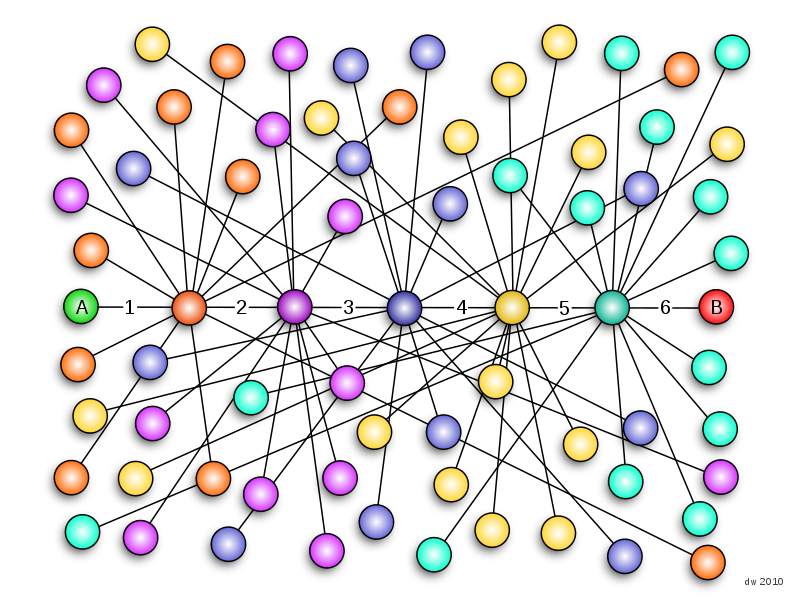 Image from wikipedia, depicting "six degrees of separation"
What if there were only six vectors needed to describe every aspect of our universe in its current state, and every possible version of our universe from its very beginning to its ultimate end? Last month, in Three Becomes One, we returned to the idea that all six dimensions become a "point" -- indicating a position within the multiverse landscape -- in the seventh dimension and above with my approach to visualizing the extra dimensions, and that's why the fine structure constant and basic physical laws stay locked in and unchanging for our particular universe. Last entry, in Are Bees More Sixth-Dimensional, we took a look at a variety of ideas related to six-sided shapes, six dimensions, and the mind-blowing theory that honey bees are using sixth-dimensional geometry to communicate the positions of new food sources to each other.
Six has been an important number to this project since its inception. In fact, back in 2006 I bought the domain name justsixthings.com, because I was thinking that might be a good name for my next book. I also bought just6things.com and 6things.ca because they were available and seemed like possibly useful variations. 6things.com was taken though, and as I mentioned last time, that's the new website that I'd like to talk about in today's entry.
The six degrees of separation concept is interesting in the way it ties into our discussions of connectedness and the nature of reality, but it has other uses as well: many different projects have found ways to use this idea as their launching pad. For instance, SixDegrees.com was an early social networking site that ran from 1997 to 2001, and at the peak of its popularity it had one million registered users. Six Degrees of Kevin Bacon is a trivia game that suggests no matter what actor you name, you should be able to use six steps or less to find a connection to Kevin Bacon. In 2007 Kevin Bacon started a charitable giving site called SixDegrees.org to show how this concept can be used to make people's lives better.
 Here's the logo for 6things.com. You'll see that the slogan here is recursive as you go round and around the circle: "six things you like from the six things you like from the..." and so on. 6things.com is a "relevance engine". Here's what they say about the project from a recent press release:
6things you like in 6 minutes Everyday.... 6things is a relevance engine, that is a perfect solution for information overload, without losing time.
6things.com is a non-linear innovation, in that it
* Provides 6things you like from 6,844,647 things
* Eliminates the need to maintain yet another account
* Improves signal-to-noise ratio by deducing your 'micro-interests'
* Reduces wasted time by kicking you off in 6 minutes
Even if the user did not share enough content, no worries. Simply press on one of the 6 Buttons up on top, that captures your interest.Passively discover curators with similar taste, without actively searching for them. Our Algorithms computes the 'taste distance' between you and others based on 'micro-interests'.
Passively consume real-time content that is your current object of attention, without actively searching for 6,844,647 things. Our Machine Learning Algorithm extracts your 'micro-interests' from your shared content.
You don't have to remember yet another password or have to signup. The product can be accessed from http://www.6things.com
Here's three twitter feeds for you: 6things (the project's feed), vasusrini (creator of the project), and samdida (co-creator and designer). I've not heard the term "relevance engine" before, but I do like the concept. Stumbleupon, for instance, could be thought of as a user-driven relevance engine, and that service continues to be one of the most popular ways for people to find my 11-minute animation about the ten dimensions. Likewise, I've talked a number of times about web 3.0 pioneer Nova Spivack and his brainchild twine.com, which uses a combination of user recommendations and the semantic web to filter out the signal from the noise for people trying to deal with The Stream. "The Stream" is what Mr. Spivack calls the oncoming deluge of information we're all having to deal with more and more each day.
In the early months of this blog (back in 2007) I was using the phrase "conceptual framing" a lot, which relates to these discussions. We tend to think in frames, we don't do so well imagining an atom and a galaxy at the same time, but if we take ideas one step at a time, one frame of reference connected to the next, we find it easier to process. Will 6things.com achieve its goal of providing relevant new links in an extremely timely manner? The project is just in beta right now, but it seems like a great idea and I look forward to watching them grow.
Here are six other past blogs where I've talked about the "Just Six Things" concept and the importance of the number six:
Just Six Things: The I Ching
E8 and the Semantic Web
What's Around the Corner?
The Statistical Universe
Alien Mathematics
Time in 3 Dimensions
Enjoy the journey!
Rob Bryanton
Next: Love and Gravity
Monday, February 15, 2010
Gimme the News
A direct link to the above video is at http://www.youtube.com/watch?v=XH-Azgc7Lf4
In my most popular blog entry of all time, Jumping Jesus, we talked about the constantly accelerating flow of information that each of us have to deal with. More recently, in entries like Monkeys Love Metallica and Placebos Becoming More Effective, we've talked about how this acceleration might be changing us. Nova Spivack calls it The Stream: and tools like the Semantic Web and Mr. Spivack's Twine are part of the ongoing efforts to provide us with tools to filter out the signal from the noise. In Connecting It All Together, I said this:
Like predictions of the end of the world, predictions that change is happening more and more quickly are really not unique to today, people have been saying such things throughout history (this is where we can cue a sound montage of parents through the ages complaining about "kids today, where do they get these crazy ideas"). This is not to say that accelerated change is not happening now, but rather to say that this has been an ongoing process of slowly accelerating growth for thousands of years which we may or may not see the culmination of within our lifetimes.My song Gimme the News, written as a satire back in 1997, encapsulates today's 140-character Twitter world quite effectively, even though it predates that service by a decade. As the old saying goes, "the only thing that stays the same is nothing stays the same", and no matter where you are along the curve that is always more true today than it was the day before.
Gimme the News
- words and music by Rob Bryanton (SOCAN)
Gimme the news and make it real quick
Keep it simple, that's the trick
Give me a soundbyte I can call my own
And quote to my friends, show 'em I'm in the know
Gimme the news, and make it real short
Want the world's events in a two minute report
Got no time for facts that just slow me down
Already feel like I'm about to drown
In an ocean of info that I don't want to see
Got way too much input, more than I need
Everywhere I look, every place I go
It's information overload
Information overload
Information overload
Gimme the news, don't make it real deep
I've got miles to go before I sleep
Banal and superficial, that'll suit me fine
Edit it down until it fits on a sign
At the edge of the highway like a wonderful ad
That sticks in my brain, just another quick fad
A jingle to rattle round inside my head
Like "Big bomb, 200 dead
Big bomb, 200 dead
Big bomb, 200 dead"
Gimme the news
Don't give me the blues
Just gimme the news
Next: What Happens if Kurzweil's Singularity never arrives, and the Transhumanists are wrong, and Mike Judge's Idiocracy becomes a chillingly real vision of the future? We're going to look at one more Rob Bob and Roberta song from that ten-song collection next time that talks about our love-hate relationship with modern technology: My Computer is My Friend.
Enjoy the journey,
Rob Bryanton
PS - Don't forget, this is just one of a ten-song collection of songs, if you'd like to purchase these ten songs as high-quality mp3s it's only five dollars for the whole collection, go to the Tenth Dimension Digital Items store if you're interested. And while you're there, check out the O is for Omniverse pdf, which we've reduced to $10 as a special for the month of February.
You should follow me on twitter here.
A direct link to this video is at http://www.youtube.com/watch?v=AjR69ddBK78
Thursday, January 21, 2010
Monkeys Love Metallica
A direct link to the above video is at http://www.youtube.com/watch?v=82zjaUNmvj0
 Photograph: Andy Fossum/Rex Features. As seen in The Guardian UK article referenced below.
It can be hard to perceive an acceleration when you're within a system where everything is accelerating, but we do catch glimpses. So on the one hand we talk about The Stream, The Singularity, Transhumanism, Artificial Intuition, Conscious Computers, and so on. On the other hand, we talk about time being an illusion and parts of each of us being connected to patterns that exist well outside of the limits of the "now" of our 4D spacetime. How do the two ideas fit together? First of all, let's look at some recent examples of these big picture patterns.
We've talked a few times about the deep underlying connections of sacred geometry and how the Golden Ratio has been considered a thing of beauty for thousands of years. Like fractals, shapes and patterns such as these occur naturally, and perhaps that's why we're so attracted to them, because they represent deeper connections to reality that are outside the limits of our observed spacetime. Here's a Science Daily article from earlier this month that extends this idea even further: it suggests that scientists have now discovered evidence of the Golden Ratio in the quantum world!
Music and sound also seem to connect us together in powerful ways that speak to a more timeless perspective. In The Big Bang and the Big O, I referred back to sections in my book where I discuss how certain sounds seem to reach us at a primal level: could the dreaded chalkboard squeal connect us to genetic memories of some ancient flying predator who swooped down from the sky making a similar sound? Here's a great TED Talks video featuring sound consultant Julian Treasure, it's called The Four Ways Sound Affects Us. It speaks very effectively to the idea that we are all connected together by the ways we react to sound. Watch this five minute video:
A direct link to the above http://www.youtube.com/watch?v=rRepnhXq33s
Julian is the chair of the Sound Agency, a firm that advises worldwide businesses -- offices, retailers, hotels -- on how to use sound and music more effectively. This leads us to the title of this entry, Monkeys Love Metallica. Okay, I admit it, "love" is overstating the case for dramatic effect but here's a link to a New York Times article my friend Pete Chema of Ten Feet Deep sent to me a couple of weeks ago, please check it out: "Music for Monkeys".
The Guardian UK also published a related article this past September that goes into more detail about this research, here's a link to that: Scientists create music that helps monkeys chill out. Both articles are linked to a study, published this past September in the Royal Society journal Biology Letters, that (to quote from The Guardian article):
Now, what Dr. Snowdon is talking about here seems to easily connect to ideas we've talked about in entries like The Geometry of Music and Disorders of the Mind: music, like the the other patterns we've just looked at, connects in ways that go beyond the limits of our 4D spacetime. But at first glance, the results of Dr. Snowdon's study seem to contradict the ideas he tells us he was exploring....will help psychologists understand the evolutionary roots of music and its effect on the brain, the authors said."The emotional components of music and animal calls might be very similar, and from an evolutionary perspective, we are finding that the note patterns, dissonance and timing are important for communicating affective states in both animals and people," said Chuck Snowdon, a psychologist at the University of Wisconsin, Madison.
 In the study, 14 cotton-top tamarins were played clips of music while the researchers noted any changes in behavior. Pieces included Samuel Barber's Adagio for Strings, a soft piano piece from The Fragile by Nine Inch Nails, Metallica's Of Wolf and Man and Tool's The Grudge.
According to the Guardian article, the monkeys didn't exhibit any clear response to these piece of music one way or another, except for the Metallica song,which had the unexpected effect of calming them down.
Interestingly, the New York Times article claims the scientists saw a similar soothing effect on the monkeys with the Tool song, but most of the other articles I found reporting on this study appear to only single out Metallica. Frankly, I have to suspect that most reporters covering this story grabbed on to the "Monkeys Like Metallica" angle because it makes for a more memorable story. Unfortunately, singling out Metallica from Tool does create some misperceptions here, though.
The monkeys did not respond one way or another to the other pieces of music. Does this mean that farmers who play classical music to their cows to keep them calm might be kidding themselves? Shouldn't Adagio for Strings have made these monkeys sad? If animals are part of the same continuum that we are, shouldn't they respond in ways similar to we humans to the joy, the sorrow, the anger, the range of human emotions that we can hear in a powerful piece of music?
Perhaps what we're talking about is more related to this accelerating generation gap we looked at above. Are our more subtle responses to music mainly cultural, mainly a learned behavior? In the same way that a young child might now expect that all viewing screens are multi-touch displays, perhaps our varying emotional responses to the music of the last four hundred years or so is something we've been trained into through repetition?
The key here is understanding that the monkeys responded to the highly rhythmic music of Tool and Metallica, and didn't respond to the long phrases and more free tempos of the other two pieces. What is the common denominator behind the development of music? Repeating structures. The drum. Patterns that can entrain the heartbeat and breath, that make a creature feel a certain way when they move along with the music. Adagio for Strings, then, is just a too subtle for our monkey friends to hear as a communication of emotion: this a generation gap of a different magnitude but similar nonetheless.
But where this gets even more interesting is when Dr. Snowdon brought in David Teie, a cellist with the American National Symphony Orchestra, to create some pieces of music that were inspired by (but to be clear, not specifically based upon) the sounds these monkeys use to communicate to each other. Here are a couple of the pieces: first, one inspired by the sounds these animals commonly produce when things are fine.
http://www.guardian.co.uk/science/audio/2009/sep/02/monkey-music-calls-example
This second piece has melodic and rhythmic connections to the calls the tamarins produce when they are anxious or alarmed:
http://www.guardian.co.uk/science/audio/2009/sep/02/monkey-music-calls-science
Certainly, this music sounds odd to our ears, but the tamarins responded as you might expect: they lounged around and ate more when the first piece of music was playing, and became upset when the second piece played. Any film soundtrack composer exercises their creativity in plugging into these same underlying connections, finding ways to soothe us, or ways to upset us with the palette of sounds, the melodic shapes and the rhythmic structures they choose. Clearly, Dr. Snowdon would have to experiment with a much larger range of musical compositions that are generally agreed to communicate a variety of specific emotions to humans, and I'm certain that such experiments would help to reveal what is primal and what is learned in modern humans' reactions to music of all kinds.
So, do Monkeys Love Metallica? Definitely a gross generalization, even if it's fun to use as a headline! But can monkeys respond emotionally to some kinds of music? This scientific study points to "yes".
Enjoy the journey,
Rob Bryanton
Next: Noein
Monday, August 24, 2009
Polls Archive 42 - Does Twitter Connect or Distract?
A direct link to the above video is at http://www.youtube.com/watch?v=jMqJjc9Q4Fw Poll 42: "With which statement do you more agree?
1: Twitter connects people together more and helps new ideas spread more quickly.
2: Twitter distracts people from being productive and is mostly a waste of their time."
Poll Ended June 24 09. This one was close throughout the poll, ended up with 53.8% saying Twitter distracts from productivity, and 46.2% saying it helps to spread ideas more quickly.
Love it or hate it, twitter has established itself as another tool for connecting people together which can't be ignored. Here's a link to a popular presentation created a while back by Marta Kagan, and here below is her followup to that presentation, "one year later". This is the first time I've embedded a "slideshare" presentation in my blog, just wanted to make sure you notice that this is not a movie, it's more like a powerpoint presentation: so you can click through the slides at your own reading speed or just sit back and watch the presentation at the more languid pace that has been programmed in.
A direct link to the above presentation is at "What the Fk is Social Media One Year Later".
As we deal with the rising flow of information coming at us from all directions, presentations like this one can help to remind us that it's all about connections, and seeing how Everything Fits Together is the basic goal of my project. Are we all swimming in an increasingly broad and deep "stream" of richly linked data? That's what web 3.0 pioneer Nova Spivack has proposed. Here's the video for my previous entry about that idea, "The Stream".
A direct link to the above video is at http://www.youtube.com/watch?v=Fz2Lx4DLNUQ
Poll 42 also relates to another previous blog entry, "Mindwalk and Twitter". If you like movies like My Dinner With Andre and Waking Life, you might enjoy the thoughtful blending of philosophy and quantum physics in the 1990 movie by Bernt Capra called "Mindwalk". In Mindwalk and Twitter I embedded a Google Video copy of that movie, check it out.
Enjoy the journey,
Rob Bryanton
Next: Poll 43 - Is the Multiverse Real?
PS - by the way, I do have my own twitter feed, check it out! http://twitter.com/10thdim
Tuesday, June 30, 2009
Computers and Consciousness
A direct link to the above video is at http://www.youtube.com/watch?v=2bXACTqKIII
In May one of of my most popular blogs was called News From the Future, an entry which fancifully portrayed a moment two decades from now where we finally use technology to realize that humans are not nearly as unique as we've convinced ourselves. We continued the discussion of such ideas a few entries ago in "Do Animals Have Souls?". You may or may not be surprised when I tell you that this all ties to the entry prior to that as well, "Logic vs. Intuition", where we talked about Monica Anderson and her Artificial Intuition project. Monica's company Syntience is developing new algorithms which may help to make computers able to process The Stream , a potentially overwhelming flood of sometimes flawed information, in ways that parallel how humans are able to deal with these contradictions and holes and an incalculably large amount of incoming data: using intuition rather than logic (see Illusions and Reality for more about how humans assemble all this data together). Would such processes allow computers to some day become more self-aware? If you look in the column to the right, you will see that we are currently running a poll question here at the tenth dimension blog which asks visitors for their opinions on that very question.
I've been following Blogging the Singularity for related ideas to all this, a very active blog with a wide range of topics, check it out. As we saw in the above video "The Singularity is Near", the idea that we live in times that are rapidly accelerating seems to be driving us to a moment of a major paradigm shift, a "flip" into a new way of existing: such ideas are connected to the transhuman movement, which believes in a future where technology seamlessly melds with humans to make our lives better. The ideas in the above YouTube clip are related to Ray Kurzweil's book and upcoming movie, "The Singularity is Near": Kurzweil predicts that humans some day not too long from now will be able to upload the unique patterns that make them who they are into a computer, and effectively live forever as a result! In order for such a thing to happen, computers would have to be able to duplicate the processes that allow each human to have their unique perspective, a concept we talked about not long ago in "Where Are You?".
Nowadays it's not so uncommon to be fooled by a "bot" for a moment, where sly programmers convince you that you're talking to a real human who really wants to offer you a one-of-a-kind deal before you leave their webpage, or who has just written you a highly personalized email. I've talked before about the amusing "Chat with Einstein" window over at the excellent Journey By Starlight blog, which is somewhat similar to ELIZA, a simple psychotherapy program that first appeared back in the 60's. Even though such programs can sometimes seem to make interesting intuitive leaps, they are certainly not what we are talking about when we say Artificial Intelligence or Artificial Intuition.
Nonetheless, they do reveal two sides of an important coin: anthropomorphism doesn't just apply to animals, and when we see a computer responding in a human-like way we're more likely to believe the computer has a personality, a point of view, all those things that point towards consciousness. But what if we played with the Turing Test, were asked to decide whether A or B was the computer, but this time we were actually talking to two humans? How long would it take us to decide there was something "off" about one of the responders, and pronounce that person to be the robot?
This is the slippery slope we find ourselves on: if we are really moving to a time when people will be able to upload their consciousness to computers, then I would say it follows that we must also be moving to a time when a computer will be conscious on its own. Rather than interpret this to mean that humans and computers will then be superior to all other living things, we have to see this as being part of the continuum that shows us how all living things have varying degrees of consciousness. As computers start to become "aware", they will not just suddenly wake up one day to become indistinguishable from civilized adults: this will be a gradual process, much as an embryo first starts to become aware of its surroundings. Interestingly, award-winning science fiction novelist Robert Sawyer, who has been writer-in-residence at the Synchrotron here in Saskatchewan for the last few months, has just released a novel called "Wake" which talks about some near future time when the World Wide Web starts to wake up, to become conscious. Here's a quote from my local newspaper, the Regina Leader-Post, about the novel:
In Wake, Caitlin, a blind female math genius gets a signal-processing implant that may give her sight. Instead, she starts to perceive the actual structure of the World Wide Web. While she's looking at it, she becomes aware that there's an entity or consciousness starting to bubble up into existence out of the vast complexity of the Internet. Caitlin gets it into her head to play the role of Annie Sullivan, the famous teacher of her hero Helen Keller, to this "nascent consciousness" of the Internet.I love the idea that things are growing and changing at an ever-increasing pace, and what that could be mean to our new future. We're going to continue this discussion next time with more about technology, AI, intuition, and connections.
Enjoy the journey,
Rob Bryanton
Next: Connecting It All Together
Thursday, May 21, 2009
Evolution's Fast Lane
A direct link to the above video is at http://www.youtube.com/watch?v=GE0D-ZPcMhI
Here's a link to an article published on the National Geographic website a couple of days ago about the "Missing Link" fossil discovery - Darwinius masillae, a 47 million year old lemur-like skeleton with primate-like characteristics. The term "missing link" is often mistakenly used to describe some kind of half-man/half-monkey, as if humans had evolved from apes. This fossil shows a much clearer indication of what a "missing link" really is: apes evolved from a creature like this one, and humans evolved from this same creature: this would be the common ancestor that we both share.
 (picture from National Geographic: a shared ancestor of both monkeys and humans)
With my last blog entry, "The Stream", and with the previous entry to that, we talked about the rising paradigm of web 3.0, where not only will data be coming at us faster and faster, but the web itself will start to wake up, connecting and filtering that deluge of information in ways that allow us to use it all more effectively. No question, these are exciting times, and I've talked about the feeling of rapidly accelerating change that appears to be moving us all to a new mode of existence from a number of perspectives: some of those past blogs include Google and the Group Mind, The Past is an Illusion, and Randomness and the Missing 96%.
Here's a link to an article from Science Daily that was published well over a year ago (isn't that just a bit strange? In this "hurry up" world of instantly updated communication, I now feel tempted to apologize to you because this link is not to something that is fresh and new!). This article talks about the work of a team of anthropologists studying the human genome who say they have evidence that during the past 5,000 years human beings have been evolving 100 times faster than at any other time in the history of the human race! This flies in direct contrast to the common wisdom, that we as a species have not changed much at all in the last hundred thousand years.
What has caused us to change so much? There are many factors listed in the article, but all of them can be connected to how the way we live now is substantially different from our ancestors one hundred or two hundred generations ago. The tiny incremental changes over tens of millions of years that moved us from Darwinius masillae to homo sapiens are now, according to this study, moving at a much faster pace since the first versions of modern civilization began to rise.
Disease factors, diet, competition, all of those natural selection processes operate differently when humans are grouped together in larger and larger numbers. But I think we should also not overlook the mental factors that have changed as the rise of civilization has gradually modified the way we interact with each other, and the ways we think about ourselves. I would say this is easily connected to the science of epigenetics, which shows that not just changes in diet or lifestyle, but changes in mental attitude can actually change the way genes are expressed: I've talked about this in entries like Changing Your Genes, Changing Your Genes Part 2, You Have a Shape and a Trajectory, and The Musician.
The fact that humans are changing so much ties very nicely to the general theme of accelerated change that we see in our increasingly expanding universe, in our genome, and in our technology. Are we on the verge of some kind of tipping point? More and more people seem to think that is exactly where we're headed.
To finish, here's the video for Google and the Group Mind:
A direct link to the above video is at http://www.youtube.com/watch?v=fbblBvi65Ok
Enjoy the journey!
Rob Bryanton
P.S. Speaking of rapidly accelerating technology, here's an announcement about a new DVD technology that uses five-dimensional encoding to store the equivalent of 2000 movies on a single disk! Thanks to my buddy John for forwarding me this link.
Next: Does the Multiverse Really Exist?
Monday, May 18, 2009
The Stream
A direct link to the above video is at http://www.youtube.com/watch?v=Fz2Lx4DLNUQ
Two days ago, I was awakened by a vivid dream. The content was unusual enough that I immediately sat down at my computer and published it as my last blog entry, which was called News From the Future.
If you read that entry, you will have noticed that I omitted the fact that this story had come to me in a dream. Why did I do that? Because I know that there are many out there who have been trained to reject dreams as nothing more than random bits of junk, just the brain sorting through its data. On the other hand, I know that there are regular readers of this blog who completely accept the idea that dream states are plugged into extra-dimensional patterns, alternate realities not part of our own, and in that sense are not that different from the visions a Shaman might witness while in an altered state of consciousness.
It's possible, too, that both might be equally true: that the brain, in the process of sorting through recently acquired memories, is plugging into memes that exist in the sense that Richard Dawkins meant when he originally coined the term: memes are information patterns, ideas, or beliefs, that exist outside the restrictions of linear time.
At the end of that previous entry, I listed some of the recent news articles I had read in New Scientist and Scientific American which seemed to connect to my dream, and I also listed some of my blog entries which have played with similar ideas in the past. Clearly, the idea that some unconscious/subconscious part of my mind was fitting all those ideas together is easy to see, regardless of whether you believe in ideas advanced in blog entries like Creativity and the Quantum Universe and Our Non-Local Universe which say that there is now scientific proof that our universe is connected together in ways that transcend the limitations of the fourth dimension. Could there really be a "stream" of connectedness that our minds are sharing, as Dr. Jill Bolte Taylor proposed in her marvelous My Stroke of Insight?
I've talked a few times before about twine.com, the brainchild of web 3.0 pioneer Nova Spivack. Here's a link to a recently published essay of his called Welcome to the Stream: The Next Phase of the Web. In it, he discusses the quandary I presented in News From the Future: as tools like twitter make the web increasingly fluid, how does an end user make sense of the deluge? How do we filter the sludge out from what we really need? Nova concludes his essay like this:
Dreams of wealth aside, what I find so fascinating about these ideas of convergence and increasingly instantaneous connection across minds is the possibility that technology really could give us some bootstraps to pull ourselves up into a new mode of connectedness. In that sense, what we are talking about could be related to Kurzweil's Singularity just as much as it could be related to Zen Buddhism. And with my own project, getting people to see their underlying connectedness has been a running theme from the beginning. Here are some past entries where I've explored those ideas further:The emergence of the Stream is an interesting paradigm shift that may turn out to characterize the next evolution of the Web, this coming third-decade of the Web's development. Even though the underlying data model may be increasingly like a graph, or even a semantic graph, the user experience will be increasingly stream oriented.
Whether Twitter, or some other app, the Web is becoming increasingly streamlike. How will we filter this stream? How will we cope? Whoever can solve these problems first and best is probably going to get rich.
Tens, Google, and the Expanding Universe
I Know You, You Know Me
You are Me and We are All Together
Daily Parrying
Where are You?
Poll 34 - God? Or the Multiverse?
Poll 37 - Do Shamans See Other Dimensions?
Finally, I wanted to mention a new scientific study just published by researchers from UCLA, who used high-resolution MRIs to discover that people who meditate regularly had "significantly larger volumes" in certain key parts of their brains. Isn't that amazing?
Enjoy the journey,
Rob Bryanton
PS - Here's an article published yesterday by TechCrunch called "Jump Into the Stream".
Next: Evolution's Fast Lane
Saturday, May 2, 2009
Mindwalk and Twitter
Here's a movie my friend Chuck Salyers recently told me about, a 1990 film by Bernt Capra called "Mindwalk". This is a film about ideas, sort of in the style of My Dinner With Andre, but with content that is more akin to films like Waking Life and What the Bleep Do We Know. If you have an hour and fifty minutes to spare, and are willing to slow yourself down and accept its more peaceful pace, this film is worth watching. It blends together a number of discussions about politics, connectedness, quantum mechanics, and how everything fits together. In other words, it relates very nicely to the generalist's perspective and playful synthesis of seemingly unrelated topics that I'm often playing with in my project.
A direct link to the above video is at http://video.google.com/videoplay?docid=9107401959308808776
One of the things this movie mentions is Systems Theory. This, according to wikipedia is...
an interdisciplinary field of science and the study of the nature of complex systems in nature, society, and science. More specifically, it is a framework by which one can analyze and/or describe any group of objects that work in concert to produce some result. This could be a single organism, any organization or society, or any electro-mechanical or informational artifact."Informational artifact" is an unusual term which ties to a number of my past blogs: if, as some quantum physicists say, Information Equals Reality, then finding ways to visualize the creative processes and hidden connections of our surprisingly Non-Local Universe is the goal of my project. What's the difference, then, between a physical artifact and an informational artifact? They're just two ways of describing the same thing.
In many ways Mindwalk was ahead of its time: what a shame it's never been released on DVD, I think it could develop a substantial following today. The growing feeling of connectedness this movie talks about is certainly much more established now, as like-minded people around the world find a way to share their voices through connections that could hardly have been imagined back in 1990.
Which leads me to the darling of the moment, Twitter. Is tweeting a useful tool for establishing connectedness, adding an immediacy that surpasses even what Google is capable of conveying? Yes, that's one of the promises held within instant distributed communication. Critics of Twitter have always looked askance at this constant stream of 140-character-long tidbits: how can any of us separate out the signal from the noise, the zeitgeist from the inane? My own twitter feed is at www.twitter.com/10thdim, and I've moved it up to near the top of the right hand column here at my blog. As you'll see, I'm not micro-blogging to tell you what I had for breakfast (not that there's anything wrong with that sort of thing!), rather I am trying to make my twitter feed a stream of links and thoughts relevant to my tenth dimension project.
Right at the top of this blog's right hand column you'll see I've added a "Tweet this" button. If you'd like to share my blog with your followers on Twitter, this button works in two different ways: it sends out a very general "this is interesting" tweet if you're looking at my blog's main page, and it creates a much more specific tweet if you are viewing a specific blog entry.
Further down in the right hand column, you'll see a blue box filled with words, kind of like this one:

What you're looking to the left is just a picture, it will never change. But over in the right hand column you'll find the live version of this box, provided by twitscoop.com, which will be different every time you come back to the site, as it tracks what words are being used most often right now in the tweets passing through twitter. Is one of the current words you see there interesting to you? You can click on it and be taken to a page showing all the most recent tweets that have included that word. There is also a "Hot Trends" button you can click on at the top of the box that will track the words or phrases that have seen the most activity for the last half a day or so. If you actually go to their site, a larger version of this cloud updates in real time, and you can watch as one word grows and another shrinks away as the conversations change from minute to minute.
Data cloud visualizations like these can reveal moments of synchronicity - why, for instance, did "10th" and "awareness" happen to come up when I took this picture? They can also reveal intense groundswells of opinion, news as it is being made, new memes that are capturing the attention of the world: which is why I've called this window "Twitter Memespace", to show how this is yet another way of thinking about information patterns that connect across time and space.
Is what you see in the Twitscoop window profound? Only occasionally. One of the ways to grab more layers of meaning out of the microblogging world is to apply filters. For instance, there is a site called Twistori that provides you with a list of six emotionally charged words - love, hate, think, believe, feel, wish - and clicking on any one of those gives you a real time scrolling list of tweets that include that word.
 Unlike Twitscoop, though, Twistori is a dead end. There's no way to see the name of the poster, or click on each of the tweets as they go by if you wanted to see more from that same poster or perhaps even follow their feed. In other words: none of the connectedness I was just talking about is possible here, this is only a voyeuristic window into what people are saying.
I started my blog in January 2007. My second post was called "Everything Fits Together", and it too was about connectedness. Coincidentally, in that entry I mentioned a site called wefeelfine.org, which Twistori was inspired by. Created by Jonathan Harris and Sep Kamvar, "We Feel Fine" gives us fascinating real-time visualizations of people's emotions as expressed in recent blog entries: any sentence that includes the phrase "I feel" or "I am feeling" becomes part of the presentation. Blog entries can also be sorted by gender, location, local weather conditions at the time of the post, pictures attached to the blog, and even a color coding based upon the emotional word attached to the "I feel" phrase. Unlike Twistori, though, any of the entries that come up in these visualizations can be clicked on, and you can read the entire entry, allowing much more possibility for connections to be made to the original poster.
When you go to wefeelfine.org, click on the box labeled "Open We Feel Fine". The first window you are presented with is called "Madness", and it is a swarming cloud of dots (blog entries) and rectangles (pictures) that are color-coded according to the emotion expressed. The emotional word attached to each of these dots or boxes appears as you pass your mouse over the shape, and you can click on any of them to see the full entry that they came from.
As with all of the different views, you'll notice that there's a bar across the top of this window that lets you filter what is shown by a variety of parameters. Meanwhile, down in the bottom left, there are six words: the first was "Madness. The second is called "Murmurs", and it gives you something more similar to the twistori experience, with the added bonus that you can still click back to the original post. "Montage" shows a screen full of pictures posted to blogs or flickr that have an "I feel" phrase attached to them.
 Next is the "Mobs" window. Pictured at left is a screen grab from that window, sorted for only entries that appeared on April 29 2009. You can see that "I feel better" was the most common phrase that day, followed by "I feel good", then "I feel bad". As you look through the almost seventy emotional words in this screen grab, does a certain overall feeling start to arise? How would you say we're doing over all? This is interesting, but there still seems to be quite a lot of variation here, just the usual diverse sets of emotions you would expert a large crowd of individuals to express.
The next window is called "Metrics", and it shows how much the currently cataloged emotions are different from the average:
 As you can see here, on April 29 2009, over five times as many people felt "behind" compared to the average occurrence of that word since this site was launched in 2005. If you were to look at the results for all of 2006 by comparison, you would see that over five times as many people felt "wanted". The possibilities for sorting this information are endlessly fascinating! Want to find the most common emotions expressed by Canadian women in 2008 on days when it was snowing? You can go amazingly deep into the data.
 The last window is called "Mounds", and it looks at the results overall, with quivering colored mounds representing each emotion. This is similar information to the Mobs window, except that it doesn't allow you to sort down to subcategories. I should mention that many of these windows scroll as you get to their outside edge, so for instance if you move your mouse over to the right edge of the Mounds window you will be able to see smaller and smaller blobs representing the other emotions and how often they occurred.
I'd love to hear from visitors to this blog about other websites they think are doing a good job of drawing sense from the noise. Other data visualization websites I've tweeted about recently are neoformix, Opinion Space, Visual Search Engines, Designing for Big Data, TwitterSpectrum, The Allosphere, and Virtual daVinci.
To finish, here's one of the 26 songs attached to my project, this one is about the memes that rise and fall over time in modern society. It's called "Insidious Trends".
A direct link to the above video is at http://www.youtube.com/watch?v=lCMe9uGs8iA
Enjoy the journey!
Rob Bryanton
Next: Polls Archive 36 - Do Plants Use Quantum Effects?




 Posts
Posts


