a new way of thinking about time and space ~ ~ ~ ~ ~ ~ ~ ~ ~ ~ by Rob Bryanton
--author and research scientist David Jay Brown says: "one of the most brilliantly-conceived and mind-stretching books that I've ever encountered".
--science fiction author Greg Bear says: "a fascinating excursion into the multiverse - clear, elegant, personal and provocative"
(This picture was created by my Facebook friend Annamaria Paizs, a Hungarian born Dutch artist living and working in Breda the Netherlands. It's called "Whitehole". Click here for other examples of her work. Thanks Annamaria!)
This video accompanies a blog entry published earlier this year called Gravity and Free Will, which was tied together with a look at the results from four recent poll questions here at this blog.
Last entry, in Threes, we worked our way through the Three Becomes One concept we explored earlier this year, and we arrived at thinking about spin. "Spin" ties together with Triality, Twistor Theory, Garrett Lisi's E8 rotation, Dan Winter's fractal compression/decompression, Nassim Haramein's point-based physics, and Marko Rodin's Rodin Coil. Could all of these different approaches be related? Let's watch a couple of movies.
This YouTube movie is titled Infinite Division. It uses visuals from a number of other videos and presents the ideas of Nassim Haramein using clips from a live presentation of Nassim's from a few years ago.
Here's a second video: this one features Randy Powell, who has studied with Marko Rodin, and has been working on ways to visualize the spin-based vortex mathematics of Rodin's work. As you'll see, in this ten minute video Randy makes some astonishing claims about the importance of this work and his group's intention to turn this knowledge into an open source project with far-reaching implications for humanity! Does this make him sound like a crackpot? Of course it does. But if these claims are supportable by hard math, then we may be looking here at a way of harnessing the Information Equals Reality paradigm I've been promoting throughout the life of this project. What do you think about this ten minute presentation?
How does the concept of infinite division relate to my approach to visualizing the dimensions? The answer is encoded into the logo I created for my project: at the core of this is the point we start with (the zero) and the point we end with (the ten), and those are connected. All of the other dimensions represent ways of dividing up the information that becomes reality, and so are shown in this graphic to be revolving around or "outside" the conceptual line which connects those starting and ending points. Those points, by virtue of being of indeterminate size, are really equivalent, but it's helpful to think of the zero as representing the drive towards division down to the infinitesimally small, and the ten as representing the drive towards encompassing the infinitely large "point" of the Omniverse.
Ultimately all of that information exists as potential within the beautifully balanced symmetry state that exists both before and after our universe or any other information set. So, if all possible states already exist and we are each merely observing infinitely dividable "slices" from instant to instant, is it possible for us to sense the future? Next time we'll look at a new science experiment on that question, with an entry called "Evidence for Seeing the Future?".
This recently published video accompanies a blog entry from earlier this year called Three Becomes One. Our discussion this time also ties to a comment I made in Entangled Awareness and OBEs, where I suggested that we could think of my approach to visualizing the dimensions as a filing system that encompasses all possible expressions of information and reality.
Here's a link to a really great article written by Brian Hayes and published in a 2001 issue of American Scientist magazine: it's called Third Base. Please read the whole article, which celebrates the advantages of using the ternary (as opposed to the binary) counting system, which is really another aspect of the three becomes one concept. I did want to quote from a section I thought was particularly innovative: Brian's sub-heading for this section is "Martha Stewart's File Cabinet".
Some weeks ago, rooting around in files of old clippings and correspondence, I made a discovery of astonishing obviousness and triviality. What I found had nothing to do with the content of the files; it was about their arrangement in the drawer.
Imagine a fastidious office worker—a Martha Stewart of filing—who insists that no file folder lurk in the shadow of another. The protruding tabs on the folders must be arranged so that adjacent folders always have tabs in different positions. Achieving this staggered arrangement is easy if you're setting up a new file, but it gets messy when folders are added or deleted at random.
A drawer filled with "half-cut" folders, which have just two tab positions, might initially alternate left-right-left-right. The pattern is spoiled, however, as soon as you insert a folder in the middle of the drawer. No matter which type of folder you choose and no matter where you put it (except at the very ends of the sequence), every such insertion generates a conflict. Removing a folder has the same effect. Translated into a binary numeral with left=0 and right=1, the pristine file is the alternating sequence ...0101010101.... An insertion or deletion creates either a 00 or a 11—a flaw much like a dislocation in a crystal. Although in principle the flaw could be repaired—either by introducing a second flaw of the opposite polarity or by flipping all the bits between the site of the flaw and the end of the sequence—even the most maniacally tidy record-keeper is unlikely to adopt such practices in a real file drawer.
In my own files I use third-cut rather than half-cut folders; the tabs appear in three positions, left, middle and right. Nevertheless, I had long thought—or rather I had assumed without bothering to think—that a similar analysis would apply, and that I couldn't be sure of avoiding conflicts between adjacent folders unless I was willing to shift files to new folders after every insertion. Then came my Epiphany of the File Cabinet a few weeks ago: Suddenly I understood that going from half-cut to third-cut folders makes all the difference.
It's easy to see why; just interpret the drawerful of third-cut folders as a sequence of ternary digits. At any position in any such sequence, you can always insert a new digit that differs from both of its neighbors. Base 3 is the smallest base that has this property. Moreover, if you build up a ternary sequence by consistently inserting digits that avoid conflicts, then the choice of which symbol to insert is always a forced one; you never have to make an arbitrary selection among two or more legal possibilities. Thus, as a file drawer fills up, it is not only possible to maintain perfect Martha Stewart order; it's actually quite easy...
The protocol for avoiding conflicts between third-cut file folders is so obvious that I assume it must be known to file clerks everywhere. But in half a dozen textbooks on filing—admittedly a small sample of a surprisingly extensive literature—I found no clear statement of the principle.
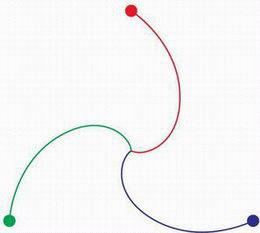
Now, here's an article from the physorg.com website about a theory proposed in 2007 by mathematician George Sparling of the University of Pittsburgh that there are two additional dimensions beyond space-time which can be described as "time-like". Sound familiar? This is one way of describing the first six dimensions of my "new way of thinking about time and space". First, read the article, which includes mention of twistors and twistor space. It also includes Elie Cartan's "triality" symbol pictured here, which ties into the idea that Sparling's three time-like dimensions can be rotated into a single point (three becomes one), which can be thought of as a "null" or "zero" created by the perfectly balanced symmetry inherent within triality.
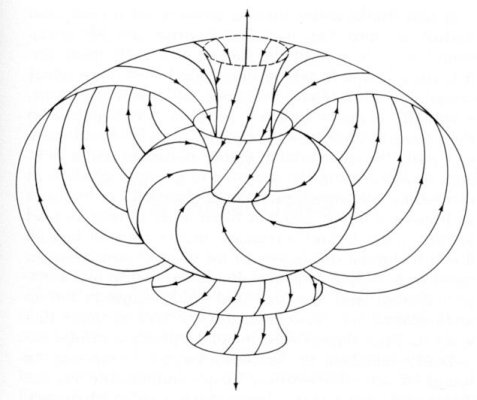
At the end of Three Becomes One I showed you the following two graphics:
Pictured at left: diagram showing congruence of null lines from Twistor Theory. Pictured at right: diagram of Marko Rodin's Rodin Coil. According to the June 2010 issue of Scientific American, there's renewed excitement about Twistor Theory and String Theory being united by the highly respected theoretical physicist Ed Witten. It appears to me that this will all tie into the work of Marko Rodin, whose Rodin Coil is pictured at right, but that remains to be confirmed.
We're going to continue this exploration next time with an entry about Infinite Division. Till then, enjoy the journey!
Image from wikipedia: "Borromean Rings". With my approach to visualizing the ten spatial dimensions, I group three dimensions together, call that a "triad", and condense it into a single entity so that it becomes a point in the next dimension up. By the time I've done that three times, I arrive at ten, the same number which Pythagoras also defined as the ultimate number encompassing all possible expressions of our reality. Let's look at some of the ways that ancient wisdom ties into all this, starting first with this mystical insight from the current Grand Archdruid of the Ancient Order of Druids in America:
In a binary, though, every action is balanced by an opposite reaction, so thinking in binaries is very problematic if you want to foster change. If you’re a mage, you respond to dysfunctions of this sort by shifting numbers. The traditional rule here is that numbers always change in a specific order: one becomes two, two becomes three, and three becomes one and shifts to another level. (The reasons for this rule, again, are too complex to go into here.)
When I came across the above text I was struck by how strongly it seemed to relate to the triads from my approach. Here's another quote, this one from a site dedicated to Chinese martial arts:
Then the link between the qi of the earth and the qi of the sky can be formed, causing the practitioner to shape the unity of heaven, earth and person; three becomes one.
The Dynamics of Creation
In Strength of Gravity, Speed of Light, I summed up the dynamics of creation like this: "One thing pushes against another, and out pops a third thing". Is this a schoolboy description of sex? Sure, why not! Long before sex came along, there's been single-celled fission, mitosis, a dividing apart: that's one kind of creation, binary and asexual. The other is sexual reproduction, a more robust form of creation because it takes elements from two sources and combines them to create something new. Hegel's dialectic is often summed up in a similar way: thesis, antithesis, synthesis.
Monad, Dyad, Triad
Pythagoras taught that odd numbers are masculine and divine, and even numbers are earthly and feminine. While such a conclusion might seem misogynistic, it's worth noting that Pythagoras welcomed females into his discipline, and his wife and daughters were accomplished mathematicians. In chapter four of my book, "The Binary Viewpoint", I suggested that the desire to catalog things into yes/no, right/wrong (and so on) tends to be a more masculine approach, while the holistic "yin/yang/both together" tends to be a more feminine one. Does this mean I would disagree with Pythagoras and say that odd numbers are more feminine, because they're less dualistic, less binary? It's an interesting thought.
"One state/an opposing state/both simultaneous" is also, of course, the basis of quantum mechanics, science's most-proven description of the foundation of our reality, and something which I've insisted will eventually be shown to be just as connected to our macro reality as it is to the quantum: it's all part of the same continuum. The June issue of Scientific American has just published an article about the first demonstration of quantum superposition on an object large enough to be seen by the naked eye! This demonstration is a major leap forward: while scientists have previously demonstrated superposition with atoms and molecules, this new experiment shows quantum superposition in an object made out of roughly ten trillion atoms. Suddenly, Schrödinger's cat, usually portrayed as nothing more than a fanciful thought experiment, moves a little closer to being something connected to our actual physical reality.
The Law of Threes
So. Two is a dynamic push and pull, while three is more stable, more balanced. In jokes and in fairy tales, it seems more satisfying when something happens three times. Lots of superstitions gravitate to this number: good luck, bad luck, celebrities dying, and so on are seen to come in threes. Father, Son, and Holy Ghost - entire belief systems are built on threes. To be sure, the phrase "Law of Threes" means a number of things depending upon who you consult, but here's the most popular answer as provided by "Galeanda" at Answerbag.com:
The Law of Threes states "every whole phenomenon is composed of three separate sources, which are Active, Passive and Reconciling or Neutral. This law applies to everything in the universe and humanity, as well as all the structures and processes".
In the final chapter of my book, I reached the conclusion that three systems are interacting, all of which in their unobserved state can be assembled into the tenth dimension as a "point" of indeterminate size. Those three systems are 1) the physical world, 2) the quantum observer who through constructive interference is actively engaged in observing specific aspects of the other two systems, and 3) the "information equals reality" world of memes, patterns, or waveforms.
It's interesting to relate this to Popperian cosmology. Philosopher Karl Popper made a similar proposal that there are three worlds: the physical, the mind which observes, and mental patterns of information. And imagine my surprise to be told that there are branches of Kabbalah which also teach that we can divide our reality into three triads, which can be summed up as the material, the moral, and the intellectual.
Three Threes
Here's an interesting version of my approach to visualizing the dimensions, using ideas connected to the point-line-plane postulate: which, as we've said before, can be used to visualize any number of spatial dimensions.
Start with a point. Choose a second point. Join those two points with a line, you're in the first dimension.
How far away are those two points from each other? Now find an additional point that is the exact same distance away from those first two points but not on the line. What have you created? An equilateral triangle, and you're in the second dimension. The fact that such a triangle can be created with nothing more than a compass and a straight edge is well known to students of sacred geometry and the vessica piscis, concepts we've looked at before in this blog.
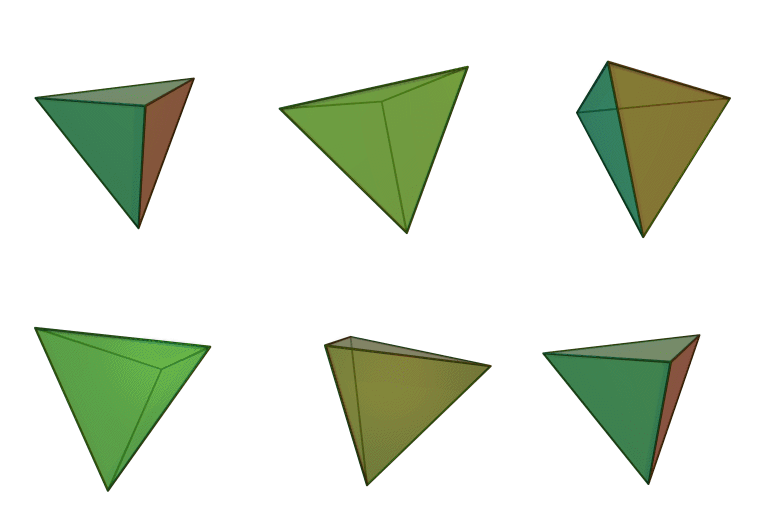
Now find an additional point that, again, is the same distance away as those first three points are from each other. What have you created now? This four-sided pyramid is called a tetrahedron. As you can see, it's made from four equilateral triangles, and now you're in the third dimension.
An article published last week in New Scientist magazine suggests that the tetrahedron is the most efficient shape for packing a large number of items into a 3D space. When we're thinking about how three becomes one, imagine collapsing this tetrahedron's outlying points towards any single point. This gives us a useful mental image for seeing how the underlying structures of our 3D space could be connecting to the fourth dimension, as we enfold all of our 3D universe in its current state -- its current "now" -- into a planck-length-sized frame which then becomes a "point" on our 4D line of time.
In Our Universe as a Dodecahedron, we looked at what happens when you rotate five superimposed tetrahedrons so that all their points are equidistant from each other, which took us to the discussion of the now-proven Poincaré Conjecture, and the proposal that the slight curve of our spacetime gives rise to the fifth-dimensional Poincaré Dodecahedral Space that our universe resides within. But once again, if you look at these beautiful symmetrical shapes, can you imagine how all of those points could easily be converged to a single central point?
In that same entry we talked about fascinating fellows like Dan Winter and Nassim Haramein who are showing us ways of visualizing how everything is connected through points or point-like structures. With "Three Becomes One", what we're trying to head towards is a way of imagining an underlying symmetry, and how that symmetry can be enfolded to eventually arrive at the unobserved whole, the big beautiful zero that our universe is moving towards and springing from within timelessness. Pull those points apart symmetrically and you get beautiful shapes like the vessica piscis, the triangle, the tetrahedron, and the dodecahedron. Allow the points to converge and you end up back where we started, at a point of indeterminate size.
Since gravity is the only force that exerts itself across the extra dimensions, that pushes or pulls, it must factor in here at a fundamental level. Let's continue to explore this idea more in our next two entries, Gravity and Free Will, and Gravity and Entrainment.
Enjoy the journey!
Rob Bryanton
P.S.: Pictured at left: diagram showing congruence of null lines from Twistor Theory.
Pictured at right: diagram of Marko Rodin's Rodin Coil.
According to the June issue of Scientific American, there's new excitement about
Twistor Theory and String Theory being united by the highly respected theoretical physicist Ed Witten. A number of people have asked me to talk about the work of Marko Rodin, I wonder what he would have to say about this latest development?
 (This picture was created by my Facebook friend Annamaria Paizs, a Hungarian born Dutch artist living and working in Breda the Netherlands. It's called "Whitehole". Click here for other examples of her work. Thanks Annamaria!)
 How does the concept of infinite division relate to my approach to visualizing the dimensions? The answer is encoded into the logo I created for my project: at the core of this is the point we start with (the zero) and the point we end with (the ten), and those are connected. All of the other dimensions represent ways of dividing up the information that becomes reality, and so are shown in this graphic to be revolving around or "outside" the conceptual line which connects those starting and ending points. Those points, by virtue of being of indeterminate size, are really equivalent, but it's helpful to think of the zero as representing the drive towards division down to the infinitesimally small, and the ten as representing the drive towards encompassing the infinitely large "point" of the Omniverse.







 Posts
Posts


