Showing posts with label synchronicity. Show all posts

Friday, February 25, 2011

Novelty


A direct link to the above video is at http://www.youtube.com/watch?v=X_ANS2k97IM

Novelty. Is the desire for change the basic craving that drives life forward?


In his marvelous book "This is Your Brain on Music", Daniel Levitin makes the point that even eight month old babies have a well-developed sense of melody and rhythm, and enjoy predictable music (read "pop" music here if you like), but they are particularly likely to notice predictable music which then breaks out of the established mode of what their sense of melody will lead them to predict. Regular readers of this blog know that I became a grandfather last year, and little Cadence turned one last week. Whether you're playing peekaboo, or watching her laugh at a musical game where an established pattern is changed, you can see the joy she takes from moment to moment in what happens next.

This is a phrase I've used before in my book and my blog: "life is any process which is interested in what happens next". This applies so nicely to the idea of music as opposed to random noise: in fact, our brains tend to suppress noise, as we talked about in Ringing in the Brain. Sure, you could say music is noise, but it's noise that has been organized in certain ways: and most of us like music which has repeating patterns which allow us to predict at least somewhat what is going to happen next. But the most interesting music of all is the music which solidly sets up an expectation, and then takes us someplace else instead - that's the musical events that we remember, that's the music that we're more likely to fall in love with. This relates very easily to the memory-creation processes we discussed last year in Entangled Neurons.

"What happens next": we like novelty, we prefer pleasant surprises over boredom (and the ongoing popularity of horror films would indicate that a number of us crave any kind of surprises, pleasant or not!). In this blog we've talked a number of times about writer/philosopher/psychedelics activist Terence McKenna, who died in April 2000. His "Novelty Theory" (also known as "Timewave Zero") project suggested that our planet regularly sees repeating cycles of higher and lower novelty, but that we will be approaching a point in 2012 where the number of novelty events climbs exponentially, eventually causing some sort of a tipping point and transition to a new form of worldwide consciousness. This year we've been talking about how light is at right angles to spacetime - this exponential curve that McKenna (along with many others) envisions could be another way of thinking about a new quantum observer system which is at "right angles" to our current existence. How much more novel can we get than that?

This month, there was a New Scientist article written by Katharine Sanderson about a new experiment with the lofty goal of creating "Life, but Not as We Know It". The experiment is being conducted by a team at the University of Glasgow under the supervision of Lee Cronin. Here's a quote from Dr. Cronin that relates nicely to our discussion:

Stripped down to its barest essentials, life can be seen as a struggle against thermodynamics and its drive towards ever more featureless uniformity.
This is another way of phrasing Erwin Schrödinger's definition of life, which we looked at in entries like Conscious Computers and Logic vs Intuition: life is a unique process which creates "pockets of negative entropy". What is the opposite of life? It's the formless, shapeless state of maximum entropy. As living beings, we crave those surprising moments of synchronicity, the novelty of uncovering new connections, the promise of a new day... and people who lose that in their lives are moving towards death more quickly.

Life is what makes us more than just a set of thermodynamic chemical processes. Life is engaged with spacetime in a way that keeps it wanting to move forward in our 4D hyperspace, not just through its own life, but through nurturing the generations that come afterwards. And ultimately, life is part of patterns which exist outside the narrow limits of our 4D reality. This has been a running theme through a number of the 26 songs I attached to this project, including Burn the Candle Brightly, What Was Done Today, Change and Renewal, See No Future, Now I Lay Me Down to Sleep, Connections, and Thankful.

Speaking of songs, I've talked before about how for me Imagining the Tenth Dimension really started out as a "concept album", a collection of songs about the nature of reality. Coming up, I'd like to show you some of the songs from a somewhat-related concept album I released way back in 1983: "Alcohol and Other Drugs".

Enjoy the journey!

Rob Bryanton

Thursday, August 26, 2010

Simultaneous Inspiration

We've talked many times about how we're each navigating through a fifth-dimensional probability space. We've also talked on a regular basis about the surprisingly enlightened Richard Dawkins concept of "memes": information patterns that connect together outside of the linear limits of space-time, an idea very easily relatable to ways of thinking about the additional degrees of freedom afforded by extra dimensions.

I don't want to make too big a deal out of this because coincidences happen, and designers have new ideas, new styles, new colors, that go in and out of fashion on a regular basis. But still, I couldn't let the interesting synchronicity that happened to me this morning pass by without making note of it : the September issues of these two magazines, both of which I subscribe to, arrived in my mailbox this morning, looking surprisingly alike, not just in design and color choice, but in the chosen message. Knowing the lead time that goes into getting magazines like these to the presses, the chances of one being a ripoff of the other's idea has to be virtually nil. Which leaves us with a concept I've talked about many times with this project: simultaneous inspiration. Is this an example of how there are patterns outside of spacetime which we are navigating within, which cause similar ideas to arise with no apparent connection across geography or shared communication? It's an interesting idea to consider.

Here's a couple of paragraphs from chapter five of my book ("Memes, Music, and Memory"), which relate to this discussion.

Dawkins also advanced the idea of the “meme” (rhymes with “team”), which would be an idea that desires itself to continue in the same way that a gene does. Ideas, belief systems, and unique points of view transfer themselves through word of mouth, the media, and so on. But the idea of the meme can also be stretched a bit to include more mysterious modes of transmission, where ideas seem to pop up simultaneously at geographically unrelated points. Sometimes it seems that an idea is just “ready to be born”, and that it may actually be somehow traveling across the dimensions without any visible mode of transmission, another demonstration of our non-local universe. For instance, could this be a way to explain the coincidences of inspiration in scientific research, where unconnected people on opposite sides of the planet sometimes come up with the same groundbreaking theory or invention?
What do you think? Are these two magazine covers pure coincidence, or an example of how ideas and inspiration are connected together for us outside of the limits of spacetime?

Enjoy the journey,

Rob Bryanton

Next: We Start

Friday, September 5, 2008

Jake Kotze and Mystical Numbers


A direct link to this video can be found at: http://www.youtube.com/watch?v=NWswxIJuMxI

In Moving Dimensions and Synchromysticism, I wrote about the creative explorations of Jake Kotze, who writes about the connections between popular culture and our reality. Jake published his own blog entry about my project, click here to read about his thoughts on how my way of visualizing the ten dimensions might be tied into the mythos he's been mapping.

One of the connections he makes note of is the importance of the number ten in the system of Jewish Mysticism known as Kabbalah, and its Tree of Life. The graphic below is from the wikipedia article on the subject, but if you search in google for "tree of life" you will find many similar diagrams.

Jake's proposal is that artists and writers, as they create new storylines and visual imagery, might be plugging into hidden patterns that reveal more about the underlying connections behind our reality than they might realize. For instance, he has mapped out the many images of the destruction of the World Trade Center towers that began appearing in popular entertainment in the years prior to 9/11. Coincidence? Or an example of resonances that connect across space and time? You really have to spend some time reading through Jake's blogs to appreciate that this is much more than an idle diversion for him: he has created a huge body of work that boggles the mind.

Since my project is not just about dimensions, but a way of understanding the relationship between consciousness and the patterns within the information that becomes our reality, there are some obvious connections between our two projects. The idea of combining synchronicity with mysticism is really not that big a stretch - anyone who has experienced a moment of surprising synchronicity has already had a taste of a mystical experience. A bit of synchronicity happened to me not long after my book was published, when people began asking about the strong visual similarity between the Kabbalistic Tree of Life and the helix I had created as an icon for my project:

I had to admit that I knew nothing about Kabbalah, but the connection did seem fascinating. Another surprise happened earlier this year when I heard from a fan about the notion of "triads" within the Kabbalah. "Triads" is also the word I chose to refer to the groups of three dimensions that are created by the line/branch/fold metaphor I use in my visualization of the dimensions.

In my book, chapter four is about what I call the "binary viewpoint": this is the tendency for us to try to categorize things into "this is what it is" and "this is what it isn't". By the end of that chapter I discuss an idea that comes from both quantum physics and ancient mysticism: there is always a third state to consider along with that binary yes/no or on/off: both states simultaneously (which, in a kind of a zen flip, is essentially the same as no choice being made). Thinking about the third dimension, then, is really thinking about the first three dimensions simultaneously, as a triad. The fourth through sixth and seventh through ninth also have a certain self-contained quality within my way of visualizing, so we end up with three triads, and in my project those three triads then become one in the tenth dimension.

An online document called "An Introduction to the Kabbalah for Beginners" is where someone first pointed me to, to show me that system's use of the term "triads". Here's what it says:

The Tree of Life contains three Triads. The first triad has been called the Intellectual World or Olahm Mevshekal, the second is called the Moral World or Olahm Morgash, and the third is called the Material World or Olahm Ha-Mevetbau.
Starting from the top of my helix logo, it's easy to superimpose these words onto my triads. The Intellectual triad is the seventh through ninth dimensions - readers familiar with my project will recognize how many times I have said this is where "Information equals reality", and this is where the "big-pictures memes that prefer one kind of reality over another" reside. The second triad, the fourth through sixth, can very easily be referred to as the Moral triad, since this is where the different parallel universes resulting from "choice, chance, and the actions of others" (another phrase I've used so often with this project) would be found. And the Material triad, obviously, would be dimensions 1 through 3, where we find the actual physical atoms and molecules that make up our universe.

What can I say? I knew nothing about Kabbalah when I created this project: this is synchronicity at work. Memes that connect across time and space, providing simultaneous inspiration, communicating meaning through shared experiences which may not even be our own. As I said in David Jay Brown and Psychedelics, I am continually humbled by the people from around the world who say they see connections between my way of visualizing reality and their own impressions of how things really work.

Here, to finish is one of my 26 songs attached to this project, another one of the simpler productions with me sitting at my old piano. This song is about the quandary you always end up with when you're trying to explain where it all comes from: whether you call it God, Indeterminacy, the Tenth Dimension, or something else, you have to end up following the cause and effect, the chickens and eggs and eggs and chickens, back and back through the links of the chain until finally, you arrive at something that has always just "been".

My song about this idea is called "Blind Faith".


A direct link to this video can be found at: http://www.youtube.com/watch?v=Vppy4BOdSJ0

Enjoy the journey,

Rob Bryanton

Next: We're Already Dead (But That's Okay)

Monday, September 1, 2008

John August and The Nines


A direct link to this video can be found at: http://www.youtube.com/watch?v=Kg0cs2qbUCM
In my last blog entry "David Jay Brown and Psychedelics", I spent some time talking about the various connections that we all find in our lives, memes of synchronicity or shared experience that connect us all together. When I recently watched John August's film The Nines, I was amazed at all of the ideas I saw behind this wonderful movie that connected to my own ways of understanding how our reality is constructed, and how the universe we observe could be just another layer of illusion triggered by the shadows of higher dimensions. As I've discussed in entries like Hypercubes and Plato's Cave and Anime, Gaming and Cusps, that could really be all we're talking about here - that ultimately there is a seemingly random background of information, and (as Gevin Giorbran revealed) there are natural processes of grouping and symmetry that reveal patterns within that information... and the patterns that become one organized reality or another are natural occurrences from within that data. In entries like God 2.0, Unlikely Events and Timelessness, and Randomness and the Missing 96%, I've tried to show how the idea that those patterns that create our reality and seem to have selected our universe from out of the multiverse (or omniverse) of all other possible universes can be called many things: and ultimately what we call those patterns is irrelevant, because those patterns that selected our universe exist no matter what we call them.

My Mini-Review of The Nines...
The Nines is a lovely and entertaining exploration, and that's all I want to say about this film because to reveal more about the surprise twists and turns of its multi-layered plot only ruins the experience. Go out and rent it, go out and buy it, I loved this film.

... and The Fountain...
I was discussing this film with Jake Kotze (of "synchromysticism" fame), and he reminded me of another wonderful film about the nature of reality: Darren Aronofsky's The Fountain. The Fountain is a hugely ambitious film, the story that it sets it out to tell is as large as any we can imagine, and I am in awe of what Aranofsky achieved with this film.

... and Terry Gilliam's Brazil...
But while I'm ranting about great films, when is the last time you watched Terry Gilliam's Brazil? This is still one of my all-time favorite films, and the fact that I was lucky enough to co-write a song that appeared on one of Gilliam's later films has nothing to do with that. With all the discussions about parallel universes resulting from different sets of chance and choice, a film that is set "somewhere in the 20th century" but is apparently not part of our own universe has got to be part of my list of great films about the nature of reality.

... and The Omniverse Almanac
Here's a new project I just came across: "The Omniverse Almanac". This is currently an unpublished literary trilogy, but which may be coming to a major movie screen near you some time in the next few years. I could quibble about the use of the word "Omniverse" in this project (since, as I've made it clear with many previous entries, according to its scientific definition the Omniverse is not really another universe with creatures and planets, but rather, it's the indeterminate background, an enfolded symmetry state from which all other possible universes and expressions of matter and energy spring), but we'll chalk that up to literary license. Follow this link and read the opening excerpt from this series of books, and please tell me if you don't see some insightful explorations of the nature of reality and consciousness wrapped up into an entertaining package.

Connecting the Dots
What is it that connects one person to another, and makes a particular artist's creation resonate so strongly for different people across the planet? Last blog I attached my song "Connections", which is about this idea. In a blog entry published last year I explored those ideas from my book a little more: do I have a "grid of awareness" which is unique to me, but which also shares a number of elements with other people around the planet? Is it those commonalities that will make me love the same music, the same books as those people? And if the task of any great artist is only to create things that they personally feel a strong affinity towards, then won't the artists who are most plugged into a grid that a lot of people around the planet share be most likely to achieve a large fanbase?

My project is certainly a good example of that. With virtually no promotion, and no coverage whatsoever in the mainstream press, my Tenth Dimension website has generated 50 million hits since its launch 2 years ago. What is it about this project that continues to attract new people to the site? Clearly, some of the high-falutin' ideas I'm discussing here are not something that your average person on the street will be interested in, but there is still that shared "grid of awareness" that connects a certain subset of the world together through this project, and for that I'm very grateful.

Insidious Trends
With the instantaneous connections that people can make across the world via the internet, those memes that connect us all together and rise and fall across time and space are more powerful, more self-reflective, and therefore more active than ever. Something can zoom to popularity one day and be submerged a week later. My song "Insidious Trends" is about that idea: it's always possible for some crazy new concept to suddenly vault to popularity around the world. This song is about that game and how it's been played up to now, and the vintage commercials from archive.org cut together by Ryan Hill reinforce that part of the idea. But this is not just about advertising: ultimately we all enjoy participating in a shared experience, whether it's the latest goofy video on YouTube, the latest Stephen King novel, the latest outlandish thing Stephen Colbert said to a guest, or the latest politician caught in a lie. Regardless of how an idea rises to prominence we are social creatures who love to connect to each other through whatever our circle of friends and associates is now interested in, and some of those insidious trends can even make our lives better.


A direct link to this video can be found at: http://www.youtube.com/watch?v=lCMe9uGs8iA

Enjoy the journey!

Rob Bryanton

Related Entries:
Information Equals Reality
Music and the Dance of Creativity
The Geometry of Music


Next: Jake Kotze and Mystical Numbers

Tuesday, August 5, 2008

Moving Dimensions and Synchromysticism

I've been talking a lot with this project about those underlying patterns and shapes that create our reality, and how mysteries like intuition, quantum entanglement, simultaneous inspiration, wave-particle duality, synchronicity, and the soul as a collection of memes can all be tied together once you begin to embrace the timeless viewpoint. Physicists have been saying that "time is an illusion" for a century! But even those physicists (as I discussed in my blog entry Unlikely Events and Timelessness) seem to have difficulty getting their minds completely wrapped around a place where all possible universes and all possible outcomes exist as one simultaneous whole, completely outside of what we know of as time and space.


A direct link to this video for "Everything Fits Together" is at http://www.youtube.com/watch?v=KcdjX72VcKI

The main theme of this project is "Everything Fits Together". With chapter one of my book, I worked through a way of visualizing reality that ultimately leaves you with a picture of the underlying perfectly-balanced symmetry state from which our universe and all other possible realities must spring. The other ten chapters of the book then explore the ramifications of all this, and the continuing popularity of my website and my tenth dimension animation show that a growing number of people around the world are being introduced to this way of visualizing reality. Those noisy few who have dismissed my project as pseudoscience are part of an old guard fiercely defending an antiquated viewpoint: a viewpoint which refuses to accept how deep and wide the underlying omniverse is, and which refuses to accept that there are many other universes out there which are just as real as our own, and which refuses to accept that our universe or any other of those possible universes are all just temporary deviations from that underlying background state.

Ever hear of Dr. Elliot McGucken and his Moving Dimensions Theory? Dr. McGucken is a respected physicist and an internet pioneer, check out the description of his work attached to his currently-out-of-print book at Amazon, or the links I have attached to his name and his theory. Moving Dimensions Theory is summed up with an idea very similar to what I've been talking about here:

The only way to stay stationary in the fourth dimension is to move at the speed of light. Ergo the fourth dimension is expanding at the rate of "c" relative to the three spatial dimensions.
Here's a video blog I posted last week. Watch the visual for this for a moment and imagine this as a representation of what Dr. McGucken is describing: each new copy of our 3D world, one planck length away from the next, creates an expanding set of "points", which we string together to create what feels like our continuous 4D line of time; and because this fourth dimension is being created at the speed of light, this becomes the maximum possible speed for a 3 dimensional object.


A direct link to this video is at http://www.youtube.com/watch?v=OBDaZiMF8jg

Thinking of how each additional dimension is at "right angles" to the one before is another way of thinking about this same idea... and if there were only one possible "line of time" from the big bang to the end of the universe, then Dr. McGucken's expanding fourth dimension would be as far as we need to go. But recognizing that the multiple outcomes of Everett's multiverse are at yet another right angle to the fourth dimension is, I believe, still an important key: as Kaluza proved and Einstein eventually agreed, our reality comes from the fifth rather than the fourth dimension, and this breakthrough idea (which allows a way for us to imagine the constantly expanding parallel-universe-versions resulting from chance and choice for our universe) is central to my project.

So here I am in the middle of the Canadian prairies, a guy with some unusual ideas about how our reality is derived, reaching out to a worldwide audience. I was interested to come across the work of Jake Kotze recently, who is in Winnipeg, Manitoba (I'm in Saskatchewan, the next province over). Jake has developed a large body of work playing with ideas surrounding the hidden connections not just in the real world but from the work of artists and entertainment media, with the idea that we are all plugged into a giant web of connections across time and space (which means, as I've said before, that these connections are occurring at the fifth dimension, where our reality comes from, and this is why those instantaneous --faster-than-light!--hidden connections I listed at the start of this blog violate no laws of physics).

Now, I've talked about synchronicity with this project before, but with "synchromysticism" Jake has taken this idea to a whole new level. If you're prepared to leave your skepticism at the door and take a look at some mind-bending explorations of the memes that knit our reality together, then check out his blogs: The Blob, and Brave New World Order.

I often end these blog entries with one of the 26 songs about the nature of reality which I have attached to this project. This time, a song about those hidden connections that occur "behind the scenes" to create and explain our universe: "From the Corner of My Eye".


A direct link to this video is at http://www.youtube.com/watch?v=MyP5jxFe5Po

Enjoy the journey,

Rob Bryanton

Related Entries:
Secret Societies
Daily Parrying
God 2.0
How to Make a Universe
Unlikely Events and Timelessness
What Would a Linelander Really See?
What Was Done Today

Next: The Tenth Dimension Polls Archive 16 to 20

Saturday, August 2, 2008

Unlikely Events and Timelessness


A direct link to this video is at http://www.youtube.com/watch?v=Hpf3y_EdHco

One of the stumbling blocks for mainstream science's willingness to embrace my way of visualizing how our reality is constructed is rooted in the difficulty in adopting a truly timeless perspective. In chapter 3 of my book I said this:

As we have been careful to note, our concept of time being a full spatial dimension is often not the accepted notion within the world of physics. Interestingly, science has a bit of a split personality when it comes to discussions of time. So, while Einstein’s theories (and the theories that follow from his concepts) seem to indicate that “space-time” is a tangible fabric which can be bent and stretched, there are many other examples where science treats time as being a completely separate entity: in other words, time becomes a quality which gets overlaid on top of the other spatial dimensions, rather than being just another dimension which is woven together with the ones above and below it.
In the wikipedia article on "time", we find this famous quote: "Time is nature's way of keeping everything from happening at once". According to wikipedia, this quote has been attributed variously to John Archibald Wheeler, Woody Allen, and Albert Einstein. Einstein has many quotes that express similar concepts: for instance, "The distinction between past, present and future is only a stubbornly persistent illusion". What are we talking about here? Timelessness: because that timeless perspective that some of the best minds of the past century have encouraged us to adopt is essential to understanding how this project portrays the underlying structures of reality.


A direct link to this video blog for The Spacetime Tree is at http://www.youtube.com/watch?v=0L-BfvDYYWg

Quantum Weirdness
In blog entries like The Spacetime Tree, we have talked about ways of visualizing that "timeless" perspective. In entries like "The Fifth Dimension Isn't Magic" and "The Annotated Tenth Dimension Video", we quoted experts like Brian Greene and Michio Kaku, who talk about the strange quantum physics facts that seem unexplainable from our limited fourth dimensional perspective: how could entangled particles instantaneously affect each other, effectively at faster than the speed of light, even across huge distances? How can the wave function of a person include the highly unlikely possibility that they pop out of existence here and reappear on the moon? For me, these are examples of the strong indications that the timeless perspective has to allow for higher dimensional connections - just like imagining a Flatlander on a mobius strip, twisting and turning in the dimension above, our fourth dimensional line has connections, twists and turns that occur in the fifth dimension. We remain unaware of those twists and turns as we travel down our fourth dimensional line. Entanglement violates no laws of physics if it occurs as a result of fifth-dimensional connections, and a wave function that allows for unlikely possibilities is much easier to visualize if we place those "so unlikely they would take longer than the life of the universe to occur" possibilities in the sixth dimension.

One of the Greatest News Stories of 2007
New Scientist magazine named the David Deutsch team at Oxford's proof that parallel universes exist one of the greatest news stories of 2007. Everett's Many Worlds Interpretation is closely tied to this proof. Despite last year's proof, there are still many scientists who reject any Many Worlds type of portrayal as being too extravagant: this interpretation means that with every branching choice or random outcome, another copy of our universe is created. How can there possibly be room for all those universe? There certainly doesn't seem to be room for them in the fourth dimension, which already contains the unimaginably huge vista of seventy sextillion stars that we call our observable universe of spacetime.

The intuitive leap I am arguing for here is that trying to keep the wave function of a branching set of parallel universes that occur at both the quantum and macro level in a logical hierarchy becomes much simpler if we use a model that moves those branching possibilities into the fifth dimension, which is where Kaluza proved and Einstein eventually agreed our reality is defined. But doing so requires us to accept that time really is one of the two possible directions in the fourth spatial dimension, an idea also advanced by Sean Carroll in the June issue of Scientific American.

Scientific American on Timelessness...
In editor John Rennie's introduction to this issue, he talks about popular literature's various explorations of the fourth dimension. He mentions Kurt Vonnegut's "Slaughterhouse-Five", a wonderful book I have read and enjoyed several times, which includes as a plot element a science fiction race of aliens from the planet Tralfamadore. The Tralfamadorians, it turns out, really do have the timeless perspective we are talking about here; and they view the past, present, and future much as you and I would view a mountain range spreading out across the horizon. Why bring up science fiction as an introduction to an article by a serious physicist about the nature of time? Because that perspective of timelessness that Vonnegut attributed to his Tralfamadorians really is necessary to understanding the underlying nature of reality.

... and on Randomness
Last blog, we talked about randomness and the missing 96% our universe. In his Scientific American article, Sean Carroll also talks about randomness and the likelihood of events to occur:
Imagine that you pour milk into your coffee. There are a great many ways to distribute the molecules so that the milk and coffee are completely mixed together but relatively few ways to arrange them so that the milk is segregated from the surrounding coffee... if you waited for it to happen of its own accord as molecules randomly reshuffled, you would typically have to wait much longer than the current age of the observable universe.
But even Sean Carroll, who along with Jennifer Chen of the University of Chicago proposed the symmetrical-time multiverse scenario he is talking about in his article, occasionally seems to fall into the language traps that come from not completely embracing the timeless perspective. For instance, later in the article as he describes he and Jennifer Chen's theory, he says:
On ultralarge scales, such a multiverse would look statistically symmetric with respect to time--both the past and the future would feature new universes fluctuating into life and proliferating without bound. Each of them would experience an arrow of time, but half would have an arrow that was reversed with respect to that in the others.
The idea of a universe with a backward arrow of time might seem alarming. If we met someone from such a universe, would they remember the future? Happily, there is no danger of such a rendezvous. In the scenario we are describing, the only places where time seems to run backward are enormously far back in our past--long before our big bang.


A direct link to the video blog for Time in Either Direction is at http://www.youtube.com/watch?v=i0j8oYNFFbw

The Big Bang, Maximum Entropy, and Timelessness
As we said in a previous blog entry about Sean Carroll's article, "Time in Either Direction", the scenario he is describing is that our universe (or any other universe) is just a temporary deviation away from an underlying background equilibrium state, and I am proposing that the background state he is referring to is very easy to align with the indeterminate tenth dimension as I've portrayed it in my visualization of the dimensions. I would propose, then, that Dr. Carroll saying "long before our big bang" is not really adopting the timeless perspective. It would be more correct to say that those other time-reversal-symmetry universes exist not before, not after, but just "elsewhere" within the multiverse. Once you go "before" the big bang for our universe, and once you go "after" the final maximum entropy state for our universe, you are back into an underlying state where time has no meaning, because everything happens at once within that underlying fabric which we have also come to refer to as the Omniverse.

Likewise, when expert physicists like Greene and Kaku talk about events which have some likelihood of occurring, but they are so unlikely that they would take longer than the life of the universe, shouldn't the same thinking apply? "Longer than the life of the universe" means outside of spacetime, and into the vision of timelessness that we are peering into here. Saying, then, that a wave function event is possible but so unlikely that it occurs outside of spacetime, would, in my way of visualizing reality, mean that it occurs in the sixth dimensional version of our reality - the parallel universes which still exist as potential for the particular different-initial-conditions universe we are part of, but which are inaccessible from our current "now" within spacetime.

While we're talking about unlikely events, let's finish with a song about unlikely events which exist as potential but which we haven't witnessed yet: the song is called "The End of the World".

A direct link to this video for "The End of the World" is at http://www.youtube.com/watch?v=S2Y9m34iJVY

Enjoy the journey,

Rob Bryanton

Next: Moving Dimensions and Synchromysticism

Sunday, June 15, 2008

Tenth Dimension Polls Archive 11-15

Click here for the archive of polls 1 to 10.
Click here for the archive of polls 16 to 20.
Click here for the archive of polls 21 to 25.
Click here for the archive of polls 26 to 30.


Poll #11 - "Traditionally, each of us has one indivisible soul. While each person's individual experience is indeed unique, it's much more accurate to think of a 'soul' as being created by an interlocking system of patterns, shared across time and space. "(poll ended April 3 08)

76% said "I agree", while the remainder disagreed.


"I think there is so much more in existence besides matter, energy, and time" - Nobel Prize-winning chemist Kary Mullis
I've talked in this blog a number of times about Douglas Hofstadter's "I Am A Strange Loop", which was published well after my own book came out. In my book I refer to Hofstadter's previous masterwork "Godel, Escher, Bach", as well as Marvin Minsky's "Society of Mind". These ideas relate in similar ways to my current references to Hofstadter's "Strange Loop" concept: there are very good arguments for us to stop thinking of each of us as being a self-contained "soul". The above poll question is my attempt to sum up the viewpoint of experts like Hofstadter and Minsky... a viewpoint that aligns very nicely, in my opinion, with the way of visualizing reality that we're playing with in this project.

"...information is never destroyed. More and more information is constantly being created, and it's not lost, and energy and matter are incontrovertible. So somehow there must be some survival, because one being represents a huge amount of information. So I can imagine that there is survival, but I'm not sure exactly what form it takes." - neuroscientist Candace B. Pert (famed discover of the brain's opiate receptors)

Are you the same person you were twenty years ago, or are there things about your beliefs and viewpoint that have changed? Do you ever marvel at how one person can change the mood of an entire room just by entering? Have you ever had an experience that made you suspect a loved one who had passed on might be trying to get a message to you? Each of these, to varying degrees, are examples of personal experiences many people in the general public have had. Finding that there are ways that we can visualize how our reality is constructed that allow for these hidden connections to occur is what we're trying to do with this project. And despite the dismissive attitudes of some in the scientific mainstream, experts like biologist Rupert Sheldrake (who I refer to briefly in my book), Nobel Prize-winning chemist Kary Mullis (quoted above), and well-known neuroscientist Candace Pert (also quoted above) tell us there are numerous scientific studies that prove we are connected together across time and space in ways that might be surprising to acknowledge.

For more about this idea:
Song 25 of 26 - What I Feel For You
Song 6 of 26 - Connections
Your Sixth-Dimensional Self
Song 14 of 26 - I Remember Flying
Song 4 of 26 - The Unseen Eye
FAQ 11 - Is this about memes, creativity, connections?
FAQ 12 - Is this about consciousness and quantum observer?

Poll question 12 - ended April 18 08. "Our universe is not random, our universe is probabilistic, which means that only certain outcomes are available at a certain moment, and those possible outcomes are based upon patterns that exist within the underlying structures of timelessness."
75% agreed, while the rest disagreed, with this statement.

In "The Fifth Dimension Isn't Magic", we talked about the standard example put forth by theoretical physicists such as Greene and Kaku that there is a small probability that any one of us could now pop out of existence here on earth and reappear on the moon. While the likelihood, these experts tell us, of such an event is so small that it would probably take longer than the life of the universe for this event to come to pass, that must also mean that it could happen right now - like any other lottery, it's just a question of playing the odds.

In the blog entry I'm referring to, I talked about the fifth dimension as "probability space", and the sixth dimension as "state space", and how those ideas relate to the possibility of one of us now appearing on the moon. This poll question was about the same idea: is the universe completely random, allowing one of us to now re-appear on the moon, or is that possibility more properly catalogued to be within the sixth dimension's state space?

There have been articles published in magazines like New Scientist lately indicating that quantum outcomes may not be random at all, and that our reality could actually be the result of "hidden variables" or underlying patterns in the quantum fabric: these are ideas that are central to my way of visualizing reality as well. For some related discussions, go to Rupert Sheldrake's www.sheldrake.org, and read about the fascinating controlled experiments by this best-selling author and biologist on telepathy, prescience, and the collective unconscious (it is at this point that some people will now stop reading this blog entry because a lifetime of training has conditioned them to reject such claims on the foregone conclusion that no scientific evidence for such things exists, but that's a whole other story).

If there are probabilistic outcomes that already exist within the fifth dimension, and we are each merely navigating towards a particular tiny subset of those possible outcomes, then all of the above becomes quite easy to imagine. There is a particular future for each of us one second from now which is more likely than all others to occur, but there are other futures contained within our fifth-dimensional probability space which any one of us could actually end up witnessing. Understanding that this probabilistic process is an effect at both the quantum and macro levels, and that what outcome each of us ends up witnessing must also be intimately tied to the trajectory each of us is on, was one of the ideas explored in my book, and in the recent blog entry "Crossing Your Arms to Change Your Trajectory".

Other blog entries that relate to these ideas:
Time in Either Direction
The Flipbook Universe
Time is a Direction

Hypercubes and Plato's Cave
Local Realism Bites the Dust

Poll #13: "0,1,2,3... keep counting, you're heading towards infinity. Take a number, divide it in half, divide the result in half, keep dividing... you're heading towards infinity Are each of those infinities the same, or is there more than one version of infinity?"
(Poll ended May 3 2008)

In the end, 53% said there is more than one version of infinity, and the remainder said all infinities are the same. This poll was nip and tuck right to the end, with each answer taking the lead over the other throughout the time the poll was running.

There has been a spirited discussion about questions related to single/multiple infinities at the tenth dimension forum: "Infinity, Eternity, Endlessness and Number System" has generated over 130 comments there so far. I believe part of the controversy here is merely language-related: when someone says "infinity", what exactly do they mean? Are they talking about a number, or a path to a number, or something else entirely?

Interestingly, doing a google search for the phrase "there can be only one infinity" (in quotes) returns mostly theological and philosophical sites. On the other hand, doing a google search for the phrase "multiple infinities" (in quotes) returns mostly math and physics sites.

Plus.maths.org and WorseleySchool.net say there's more than one infinity. PhysicsForums.com says there's different degrees of infinity. Maria Henderson's TCMTechnology blog (a teacher's blog about teaching college math) says there are countable and uncountable infinities, and this blog entry includes a great set of parody lyrics for the song "Hotel California" which explains some of the seemingly paradoxical ideas behind there being multiple infinities.

Robert Kaplan's "The Art of the Infinite: the Pleasures of Mathematics" says there can be infinite infinities. Rudy Rucker's Infinity and the Mind: the Science and Philosophy of the Infinite" is described by Martin Gardner as "a dizzying glimpse into that boundless region of blinding light where the mysteries of transcendence shatter the clarity of logic, set theory, proof theory, and contemporary physics". Click here for a site that talks about Cantor and his proposals that some infinities can be subsets of other infinities, while clicking on the following words takes you to a review of of the book "A Brief History of Infinity", which also mentions Cantor again and his idea that there are multiple infinities, and some infinities are larger than others. This blog says there can be small infinities and big infinities. And finally here is a mathematical dissertation that says there are many roads to infinity.

Infinity is not a number, it's a concept, and even though one infinite set can be a subset of another infinite set, ultimately all infinite sets are the same because they are all of indeterminate size... (just like the point we start from in the tenth dimension animation!). That's why I think "there are many roads to infinity" is a great phrase, as it shows us how different infinities can appear to be of different sizes as we travel towards them, and this is why saying that there are multiple infinities in the tenth dimension animation has strong roots in mainstream theory. In the animation, I say:
"but how can there be anything more than infinity? The answer is, there can be other completely different infinities created through initial conditions which are different from our own big bang."
So, those different infinities we're talking about all come from the same background of unobserved quantum indeterminacy, which is the place where all infinities are the same.

There are many roads to infinity.

Poll Question 14: "Every direction has its opposite: up/down, east/west. For us, 'time' is a direction in the 4th spatial dimension: but even though the opposite direction exists our bodies never travel that way because they're made from thermodynamic chemical processes. (poll ended May 18 2008)

78% agreed, while the rest disagreed.

Like Kaluza's 1919 proof that our physical reality is defined at the fifth dimension, the concept of time-reversal symmetry is well-known in the scientific community but not something generally known to the public. The laws of physics make just as much sense if time travels in the opposite direction, so why don't we ever see "time's arrow" traveling from the target back to the archer's bow?

I suggest that our experience of time traveling only in one direction is tied to our role as conscious observers living in bodies made out of thermodynamic processes, and 78% of the visitors to this site were willing to agree with that statement (this also means, presumably, that they were willing to accept that "time" is a direction in the fourth spatial dimension, which is already a somewhat contentious viewpoint according to those who believe time should always be discussed separately from the other spatial dimensions). In my book, as a mental exercise I work through some scenarios of what might have happened if other forms of life were defined by the time-reversal symmetry versions of reality that science tells us are just as real as our own. What would it be like to meet a "reverse-time alien" who was riding time's arrow in the reverse direction, because that alien was constructed from time-reversal symmetry chemical processes?

Like many of the ideas I explore in this project, "time as a part of the observer effect" relates to concepts from quantum physicist John Wheeler, and from Digital Physics. This also relates to one of our most basic questions: what is life? According to this recent blog entry by Hazel Muir over at the New Scientist Blogs, there are 280 accepted definitions of life in the scientific literature. The question of "what is life" takes on greater significance as we discover more about our own solar system, and about the other planetary systems of our universe: any attempts to search for "life" should not assume that all life uses the same chemical processes or matter/energy distributions as life on Earth.

My simple definition of life is "any process that is interested in what happens next". By the time we are are thinking of an omniverse of possible expressions of matter, energy, and other patterns of information, we can think of a great many other ways that life might be able to express itself that have nothing to do with genes, and that might even be able to transcend the narrow boundaries of a three-dimensional space being observed one planck length after another to create the arrow of time.

Other entries that relate to these discussions:
Infinity and the Boltzmann Brains
Time is a Direction
How to Make a Universe
Hypercubes and Plato's Cave
You Can't Get There from Here

Poll Question 15: "We start with a point. We make another point. We join those points with a line. The line that passes through those points extends to infinity in either direction. Can we call those two directions positive infinity and negative infinity then?" (poll ended June 1 '08)
54% disagreed, while the rest agreed.

Poll Question 13 was another question that dealt with infinity, and that one came out pretty close to a tie. Even though the responses to this current question leaned very slightly more towards "no" throughout the polling period, it still didn't have a clear winner - which, I think (as with Poll 13) reflects the fact that there are a lot of different opinions out there as to what the word "infinity" really means.

With this current poll question, we find another way to wrestle with the mainstream science concept of there being "many roads to infinity", which I discussed in more depth in my discussion of Poll 13. These ideas also tie nicely into Gevin Giorbran's ideas of enfolded symmetry, which I've talked about so many times in this blog and at the tenth dimension forum, and in blog entries like John Wheeler and Digital Physics, Hidden Variables and the Seventh Dimension and Dark Matter, Dark Energy, Dark Information.

If we start with a geometric point of indeterminate size, and infinity is of indeterminate size, then can a point on a line encompass infinity? Usually, when people hear that a geometric point is of indeterminate size, they imagine this to mean that the point is infinitely small: which would make it yet another "road to infinity". With imagining the tenth dimension, we are wrapping all of those concepts together: this means that the point that we start from (at zero) and the point that we end up on (at ten) can, potentially, both be the same thing. Or, in the same way that the infinite set of all even numbers can be a subset of the infinite set of all whole numbers, the zero we start from can be a subset of the omniverse of all possible states of matter, energy, and information that we end up within. Images of Mobius strips, Klein bottles, and doughnut-shaped torus universes all have this same "wrapping back around on themselves" quality that we get to by the time we've imagined the zero and the ten being part of a Douglas-Hofstadter-style self-referential loop that creates consciousness and the world that each of us witnesses each day.

Enjoy the journey,

Rob Bryanton

Next: Magnets and Souls

Tuesday, June 10, 2008

Tenth Dimension Polls Archive 11

Poll #11 - "Traditionally, each of us has one indivisible soul. While each person's individual experience is indeed unique, it's much more accurate to think of a 'soul' as being created by an interlocking system of patterns, shared across time and space. "(poll ended April 3 08)

76% said "I agree", while the remainder disagreed.


"I think there is so much more in existence besides matter, energy, and time" - Nobel Prize-winning chemist Kary Mullis

I've talked in this blog a number of times about Douglas Hofstadter's "I Am A Strange Loop", which was published well after my own book came out. In my book I refer to Hofstadter's previous masterwork "Godel, Escher, Bach", as well as Marvin Minsky's "Society of Mind". These ideas relate in similar ways to my current references to Hofstadter's "Strange Loop" concept: there are very good arguments for us to stop thinking of each of us as being a self-contained "soul". The above poll question is my attempt to sum up the viewpoint of experts like Hofstadter and Minsky... a viewpoint that aligns very nicely, in my opinion, with the way of visualizing reality that we're playing with in this project.

"...information is never destroyed. More and more information is constantly being created, and it's not lost, and energy and matter are incontrovertible. So somehow there must be some survival, because one being represents a huge amount of information. So I can imagine that there is survival, but I'm not sure exactly what form it takes." - neuroscientist Candace B. Pert (famed discover of the brain's opiate receptors)

Are you the same person you were twenty years ago, or are there things about your beliefs and viewpoint that have changed? Do you ever marvel at how one person can change the mood of an entire room just by entering? Have you ever had an experience that made you suspect a loved one who had passed on might be trying to get a message to you? Each of these, to varying degrees, are examples of personal experiences many people in the general public have had. Finding that there are ways that we can visualize how our reality is constructed that allow for these hidden connections to occur is what we're trying to do with this project. And despite the dismissive attitudes of some in the scientific mainstream, experts like biologist Rupert Sheldrake (who I refer to briefly in my book), Nobel Prize-winning chemist Kary Mullis (quoted above), and well-known neuroscientist Candace Pert (also quoted above) tell us there are numerous scientific studies that prove we are connected together across time and space in ways that might be surprising to acknowledge.

Enjoy the journey,

Rob Bryanton

For more about this idea:
Song 25 of 26 - What I Feel For You
Song 6 of 26 - Connections
Your Sixth-Dimensional Self
Song 14 of 26 - I Remember Flying
Song 4 of 26 - The Unseen Eye
FAQ 11 - Is this about memes, creativity, connections?
FAQ 12 - Is this about consciousness and quantum observer?

Click here for the blog discussing polls 1 through 10.
Click here for the blog discussing polls 11 through 15.
Next: Poll 12 - Is our universe random, or is it probabilistic?

Monday, June 2, 2008

Being More Fifth-Dimensional


A direct link to the above video is at http://www.youtube.com/watch?v=Hz-Iz5oTADM

Back in March 2007 I wrote a blog entry called "Death?" in which I played with the idea that dogs might be more tuned into what I often refer to as the bush-like branching structure of possible futures from the fifth-dimensional probability space that we are each navigating through. Here's a quote from that blog entry:

I am reminded of Al Gore's story, "it was like a man from the future came back to tell me about the bad things that were going to happen". Warnings from the future can come in many shapes and sizes. Dogs use well-developed senses like smell and hearing which are better at telling the future than the more immediate senses such as touch or taste - by the time you can touch or taste impending death, it is probably too late. If you can "smell trouble brewing", you stand a better chance of survival. Are dogs from a bit in our own future then? Sure, if you'd like to think of it that way. The early warning system that a dog can provide is not that different from Al Gore's man from the future: because dogs sometimes know when bad stuff is coming before the rest of us do. Being able to smell things or hear things that are further away in time and space than what we humans are capable of gives them that power.
Now, here's a few quotes from the 1993 Nobel Prize winner in Chemistry, Kary Mullis.
I think there is so much more in existence besides matter, energy, and time. Nineteenth-century physics had those in an orderly arrangement, but it is too weird to be just that.
If you think about yourself as something going through time, how thick are you? You've got a have a certain finite "thickness" in time, or you wouldn't exist. So you might be a fraction of a second, or a second wide, or five, sliding through time.
It might be that certain parts of you are weeks, months, or years wide. Or maybe some part of you is "now" all the time--from your birth (or maybe even before birth) to your death. Some part of you is in the future at any moment, and some part of you is in the past, because you couldn't possibly be just in this infinitesimally thin thing we call "now"--because there wouldn't be room you in there!
These Kary Mullis quotes are from the book I mentioned two entries ago, "Conversations on the Edge of the Apocalypse". Please check David Jay Brown's books out, lots of stimulating food for thought: and regular readers of this blog, I trust, will be able to see that there are an awful lot of parallels between Dr. Mullis's ideas about reality and my own. As I've said many times, these unexpected connections between people from radically different backgrounds who all seem to be heading towards the same central set of ideas is a major theme of my project.

Are you more fifth-dimensional? Are you tuned in to the probability space that opens before you, and taking joy in the tiny moments of synchronicity and intuition that just might be glimpses of a wider, more fifth-dimensional perspective?

Enjoy the journey!

Rob Bryanton

Next: Are animals and kids more fifth-dimensional?

Friday, December 7, 2007

Boredom and Consciousness Part One


A link to this video can be found at http://www.youtube.com/watch?v=ob6GmDriYGo


A link to this video can be found at http://www.youtube.com/watch?v=phn3mWSa584

At the tenth dimension forum, one of the subjects that comes up from time to time is synchronicity: the feeling many of us have experienced that information is coming at us from unconnected sources, yet it all seems to fit together somehow. Since our brains are all about finding and decoding patterns, there are no doubt going to be times when that information really is unconnected, and it is purely our brains that are building those connections. But these days, in a world of increasingly accelerated information input, there are also more and more times when those connections are real, and what we are viewing is really a map of the rapidly rising and falling memes that make up our combined consciousness.

Talking to the general public about consciousness in terms of the nature of reality is something that appears to make quantum physicists uncomfortable, particularly those who like their science to be completely separate from anything more than a purely atheistic viewpoint. With this project, which joyfully embraces such a multitude of ways of imagining reality, including ones which mainstream science doesn't endorse, we are part of a growing community of people around the world who think that there is a major shift of global consciousness approaching. And for those who say this is more "What the Bleep" nonsense, I would like to quote from a book I've talked about in this blog before. Written by two respected physicists from the University of California, Santa Cruz (Bruce Rosenblum and Fred Kuttner), the book is called "Quantum Enigma: Physics Encounters Consciousness":
"...in dealing with the mysteries of quantum mechanics, we walk the edge of a slippery slope.
A recent movie...informally called What the Bleep Do We Know?...provides a good illustration of the problem. ...The movie uses special effects to display quantum phenomena with macroscopic objects--for example, exaggerating the uncertainty of the position of a basketball. That's legitimate and is understood as hyperbole. The movie's allusion to mysteries in quantum mechanics being connected to the realm of consciousness is also valid. But then the movie blends over to "spiritual revelations" and to the implication of a quantum connection with the channeling of a 35,000-year-old Atlantis god named Ramtha and other such nonsense."

That slippery slope, then, is what I'm referring to when I say that consciousness and quantum physics are intimately tied together, and just where on that slope a particular physicist is willing to place themselves has a lot do with whether they believe there is any spiritual aspect to our reality or not. But even at the most atheistic viewpoint, we are still left with the mysteries of how matter can remain in indeterminate states until it is observed, and that is a very big mystery indeed.

A few weeks ago I published a blog entry suggesting one of those strange connections - that the accelerating expansion of our universe might be tied to the accelerating expansion of our consciousness, and that the first witnessing of dark energy and the launch of google, both in 1998, might be connected to the beginnings of a change. As crazy as that idea sounds to some, it appears I didn't go far enough: a few weeks later an article was published in New Scientist magazine which starts with these astonishing paragraphs:


Has observing the universe hastened its end?
- by Marcus Chown

Have we hastened the demise of the universe by looking at it? That's the startling question posed by a pair of physicists, who suggest that we may have accidentally nudged the universe closer to its death by observing dark energy, which is thought to be speeding up cosmic expansion.

Lawrence Krauss of Case Western Reserve University in Cleveland, Ohio, and colleague James Dent suggest that by making this observation in 1998 we may have caused the universe to revert to a state similar to early in its history, when it was more likely to end. "Incredible as it seems, our detection of the dark energy may have reduced the life-expectancy of the universe," says Krauss.
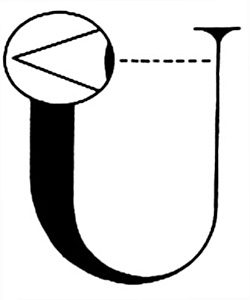
This reminds me of a simple cartoon drawn by famed quantum cosmologist John Wheeler, which shows a U-shape with an eyeball at one tip, which is looking at the other tip as a representation of the big bang (Rudy Rucker discusses the cartoon in this blog entry): the question Dr. Wheeler is asking with this cartoon is "Does looking back "now" give reality to what happened "then"? This relates to discussions we've had here: the startling implication of all this is that not only are there many branching possibilities from the "now" forward in time, but there are also many branching possibilities back to the beginning of time as we experience it. While in my book I ask the reader to only acknowledge that these branches exist both forward and back, and that the simple "line of time" we look back upon is only one of many that could have got us here, the implications from these quantum physicists is even stranger: they are indeed saying that not just the present, not just the future branches, but the past as well can be changed by observation!
This cartoon is also discussed in Quantum Enigma:

The provocative sketch has not lost impact. At the recent conference honoring Wheeler on his 90th birthday, a keynote speaker introduced his talk with Wheeler's sketch.
The anthropic implications of his diagram must have been a lot even for Wheeler to buy. After asking the above question, he immediately added the comment: 'The eye could as well be a piece of mica. It need not be part of an intelligent being.' "
My song The Unseen Eye talks about these same ideas:


And of course, my song The Anthropic Viewpoint talks about those implications contained within this sketch as well: to again quote from Quantum Enigma, "...the strong anthropic principle asserts the universe is hospitable to us because we could not create a universe in which we could not exist." Or as I put it in the tongue-in-cheek chorus to my song, "The reason we're here is because we're here":


Which leads back to the idea that memes rise and fall, and that synchronicity may or may not be the universe communicating memes to us, but in either case the connections that our wonderful pattern-oriented brains make are very real, because that's what brains are designed to do. Next blog entry I am going to talk about two magazines that arrived in my mailbox yesterday (another bit of synchronicity), and the connections that I see in those magazines and this project to the idea of "Boredom and Consciousness". My song "Automatic", which is about Julian Jaynes' theories of the bicameral mind, is also going to figure prominently into where we go with this discussion:


Enjoy the journey,

Rob Bryanton

Click here to continue on to Boredom and Consciousness Part Two

Tenth Dimension Vlog playlist