a new way of thinking about time and space ~ ~ ~ ~ ~ ~ ~ ~ ~ ~ by Rob Bryanton
--author and research scientist David Jay Brown says: "one of the most brilliantly-conceived and mind-stretching books that I've ever encountered".
--science fiction author Greg Bear says: "a fascinating excursion into the multiverse - clear, elegant, personal and provocative"
The above video accompanies my previous blog entry Just Six Things, which was published earlier this year. It connects to the video we looked at last time in Bees and the LHC, in which we considered the possibility that bees can somehow perceive the sixth dimension (as has been proposed by a scientist analyzing the "waggle dance" they perform to communicate to each other), and the controversial leap I made that perhaps the declining bee population of the world is connected to their sixth-dimensional perception.
In entries such as Just Six Things, I've been relating the quantum mechanics concept of there being a wave function of all possible states for our universe to my way of describing the sixth dimension, the entirety of which then becomes a point in the seventh dimension, which gives our universe a certain location within the multiverse landscape. Thinking that there is a set of all possible states that already exists for our universe leads some back to the idea that free will is an illusion, since within that wave function we can see that everything that can happen already has happened from the perspective of timelessness.
Everett's "Theory of the Universal Wavefunction" (also referred to as "Many Worlds") is the way out of this quandary, which brings us to today's topic.
A YouTube user named Lee Ann recently asked me a question about time travel paradoxes, and here's how I responded to her:
Hi Lee Ann, that's a great question.
I subscribe to Everett's Many Worlds Interpretation of quantum mechanics, because it allows a logical consistency to such discussions, and avoids the Grandfather Paradox issues. I presume you're familiar with the Grandfather Paradox where someone goes back in time, kills their grandfather, which means they were never born, so the grandfather is not killed, so the person is born and goes back and kills the grandfather, and so on?
Everett's interpretation makes more sense to me. So to answer your question specifically, assuming reliable time travel technology now exists it's December 2010 and you and your son climb into your time machine. There will be two main branches of you created now: the one where you go back in time (B) and the version that said "I choose not to go back in time" (A). Version A continues on with their life, no time travel occurred so things happen accordingly with their life from there on.
Version B goes back to 1992 and does something - carves their name in a tree, blows up their house, whatever you care to imagine. They could meet with and talk to themselves --the 18 years younger versions of themselves-- but in doing so they would be creating a new timeline, a version C of themselves who in December 2010 remembers that time 18 years ago when the time travelers appeared.
Does version A ever see the carving in the tree? No. Does version B become the 18 years younger version of themselves when they travel back in time? No. And as time travelers are they able to cause things to happen like causing their parents to never fall in love so they're not born (a la Back to the Future)? No.
In fact, here's a couple of paragraphs from my book on the Back to the Future question:
It should be clearer now that "Back to A Future" might have been a better title for this movie trilogy, since anyone who goes into their own past will never be able to get back to the present they had started from--because in that present time they started from they had never traveled to their own past. Their action of traveling to the past automatically puts them on a new timeline, the one where they had been in their own past, which might end up arriving at a present extremely similar to their original timeline, but is more likely to be completely different. Paradoxes such as this are built into any discussion of time travel--but agreeing that all possible pasts and futures really do exist is still easier to deal with than the alternative, which would be to imagine that there is only one real timeline and every aspect of the past and future is already carved into stone. If each of us is correct in our belief that we have free will, then the future must be filled with options, not just a single track.
There could be a whole other set of "Back to A Future" movies created where the inherent paradoxes are explored--for instance there is the plot where Marty travels to the new and improved future (the ending of the original movie), and discovers a family and friends who have lived a happy life with some other "timeline twin" of Marty, who we will call "New Marty". "Old Marty" realizes that "New Marty" must exist, because otherwise his new and improved family wouldn't have recognized him, and would have chased him out of the house as a stranger. So "Old Marty" has a gruesome task ahead of him: he must find and kill "New Marty" and dispose of the body before anyone finds out they both exist. The rest of the movie would entertain us with the hilarious slip-ups as "Old Marty" then tries to interact with his new and improved family despite never having shared any of their past years together.
Next time we're going to discuss one of my favorite blog entries of 2010, which finally has a new video up on YouTube: the entry will be called Gravity and Love.
Last time, in Psychedelics and Spacetime, we discussed the aspects of our reality that come from extra dimensions, and whether it's possible for us to perceive those additional spatial dimensions which, by definition, are at additional sets of "right angles" to our 4D spacetime. In the next few entries we'll look at some poll questions that have explored concepts related to "tangential thinking".
Poll 69 Poll 69: "Are bees more sixth-dimensional"? Poll ended August 9 2010. 40.5% said yes, while 59.5% said no.
For somebody reading this poll by itself, I realize this must have seemed like a very strange question indeed! My blog entry "Are Bees More Sixth Dimensional" should make the reason for this question more clear. In that entry, we looked at an article about a fascinating theory proposed by Barbara Shipman, a mathematician at the University of Rochester. Dr. Shipman analyzed the complex dance patterns bees use to indicate the position of new sources of food to each other. She discovered that the geometric patterns the bees use in the dance made sense if they were analyzed using a "sixth dimensional flag manifold", an analysis method also useful in solving some of the mathematical problems that arise in dealing with quarks. Please read the entire article, it presents some amazing insights.
In Psychedelics and Spacetime, we looked at Terence McKenna's passionate proposals that primitive creatures were by nature more aware of the extra patterns that are "outside" of our spacetime, and that as organisms like us evolved to become more complex, there was an evolutionary advantage afforded by narrowing our focus down to just the "here" and "now" of our current position within spacetime. Being connected to the cosmic "all" could well be a distraction when what you really need to do right now is focus on the hungry predator hiding just beyond those bushes!
If bees really are using sixth-dimensional geometry to communicate with each other, could this be an example of a creature who found a way to utilize a part of this extra-dimensional awareness that McKenna suggests was actually the more natural mode of existence for living creatures? Could the numerous scientific studies coming out recently indicating that the cells within our bodies seem to be having "conversations" with each other be examples of how the simpler components of a living creature are still more plugged into these extra-dimensional patterns? And might the nearly instantaneous neuronal patterns related to the formation of memory which we looked at in Entangled Neurons also be an indication that we still use extra-dimensional patterns within our brains even if we're not conscious of those actions?
We've talked before about Stephen Hawking's famous quote:
I still believe the universe has a beginning in real time at the big bang. But there's another kind of time, "imaginary time", at right angles to real time, in which the universe has no beginning or end.
What is Hawking's "imaginary time"? I would say that if it's at right angles to our 4D spacetime, then it must be the fifth dimension. While I understand his use of "time" and "imaginary time" to convey these fourth- and fifth-dimensional ideas to the public, they do create some confusion. Calling the fourth dimension "duration" rather than time, and the fifth dimension our "probability space" has been my suggestion for making these concepts more clear, something that we explored in more detail in "Aren't There Really 11 Dimensions?".
So perhaps Stephen Hawking is more fifth dimensional, but bees do him one better by being more sixth dimensional? An interesting thought!
What if there were only six vectors needed to describe every aspect of our universe in its current state, and every possible version of our universe from its very beginning to its ultimate end? Last month, in Three Becomes One, we returned to the idea that all six dimensions become a "point" -- indicating a position within the multiverse landscape -- in the seventh dimension and above with my approach to visualizing the extra dimensions, and that's why the fine structure constant and basic physical laws stay locked in and unchanging for our particular universe. Last entry, in Are Bees More Sixth-Dimensional, we took a look at a variety of ideas related to six-sided shapes, six dimensions, and the mind-blowing theory that honey bees are using sixth-dimensional geometry to communicate the positions of new food sources to each other.
Six has been an important number to this project since its inception. In fact, back in 2006 I bought the domain name justsixthings.com, because I was thinking that might be a good name for my next book. I also bought just6things.com and 6things.ca because they were available and seemed like possibly useful variations. 6things.com was taken though, and as I mentioned last time, that's the new website that I'd like to talk about in today's entry.
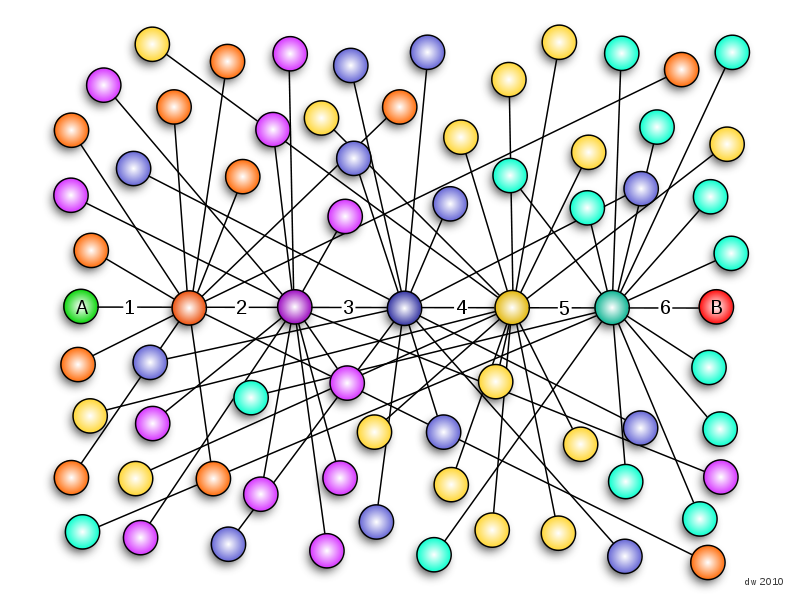
The six degrees of separation concept is interesting in the way it ties into our discussions of connectedness and the nature of reality, but it has other uses as well: many different projects have found ways to use this idea as their launching pad. For instance, SixDegrees.com was an early social networking site that ran from 1997 to 2001, and at the peak of its popularity it had one million registered users. Six Degrees of Kevin Bacon is a trivia game that suggests no matter what actor you name, you should be able to use six steps or less to find a connection to Kevin Bacon. In 2007 Kevin Bacon started a charitable giving site called SixDegrees.org to show how this concept can be used to make people's lives better.
Here's the logo for 6things.com. You'll see that the slogan here is recursive as you go round and around the circle: "six things you like from the six things you like from the..." and so on. 6things.com is a "relevance engine". Here's what they say about the project from a recent press release:
6things you like in 6 minutes Everyday.... 6things is a relevance engine, that is a perfect solution for information overload, without losing time.
6things.com is a non-linear innovation, in that it * Provides 6things you like from 6,844,647 things * Eliminates the need to maintain yet another account * Improves signal-to-noise ratio by deducing your 'micro-interests' * Reduces wasted time by kicking you off in 6 minutes
Even if the user did not share enough content, no worries. Simply press on one of the 6 Buttons up on top, that captures your interest.
Passively discover curators with similar taste, without actively searching for them. Our Algorithms computes the 'taste distance' between you and others based on 'micro-interests'.
Passively consume real-time content that is your current object of attention, without actively searching for 6,844,647 things. Our Machine Learning Algorithm extracts your 'micro-interests' from your shared content.
You don't have to remember yet another password or have to signup. The product can be accessed from http://www.6things.com
Here's three twitter feeds for you: 6things (the project's feed), vasusrini (creator of the project), and samdida (co-creator and designer). I've not heard the term "relevance engine" before, but I do like the concept. Stumbleupon, for instance, could be thought of as a user-driven relevance engine, and that service continues to be one of the most popular ways for people to find my 11-minute animation about the ten dimensions. Likewise, I've talked a number of times about web 3.0 pioneer Nova Spivack and his brainchild twine.com, which uses a combination of user recommendations and the semantic web to filter out the signal from the noise for people trying to deal with The Stream. "The Stream" is what Mr. Spivack calls the oncoming deluge of information we're all having to deal with more and more each day.
In the early months of this blog (back in 2007) I was using the phrase "conceptual framing" a lot, which relates to these discussions. We tend to think in frames, we don't do so well imagining an atom and a galaxy at the same time, but if we take ideas one step at a time, one frame of reference connected to the next, we find it easier to process. Will 6things.com achieve its goal of providing relevant new links in an extremely timely manner? The project is just in beta right now, but it seems like a great idea and I look forward to watching them grow.
Here are six other past blogs where I've talked about the "Just Six Things" concept and the importance of the number six:
Six is an interesting number that we haven't talked about as much recently with this project. Coincidentally, last week we looked at Philip Zimbardo's The Secret Powers of Time, where he suggested that there are six possible ways for people to interface with time: awareness tends to be oriented towards positive or negative versions of past, present, or future.
With my approach to visualizing the dimensions, our universe has six dimensions to express all possible versions of itself, and all of that becomes a single "point" in the seventh dimension: we looked at this most recently in "Our Universe as a Point". A couple of years ago here at the Imagining the Tenth Dimension blog, in an entry called Time is a Direction, I had this to say about the number six:
"Do a google search on the words 'six directions' and you will see how deeply embedded that concept is into various spiritual/metaphysical systems. Do a google search on 'six dimensions' and you will find an interesting mix of musings about business/social connections (the six degrees of separation concept), geometry/physics, and other discussions about the nature of reality from the viewpoint of ancient spiritual systems."
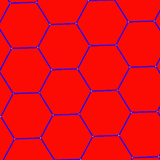
In Three Becomes One, we looked at various geometric patterns that can be derived from the triangle, and the images we're looking at here come from the wikipedia article on hexagons, which are six-sided polygons. The image at left is a hexagram, created by superimposing two triangles. A six-sided hexagon appears in the middle of this shape, and can also be created if you draw new lines joining the six outer points of this shape.
As you'll see if you spend some time examining the different patterns shown above, the idea of triangles being pushed apart from a central point into a symmetrical pattern from which other shapes emerge can be seen time and again in these images, and of course all of this is old hat to fans of sacred geometry.
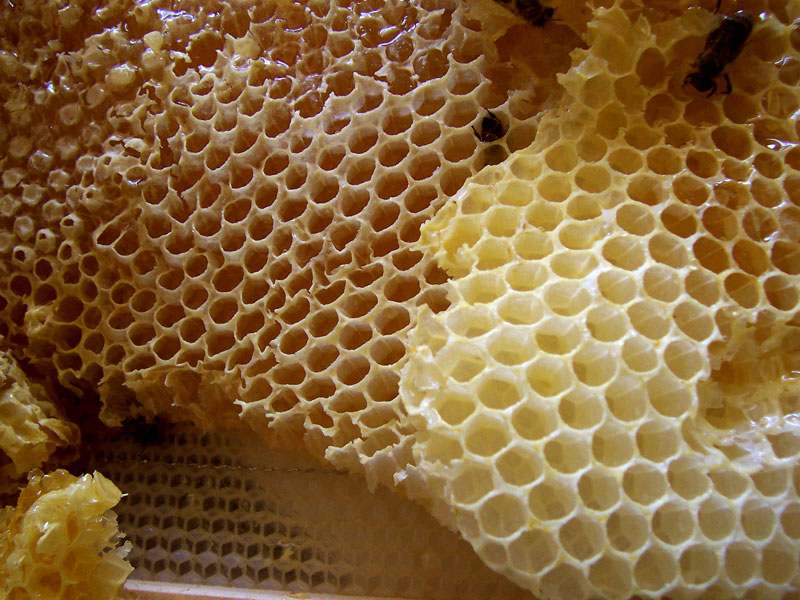
The six-sided hexagon is not just an abstract concept from your geometry class: it appears in nature as well. Here are some pictures demonstrating that.
First of all, one of the most obvious ones: the hexagons of a beehive's honeycomb. Then, the six-sided scutes of a turtle's carapace.
Next, at left we see a North polar hexagonal cloud feature on Saturn, discovered by Voyager 1 and confirmed in 2006 by Cassini; and at right we see naturally formed basalt columns from Giant's Causeway in Ireland.
Hexagons also appear in snowflakes, and even at the molecular level in various compounds.
In Are Animals and Kids More Fifth-Dimensional?, we discussed something that can be connected to The 5th-Dimensional Camera Project, which is a more recent entry looking at one of the central ideas to my project which has now received some support from scientists at Oxford University: the fifth dimension can be thought of as our probability space. The wave function of potential pasts and futures that connect to our "now" is a pattern in the fifth dimension which we are potentially connected to through chance and choice, Everett's Many Worlds.
Being able to see fifth-dimensionally, then, would be to see all the possible world lines that are causally connected to a particular instant of our spacetime universe. And someone who is more connected to the past and future through intuition, inspiration, creativity, deja vu, clairvoyance, and so on, could be said to have a more fifth-dimensional awareness.
Seeing sixth-dimensionally, on the other hand, would be seeing all the possible versions of the universe you are within, including the versions that are not causally connected - like the one where you pop out of existence here and reappear on the moon, or the one where it's 2010 and Michael Jackson is still alive. The sixth dimension is the complete Quantum Field for our unique universe, including those outcomes which we acknowledge must exist as possible versions, but which would take longer than the existence of the universe for us to observe. Can any living creatures see sixth-dimensionally?
In this article, we see a fascinating theory proposed by Barbara Shipman, a mathematician at the University of Rochester. Dr. Shipman analyzed the complex dance patterns bees use to indicate the position of new sources of food to each other. She discovered that the geometric patterns the bees use in the dance made sense if they were analyzed using a "sixth dimensional flag manifold", an analysis method also useful in solving some of the mathematical problems that arise in dealing with quarks. Please read the entire article, it presents some amazing insights.
According to many sources there are now 30% less honeybees in the world than there were in 2006. Are bees more sixth-dimensional? Perhaps they are. Why, then, have bees been disappearing from our planet in record numbers for the last four years? That's an intriguing question, and the subject of a number of books that have come out in the last year, including Fruitless Fall, The Hive Detectives, and A World Without Bees. Are bees our sixth-dimensional canaries in a coalmine, warning us about environmental catastrophes that we need to avoid, and that in some sixth-dimensional versions of our universe, have already not avoided?
We'll continue this exploration next time as we talk about a new company exploring the world of connected ideas, who are using a honeybee as their logo: 6things.com .
In "Life is But a Dream" we discussed the surprising conclusion that not just philosophy but quantum mechanics tells us each of us is an observer at the center of our own particular version of the universe. Likewise, cosmology tells us that we are at the center of the known universe, and this lovely new video from the American Museum of Natural History takes us on a journey from the planet earth out to the huge bubble of the cosmological horizon, the bubble that we are always at the center of.
As it says in the above video at the 3:36 mark, this cosmological horizon is not only a 3D space object, but a 4D spacetime object. Because space and time are so intimately connected for us, we have to keep reminding ourselves of this important fact: we look out into space and it's so easy to forget that we are looking back in time as we do so. We've talked about this idea in blogs like An Expanding 4D Sphere, What's South of the South Pole and What's Around the Corner. Taking this idea even further leads to blogs like The Biocentric Universe Part 2, which is about a scientific theory stating that without life there is no time, space, or the cosmos, an idea which some people strongly dislike because it feels like a return to the geocentric model - hasn't it been proven long ago that the universe does not revolve around the earth? And yet the above animation shows that in a real sense it is true that we are at a point right at the center of the known universe, and that an observer ten billion light years away from here would have the same experience, seeing themselves to be right at the center of their own version of the universe.
Let's work through my approach to visualizing the spatial dimensions again keeping the above ideas in mind.
"In science, a physical picture is often more important than the mathematics used to describe it."
Zero - a Point We start with a point of indeterminate size. Like the point we know from geometry, this point has no size, no dimension: which means we can think of it as being infinitely large, or infinitesimally small. What does it mean if we say a point's size is not just very very small or very very large, but indeterminate? If we consider every size of this point simultaneously, all of the possible values cancel each other out, and we end up in what physicists call the "underlying symmetry state": a perfectly balanced zero, which contains within it the unobserved potential of all other states. One good word to describe this "set of all possible states" when it's considered simultaneously like this is the omniverse.
Now, let's imagine that you are that point of no size, no dimension, and think about how a point is useful for indicating a position within a system, and how our universe or any other springs from a breaking of that underlying symmetry state.
"In my beginning is my end"
- T. S. Eliot, from his poem East Coker published in 1943
One - a Line You are a point on a one-dimensional line. Your options are very limited - you can move forward, you can move backward, there are only two directions you can travel. But here's another fact to consider: because you are a point of indeterminate size, you can imagine yourself as being an infinitely tiny point someplace on that line, or you can imagine yourself as an infinitely large point some place on that line, which means you would encompass the entire line. Since a line extends to infinity in both directions, making yourself this large would allow you to see how it doesn't really matter where you are on the line, because ultimately you can end up in the same place: the enfolded symmetry of all possible positions on that line considered simultaneously.
Now let's add some other spatial dimensions. But to keep our frame of reference, let's imagine that no matter how many other dimensions we add, this very first point on this very first one-dimensional line we've just looked at will always be the same one.
"Blue is blue and must be that, but yellow is none the worse for it"
from a poem by Michael Nesmith (attributed to his fictional character Carlisle Wheeling) printed on the back cover of the 1968 record album The Birds, The Bees & The Monkees
Two - a Plane Okay, so here we are now in a two-dimensional plane. Our point on our original line continues to have its forward and backward directions, but now there are two new directions at right angles to the first set that we can use to view that line and that point from. Regardless of where we go in our 2D plane, we can still always see that 1D line as a subset of that plane. And if we now imagine our point as being infinitely large it will encompass the entire plane and end up in that very same place once again - infinity, indeterminacy, the omniverse.
Way back in 1884, Edwin A. Abbott wrote a book called "Flatland: a Romance of Many Dimensions". In it, he introduced the world to the concept of imaginary creatures called "flatlanders" living in a flat, two-dimensional world.
Humans and the rest of the matter in our universe are all made out of 3D atoms and molecules, so we often say that we live in a three-dimensional universe. If you were a 2D flatlander, you would have a much more limited range of motion - you could only move in four directions rather than the six that 3D people are used to, and if you were to look at a circle you would not be able to see inside it. In fact, because you would be living within this 2D plane, all that you would see as you looked around you would be lines all constrained within this flat 2D world: some of those lines would be near, some would be further away, and whatever shape was closest to you would keep you from being able to see any other shapes that were further away. The only way that you could deduce you were looking at a circle, then, would be to move around it and see it against the background of the other more distant shapes.
"No matter where you go, there you are".
- Although this phrase has been attributed to various sources, many people know this as a line from the 1984 movie Buckaroo Banzai.
Three - a Space Now let's move to the dimension we're most familiar with, the third. If we go back to thinking about you as a point at that position we started from, there are now six directions you can view yourself from. You can still be infinitesimally small, but now when you expand you will become a 3D sphere that eventually grows so large that it encompasses infinity. You can think of that point as your awareness of the universe at this very specific "now", and that awareness can be as broad or as tight as you care to make it - because you are right at the center of this particular version of the universe, right at this very instant.
What we have just imagined is like a gigantic photograph of our universe at a particular instant. Because light takes a certain amount of time to get here, that photograph is different from what you see when you look through a telescope - because the light from those distant objects takes so long to get here, a telescope is like a way of looking back in time. The further away the star or the galaxy, the longer it took for the light to reach us. Thinking of you as a 3D point of infinitely large size requires us to think of something completely different - if a star is ten light years away, then the photograph we're thinking about here will show us how that star will look to us through a telescope ten years from now! This is a very important difference in what we're imagining here.
"Time may change me, but I can't trace time"
- David Bowie, from his 1971 song "Changes"
Four - a Line Thinking of that entire snapshot of the universe as a single point, then, allows us to imagine how the fourth dimension would be a way of joining one snapshot, one "now", to another, and this is how some people come to think of the fourth dimension as being "time". There are two things wrong with that generalization - first of all, "time" is not a spatial dimension, it's just a way of describing change. At best, it's a direction, not a full dimension. And secondly, you can think of any dimension in a particular state, think of that dimension in a different state, and think of how the next dimension up would be how you change from one state to another. For a 2D flatlander, then,"time" would be one of the two possible directions in the third dimension, and it would be how our imaginary 2D creature changes from state to state.
For a 3D person, time is one of the two possible directions in the fourth spatial dimension, and the other opposing direction can be called "anti-time". If you are a point, you can be any place on that line, and you can be infinitesimally small, or you can be infinitely large, which once again would show you that ultimately this spatial dimension is just like all the others - you can imagine that eventually you can grow to encompass the same state at either end of the line, and we use words like infinity, eternity, and enfolded symmetry to discuss what you are heading towards in both directions.
"The further back one looks, the further ahead one can see"
- a decidedly fifth dimensional way of viewing reality commonly attributed to Winston Churchill
Five - a Plane As I've always said, my proposed way of visualizing the dimensions is not the explanation for string theory, but it does have many interesting tie-ins to various schools of thought. The starting point for string theory came from Theodor Kaluza back in 1919, when he proposed that the field equations from gravity and electromagnetism are resolved when they're calculated in the fifth dimension. Einstein eventually embraced this startling new theory and gave it his full support in 1921. With additional input from Oskar Klein, the resulting Kaluza-Klein theory became the starting point for the exploration of how our reality comes from extra dimensions that rose to dominance in the closing decades of the twentieth century.
Here's something to consider - if there really are ten spatial dimensions, then the fifth dimension is the halfway dividing point.
In the original tenth dimension logo we see the "zero" and the "ten" as being the two extremes of a line, and if we were to think of that line as being like a guitar string then the "five" would exactly divide that string in half, with 1,2,3, and 4 being part of a wave below, and 6,7,8 and 9 being part of a complimentary but opposing wave above. Persons familiar with my book will recognize the following diagrams. The three images below were accompanied by the following text:
a. The concept of "harmonics" might be more familiar to anyone who has played a stringed instrument. When you pluck a string on a guitar or violin, the action is not as simple as you might imagine. While it might appear to your eye that the string is simply moving back and forth to describe a gentle curve that is widest at the middle of the string, there are other vibrational patterns that are also part of the string's motion, and the proportion of those other vibrational patterns is what gives each instrument its unique timbre. b. We can more clearly see the other competing patterns by lightly touching the string at various points along the string when we strike it, and we call these other vibration modes "harmonics" or "partials'. So, by touching the string at its half way point we cause the perceived note to jump up an octave, and a high speed photograph would show us that the string is now vibrating in a pattern that describes two equal curves rather than one, with each curve occupying half the length of the string. The point we touched in the middle of the string would now appear to not be vibrating, and we can call that point a node. c. Now, if we touch the string at the one third point we can create a note which is an octave and fifth higher, which would be the next harmonic, and our high speed photograph would show the string now vibrating with two nodes dividing the string into three equal sections. Dividing the string at the one-quarter mark produces a note two octaves up, and so on up through a series of harmonics, all of which are part of the main vibration of the open string when we pluck it.
Looking at the second of the three images above then, helps us to imagine the symmetry we're thinking about here - when the left hand side of that waveform is going up, the right hand is going down, and so on. But let's be clear here: even when the string is vibrating freely as in the top image, all those other vibration modes are happening. A high-speed strobe light set to very specific frequencies would be able to reveal (though interference between the frequency of the strobe and the patterns of the vibrating string) the other vibration modes such as the two we're picturing here.
What does all this have to do with the fifth dimension? In entries like The Flipbook Universe, Slices of Reality,and The Holographic Universe, we keep returning to the idea that our reality is not continuous, and our experience of the fifth dimension is divided into planck-unit-sized "frames" (which is what leads some physicists to say that the fifth dimension is "curled up at the planck length"). Those planck frames are the "strobe light" that reveals how freely moving patterns that exist across the dimensions contain a node at the fifth dimension, the strongest harmonic as pictured in the middle of the above three images. Since holograms are observed through interference, when a cosmologist says "our spacetime universe is the shadow of a fifth dimensional hologram" that is what we're talking about here.
Imagining then, that anything above the fifth dimension is how we get to the other versions of our universe that don't connect to the one we're currently in, and to the other universes that have different basic physical laws, and even the patterns of information that are not part of our underlying reality, is all part of what this particular visualization should help us to hold in our minds.
And likewise, just as we did with the previous dimensions and could continue to do with each additional spatial dimension beyond this one, we can imagine how the "point" that represents us in our current state within the fifth dimension could be infinitesimally small, or infinitely large, or some place in between, and this is how I suggest our reality is really connected together in ways that seem much less mysterious when we realize that what we are observing is defined at the fifth dimension rather than the fourth. For more about all that from a variety of perspectives, please check out blog entries like The Fifth Dimension is Spooky, Creativity and the Quantum Universe, The Statistical Universe, and Now vs. the Future.
Last time, in "A Hug From Another Dimension", we returned to Edwin Abbott's imaginary 2D creatures, the flatlanders, and the idea that a 3D person passing through the flatlander's plane would appear very strange indeed to the flatlander. It has been rightly pointed that in my original 11 minute animation I show the flatlander world not as they would see it, but as we would see it viewing from "above" their plane. While that perspective is boggling enough, the "lines all in the same plane" that a flatlander would really see is even more difficult for people new to these concepts to try to imagine.
Why do we talk about flatlanders? Because with this project we're talking about spatial dimensions: the ways that our 3D reality relates to the flatlander's 2D reality gives us some useful clues to the relationship between any spatial dimension and the next. Since the extra dimensions beyond spacetime that physicists talk about are all spatial dimensions (or "space-like" as some prefer to say), thinking about how the simplest spatial dimensions relate one to another gives us tools for imagining the more complex ones. The key to remember with all this is that each additional spatial dimension is at "right angles" to the one before: so each new dimension allows an observer to see "around the corner" in a way that was unattainable from the previous dimension. This time, let's work through the dimensions with that idea in mind.
0
We start with a point of indeterminate size. We can imagine this point to be any size we choose, and it can exist in any dimension. Let's say that's all you really are - a point. What will it be like for you to exist within each of the spatial dimensions?
1
You are a point on a one dimensional line. You can look in either direction on your line, but whatever's nearest to you obscures your ability to see anything beyond. If there were nothing else on your line to get in the way, you would be looking towards infinity in either direction.
What if you wanted to see what lies beyond any nearby objects on your line? You would need a way to move on your line. For you, "time" would be a direction in the second spatial dimension, and it would be what you use to change from state to state, from position to position, which would allow you to see "around the corner" to what lies beyond. Think about what the third dimension would be like for you on this one dimensional line - it would be omni-directional, all around you.
2
Now you're a point on a two-dimensional plane. You can look in four directions on your plane, and the new directions are at "right angles" to the previous ones. If there were nothing else on your plane, you would be looking towards infinity in four directions.
What if there were nearby objects that were obstructing your view and you wanted to see around them? You would need a way to move within your plane. For you, "time" would be a direction in the third spatial dimension, and it would be what you use to change from state to state, from position to position, which would allow you to see "around the corner" to what lies beyond. Think about what the fourth dimension would be like for you on this two dimensional plane - it would be omni-directional, all around you.
3
Now you're a point within a three-dimensional space. You can look in six directions from within your space, and the new directions are at "right angles" to the previous ones. If there were nothing else within your space, you would be looking towards infinity in six directions.
What if there were nearby objects that were obstructing your view? Since we're already living in a 3D world, this is the easiest for us to picture. If that object were a building, for instance, and you wanted to see what was on the other side of the building, you would need a way to move within your space. For you, "time" would be a direction in the fourth spatial dimension, and it would be what you use to change from state to state, from position to position, which would allow you to see "around the corner" to what lies beyond. Think about what the fifth dimension would be like for you within this three dimensional space - it would be omni-directional, all around you.
Up to now this has been fairly simple to visualize, because we're so familiar with these dimensions from our basic day-to-day experience. But this logic continues to work all the way up. Understanding what that means to us is an important key to understanding the connections between the quantum world, Everett's Many Worlds Interpretation, and the multiverse landscape.
4
Now you're a point within a four-dimensional "hyperspace". You can look in eight directions from within your hyperspace and the new directions are at "right angles" to the previous ones. If there were nothing else within your hyperspace, you would be looking towards infinity in eight directions.
What if there were nearby objects that were obstructing your view and you wanted to see around them? You would need a way to move within your hyperspace. For you, "time" would be a direction in the fifth spatial dimension, and it would be what you use to change from state to state, from position to position, which would allow you to see "around the corner" to what lies beyond. Think about what the sixth dimension would be like for you within this four dimensional hyperspace - it would be omni-directional, all around you.
If we think of the quantum wave function for our spacetime as existing within the fourth spatial dimension, we are in one of the "worlds" of Everett's Many Worlds Interpretation, and another phrase for what obstructs our view beyond our spacetime would be the cosmological horizon. For people who believe there is nothing more than the fourth dimension, it can be easy to assume that free will does not exist and that there is only one "world", one inevitable version of our universe which exists from its beginning to its end. If there's really nothing more beyond the fourth dimension then we are all like riders on a train, unable to change whatever we're about to observe. What if we wanted to get off that train track and see what lies beyond, see what other "parallel universe" versions of our universe are out there? The same logic continues to apply, so that's the fifth dimension. Because those other worlds are causally connected to our current one by the probabilities of the quantum wave function along with the choices that are made, let's call the fifth dimension our "probability space".
5
Now you're a point within a five-dimensional probability space. You can look in ten directions from within your probability space and the new directions are at "right angles" to the previous ones. If there were nothing else within your probability space, you would be looking towards infinity in ten directions.
What if there were nearby objects that were obstructing your view and you wanted to see around them? You would need a way to move within your probability space. For you, "time" would be a direction in the sixth spatial dimension, and it would be what you use to change from state to state, from position to position, which would allow you to see "around the corner" and see what lies beyond. Think about what the seventh dimension would be like for you within this five dimensional probability space - it would be omni-directional, all around you.
So what does "obstructing your view" mean when we're in a five dimensional probability space? Here's a couple of examples. Because the probabilistic outcomes for our universe's wave function of possible state are causally connected, no matter where we are in the fifth dimensional version of our universe there are going to be parallel universe versions which are "around the corner" and can't be seen from our current position. For instance, the version of our universe where it's 2010 and Elvis is still alive must exist within the set of all possible states, but no amount of choice or chance will allow us to see that version from here - it's just like our inability to see what lies on the other side of a building, we need to use the next dimension up to move to a different position if we want to be able to see that version of our universe. Also, quantum physicists talk about the wave function of our universe including the possibility of extremely unlikely events -- like one of us now disappearing here and reappearing on the moon. Why do we never see such events? Because they are like seeing the other side of a building: we need to move through the sixth dimension to be able to see that version of our universe, because those events lie outside of our cosmological horizon.
For we spacetime creatures our actual "now" is always really a point in the fifth dimension, being observed one planck frame at a time. This is why physicists suggest that the fifth dimension is "curled up at the planck length": not because the fifth dimension is small, but because the granular nature of spacetime only allows us to view the fifth dimension through our tiny little planck-length window. We look around us and see what feels like a solid, continuous reality, but physicists are now proving that this is an illusion. The fact that our spacetime reality is divided into planck-length "frames" is also part of the recent theories suggesting that our 4D universe is actually the shadow of a 5D hologram!
Now, as we move on to think about the sixth dimension we are thinking about the wave function for All Possible States for our particular universe. This wave function includes all the possible states for our universe, including those which are not causally connected to each other: the version of universe where it's 2010 and dinosaurs aren't extinct should have some possibility of existing, but that version is not connected to our own version of 2010. Because both chance and choice are participants in choosing what version of the universe we observe, this 6D space for our universe also would include versions of the universe that each of us would never choose to observe (like the one where I go crazy and kill my neighbors). And as we said, it also includes the states which we can't observe because the event is so unlikely it would take longer than the existence of the universe for the event to occur (like the version where one of us now disappears from here and reappears on the moon).
6
Now you're a point within a six-dimensional wave function space. You can look in twelve directions from within your wave function space and the new directions are at "right angles" to the previous ones. If there were nothing else within your wave function space, you would be looking towards infinity in twelve directions.
What if there were nearby objects that were obstructing your view and you wanted to see around them? You would need a way to move within your wave function space. For you, "time" would be a direction in the seventh spatial dimension, and it would be what you use to change from state to state, from position to position, which would allow you to see "around the corner" and see what lies beyond those nearby obstructions. Think about what the eighth dimension would be like for you within this sixth dimensional wave function space - it would be omni-directional, all around you.
What's outside of our wave function space? By the time we've imagined every possible state for our universe, no matter how unlikely some of those states might be, haven't we got everything covered? In other words, what's hidden from view within a point in the sixth dimension? Now we're starting to think about the multiverse landscape of other universes with different basic physical laws from our own. Up to now, no matter how we twisted and turned in the dimensions we were in, we were always confined to our universe, with its specific value for gravity, its specific planck length and speed of light. To look "around the corner" and see one of those other universes, we need to move through the seventh dimension.
7
Now you're a point within a seven-dimensional multi-universe space. You can now look in fourteen directions, and the new directions are at "right angles" to the previous ones. If there were nothing else within your multi-universe space, you would be looking towards infinity in fourteen directions.
What if there were nearby objects that were obstructing your view and you wanted to see around them? You would need a way to move within your space. For you, "time" would be a direction in the eighth spatial dimension, and it would be what you use to change from state to state, from position to position, which would allow you to see "around the corner" and see what lies beyond. Think about what the ninth dimension would be like for you within this seventh dimensional space - it would be omni-directional, all around you.
String theory suggests that our universe is embedded in a seventh-dimensional "brane". What if you moved to a different seventh dimensional brane to observe a completely different universe? Would that be the same as moving to a different 7D "point" within this way of visualizing the dimensions? That's what I'm suggesting. A different "point" might define a universe with a different strength for gravity, or a different speed of light. So once we defined any arbitrary second "point" there would be a line that passes through our point and this second one, but there would still be a huge number of other universes that would not be on the unique line we had just created. To get to those other universes not on our 7D "line" (a line that exists within a space defined by 7 pairs of directions all at right angles to each other!) would require us to travel through the 8th dimension. By the time we get to the 8th dimension, then, we are able to consider all possible universes that could have a physical expression, so what we're talking about by now is also sometimes called the "multiverse landscape".
8
Now you're a point within an eight-dimensional multiverse space. You can look in sixteen directions from within your multiverse space and the new directions are at "right angles" to the previous ones. If there were nothing else within your space, you would be looking towards infinity in sixteen directions.
What if there were nearby objects that were obstructing your view and you wanted to see around them? You would need a way to move within your space. For you, "time" would be a direction in the ninth spatial dimension, and it would be what you use to change from state to state, from position to position, which would allow you to see "around the corner" and see what lies beyond. Think about what the tenth dimension would be like for you within this eight dimensional space - it would be omni-directional, all around you.
Although Garrett Lisi's E8 rotation is not usually described as being a way to represent actual spatial dimensions, I think it's fascinating that his theory also suggests that interlocking 8 dimensional patterns would be able to describe any particle in our universe. What do we need to go beyond the 8th dimension for? Because there are still other ways of organizing the information that becomes reality that don't actually become physical realities (for more about the "Information Equals Reality" concept, look up digital physics).
That's why it's useful to think of the ninth dimension as being our information space.
9
Now you're a point within a nine-dimensional information space. You can look in eighteen directions from within your information space and the new directions are at "right angles" to the previous ones. If there were nothing else within your information space, you would be looking towards infinity in eighteen directions.
What if there were nearby objects that were obstructing your view and you wanted to see around them? You would need a way to move within your space. For you, "time" would be a direction in the tenth spatial dimension, and it would be what you use to change from state to state, from position to position, which would allow you to see "around the corner" and see what lies beyond. But because there are no actual physical objects within this nine-dimensional space, only information patterns, things are much more open-ended here, and in that sense the tenth dimension is also all around, and omni-directional to the ninth dimension.
In this way of visualizing the dimensions, we sometimes talk about the ninth dimension as being where the "big picture memes" reside: these would be the general organizing patterns that could result in a universe as specific as ours, or it could be an organizing pattern that expresses a preference towards one kind of order over another, or one kind of universe over another. Michael Shermer, well-known editor of Skeptic Magazine, has said that he is quite willing to accept this as a new way of thinking about what "God" could really be - an organizing pattern that chooses one kind of universe over another.
10
Now you're a point of indeterminate size in the tenth dimension, which some people call the Omniverse. As soon as you try to move, or observe any aspect of the Omniverse, you are spilled back into the dimensions below. In that sense, the tenth dimension is the infinity that all of our other directions were pointing towards, no matter what direction and no matter what dimension we were considering.
The tenth dimension as described in this way of visualizing the dimensions is "outside the system" in the sense that Gödel used the phrase. It's the unobserved wave function of all possible information states, all patterns, all universes, and it's the enfolded symmetry state that exists both "before" and "after" our universe or any other, as physicist Sean Carroll likes to say. As Gevin Giorbran described it, it's also like a big, beautiful, perfectly balanced "zero" which is not empty, but full of all the other possible states. This means that our universe, like any others, is just a temporary deviation from that symmetry, and symmetry breaking is what makes any universe more interesting than this unobserved whole.
I hope you've enjoyed our tour of the ten dimensions, a logical presentation of ideas that I believe will one day be embraced by mainstream science. In the meantime, even though this is not what you would currently be taught in a university physics class, the five million unique visitors who've been to the tenth dimension website show me that a great many people see resonances and connections between this approach and their own understanding of how reality works, and for that I'm truly grateful.
Thanks and enjoy the journey!
Rob Bryanton
PS - here's a classic clip from Carl Sagan showing us his introduction to the Edwin Abbott concept of 2D flatlanders.
Last October, Seed Magazine published a great article written by one of the two physicists who came up with that proposed number of ten to the power of 500 possible universes. Raphael Bousso is a theoretical physicist at The University of California, Berkeley. His article was called The Statistical Universe: please do check out the whole article. Here's a few paragraphs:
We cannot see farther into the universe because the big bang happened only 14 billion years ago and light from distant regions has not had enough time to reach Earth. Yet subtle clues are beginning to reveal some of the properties of the regions of space hidden beyond our cosmic horizon. Our world appears to be only a small part of a “multiverse,” an expanse vastly larger than the visible universe, and for the most part completely different from it.
The multiverse comprises a large number of distinct patches, each far bigger than our night sky. What observers see, therefore, also depends on where they find themselves. Most of the regions in the multiverse are inhospitable to life, and their properties will not be observed. But what exactly is life? In order to extract predictions from the multiverse, my colleagues and I have developed a statistical tool to find regions with observers: We look not for life itself but for the disorder left behind by the complex processes that its formation depends on. To understand the physical signatures of life in this way may help us finally to comprehend our own little corner of the multiverse.
String theory is the leading candidate for reconciling two very fundamental laws — gravity and quantum mechanics. But to accomplish this feat requires at least nine dimensions of space, when we see only three. In order for six dimensions to have remained undetected, they must be tied up into loops too small to see under our best microscopes. In physics there are fundamental laws and local laws, which depend on the environment. Iron and carbon are made from the same elementary particles but assembled differently. As a result local properties like density and conductivity differ widely. The fundamental laws of string theory also appear as different local laws, depending on how the extra dimensions are tied up. If we could open the knots and tie them differently, then supposedly “fundamental” phenomena, like neutrons or the electric force, would disappear and be replaced by an utterly different set of particles and forces.
Because extra dimensions need not be tied up the same way everywhere, physical laws may vary from place to place. Inflation makes each “legal district” much larger than the visible universe, giving us the illusion that particles and forces are the same everywhere. But beyond our cosmic horizon, inflation allows the universe to grow so enormous that it contains every set of possible laws that can be constructed from string theory. Eight years ago, Joe Polchinski and I estimated that the number of possibilities is truly enormous: a one with roughly 500 zeros behind it (10500).
Let's pause and point out the similarities between what Dr. Bousso is talking about and my approach to visualizing the dimensions. First of all, he states that there is a spacetime horizon to our universe, extending back almost 14 billion years, but the multiverse of other different-initial conditions universes lies beyond that horizon. In The Holographic Universe, I showed an animation visualizing how this is much like what happens when you're in the middle of the ocean - you see a horizon which is the same distance away no matter which direction you look, but there is still a much larger sphere beyond that horizon. Transferring that idea to 4D spacetime rather than 3D space is a mind-boggler, and I have been continuing to insist that this all makes more sense if you imagine that this 4D "spacetime horizon" shows how spacetime has a very slight curve to it. That curve moves through the fifth dimension (where Kaluza demonstrated to Einstein that the field equations for gravity and light are resolved), and the idea that our spacetime is a projection from a 5D hologram ties nicely to all this.
Next, he talks about the idea that many parts of the multiverse will be inhospitable and chaotic jumbles, but there will also be regions somewhat like our own where matter and energy are stable enough to allow some other kind of life to form. Since the basic physical laws of a universe within this other part of the multiverse would be different from our own, the life that arises there would almost certainly be very different from what we think of as life as well. We've talked about this idea recently in blog entries like Alien Mathematics and The Flexi-Laws of Physics, and we've looked at some scientific theories that take the "observer participation" idea to a logical extreme in The Biocentric Universe and The Biocentric Universe Part 2.
Thinking of this multiverse of universes as a probabilistic set of possible arrangements that lie outside of our spacetime has led me to talk about the concept of there being a "probability space" for the information that becomes our reality. I've talked about this in blogs like You Have a Shape and a Trajectory, Time in 3 Dimensions, Information Equals Reality, and The Fifth Dimension Isn't Magic. One question that is sometimes asked is why do we even need to imagine that there is a multiverse of other possible universes? Dr. Bousso offers a succinct explanation:
This may seem laughable, but without the multiverse our finest theories predict that empty space should contain about 10123 times more energy than it actually does. This is known as the “cosmological constant” or “dark energy” problem. It has been called the “worst prediction in the history of science” and the “mother of all physics problems.” And it was the main reason why Polchinski and I, building on work of Steven Weinberg and others, began studying the multiverse of string theory.
This is a densely-packed and well-written article which gets into a number of other areas: again, please do read the whole article. For instance, his discussion of the role of entropy ties nicely to our previous blog entry, The Quantum Solution to Time's Arrow.
Here's a great video from the TED Talks series featuring astrophysicist George Smoot talking about the structure of spacetime. Dr. Smoot won the 2006 Nobel Prize in physics (along with John Mather) and is a physicist at the University of California at Berkeley. There are some really stunning graphs and animations in this presentation, please do try to watch all 19 minutes. I'm impressed with how Dr. Smoot does such a good job of walking the same line I try to: if our universe sprang from a selection pattern that established some basic rules, some basic laws, and the universe sprang from all that, then what you call the selection pattern doesn't matter. In God 2.0 I talked about the well-known debunker and publisher of Skeptic Magazine, Michael Shermer, who (somewhat surprisingly) says he is quite willing to accept the argument for the existence of a selection pattern that some people call God when it is expressed in these terms.
I particularly liked the animation Dr. Smoot shows from about the 10:55 mark, because it visually ties so nicely to what we talked about in Nassim Haramein: there's a fractal, recursive, self-similar nature to the structures of our reality, and people who compare images such as those seen in this animation to pictures of the human brain's neural pathways do seem to be on to something very interesting.
If our incredibly fine-tuned universe that allows for the unlikely miracle of our existence is just one out of 10500 possible universes, then statistically speaking we have all hit the most unlikely jackpot imaginable just by virtue of our own existence. A few entries ago, in Poll 44 - The Biocentric Universe Theory, I mentioned the idea that we have new proof that life is a process which exists outside of spacetime. We'll tie these two ideas together next time in "Beer and Miracles".
In Alien Mathematics, we talked about the work of cosmologist Martin Rees, who proposed that there are only six basic structures underlying our reality. A few entries later, in The Map and the Territory, we looked at the difficulties in trying to map the extra dimensional patterns that create our reality, because a map becomes less useful when it tries to represent too much. A map with a scale of 1 to 1, for instance, should be able to faithfully capture absolutely every detail about a landscape, but a much smaller map is going to be significantly more useful as a guide.
Think about this, then. What if there were an ancient mapping system which boiled down our current position within the multiverse to only six parameters? This takes us, tangentially, to a territory that some readers of this blog won't be comfortable with, but which has enough connections to the big picture ideas we've been playing with that I believe it's worthy of consideration: this ancient system of mapping our reality is called the I Ching. Victor Robin, a student of the I Ching from California, explained it to me this way:
This is the Ancient Chinese way of viewing the Universe as energy, or Qi, moving through us and everything around us. (sounds familiar, huh?)
The Yi Jing (I Ching) is a compilation of centuries of ascetic observation put into a format that intentionally invites the participation of present timespace. The most common way people use the Yi Jing is by tossing coins to determine which verses are appropriate for the user to read at his point in "time." The user prepares to throw the coins by mentally focusing on a "question" for the Yi Jing to "answer."
The I Ching is a "reflection of the universe in miniature." The word "I" has three meanings: ease and simplicity, change and transformation, and invariability. Thus the three principles underlying the I Ching are the following:
Simplicity - the root of the substance. The fundamental law underlying everything in the universe is utterly plain and simple, no matter how abstruse or complex some things may appear to be.
Variability - the use of the substance. Everything in the universe is continually changing. By comprehending this one may realize the importance of flexibility in life and may thus cultivate the proper attitude for dealing with a multiplicity of diverse situations.
Persistency - the essence of the substance. While everything in the universe seems to be changing, among the changing tides there is a persistent principle, a central rule, which does not vary with space and time.
I love how those three ideas sum up trying to think of our universe of genes, memes, and spimes from a perspective which is "outside" of our spacetime, a running theme in this project (see Information Equals Reality, You Have a Shape and a Trajectory, and The Big Bang is an Illusion for a few examples). The I Ching also fits nicely with another subject we've touched on in this blog a number of times, sacred geometry. Here's more from that wikipedia article:
Richard S. Cook reported that that the I Ching demonstrated a relation between the golden ratio (aka the division in extreme and mean ratio) and "linear recurrence sequences" (the Fibonacci numbers are examples of "linear recurrence sequences") :
...the hexagram sequence, showing that its classification of binary sequences demonstrates knowledge of the convergence of certain linear recurrence sequences ... to division in extreme and mean ratio... that the complex hexagram sequence encapsulates a careful and ingenious demonstration of the LRS(linear recurrence sequences)/DEMR (division in the extreme mean ratio relation), that this knowledge results from general combinatorial analysis, and is reflected in elements emphasized in ancient Chinese and Western mathematical traditions.
Thinking of the I Ching as a road map of our available probability space, then, leads to its use for divination:
The I Ching has long been used as an oracle and many different ways coexist to “cast” a reading, i.e., a hexagram, with its dynamic relationship to others. In China the I Ching had two distinct functions. The first was as a compendium and classic of ancient cosmic principles. The second function was that of divination text. As a divination text the world of the I Ching was that of the marketplace fortune teller and roadside oracle. These individuals served the illiterate peasantry. The educated Confucian elite in China were of an entirely different disposition. The future results of our actions were a function of our personal virtues. The Confucian literati actually had little use for the I Ching as a work of divination.
John Thomas Bryant (who you will recall from his fascinating Astrotometry project), pointed out this hexagram, number 24, to me. Here's one version of the descriptive text for that hexagram: "A movement is accomplished in six stages and the seventh brings return". The idea that our universe has six degrees of freedom, which are then constrained at the seventh dimension, seems very related to all this. There are, of course, many other systems of divination, and I realize how easy it is for people to dismiss all this as superstition. Like many other aspects of Imagining the Tenth Dimension, though, I'm willing to entertain the possibility that ancient wisdom may have figured some things out about our reality which science has yet to catch up to. As more and more physicists embrace the idea of a multiverse, and as Everett's Many Worlds Interpretation of quantum mechanics also sees increasing support, we see that ultimately everything about our universe exists simultaneously as a wave function that is outside of space and time. If so, then connections such as those explored thousands of years ago by Chinese scholars may not be as much of a stretch after all.
Have you ever had your palm read, or a tarot card reading, or a personal astrology analysis done? Was it all absolute bunk? If so, then the rest of this blog will be of no interest to you. On the other hand, if you have ever had the experience that many people around the world have had, where the reader seemed to know things, have insights, even specific knowledge that surprised you with its details, then you may be willing to consider that this is more than just lucky guesses that we're talking about here. Clearly, some people who do readings like these have strong intuitive capabilities, and regardless of the system of divination they use, that intuition helps them to be more effective at telling people's futures. I would say, then, that dismissing such events as coincidence, or worse still the deliberate deceptions of scam artists is too harsh a judgment: if we really are navigating our way through a probability space of unique outcomes that are available from our current "now", and those outcomes already exist within a timeless set of states that exist outside of our spacetime, then I don't think it's that hard to imagine that some people are more able to intuitively "see" the map of that upcoming information space than others.
We'll continue even further with this discussion about divination and superstition in an upcoming blog where we look at some fascinating reports from Norway, that entry will be called Norway's "Reverse Deja Vu". To close, here's a video for one of the 26 songs that go along with this project, a song about our ongoing quest to figure out the secrets of the universe: "What I Feel For You".









 Posts


