a new way of thinking about time and space ~ ~ ~ ~ ~ ~ ~ ~ ~ ~ by Rob Bryanton
--author and research scientist David Jay Brown says: "one of the most brilliantly-conceived and mind-stretching books that I've ever encountered".
--science fiction author Greg Bear says: "a fascinating excursion into the multiverse - clear, elegant, personal and provocative"
Showing posts with label fifth dimension. Show all posts
Showing posts with label fifth dimension. Show all posts
Two weeks ago I told you about student Jim Evins, who gave me a list of questions for a school paper he's writing about my "new way of thinking about time and space". Here's his second question:
"The 7th dimension dictates all the possible beginnings and ends of our universe, but why would this characteristic not fall under the 5th dimension, seeing as the 5th dimensions explores all possibilities of our current reality?"
...and here's my reply:
In one sense, we've already covered this in my previous response. Or try thinking of it this way: Einstein accepted that our observed reality is derived from the fifth dimension way back in 1921, yet this is rarely taught in schools. Quantum mechanics and concepts such as Feynman’s “sum over paths” tell us that there are many causally connected pasts and futures that connect to any particular “now”, and Everett said that these branches are orthogonal to space-time: so this leads me to insist that you or I are moving points within a fifth-dimensional probability space. Right now, there is zero probability that you and I can suddenly be in the universe where it’s 2012 and dinosaurs never became extinct. If I had lost my leg in a car accident as a child, there would be zero probability of me now suddenly being in the universe where that leg is still fine. But those other versions of our universe, according to the Schrodinger wave equation and Everett’s Theory of the Universal Wave Function, must exist. We just can’t get there from here because Einstein was right: our reality is being derived from the fifth dimension, and not the sixth.
There is one very unique case in which your question does apply, what if one of the two points we’re drawing a line from is the beginning (most commonly called the big bang) of our universe? In the fourth dimension, we can only perceive one causally connected line that gets you from that beginning, that passes through “now”, and gets you to the end of the universe. If the hard determinists were correct, and everything about our universe is inevitable and free will is an illusion, this would be the end of the discussion. Still, we’ve already established that our reality comes from the fifth dimension, not the fourth, so if the first point we define in the fifth dimension is the beginning of our universe, then within this 5D probability space there are all the causally connected 4D lines that get you to any other version, or the phase space of our universe, but it’s important to realize that most of those lines would not pass through the unique “now” that you or I are currently observing because there are so many different possible world lines. Most important of all, once you travel on any one of those lines you are immediately beginning to pare away the possible causally connected paths. In other words, by saying “then this happened” you are obviously excluding all the other possible outcomes that are not logically compatible with the “then this happened” you have just described. The only way to have the complete freedom to navigate within our unique universe’s phase space is within the sixth dimension, and the only way to think of that phase space as a single point is to perceive it within the seventh dimension and above.
Thanks Jim for the great questions. We'll finish these up next week with an entry called "Tesseracts and Time Travel".
A crystal or crystalline solid is a solid material whose constituent atoms, molecules, or ions are arranged in an orderly, repeating pattern extending in all three spatial dimensions.
We've talked before in this blog about physicist Frank Wilczek, winner of the 2004 Nobel Prize in Physics, who has some interesting ideas about the nature of time which can be tied to this project. Last month Dr. Wilczek, along with Alfred Shapere of the University of Kentucky published a paper at arxiv.org with the fascinating title of "Classical Time Crystals". That same day, Dr. Wilczek published a related paper, called "Quantum Time Crystals". Please follow the links if you'd like to get into the nitty gritty of what these scientists are proposing. Or check out this informative article written by Lisa Zyga and published February 20, 2012 at physorg.com: "Time crystals could behave almost like perpetual motion machines".
Wait, perpetual motion? That's impossible, right? We've talked a few times lately about the suspicions held by some that free energy technologies already exist and have been deliberately and maliciously suppressed by powers-that-be. Could time crystals be another path to this ideal? A time crystal would be a structure which exhibits a continuously repeating motion across time even in its lowest energy state. Lisa Zyga's article says Shapere and Wilczek suggest that even if time crystals don't exist in nature, it should be possible to construct them:
“It’s so tricky to implement mathematically,” Wilczek told PhysOrg.com. “It’s surprising that they can exist at all. But, whether or not they exist naturally, I’m very optimistic that it’s something one could engineer.”
But let's not jump to the wrong conclusion here: Wilczek is not promising a new free energy source or a violation of the laws of thermodynamics. As the article reports:
He added that, even though time crystals might move continuously, they couldn’t be used to generate useful energy since they can’t be disturbed, and they wouldn’t violate the second law of thermodynamics.
I still believe the universe has a beginning in real time, at the big bang. But there's another kind of time, imaginary time, at right angles to real time, in which the universe has no beginning or end.
And as I said in that previous blog entry: what is Hawking's "imaginary time"? It seems clear to me that if it's at right angles to our 4D spacetime, then it must be the fifth dimension. While I understand his use of "time" and "imaginary time" to convey these fourth- and fifth-dimensional ideas to the public, they do have the potential to create some confusion. Calling the fourth dimension "duration" rather than time, and the fifth dimension our "probability space" has been my suggestion for making these concepts more clear.
What I love about this new idea of "time crystals" is that it encourages us to think about time as just another spatial dimension, which could have repeating structures within it that occur naturally, or that can be constructed. Like Hawking, Wilczek also invokes "imaginary time", but he gives us a modern spin on this idea: he calls imaginary time "iTime".
In nature, fractals and fibonacci sequences and even DNA could be thought of the same way: as repeating structures which have a larger function that exists not just within space-time, but as waves and repeating patterns that exist outside of space-time. Extending these ideas of extra-dimensional patterns beyond the fourth dimension to explain much else about our reality has been one of the main goals of this project.
Is life itself like a time crystal? In entries like Beer and Miracles, we've looked at some astonishing implications of how yeast cells have been shown to be able to lie dormant for 45 million years and still spring back to life when the proper conditions are presented. What was within those cells during that huge time period that could be called "alive"? This is one of the great mysteries of the universe, and I believe Frank Wilczek is providing us with new and important implications about how that "tiny spark of life" that we've talked about so often with this project really could be something that forms naturally within the underlying extra-dimensional structures of our reality: like a crystal, the repeating pattern that engages with space-time to allow life to occur at any place within the universe could be a highly ordered extra-dimensional structure, a time crystal from the "iTime" of the fifth dimension. How cool is that?
Poll 84: "Physicists Leonard Susskind and Raphael Bousso say in their new paper that the multiverse and the many worlds interpretation of quantum mechanics are formally equivalent. Do you agree with them?" Poll ended August 11, 2011. 87.1% agreed, while the remainder disagreed.
I've used this quote from Raphael Bousso before, this comes from an article published in the October 2008 edition of Seed magazine: "This may seem laughable, but without the multiverse our finest theories predict that empty space should contain about 10 to the power of 123 times more energy than it actually does. This has been called the 'worst prediction in the history of science' and the 'mother of all physics problems'.”
And in entries like Holograms and Quanta and The Holographic Universe, I've talked about related theories by Leonard Susskind. To see these two leading-edge cosmologists put their heads together to come up with a proof that ties directly to the contentions of my project was a great thrill for me in 2011.
Are we a shadow of the fifth dimension, an extra-dimensional version of Plato's Cave? That is the conclusion I believe we can draw from these Holographic Universe theories. And as we saw in my video Imagining the Fifth Dimension, if Everett believed that the different parallel universe outcomes for our universe reside in a subspace which is orthogonal to space-time, isn't that also another way of describing how our reality comes from the fifth dimension? This is still a controversial idea from my project, but I believe Bousso and Susskind are pushing us closer towards reaching that understanding, and I'm happy to see how many visitors to this blog accepted the basic thesis of their paper.
The Scientific American blog entry describing my project so favorably was also a great thrill for me in 2011. As we now begin the fabled year of 2012, I can't wait to see what happens next. Enjoy the journey!
"The further back one looks, the further ahead one can see"
- a 'fifth dimensional' way of viewing reality commonly attributed to Winston Churchill, for more about this idea check out entries like You Are the Point and Being More Fifth-Dimensional
We keep returning to this idea - every time we add a spatial dimension, we need to find a way to think about how the new dimension is at right angles to the ones that have come before. Another word for this concept is that each new dimension is orthogonal to the previous ones. Here's the definition of that word from the Merriam Webster online dictionary:
Orthogonal
a : intersecting or lying at right angles
b : having perpendicular slopes or tangents at the point of intersection
Last entry we looked at how it makes the most sense to say that the fourth dimension is space-time, a dimension which enfolds length, width, depth, and duration, and to accept that the fourth dimension is spatial. Yes, as creatures who get their energy from chemical processes that obey the thermodynamic laws of entropy, we appear to be moving in only one direction within that dimension, a direction which we call "time". But the evidence is strong that the opposite direction, anti-time, is just as valid and just as real, and having two opposing directions is one of the basic attributes added by any additional spatial dimension.
"One can think of ordinary, real, time as a horizontal line. On the left, one has the past, and on the right, the future. But there's another kind of time in the vertical direction. This is called imaginary time, because it is not the kind of time we normally experience. But in a sense, it is just as real, as what we call real time."
And it's interesting to think about this: one of the central ideas to this project's approach to visualizing the extra dimensions is Everett's Many Worlds Interpretation of quantum mechanics, which explains how every possible outcome for our universe is equally real, but as observers we can only see one of those universes at a time. According to Everett's "Theory of the Universal Wave Function", the reason we can't see any of the other universes is because they exist within a subspace which is orthogonal to the one we are are observing at any particular instant.
But even though Hawking has talked about another kind of time which is at right angles to our space-time, and Everett has talked about the other parallel universes being orthogonal (at right angles) to the version of the universe any one of us is observing right "now", neither of them have said that these additional realms are in the fifth dimension. Why is that? Is this a failure of imagination from two of the most brilliant minds of the twentieth century? Or is this a free will discussion?
Both Hawking and Everett have said they believe free will is an illusion. From Hawking's viewpoint, free will is a convenient fiction, only useful in recognizing how complex the factors are that cause one inevitable outcome or another to occur. Everett's viewpoint was similar - because an observer can only see one outcome, even acknowledging the existence of the other outcomes makes no difference to any one observer - because within the world line that they occupy, stretching from the beginning to the end of the universe, only one outcome could possibly have occurred. And Everett's viewpoint was that for a different version of the same person, within their parallel universe where they observe a different set of outcomes, those would be equally as inevitable! In either case, the other possible outcomes become part of a set of universes which are inaccessible, or decoherent, to the one being observed.
Is it easier to believe that free will is an illusion if there's nothing beyond space-time? And even when great minds like these are talking about versions of our universe which are at right angles to our space-time, is that why they continued to portray these as being part of the fourth dimension? Perhaps that's a philosophical rather than a scientific question. If so, then my philosophy is that the fifth dimension exists, and that's where each of us have the free will to navigate through the branching possibilities that Everett's Many Worlds Interpretation tells us really do exist.
Last entry we talked about how envisioning 3D space in its largest possible state is a way to think of a "quantum frame", and thinking about 4D space-time in its largest possible state encompasses an entire "world line" for our universe, extending from its very beginning through its very end. But you and I are not infinitely large within 3D space or 4D space-time, and what we're trying to visualize here is how those dimensions can have an additional degree of freedom that allows those connections to occur. This is where my project's line-branch-fold concept for imagining dimensions becomes particularly useful: the 5th dimension, by virtue of being at right angles to all of the dimensions that have come before, gives us a way to get to those other connections of the quantum world and Everett's Many Worlds that might seem unimaginable from the viewpoint of someone who believes there's nothing more than 4D space-time.
I have a lot of respect and admiration for physicist David Deutsch, so you can imagine how excited I was to receive an email from him about this project back in 2007. David wrote to say he enjoyed my animation but thought it made no sense past the fourth dimension, and he added this explanation: "the multiverse is simply not a manifold, or space, whose 'points' are universes, nor are the universes 'stacked' or 'clustered', with a notion of near and far, adjacent etc". My question back to him was this:
"As I understand it, the term "multiverse" has two aspects to it: there is the multiverse represented by the bush-like branching structure of a potentially observed wavefunction for our own universe from instant to instant, and there is the multiverse of other universes with different basic physical laws. As our own universe makes its selections from the quantum wavefunction, it never wanders off into those other different-initial-conditions universes, even though those other universes are just as real as our own. If there is no near/far/adjacent within the probability space of the "next available set of choices" at the quantum and physical levels for our universe, then what constrains those choices to keep us from jumping around in the multiverse with no logical progression, no coherent experience? This is what I like about the idea of our limited fourth-dimensional "line of time" actually being selected from within a bush-like branching structure of fifth-dimensional paths, that are still constrained by their "position" within the multiverse. It also gives us a way to see how the past is just as fluid as the future - as per Feynman's sum over paths, there are many ways we could have gotten to this instant in time that we call "now"."
David Deutsch has long been a strong supporter of Everett's Many Worlds Interpretation. What I was trying to get him to discuss with me is how the many universes of Everett's Relative State Formulation (and the ten to the power of 500 other universes with different basic physical laws potentially described by string theory) exist out there within the timelessness that a number of the great minds of the twentieth century have told us we should imagine as "really existing, in the same way that space really exists" (to use a phrase from Brian Greene's The Fabric of the Cosmos).
Dr. Deutsch never responded to that question, I'm sure he's a very busy man and I'm grateful that he took the time to write me at all. My own answer would be that ultimately we're talking about an underlying structure where all those universes exist not sequentially, but simultaneously, within an underlying state that everything we are witness to (and not witness to!) comes from. So the universe where I got up five minutes earlier this morning is not in some other part of an infinitely large 4D plane (even though that is the way some cosmologists describe it): as I say in my song The Unseen Eye, that other universe is "just around the corner in time", accessed via the fifth dimension. And I contend that those other universes with different physical constants from ours (each with their own unique set of all possible states within the lower dimensions) can only be accessed by moving in a higher dimensional multiverse landscape which is well beyond the fifth dimension.
In 2007, a team of scientists at Oxford under the direction of David Deutsch published a new proof equating Everett's MWI with the probabilistic outcomes at the quantum level and the parallel universes resulting from chance and choice, and New Scientist magazine declared this to be one of the top science news story of the year. In 2010, a team of scientists at Oxford participated in a speculative art project created by Jon Ardern and Anab Jain as "Superflux": "The Fifth Dimensional Camera Project". David Deutsch acted as one of the consultants on this project too, but of particular note is the following video featuring Dr. Simon Benjamin, who is from the QIP IRC (Quantum Information Processing Interdisciplinary Research Collaboration), based at Oxford University. If you jump to the 5:43 mark, you will see he shows a diagram very similar to the ones from my project, of branching timelines resulting from chance and choice, and he suggests that these are occurring at the fifth dimension. Jon and Anab did show my tenth dimension animation to these scientists, so this is not just a coincidence. Is my idea of the fifth dimension as our probability space catching on with the mainstream? Inch by inch, it would appear to be so.
Einstein, another of the great minds of the twentieth century, accepted the existence of the fifth dimension. He did take a while to get used to the idea, but in 1921 he eventually gave his approval to Theodor Kaluza's proposal that the field equations for gravity and light are resolved for our space-time when they're calculated at the fifth dimension. The fifth dimension, then, becomes a way to combine Einstein's theory of general relativity with Maxwell's equations describing electromagnetism. A few years later, with Oskar Klein's additional input, the resulting Kaluza-Klein theory would eventually become the starting point for string theory.
But if we're talking about something that is at right angles to space-time, why can't we see it? Well, we've already talked about our mythical 2D flatlanders, who would be unable to perceive "up and down" because it was outside of the length and width of their 2D world. And we've also discussed that although we've been taught that the world around us is 3D, the startling fact is that the time it takes for light to travel to our eye means it's impossible for us to see the third dimension by itself. So asking why we can't see the fifth dimension may be like asking why we can't see the other side of a building as we stand in the middle of a street: it's not that the back of the building isn't there, or that it's impossible to see, it's just that we can't see it from our current reference frame.
But the standard explanation for why we can't see the fifth dimension (and beyond) is because it's compactified, or "curled up at the planck length". Since we've already established that our 4D space-time is not continuous, but is divided into 3D frames, or quanta, I have proposed that it follows that our physical "window" into the fifth dimension is only one planck frame wide, and that various aspects of our awareness can, as we saw in our opening quote from Winston Churchill, connect into the fifth dimension more fully.
Make no mistake about it: with this project I am insisting that we are really not in the third dimension, or even the fourth dimension. Our "now" is a moving point within a fifth dimensional probability space, and I believe the more that people embrace this idea the deeper their understanding of our reality will become.
The analogy often used in string theory is to think of the fifth dimension as being like a garden hose stretched out on the ground. From a distance, the hose looks like a line. But up close, we can see that the walls of the hose are curled up on themselves, so that if an ant were to walk inside that hose, it could go from one end to the other (the "straight line" of the fourth dimension), but be moving in a second dimension as well as the first.
In my Imagining the Tenth Dimension animation, I showed a Möbius strip, and asked people to think about how a flatlander moving on this strip would feel like they were traveling in a straight line, but in reality they would be twisting and turning in the dimension above. This is useful as a way to think about the fifth dimension, but the garden hose analogy adds one further wrinkle - what if a fly were to enter our hose? Unlike the ant, the fly would be able to travel not just in a second dimension but a third: so if our hose were 4D space-time, the ant would be moving in the fifth dimension and the fly would be moving in the sixth!
You and I, it appears, are ants rather than flies. But next entry we'll talk about how that's a good thing, as we move on to Imagining the Sixth Dimension.
Before we finish though, I want to mention one final thing: some critics of this project say I mistakenly try to combine unrelated ideas: that Everett's Many Worlds Interpretation is not related to string theory, that general relativity doesn't require extra dimensions, that anyone willing to consider discussions of the more metaphysical or spiritual ramifications of all this should be immediately dismissed as a lunatic. On the other hand, every day I receive positive feedback from people who see ways in which my approach to visualizing the extra dimensions connects to their own ideas about how reality fits together, and in this blog I have tracked scientific developments that connect to my "new way of thinking about time and space". Needless to say, I was thrilled to read recently that well-known physicists Leonard Susskind and Raphael Bousso have published a proof equating the branching probabilistic outcomes of Everett's Many Worlds with the string theory multiverse. Here's a link to Sean Carroll's blog entry about the new proof, and here is a link to the paper as it was published at arxiv.org. And while we're looking at links, here's a Discovery channel blog entry about a new theory analyzing black holes from the perspective of the same compactified fifth dimension we've been talking about in today's entry.
P.S. - After publishing this entry I forwarded it on to David Deutsch to see if he had softened his position on this concept of the "fifth dimension as a representation of the probability space of Everett's Many Worlds". He did reply, and his answer was short and to the point: " 'Fraid not.". Oh well!
Poll 79 - "In Einstein's view of the universe, gravity is pictured as a bending of the 'rubber sheet' of our spacetime. If our 'sheet' was a 2D plane, we'd see this bending as being through the 3rd dimension. This shows us gravity comes from the 5th dimension." Poll ended March 28 2011. 63.3% agreed, while 36.7% did not.
Interesting fact: what is the speed of gravity? Most physicists agree that it's equal to the speed of light. The thought experiment often used around this conundrum is "what would happen if the sun suddenly ceased to exist?". Since the light from the sun takes roughly eight and a half minutes to travel from the sun to the earth, this means it would take that length of time before we were plunged into darkness. But what about the gravitational attraction that keeps the Earth in orbit around the sun? It turns out that the answer is the same: if the sun suddenly disappeared, it would take roughly eight and a half minutes until the Earth would be flung out of the solar system, since the gravity of the sun would no longer be there to keep us orbiting.
Here's a link to a New Scientist article from 2003 about the first measurements taken that prove this concept. How does all this relate to my approach to visualizing the dimensions? Let's return yet again to a diagram I've been showing you this year which seems to sum all this up nicely:
Both the speed of light and the speed of gravity are illusions, created by the non-continuous nature of our reality. The jury's still out on whether gravitons really exist, but if they do they would be just like photons: from their perspective, past present, and future are simultaneous. But from our perspective, reality is divided at the fifth dimension into a series of "Now"s that are each one planck frame after another. This is why for us looking into the night sky filled with stars is looking into the past, and why it would take eight and a half minutes for disaster to strike if the sun's gravitational pull on planet Earth were to suddenly disappear.
According to my approach to visualizing the dimensions, our observed universe is an interference pattern, a holographic projection, created at the fifth dimension by the interaction of gravity and light.
Yesterday a YouTube user named Jimmy asked me this thought-provoking question: "If the fifth dimension includes a version of the universe where I could have worn a blue shirt or a red shirt today, did the events that led to today make it inevitable that I would choose the red shirt? Did the fifth dimension choose this outcome for me?"
This is a good question because it gets to the root of whether free will is an illusion, and why people who don't believe we exist in the fifth dimension can be more likely to conclude, as Stephen Hawking has, that our free will is nothing more than a convenient fiction to acknowledge the complex and interlocking pattern of outcomes that led to our currently observed universe. My response:
Here's how I think about it. Einstein and Kaluza agreed that our reality is defined at the fifth dimension. So although we think we're in 4D spacetime, I would insist that our "now" is really a constantly evolving point in the fifth dimension.
Using your example, yesterday your 5D "point" had many possible 5D paths leading both to it and from it. One set of paths forward involved you selecting a blue shirt today, another involved you selecting a red shirt. Today, your 5D position includes only the paths where you're wearing a red shirt, so even though the path of you choosing a blue shirt this morning was an available path yesterday, that path is no longer accessible today - unless you were now able to leap over to that path using the sixth dimension.
What makes the choice? This is where quantum physicists can get uncomfortable, because it has been experimentally proven time and time again that the wavefunction of all possible states for the universe exists in superposition until an observation is made. That includes the red shirt today and blue shirt today universe for you. Schrodinger made up his story about his cat experiment to try to show people how ridiculous it would be if what happens at the quantum level were also happening here at the macro level, but nowadays experimental evidence is making it increasingly difficult to say where the dividing line between the quantum world and our classical world resides - and I remain firmly convinced that there is no dividing line. Which means that you, your consciousness, your free will, chose to observe the "red shirt today" universe from your current 5D vantage point, but the "blue shirt today" universe was and continues to be just as real, but is no longer accessible from your current position within the observed quantum wavefunction.
Yes, that current point might be more likely based upon what has come before, but your decision this morning to choose a red shirt was not forced upon you by some inevitable quantum process. "But what about Schrodinger's imaginary cat?", you might say. "The cat didn't choose to have the radioactive particle decay or not, didn't choose to have the vial of poison smashed or not, didn't choose whether to live or die while trapped in Schrodinger's imaginary box." This is very true. And likewise, in our own day-to-day existence there are random events, random selections and choices happening at the quantum level and at the macro level which can occasionally make one path or another selectable while eliminating others.
If somebody had killed you yesterday, you would not be here to select a red shirt or blue shirt today. But since you're here, you have a consciousness which can be aware of the paths forward, and within the bounds of causality and probability select the red shirt path or the blue shirt path, but not the path where you jump to the moon. And to use that famous cat example, there was still the path where the cat could have chosen to jump out of the box before they closed the lid!
This song was written back in 1982, was not part of the live show that most of the other songs on this 1983 album were written for, but it had a tangential connection to the ideas from the rest of the album and seemed like a good one to include because of that.
Over the last few months, in blog entries like Just Geometry, Bees and Tangential Thinking, More Tangential Thinking and At Right Angles to Spacetime, we've been returning to some of the basic ideas behind my approach to visualizing the extra spatial dimensions. I've talked before about how I went for decades showing people the basic ideas of my approach, drawing little diagrams on napkins or whatever was available, but until I read Michio Kaku's Hyperspace: A Scientific Odyssey Through Parallel Universes, Time Warps, and the 10th Dimension, I had always thought that my approach was useful for visualizing nothing more than the seven dimensions of our reality. Kaku's book gave me a way of thinking how my logic could be extended to ten spatial dimensions, but even seven is mind-blowing enough!
So, way back in 1982 I was already fascinated by the concepts of extra spatial dimensions, and that was a part of what I was thinking about as I created this song - if you are operating from a realm which is not confined to our 4D spacetime, from a fifth dimension which is somehow "outside" of our reality at another angle, then the title of this song is a way of thinking about that concept. Here's the lyrics:
LIVIN ON THE EDGE OF THE WORLD
- words and music by Rob Bryanton (SOCAN)
What am I s’posed to do with you when you’re so far away
I need to have your near me
How am I s’posed to get the news, the issues of the day
Who’s gonna set me straight?
Hey hey hey
What were you tryin to say to me the day you made it clear
You said “Look inside yourself now”
But you don’t know the things I see, you’ve never felt the fear
As I stand before the mirror
Can’t you see I’m livin on the edge of the world
Livin on the edge of the world, hey hey hey
I’ve got to be stronger, gotta take control
Got to give my life some order
I can’t take it any longer, don’t know where to go
Then you tell I must grow
Well can’t you see I’m livin on the edge of the world
Livin on the edge of the world, hey hey hey
Sometimes I scare myself
I take me by surprise
Sometimes I scare myself
Believin my own lies
Can’t you see I’m livin on the edge of the world
Livin on the edge of the world
Can’t you see I’m livin on the edge of the world
Livin on the edge of the world
Can’t you see I’m livin on the edge of the world
Livin on the edge of the world
Can’t you see I’m livin on the edge of the world
Livin on the edge of the world
Can’t you see I’m livin on the edge of the world
Livin on the edge of the world
Livin on the edge of the world
I am livin on the edge of the world
Hey hey hey
This new video accompanies one of my favorite blog entries of 2010, Light Has No Speed. This one has already generated a lot of interest and discussion over at my YouTube channel.
We talked about one of the central ideas in the above entry last week in At Right Angles to Spacetime, where I showed you two intersecting arrows. Here's that diagram again, this time with a little more explanatory text added:
(you can click on the above picture for a higher resolution version)
Understanding that our reality is actually a continually evolving series of "points" in the fifth dimension, representing the intersection between the above two lines, is key to understanding my approach to visualizing the extra dimensions. Think about these ideas:
From a photon's point of view, there is no space, no time. The "time" it takes for light from a distant star to reach our eye does not exist for a photon - from its perspective it took no time to reach us. In that sense, thinking of this photon's path is like thinking of the "long undulating snake" we think of in my project, or the "spime" concept that Bruce Sterling likes to talk about - it's a data-set that connects the past to the future, viewed from outside of spacetime.
If that photon had not reached our eyes, it could have continued on into the future, traveling from that distant star many light years away with the light that from our perspective is already from many years ago: but even from the perspective of a photon coming from the very beginning of our universe traveling to the very end of our universe, this would still all happen simultaneously: for such a photon, the entire life of our universe would be one single event.
This reveals the contradiction in believing in free will and believing that there is nothing beyond our 4D spacetime: from this photon's perspective, then, there is only one single past, one single future, and everything is inevitable: including the dogged insistence that the free will we believe we're experiencing is real, when in fact it's only an illusion.
But thinking of our spacetime universe as having only one path from its beginning to its end leaves us with no easy way of understanding non-locality or quantum entanglement: these effects seem mysterious, unfathomably weird. This "photon's perspective" we're talking about here doesn't have room for such "spooky actions" (as Einstein referred to them) to occur, and yet quantum theories have been confirmed through experimentation to a higher degree of accuracy than any other theory about the underlying structures of our reality.
In Time's Illusions, we talked about the two kinds of "now" that are shown in my above diagram, and we started a poll question to see which kind of "now" people think of as applying to our space-time reality. Then, with At Right Angles to Spacetime I started another poll question, asking if people agree with that blog's title as a definition of light.
Here's the kicker - in both cases, there's a third "all of the above" answer I should have provided, but chose not to because it would have been so easy for people to select it without thinking about the other options. That answer, as I hope I've made clear with my blog entries this month, is that our spacetime "now" is in the fifth dimension, not the fourth, so both versions of "now" are correct depending upon your perspective. And because both light and gravity push against each other to create our reality, whether you think one or the other is at right angles to spacetime also depends upon your frame of reference. As I've said before, it's the same with the third dimension - calling the directions added by the third dimension up/down, or forward/backward, or left/right, or whatever doesn't change what you're adding, because these are just labels that are defined by the frame of reference already established.
Likewise, what we call the additional degree of freedom afforded by the fifth dimension can change depending upon your frame of reference, or which of the two "now" arrows pictured in the above diagram, you choose to assign to the fourth dimension.We'll talk about how our reality is defined at the fifth dimension through constructive interference more next time, with Cymatics.
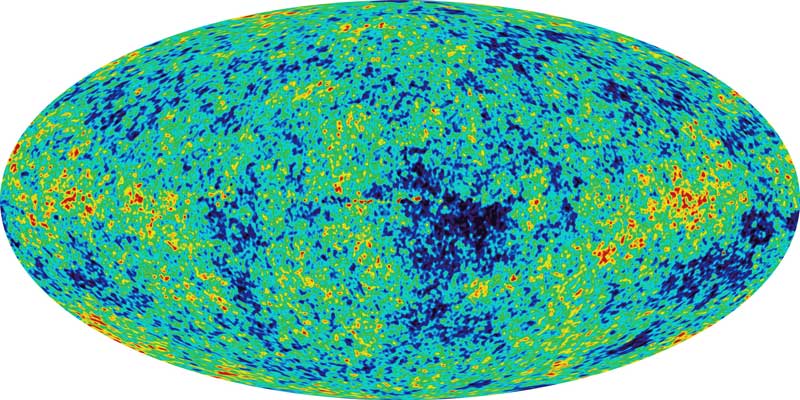
Here's an image generated by data from WMAP, the Wilkinson Microwave Anisotropy Probe. According to WMAP's results, our universe is flat to within a 2% margin of possible error. Is our universe really flat? I believe that it isn't.
Remember this: our universe is not just space. If you are traveling in space you are really traveling in spacetime, unless you've discovered some way to instantly transport to a distant star using no time whatsoever.
Here's one way I saw the concept of a perfectly flat universe within the multiverse explained.
If spacetime is absolutely flat, then if you were to set off in a rocket ship and travel in a single direction, you would eventually get to the universe that's just like the one you're in now, but where you got up an hour later this morning, or where Michael Jackson is still alive. And if you continued on this journey, eventually you would start getting to the other universes with basic physical laws, the other universes of the multiverse.
So. There is evidence that spacetime is close to flat, but I still feel certain that it will be proved that there is a certain very small curvature to spacetime, which is why our universe is not really infinite, it's finite but unbounded. It's like the old video games where going off the top of the screen gets you to the bottom, or going off the left gets you to the right (or traveling on the equator eventually gets you back to where you started). To continue the analogy, our observed spacetime universe and its cosmic horizon would be a tiny dot in the middle of that video game screen: we've talked about this in entries like Finite But Unbounded and An Expanding 4D Sphere, how some cosmologists say that if this dot representing our observable universe were the size of a quarter, this "video game screen" we're thinking about here would be the size of planet Earth.
Now, in a finite but unbounded universe with a slight curvature, if you were to set off in a rocket ship and travel in one direction, you would traverse the finite but unbounded hypersphere of spacetime, and eventually end up back where you started. Or with a slight change in trajectory, you could end up in the universe where you got up an hour later this morning, or where Michael Jackson is still alive... or any of the other possible versions of our universe that are part of the wave function of outcomes which could have or will have occurred for our particular universe with its locked in fine structure constant.
The other "perfectly flat spacetime" explanation we looked at above has its supporters, I think, because it still allows the viewpoint that free will is an illusion and everything is inevitable. If you eventually get to that universe where Michael Jackson is still alive using flat spacetime, then where you get to is really completely unrelated and causally unconnected to our own version of spacetime! No wonder some people who are shown this theory reject the idea of parallel universe versions of our universe even existing. And where that model breaks down further for me is that we have to eventually encounter an "edge" to our spacetime universe where the basic physical laws become fuzzy, and we somehow transition into the spacetime "edge" of a different universe with a different fine structure constant.
The slightly curved spacetime model works better for me because it seems much more likely that the universe where you got up an hour later this morning is directly connected to the universe we're in, and that the spacetime tree of possible outcomes connected to "now" has its branches within the fifth dimension. It also explains why no matter how far out into spacetime we look, we're never going to see other universes with different physical laws - because getting to those other universes would require extra dimensional movement within the seventh dimension and above (or to use the string theory perspective, it would require us to break out of the D7 brane our universe is embedded within), and arriving at a new "point" within that multiverse landscape would reveal some other universe that is apparently infinite within its version of spacetime, but is really just as finite but unbounded as our own.
Next time, we'll be looking at the video for one of my favorite blog entries from 2010, "Light Has No Speed" in a new entry called Photons and Free Will. Enjoy the journey!
My YouTube channel is currently at over 15,000 subscribers, and we just passed the 350 mark for the number of videos I've posted there, which have been viewed a total of over four million times!
As we saw in The 5th Dimensional Camera Project, a team of scientists at Oxford were introduced to my way of visualizing the extra dimensions by Anab Jain and Jon Ardern, and one of those scientists participated in a video explaining my concept of the fifth dimension as our "probability space".
In October I was invited by the amazingly energetic Dr. Mark Filippi of somaspace.org to attend the 2010 Coherence Conference, which took place at the University of Bridgeport. Unfortunately my schedule did not allow me to attend, but I did submit a five minute video to the conference which you can view at this link: Global Coherence.
My company Talking Dog Studios continued to develop expertise in Augmented Reality, and created the AR experience Hollywood's Legendary Pictures used to announce their upcoming 2012 release of their re-launch of the Godzilla Franchise. Meanwhile, our Augmented Reality game ScavengAR Hunt, which can be played on iPhones and Android Phones, is continuing to develop a worldwide audience.
Several projects that claimed Imagining the Tenth Dimension as inspiration were released this year: Hipercubo, an iPhone game; Rift, an award-winning game prototype developed by Blake Maloof and his team at the Savannah College of Art and Design; Alexander's Time Illusion, a simple java game created to explore a concept we looked at in Time and Schizophrenia. Plus, Scope DJ, a well-known music producer from the Netherlands, released a track using samples of my voice.
O is for Omniverse, my followup book created in collaboration with visual artist Marilyn E. Robertson continues to be available at Omniverse.tv, and other Imagining the Tenth Dimension books, t-shirts, and DVDs are available at www.tenthdimension.com/store. Meanwhile, at www.tenthdimension.com/digital, various files are available for download, including high quality versions of the original animation, books in non-copy-protected pdf format, mp3s of various songs, and the audiobook version of Imagining the Tenth Dimension. The first two sections of the audiobook (the Preamble and the Introduction) are also posted on YouTube.
As we see up at the top here, I've been posting monthly reports with "top ten blogs of the month" and the latest top 26 blogs of all time for almost three years now, and at the end of 2008 and again at the end of 2009 I published a Top 100 Tenth Dimension list. I'd like to continue that tradition this year, so the list below is in the same format as last year's, showing the month the blog entry originates from. Also, just for interest's sake, I've put a number at the end of each line indicating the position that blog entry held in our 2009 report. Thank you tenth dimension fans for your support!
Our world is changing, and as it changes more and more people are becoming interested in this project. To everyone out there, I send you my best wishes and fond regards for the upcoming year. Enjoy the journey in 2011!
It's been a while since we paused to look at some of the poll questions here at the tenth dimension blog, let's do that today. If you're interested in some of the older poll questions, check out this link: Poll 1 to 52.
On my twitter page, I describe myself this way: "Rob is interested in thinking about the big picture of reality". That would be a common thread within these four poll questions we're looking at today: in various ways, they're all about "thinking big".
Poll 65 Poll 65: "Is there only one possible ending for our universe? 1. Yes, that's why everything is inevitable and free will is an illusion. 2. Yes, but randomness and free will provide many paths to get to that single ending. 3. No, there are many possible endings." (Poll ended June 2 2010) Only 12% said "Free will is an illusion, while a fairly even split chose the other two responses: 41.5% said "Randomness and free will provide many paths, and 46.5% said "No, there are many possible endings".
My pick from these choices would have been number two, which lost out to number three by a fairly narrow margin. I wonder how many people would have selected number two if blogger's poll function had allowed me to be as wordy as this?
2. There is only one possible final state which lies beyond the "ending" for our universe, and it's the same as just before the "beginning" of our universe: enfolded symmetry. But because there are many possible paths (or "world lines") that we can travel to get to that final state, it may appear from within our spacetime continuum that there is more than one possible "ending", even though that's ultimately not the case.
I would say the original version of answer number two sums this same idea up with less words, but since I myself have used the phrase "one of the many possible endings for our universe" in my original tenth dimension animation, I would be the first to admit that I haven't always made my position as clear as I could have on this topic. Related concepts were explored most recently in my new video for "Strength of Gravity, Speed of Light", which we discussed further in an entry from a few weeks ago called "Cymatics, Gravity and Light".
Poll 66 Poll 66: "The dodecahedron is a fundamental underlying shape to our reality." Poll ended June 18 2010. 61.9% agreed while 38.1% disagreed.
We're going to discuss this idea again next week in an entry called "Extra Dimensional Geometry", as we look at the just published video for a blog entry called "Our Universe as a Dodecahedron".
This question relates to a postulate put forth by Henri Poincaré in 1900 which became a famously difficult problem to solve, with a number of proofs being offered and then rejected throughout the twentieth century. The Poincaré Conjecture should now be more correctly referred to as the Poincaré Theorem since it was officially accepted in 2006 that Grigori Perelman had successfully solved the problem. This was a very big deal in the world of mathematics, although Grigori has refused to accept any of the accolades offered to him for his proof: as the most recent example on July 1st 2010, he turned down the million dollars that had been awarded to him by the Clay Mathematics Institute's Millennium Prize Project for his solution.
For more background about the above poll question, check out this link to an article on the Poincaré Dodecahedral Space.
Poll 67 Poll 67: "All memories are formed during fifth-dimensional branching in our spacetime tree." 73.6% agreed, while 26.4% did not. (Poll ended July 5 2010)
This poll question relates to a blog entry called Entangled Neurons, in which we looked at a new scientific study indicating that quantum entanglement is intrinsic to the process of memory creation. Regular readers of this blog will know that my project tries to get people to accept that quantum effects, often portrayed as being unimaginably strange, make more sense when we accept that they come from the additional degree of freedom offered by the fifth spatial dimension. Please go back and read Entangled Neurons, I don't have anything to add here other than I'm pleased to see that almost three quarters of the visitors to my blog were willing to accept my proposal here.
A direct link to the above video is at http://www.youtube.com/watch?v=o87TkFOR_Js Poll 68 Poll 68: "Now that some Oxford University scientists have shown support for Rob's concept of our reality coming from a 5th-dimensional probability space, we can see that this idea will one day be embraced by mainstream science." 85.1% agreed, 14.9% disagreed. (Poll ended July 22 2010)
Do the branching world-lines and parallel universes of Everett's Many Worlds Interpretation occur within the fifth dimension? That's the big idea my project has proposed. In the video for my blog entry The 5th-Dimensional Camera Project, we see Oxford's Dr. Simon Benjamin showing graphics very similar to the ones from my project: he talks about how our currently observed reality is derived from a branching tree-like structure in the fifth dimension, and those branches are the potential result of a combination of chance and choice. I'm grateful to Jon Ardern and Anab Jain, who showed Dr. Benjamin my original tenth dimension animation.
Is this the thin edge of the wedge? Will more mainstream scientists be starting to embrace my approach to visualizing the extra dimensions, because of the intuitive leaps it allows between previously compartmentalized realms of physics, cosmology and quantum mechanics? Only time will tell. But hey, if time really is an illusion then the world where this has happened already exists within my fifth-dimensional probability space, and all I have to do is find a way to get there!









 Posts
Posts


