Showing posts with label anthropic. Show all posts

Wednesday, August 31, 2011

Imagining the Sixth Dimension


A direct link to the above video is at http://www.youtube.com/watch?v=OdnhKE95AqM

"...cosmology is simpler in one important respect: once the starting point is specified, the outcome is in broad terms predictable. All large patches of the universe that start off the same way end up statistically similar. In contrast, if the Earth's history were re-run, it could end up with a quite different biosphere."

- Cosmologist Martin Rees, from his book Just Six Numbers, the Deep Forces that Shape the Universe


What's the difference between the fifth dimension and the sixth dimension? With this approach to visualizing the dimensions, that question comes up a lot. After all, if the fifth dimension includes every possible state for the universe which can be connected to the "now" any one of us are currently observing, why do we need to talk about anything beyond that?

Let's pull out a piece of paper and ponder this question further.

First of all, put a dot near one edge of the paper, and label it "the big bang". Likewise, place a dot near some other edge of the paper, and label it "the end of the universe". Finally, draw a line that passes through those two points, and place a point somewhere near the middle of that line, which we'll label "you".

Okay, if that middle point represents "you" right now, then let's place another point nearby but not on the line we've just drawn. Do you see how this point could represent some other version of "you", such as the one where a childhood accident completely changed your life, or even just the version of "you" that got bored with this blog entry and stopped reading ten seconds ago? There would be a new line which extends from the big bang and passes through this alternate version of you, and each of those could be thought of as a one-dimensional line: but the only way the line for version "one" and the line for version "two" could be considered simultaneously is if we were to consider the 2D "plane" of the paper we were drawing on. In fact, we could place another point earlier on one of the lines and say that it represents your moment of conception, and then imagine a "ray" of possible lines representing all of the versions of "you" that could possibly have existed from your moment of conception onwards, and they could all be contained within this 2D plane.

Now let's think of a different point, but in this case let's imagine that it's floating a few inches above the paper. Perhaps this new point represents the version of the universe where dinosaurs never became extinct, which would mean that "you" as we know you wouldn't even exist on that line! We can imagine a one-dimensional line that passes through the big bang point on the paper and this new point. We can imagine a different 2D plane that passes through our first or second line and this new "dinosaurs" line. But here's something important about what we've been visualizing: the only way we can consider all three lines at the same time is by using the third dimension.

I hope it's obvious by now that the point-line-postulate tells us the logic we've just used to think about the 1st, 2nd, and 3rd dimension is directly translatable to the 4th, 5th, and 6th. Which means that with a piece of paper and a bit of imagination, we've already visualized the first six dimensions of our reality!

But wait, some critics might be thinking. Wasn't it arbitrary for me to place the "dinosaurs" line outside the plane of my paper? Couldn't I just have easily placed a point at the center of the paper, called it the big bang, then imagined that all around the outside edge of the paper were points representing all the different universes that could have resulted from the initial conditions that created our unique universe with its locked-in fine structure constant? And you may be surprised to hear that I'm willing to agree with that statement. From the initial conditions of our universe, we can get to any of the possible universes which the Many Worlds Interpretation tells us really exist, just as real as the one we're currently observing. From anywhere else beyond the big bang though, we're already seeing a paring away of possibilities - when one version of the universe is observed, the other universes are not, and causality shows us that this renders some of those other universes permanently inaccessible from that point forward on our entropy-driven "line of time".

How would you or I get to the universe where it's this point in time which we call the twenty-first century, but dinosaurs never became extinct? Everett's theory tells us that a version of the universe must exist where dinosaurs are living and dying right "now", and those dinosaurs are observing all the different versions of the universe where they still exist. So why can't you or I get there from here? In other words, if everything is probabilistic outcomes, why does it appear that there is zero possibility that the "next possible now" for us might include this "dinosaurs" world line?

The answer is: there is a missing degree of freedom. If you and I were within the sixth dimension rather than the fifth, then we would be able to leap across these different world lines, and get to those other versions of the universe which are not causally connected to the one we're in right "now". As we said last time, this is because "you and I are ants, not flies". Every instant that we observe is one planck frame beyond the instant before, which gives us the impression that the fifth dimension is compactified, or curled up on itself. If the fourth dimension is like the straight line of a garden hose stretched out on the ground, the fifth dimension is like an ant walking inside that hose, while a fly inside that hose would be able to flit from one location to another without having to worry about fifth dimensional causality.

Phase Space
What we're talking about with the sixth dimension, then, is the phase space of the set of parallel universes resulting from our universe's unique initial conditions. A phase space, to quote wikipedia, is "a space in which all possible states of a system are represented, with each possible state of the system corresponding to one unique point in the phase space."

Hugh Everett III's Theory of the Universal Wave Function is a way of thinking about the phase space of our universe as defined by quantum mechanics and the Schrödinger Equation. The prevailing opinion about this wave function back when Everett published his theory in 1957 was known as the Copenhagen Interpretation,  which said that an observer collapses this wave function of all possibilities into just one version, purely through the act of observation. Everett proclaimed this idea to be ridiculous: how could a single observer collapse the wave function of an entire universe? That was the accepted interpretation amongst most quantum physicists of the time, though, and resistance to abandoning that opinion was one of the reasons why it took so many decades for Everett's theory to become more accepted. But within the last ten years or so, more and more people have moved to the idea that his interpretation really is the more elegant one: the phase space of all possible outcomes continues to exist, and you or I are not collapsing the wave function, we are merely observing it in one state out of the many potential versions we could have observed.

Let's sum all this up: Everett's Many Worlds Interpretation says there is a wave function which encompasses every possible state for our universe, and I'm saying that's the sixth dimension. But because we're in the fifth dimension, choosing from a set of causally related outcomes that are available to us one planck frame after another, there are versions of the universe which have nothing to do with us - like the version where I died in a car crash yesterday, or the version where dinosaurs never became extinct. Likewise, the version where I decided to rob a bank yesterday must exist, but with my free will I chose not to observe that universe. All of those "other" universes have nothing to do with the universe I'm observing, even though I can acknowledge their existence within the sixth dimension.

What's Outside Our Phase Space?
Thinking back to that piece of paper we started from there are a few other ideas we can glean from this. First of all, that first and second point we drew, representing the beginning and end of the universe, can be joined with a line. But more properly, what we're talking about then is a "line segment". A true "line" would pass through those two points and extend past the edge of our paper and out towards infinity in either direction. This gives us a way to think about about how both "before" and "after" our universe is the same thing: a return to an underlying state which is outside the system representing all possible versions of our unique universe. Theoretical physicist Sean Carroll makes a similar claim in his recent book "From Eternity to Here".

But wait, there's that word again: "system". In my original animation, I described the "point" we start from as being something that indicates a position within a system. As we just saw, a "phase space" includes all possible versions of a system, with each possible state of the system corresponding to one unique point within the phase space. So we can extend our analogy here to think of our paper as being on an endless landscape covered with other papers, none of them touching, many of them widely separated from each other, each of them representing other universes or "systems" with other initial conditions and basic physical laws: the multiverse landscape. And within some of those other systems would be creatures sufficiently advanced to be able to look around and wonder how they ended up in a universe where the laws of physics appear to have been uniquely fine-tuned in a way to allow their universe to exist.

This idea is known as the Anthropic Principle. As I say in my song "The Anthropic Viewpoint":
If there’s other worlds then we’ve just missed ‘em
No way to know what’s outside our system
We’re like goldfish livin in a bowl
What’s beyond it we can never know
All we can do is theorize
Cause we can never… get outside, outside

In the anthropic viewpoint
The reason we’re here is because we’re here
And if it were impossible
Then we wouldn’t be
Coincidentally, as we talk about the sixth dimension, it's interesting to note that cosmologist Martin Rees has told us only six basic physical constants need to be defined to create our unique universe: check out his book Just Six Numbers: The Deep Forces that Shape the Universe for more about these concepts. It's also interesting to note that string theory predicts there could be ten to the power of five hundred other universes out there in the multiverse landscape, each with its own unique physical laws.

So we can't get to those other universes, those other systems, from the sixth-dimensional phase space representing our universe. Why not? Because we haven't achieved that degree of freedom yet within our approach to visualizing the dimensions. Which of course, will lead us to our next entry: Imagining the Seventh Dimension.

Enjoy the journey,

Rob Bryanton

Previous:
Imagining the Fifth Dimension
Imagining the Fourth Dimension
Imagining the Third Dimension
Imagining the Second Dimension 

Tuesday, March 30, 2010

Polls Archive 59 - Placebos and our Interface with Reality

Poll 59 -"Pharma companies are wrestling with the fact that placebos have grown twice as effective in drug trials over the last few decades. This is evidence that something is changing about our interface with reality." Poll ended March 2 2010. 61.5% agreed, while 38.5% did not.

This poll began not long after an entry called "Placebos Becoming More Effective?"was published here. If you would like to know more about the evidence surrounding this poll question, please go back and read that entry, I'm not going to repeat myself here because I want to talk about some other interesting connections to this idea.

In Poll 54 - Is Time Moving Faster? we returned to a question that relates to Gödel's Incompleteness Theorems: how can we know everything about the system we're within, when we can't get outside the system to "see it from the outside", so to speak?

This was one of the central ideas within Song 11 of 26 - The Anthropic Viewpoint, which has this verse:

If there’s other worlds then we’ve just missed ‘em
No way to know what’s outside our system
We’re like goldfish livin in a bowl
What’s beyond it we can never know
All we can do is theorize
Cause we can never… get outside, outside
Here's a video for that song, which has proved to be one of my more popular music videos on my youtube channel:

A direct link to this video is at http://www.youtube.com/watch?v=du86lNCvOdA

Would the evidence that placebos are becoming noticeably more effective qualify as evidence that we are collectively shifting our reality in some subtle way? That's the crazy idea that I'm proposing here. But since 61% of the visitors to this blog were willing to go along with this as a possibility, maybe it's not all that crazy after all.

Here's some of the other entries where we've talked about Gödel's Incompleteness Theorem over the past few years:
The Anthropic Viewpoint
Everything
Just Ten Things
The Universe as a Song
What's Around the Corner

Enjoy the journey!

Rob Bryanton

Next: We'll look at one more poll question: Polls Archive 60 - Quantum and Macro a Continuum?

Friday, September 11, 2009

Beer and Miracles

Here we are on the eighth anniversary of the World Trade Center attacks. I remember waking up that morning, seeing that the first tower had been hit, and immediately running to wake up my two (then) teenaged sons. "This is one of those cusp moments that you're going to remember for the rest of your lives", I told them. "Our world has taken an unlikely new tangent and this is a major shift in our reality."

Yes, even though this was five years before I launched Imagining the Tenth Dimension, this was the way I've always thought about how our reality is constructed, and as I've mentioned many times before, I spent over two decades prior to the 2006 launch of my website trying to get anybody else who would listen to see that this was a useful way of visualizing that multi-dimensional and parallel universe fabric that our reality springs from. I've talked about this concept in older entries like The Spacetime Tree, Anime, Gaming and Cusps, Everyone Has a Story, and John August and The Nines.

When we're thinking about a multiverse of possible parallel universes for our particular universe, in how many of those do you think it's 2009 and the World Trade Center towers are still standing? If we're talking about how we are each navigating through a fifth dimensional probability space, it doesn't really matter whether you believe those towers coming down was an inevitable outcome as a result of a long chain of previous actions and reactions in the years or decades prior to 2001, or if you believe that the terrorists got extremely lucky to have their plans come to fruition that day: in the Many Worlds Interpretation, both outcomes were possible, and we happen to be in one of the parallel universes where the towers no longer stand, while in other versions of our universe it's 2009 and they are still one of New York's major landmarks.

Last blog, in The Statistical Universe, we talked about the unlikely chain of events and alignment of forces that had to be put in place for there to be life in our universe, and how our very existence was like winning a cosmic jackpot. In The Flexi-Laws of Physics, we talked about the work of cosmologist Paul Davies, but we didn't mention his famous book which is in fact called "The Cosmic Jackpot: Why Our Universe is Just Right for Life". In that book he explores the Anthropic Principle, a concept which has received a lot of negative critiques over the past decade, but as I discussed recently in Does the Multiverse Really Exist?, is now being embraced by many more mainstream physicists such as Brian Greene. My song The Anthropic Viewpoint, which I wrote back in 2002, is about the same concept.

As a bit of synchronicity, this past weekend I watched the DVD of Watchmen: you know, the movie with the big blue naked guy in it? That guy's name is Dr. Manhattan, and in typical superhero comic logic, a lab accident which should have been fatal has instead given him superpowers, including the ability to simultaneously see his own past, present and future (in Dr. Mel's 4D Glasses, we talked about the sci-fi creatures Kurt Vonnegut invented, the "Trafalmadorians", who had a similar capability of viewing reality from a timeless perspective).

In this movie, Dr. Manhattan gradually loses touch with his own humanity as he becomes more and more convinced that free will is an illusion - I've spoken many times in my book and this blog about how this "hard determinist" viewpoint is a common pitfall arising from not seeing that our reality comes from a fifth dimensional probability space rather than a single, narrow "line of time". Near the end of the movie Dr. Manhattan takes his former girlfriend Laurie up to Mars, where Laurie pleads with him to intervene in a nuclear disaster about to happen back on Earth:

Laurie - John, please, you have to stop this. Everyone will die.
Dr. Manhattan - And the universe will not even notice! In my opinion, the existence of life is a highly over-rated phenomenon. Just look around you. Mars gets along perfectly well without so much as a micro-organism. Here it's a constantly changing topographical map, flowing and shifting around the globe in ripples ten thousand years wide. So tell me how would all of this be greatly improved by an oil pipeline? By a shopping mall?
Laurie - So it's too much to ask? For a miracle?
Dr. Manhattan - Miracles by their definition are meaningless. Only what can happen does happen.
Over the next few minutes, Dr. Manhattan reveals some devastating information to Laurie which causes her to lose hope, just as Dr. Manhattan begins to have a change of heart:
Laurie - My life is just... one big joke.
Dr. Manhattan - I don't think your life is a joke.
Laurie - Yeah, well, I'm sorry if I don't trust your sense of humor.
Dr. Manhattan - Will you smile if I admit I was wrong?
Laurie - About what?
Dr. Manhattan - Miracles. Events with astronomical odds of occurring like ... oxygen turning into gold? I've longed to witness such an event. And yet I neglect that in human coupling. Millions upon millions of cells compete to create life, for generation after generation until --finally-- your mother loves a man... a man she has every reason to hate. And out of that contradiction, against unfathomable odds, it's you. Only... you... that emerged... to this still so specific a form from all that chaos. It's like turning air into gold. A miracle.
And so... I was wrong.

Since I had already started writing this blog entry about "Beer and Miracles", the above dialogue had a lot of extra resonances for me. Let's talk about miracles for a moment.

Sir Arthur Clarke had a famous and often-quoted phrase: "any sufficiently advanced technology is indistinguishable from magic". How do you like this for my variation on the same theme? "Any dramatically unlikely occurrence is indistinguishable from a miracle". When we talk about how unlikely our universe is, and how unlikely life is, is the word "miracle" out of place?

Last month, New Scientist magazine published an essay by Hugh McLachlan, a professor of applied philosophy at the School of Law & Social Sciences, Glasgow Caledonian University, UK. The name of the essay is "Do You Believe in Miracles?". Here's a few paragraphs from that essay:

Consider the Azande, an African tribe whose members believe all deaths and misfortunes are caused by either witchcraft or sorcery. Suppose a falling branch kills someone. On one level, the tribe accepts a scientific account of the incident in terms of, say, the effect of termites on wood. But on another level, they ask why did it come about that the particular person happened to be standing under the tree when the branch happened to fall?

We are unlikely to ask that particular question, and unlikely to accept their particular explanation, but it is not at all clear why we should say that questions of that sort are inappropriate. There is no apparent clash with science or hostility to it, as the British anthropologist Edward Evans-Pritchard, who studied the Azande, was keen to stress.

People might accept a scientific account of why a particular event occurred, yet ask similar sorts of questions about why there are particular juxtapositions of occurrences. Much of this speculation and theorizing will be baseless, but there seems no justification for saying all such thinking is nonsensical. By analogy: most conspiracy theories are groundless, but not all of them are.


Okay, we've talked about statistically unlikely events and miracles, now let's add in some beer.

Wired Magazine published a fascinating article last month about a scientist who was able to recover dormant yeast cells that had been trapped in amber for 45 million years. As soon as he placed those cells into a growing medium they again flourished. Does that sound like a statistically unlikely occurrence to you? Would you be willing to call it a miracle if a living thing were somehow able to sleep for 45 million years, then wake up again as if nothing had happened? This yeast was discovered by Raul Cano, a 63-year-old microbiologist at California Polytechnic State University back in 1995. After years of trying to figure out what he could do with this miracle, he ended up in a business relationship with a micro-brewery who are now marketing a beer made with this ancient yeast to the world. The whole story is definitely worth a read, it's called "Amber Ale: Brewing Beer from 45-Million-Year-Old Yeast".

Why beer? The yeast strain that was recovered is Saccharomyces cerevisiae, commonly known as brewer's yeast, so it really didn't require that much of a stretch of the imagination. But there's some other interesting bits of synchronicity here. That same strain of yeast was big news back in 1996 when it became one of the first living organisms to have its genome completely sequenced. And at the time, there was a lot of press about how remarkably similar that yeast's genome was to that of human beings: here's a link to an article from back then that claimed about 50% of the yeast cell's genome is the same as a human being's.

How similar do you think you are to a yeast cell? We're not single-celled organisms so there's still clearly quite a leap from yeast to human, but at its core I think this news of 45-million-year-old yeast still having that mysterious "spark" of life within it reinforces a point I've made a number of times: life is a force which is somehow engaged with reality "outside" of our limited spacetime window. Other recent blogs where we've explored this idea include Creativity and the Quantum Universe, The Biocentric Universe Theory, Alien Mathematics, God? Or the Multiverse?, and Could I Meet My Incarnation?.

So next time you're enjoying a beer, or enjoying your favorite raw fruit or vegetable, stop and think for a moment about what a miracle it is that life exists, and that we are each here to enjoy the journey.

Rob Bryanton

PS: Back in Placebos and Nocebos, we talked about how the power of the mind could cause amazing changes to occur in our personal health (or lack thereof), but we also quoted a New Scientist magazine article which said this doesn't mean we have the power to make miracles occur. What do you think about life and miracles? Coincidentally, I've just posted the video blog version of "Placebos and Nocebos" on YouTube, take a look:


A direct link to the above video is at http://www.youtube.com/watch?v=pg2Fxp7DgX0


Next: Polls Archive 45 - Conscious Computers?

Saturday, August 29, 2009

Polls Archive 43 - Is the Multiverse Real?


A direct link to the above video is at http://www.youtube.com/watch?v=XHsI1xKF7Kw

There is a multiverse of other "different-initial-conditions" universes out there, and they are not just theoretical, they are equally as real as the universe in which we live. Poll ended July 9 09. 85.7% agreed, while 14.3% disagreed.

While no one would ever take a simple opinion poll on the internet as being some kind of scientific proof, I do find the results of this poll very interesting: when I launched my project over three years ago, I'm sure we would have seen a lot less people comfortable with this idea. What has changed? What has caused experts like physicist Brian Greene (of "The Elegant Universe" fame) to state the following just a few months ago in New Scientist magazine?

"You walk along a number of pathways in physics far enough and you bang into the possibility that we are one universe of many. So what do you do? You smack yourself in the head and say, 'Ah, maybe the universe is trying to tell me something.' I have personally undergone a sort of transformation, where I am very warm to this possibility of there being many universes, and that we are in the one where we can survive."
I discuss all this in more detail in the blog I put up the same time as I started the poll we're looking at now: "Does the Multiverse Really Exist?". Here's the video I put up on youtube for that blog entry just a few days ago:


A direct link to the above video is at http://www.youtube.com/watch?v=9187JKkKxx4

When I wrote my song "The Anthropic Viewpoint" back in 2002, even fewer people were willing to accept the idea that the other universes are just as real as the one we live in. Regular readers of my blog will already know this song but for those newer readers who haven't come across it yet, here's one of the videos. Follow this link for lyrics and further discussion about this concept that Brian Greene is now finally saying he embraces: that those other universes are just as real as our own, they just don't happen to be the one that we find ourselves to be within.


A direct link to the above video is at http://www.youtube.com/watch?v=du86lNCvOdA

Enjoy the journey!

Rob Bryanton

Next: Poll 44 - The Biocentric Universe Theory

Saturday, September 13, 2008

Time in 3 Dimensions


A direct link to this video can be found at: http://www.youtube.com/watch?v=V4FpPp8MPIQ
In Twisted Dimensions, we talked about a way of imagining how our 3D world is constrained by a D3-brane and a D7-brane, and how that relates to the way of visualizing reality that we've been playing with here. In entries like You Can't Get There From Here and What Would a Linelander Really See? I've tried to describe in more detail how there might be conceptual similarities between one group of dimensions and another. In my book I suggested that our reality can be broken down into what I called self-similar "triads", and this basic concept is encoded into the helix I had created for this project:

The repeating line, branch, fold metaphor that we use with this project gives us a powerful way to keep imagining one spatial dimension stacked upon another. If we look at the helix diagram, we see that the one, the four, and the seven are connected, as are the two, five, and eight, and as are the three, six, and nine, and this is part of the mental trick we use to allow ourselves to imagine many more spatial dimensions than most would have thought possible. This time I'd like to talk more about the idea that "time" (which is not a dimension but a direction) is part of an enfolded structure that encompasses the fourth through sixth dimension, and this structure shares many of the characteristics that we are familiar with from our experience of 3D space. Please note, though: when we talk about the third dimension, we are automatically talking about the second and first dimension: in other words, a 3-dimensional object has length, width, and breadth, so the first and second dimension are automatically included in a discussion of the third dimension. Likewise now, when we speak of the sixth dimension, this means we are then automatically considering the fourth and fifth dimension which are part of the sixth (and by extension, the first through third as well).

And why do I insist that all of the different possible timelines for our universe are not just in the fourth dimension, where science has traditionally allocated them? I believe this relates to the quantum physics idea of every possible aspect of our reality being represented by a wave function.

Events that are so unlikely they are outside spacetime
Here is a quote I have used before from recognized physics expert Michio Kaku, which represents the established viewpoint of quantum mechanics:

"... if we could "see" the wave function of a person, it would look remarkably like the person himself. However the wave function also gently seeps out into space, meaning that there is a small probability that the person can be found on the moon. (In fact, the person's wave function actually spreads out throughout the universe.) "
- Theoretical Physicist Michio Kaku, from his book "Parallel Worlds"
With this project, I'm proposing that our reality comes not from the fourth dimension, but the fifth, which is where Kaluza proved and Einstein eventually agreed that the field equations for gravity and light for our universe are resolved. What I have often suggested in the past is that the "wave function of all possibilities for our universe" that quantum mechanics experts like Dr. Kaku talk about must come from the sixth dimension rather than the fifth, and that the often-used "small probability of appearing on the moon" example is much easier to understand when we see that this is true. After all, if every completely unlikely event exists as part of the wave function of our reality, then even if the likelihood of those events is astonishingly small, the number of those unlikely events is also astonishingly large: surely the two factors must balance each other out somewhat, in which case there should be events each of us have witnessed within our lifetimes which should fall within that astronomically unlikely realm of "nearly impossible" events for our universe, and many of those would be even stranger than people popping out of their homes and reappearing on the moon.

Everett's Many Worlds Interpretation and Unlikely Events
A similar argument is often used for the evidence of extraterrestrial life: even if the odds of some other race having risen to dominance in the universe are astonishingly small, the universe is astonishingly large, so why are we not constantly being bothered by alien visitors? One possible answer is that we are but that information is somehow being hidden from us. Here's another more likely answer: that particular possibility does indeed exist within the wave function of all possible outcomes for our universe, but it is not part of the wave function that you or I are currently observing. This brings to mind the Anthropic Principle, which is central to my project, and which coincidentally is receiving renewed interest now that there are more mainstream scientists willing to consider the following idea which is central to my project: all of the other different-initial-conditions universes--and all of the other parallel universes resulting from chance and choice for our own universe--do exist within the multiverse (or ultimately, the omniverse), and are just as real as our own.

But why can't we see them? Why aren't people reappearing on the moon, why don't we wander into other universes where gravity has a different value, why aren't we part of the universe where alien invaders have destroyed the planet, or where it's 2008 and Elvis is still alive?

"Time" as a Sphere
The answer, I believe, is within my way of visualizing how our reality is constructed: in a sense, time is 3-dimensional, and the fifth dimensional reality we are witnessing is like the 2D image we see on a screen. If I look at a picture, it seems completely normal to me that I can't see through walls or around objects: unless we start moving around in 3D dimensions, which then allows us to see "behind" and "around" the objects on the screen. If we imagine time as a sphere, then we can suppose that our 3D reality as we're experiencing it at this very instant is at the south pole, and the timelines of possibility extend out northward. All of the possible (entropy-driven) futures that could extend from "now" are visible to us, up to the equator. But the other half of the sphere, from the equator and northward, are hidden from view. They exist as part of the sphere, but there's no path visible to us to see how to get to those other points that exist as part of our sphere: it's like they're on the dark side of the moon.

Imagining what's at "right angles" to the 3rd dimension
Does this metaphor work completely? I believe that it does within Dr. Elliot McGucken's Moving Dimensions Theory, which expands our minds with the knowledge that our 3D universe is already moving through a 4th dimension which is effectively expanding one planck length at a time at the speed of light. If we can imagine that each one of those new quanta, or frames, that represent our 3D universe are the south pole of a new 3D time sphere, we can see how that constantly revised sphere can ultimately encompass the wave function of all possible states within the entirety of that "time-sphere", but this visualization explains why only a certain subset of those possible states are accessible to us from our current position within spacetime.

To be clear, though, that 3D "time-sphere" we are imagining is much more mind-boggling than just a round ball: because that south pole point we have imagined is at the center of a hypersphere, extending out in the fourth dimension and beyond! For more about that idea, please read my entries Hypercubes and Plato's Cave, and Time in Either Direction.

To wrap this entry up, here, for fun, are the karaoke versions of three of the 26 songs I have created for this project, and these are relevant to the discussion we've just had: the songs are "The Anthropic Viewpoint", "The Unseen Eye", and "Everything Fits Together".


A direct link to this video can be found at: http://www.youtube.com/watch?v=EB3MzLoB5uw


A direct link to this video can be found at: http://www.youtube.com/watch?v=zHr_IVxtfgs


A direct link to this video can be found at: http://www.youtube.com/watch?v=kqvpDMtnehk

Enjoy the journey!

Rob Bryanton

PS - for further exploration of the idea that "some events are so unlikely that they will take longer than the life of the universe to occur" must place those events in the sixth dimension, read Unlikely Events and Timelessness. For the surprising connections between this project's use of "triads" as a concept and the Kabbalah, read Jake Kotze and Mystical Numbers. And for more explanation of why this project insists that our reality comes from the fifth dimension rather than the fourth, read entries like The Fifth Dimension Isn't Magic, or Your Fifth-Dimensional Self.

PPS - yesterday on the tenth dimension forum, member "nimblesquirrel" mentioned Heim Theory, which started out based upon our four dimensions of spacetime, plus two additional time-like dimensions: another way of connecting to what we've just talked about in this blog. Heim Theory was then extended to eight dimensions, which I have talked about here in this blog as being the highest dimension where any physical expressions of reality might occur. The theory has also been extended to a 12-dimension version - whoops, no correlation there, but interesting to read about nonetheless.

Next: Crossed Wires in the Brain

Wednesday, July 30, 2008

Randomness and the missing 96 per cent


A direct link to this video is at http://www.youtube.com/watch?v=OBDaZiMF8jg


junk DNA
DNA that does not code for proteins or their regulation but constitutes approximately 95 percent of the human genome.
- from American Heritage Dictionary
dark energy
A form of energy hypothesized to reside in the structure of space itself, responsible for the accelerating expansion of the universe.
- from American Heritage Science Dictionary

In blog entries like Dark Matter, Dark Energy, Dark Information and Dark Energy, Linelanders, and the LHC we've talked about the astonishingly large amount of the universe that appears to be "missing". In entries like Google, Memes, and Randomness and How to Make a Universe, we've talked about the idea that grouping and symmetry order could be what operates upon the information that becomes our reality to create the universe in which we live. And in blog entries like John Wheeler and Digital Physics, Making New Connections, and Changing Your Genes, we've talked about the quantum physics idea that parts of the past can be changed by our current observation, a fact that seems to defy our common-sense ideas of how the world works.

With all that in mind, here are two facts that might be revealing more about the nature of our reality than we realize:

  • 95% of a human being's genome appears to be random repetitions and noise.
  • 96% of the universe is completely undetectable dark matter and dark energy.

Don't both of those numbers seem much higher than we should expect them to be, yet remarkably similar? With only 90% hidden, even an iceberg has more to show than would appear to be indicated by these two basic facts about our universe and us as life within it!


A direct link to the above video "God 2.0" is at http://www.youtube.com/watch?v=V-Y4xseftgQ

In entries like Time in Either Direction and God 2.0, we've talked about the patterns that create the world around us from out of a background equilibrium state. Are these high percentages an indication of grouping and symmetry order at work (as Gevin Giorbran suggested) on an underlying fabric which is ultimately random? Could we be seeing evidence of this underlying pattern, which exists not just in the present, the past, and the future, but outside of time completely? If you look up "normal distribution" in wikipedia, you are shown the bell curve, which is the natural result of random generation of data.

The graph shown here is from that wikipedia article. If you add up the dark blue and the medium blue data from this bell curve, you are looking at what is known as "two standard deviations" from the mean (the mean being the exact center of the graph). And what do two standard deviations add up to? Why, 95.4%, virtually right in the middle of the 96% of the universe that is missing, and the 95% of the human genome that appears to be noise.

Does it seem backwards to be looking at bell curves when we're talking about unlikely probabilities? It does if you believe our universe was the inevitable and only outcome possible - in other words, if you don't believe there is a multiverse of universes out there, most with different basic physical laws than our own. I believe that dark energy and junk DNA could be showing us that our universe is not in the center of this bell curve, but on the outside edge: in other words, the least likely parts of the bell curve represent both the reality we are observing, and the genetic outcome that creates us as living creatures. The central part of this bell curve, then, is in the patterns and higher-dimensional shapes that occur in the extra dimensions. For our genome and our universe, the missing/unexplainable 95% makes more sense when viewed from those extra dimensions: but ultimately most of the potential shapes that exist within the omniverse are not connected to our universe, they are connected to the other possible expressions of matter and energy that exist out there within timelessness.

Which takes us back to our old friend, the oft-maligned Anthropic Principle: if we are really thinking about all possible universes and all possible expressions of life, then the one unique universe and the one unique expression of life that we are witnessing here in our little corner of the omniverse is only a tiny subset of a much larger expression of other versions of the possibilities that are out there within the information that becomes our reality, or any other reality.

A direct link to this video for "Infinity and the Boltzmann Brains is at http://www.youtube.com/watch?v=JLXhj7TK520

In entries like Infinity and the Boltzmann Brains, we looked at the random, burbling, fields of indeterminacy that might occasionally generate a partial universe or a partial bit of organized information, from a random collection of quantum outcomes that would (with even less likelihood of success) occasionally coalesce into a universe as complex and detailed as the one in which we live. In God 2.0, we looked at the patterns that create our reality, and how what you name those patterns has more to do with your point of view than what is really happening. Now let's think about this: is the fact that our universe is missing 96% of itself really a very strong indication of the fact that it comes from higher dimensional patterns the sum of which have only a third-standard-deviation likelihood of falling outside of the bell curve of random noise? Randomness and patterns, patterns and randomness - it's all in the way you choose to look at the data.

Let's finish this entry with a song about how unlikely our universe really is when you look at the biggest picture of them all: "The Anthropic Viewpoint".


A direct link to this video for "The Anthropic Viewpoint" is at http://www.youtube.com/watch?v=du86lNCvOdA

Enjoy the journey,

Rob Bryanton

Next: Unlikely Events and Timelessness

Wednesday, April 16, 2008

John Wheeler and Digital Physics


A direct link to the above video is at http://www.youtube.com/watch?v=FgQavdF4OzI

We are participators in bringing into being not only the near and here but the far away and long ago. We are in this sense, participators in bringing about something of the universe in the distant past and if we have one explanation for what's happening in the distant past why should we need more? - Physicist John Archibald Wheeler, who died just three days ago at the age of 96

Last blog, we talked about the omniverse: what if this project had been called "Imagining the Omniverse"? The omniverse is a term coined to imagine all of the possible universes, all of the parallel universes resulting from chance and choice for each of those universes, all of the possible expressions of matter and energy which exist simultaneously within the underlying quantum fabric of reality.

As mind-boggling as that concept is to hold in our heads all at once, there is still another way of looking at all of this: our specific universe is reflective of big-picture-memes, ways of organizing that omniverse's information that becomes our reality. Calling that "God", or a Quantum Observer acting within an O-region, or just the random assortment of implicate patterns responsible for distilling out one version of reality over another, has much more to do with mindset than the actual processes that we are thinking about: and this is how we got to David Bohm's idea of implicate and explicate order being reflective of how our universe came to be part of just one of the many multiverses that exist within the omniverse.

Ever hear of "digital physics"? Look that term up in wikipedia. Experts such as Seth Lloyd, John Wheeler (quoted above), and David Deutsch, all of whom I have mentioned regularly in this blog, are listed as proponents of digital physics, which advances the same theory that I have been promoting here: our universe is reflective of patterns that exist within timelessness, and time as we experience it is an illusion, only a tiny slice out of what's really happening "out there". Digital Physics does not require there to be extra dimensions, but I believe it ties very nicely to what I've been talking about here: the idea that our universe is created one planck length after the next, with our fourth-dimensional "line of time" twisting and turning in the fifth dimension is the way into that discussion.

Comparisons between digital physics, the universe as a hologram, and the idea that we as observers could "reverse fine tune" our universe are all connected to the way of visualizing reality that I'm promoting here. There are clear echoes of The Matrix in all of this as well, which make some people assume I'm talking about science fiction here: but the tenth dimension meme continues to grow, as more and more people begin to see connections between their own ways of understanding reality and what's being discussed here.

John Wheeler was a strong believer in the anthropic principle, which ties into the Omniverse idea I talked about in the last blog entry as well. As his quote at the start of this blog entry reveals, he also liked to talk about the role of the quantum observer in a "self-excited circuit" that creates the reality we see around us from out of the background of quantum indeterminacy, and that is a fascinating discussion by itself. Here are some previous blog entries where I've talked about how John Wheeler's theories can be related to my way of visualizing reality:

Infinity and the Boltzmann Brains
Song 24 of 26 - See No Future
Song 15 of 26 - What Was Done Today
Song 11 of 26 - The Anthropic Viewpoint
Boredom and Consciousness


Enjoy the journey,

Rob Bryanton

Coming up next: The Flipbook Universe

Friday, December 7, 2007

Boredom and Consciousness Part One


A link to this video can be found at http://www.youtube.com/watch?v=ob6GmDriYGo


A link to this video can be found at http://www.youtube.com/watch?v=phn3mWSa584

At the tenth dimension forum, one of the subjects that comes up from time to time is synchronicity: the feeling many of us have experienced that information is coming at us from unconnected sources, yet it all seems to fit together somehow. Since our brains are all about finding and decoding patterns, there are no doubt going to be times when that information really is unconnected, and it is purely our brains that are building those connections. But these days, in a world of increasingly accelerated information input, there are also more and more times when those connections are real, and what we are viewing is really a map of the rapidly rising and falling memes that make up our combined consciousness.

Talking to the general public about consciousness in terms of the nature of reality is something that appears to make quantum physicists uncomfortable, particularly those who like their science to be completely separate from anything more than a purely atheistic viewpoint. With this project, which joyfully embraces such a multitude of ways of imagining reality, including ones which mainstream science doesn't endorse, we are part of a growing community of people around the world who think that there is a major shift of global consciousness approaching. And for those who say this is more "What the Bleep" nonsense, I would like to quote from a book I've talked about in this blog before. Written by two respected physicists from the University of California, Santa Cruz (Bruce Rosenblum and Fred Kuttner), the book is called "Quantum Enigma: Physics Encounters Consciousness":
"...in dealing with the mysteries of quantum mechanics, we walk the edge of a slippery slope.
A recent movie...informally called What the Bleep Do We Know?...provides a good illustration of the problem. ...The movie uses special effects to display quantum phenomena with macroscopic objects--for example, exaggerating the uncertainty of the position of a basketball. That's legitimate and is understood as hyperbole. The movie's allusion to mysteries in quantum mechanics being connected to the realm of consciousness is also valid. But then the movie blends over to "spiritual revelations" and to the implication of a quantum connection with the channeling of a 35,000-year-old Atlantis god named Ramtha and other such nonsense."

That slippery slope, then, is what I'm referring to when I say that consciousness and quantum physics are intimately tied together, and just where on that slope a particular physicist is willing to place themselves has a lot do with whether they believe there is any spiritual aspect to our reality or not. But even at the most atheistic viewpoint, we are still left with the mysteries of how matter can remain in indeterminate states until it is observed, and that is a very big mystery indeed.

A few weeks ago I published a blog entry suggesting one of those strange connections - that the accelerating expansion of our universe might be tied to the accelerating expansion of our consciousness, and that the first witnessing of dark energy and the launch of google, both in 1998, might be connected to the beginnings of a change. As crazy as that idea sounds to some, it appears I didn't go far enough: a few weeks later an article was published in New Scientist magazine which starts with these astonishing paragraphs:


Has observing the universe hastened its end?
- by Marcus Chown

Have we hastened the demise of the universe by looking at it? That's the startling question posed by a pair of physicists, who suggest that we may have accidentally nudged the universe closer to its death by observing dark energy, which is thought to be speeding up cosmic expansion.

Lawrence Krauss of Case Western Reserve University in Cleveland, Ohio, and colleague James Dent suggest that by making this observation in 1998 we may have caused the universe to revert to a state similar to early in its history, when it was more likely to end. "Incredible as it seems, our detection of the dark energy may have reduced the life-expectancy of the universe," says Krauss.
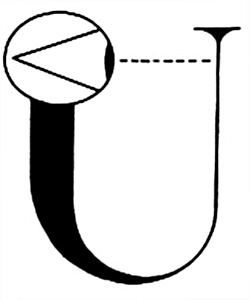
This reminds me of a simple cartoon drawn by famed quantum cosmologist John Wheeler, which shows a U-shape with an eyeball at one tip, which is looking at the other tip as a representation of the big bang (Rudy Rucker discusses the cartoon in this blog entry): the question Dr. Wheeler is asking with this cartoon is "Does looking back "now" give reality to what happened "then"? This relates to discussions we've had here: the startling implication of all this is that not only are there many branching possibilities from the "now" forward in time, but there are also many branching possibilities back to the beginning of time as we experience it. While in my book I ask the reader to only acknowledge that these branches exist both forward and back, and that the simple "line of time" we look back upon is only one of many that could have got us here, the implications from these quantum physicists is even stranger: they are indeed saying that not just the present, not just the future branches, but the past as well can be changed by observation!
This cartoon is also discussed in Quantum Enigma:

The provocative sketch has not lost impact. At the recent conference honoring Wheeler on his 90th birthday, a keynote speaker introduced his talk with Wheeler's sketch.
The anthropic implications of his diagram must have been a lot even for Wheeler to buy. After asking the above question, he immediately added the comment: 'The eye could as well be a piece of mica. It need not be part of an intelligent being.' "
My song The Unseen Eye talks about these same ideas:


And of course, my song The Anthropic Viewpoint talks about those implications contained within this sketch as well: to again quote from Quantum Enigma, "...the strong anthropic principle asserts the universe is hospitable to us because we could not create a universe in which we could not exist." Or as I put it in the tongue-in-cheek chorus to my song, "The reason we're here is because we're here":


Which leads back to the idea that memes rise and fall, and that synchronicity may or may not be the universe communicating memes to us, but in either case the connections that our wonderful pattern-oriented brains make are very real, because that's what brains are designed to do. Next blog entry I am going to talk about two magazines that arrived in my mailbox yesterday (another bit of synchronicity), and the connections that I see in those magazines and this project to the idea of "Boredom and Consciousness". My song "Automatic", which is about Julian Jaynes' theories of the bicameral mind, is also going to figure prominently into where we go with this discussion:


Enjoy the journey,

Rob Bryanton

Click here to continue on to Boredom and Consciousness Part Two

Tuesday, October 23, 2007

Thankful 2


A link to this video can be found at http://www.youtube.com/watch?v=bvROwf2KeOg

Now that over two million unique visitors have been to the Tenth Dimension website, I'd like to pause for a moment and look at where we're at.

Fans of the original flash animation will be pleased to know that we have now opened a "Digital Items Store", where a self-contained flash (versions for PC and for Mac), plus a high resolution quicktime can now be downloaded. In addition, an eBook file of the revised second edition of my book plus various versions of some of the songs attached to this project are also available there.

I'm thankful to all of the fans of this project who continue to share their ideas at the tenth dimension forum. I'm thankful to people like John Daniels Riveros who have embraced the interactive chat broadcasts we're doing with unbounded enthusiasm. I'm also thankful for all the critics: it's important that people understand that when my book is called "Imagining the Tenth Dimension", subtitled "a new way of thinking about time and space", and its brief description at online bookstores like Amazon includes the phrase "not about mainstream physics", those are important bits of information. But do I think it's fair then, that online reviewers of the book are allowed to give my book a thumbs down because it's not about mainstream physics? To the extent that they feel they were misled about the content, that's fair... but buying a book without reading its description and then complaining when the content is not what you expected does seem somewhat misguided to me. Oh well... there are also many people who have posted positive reviews of the book as well, and this project certainly does seem to be one of those that elicits a strong response, whether that be negative or positive.

The online listing for my book ends with this sentence: "Imagining the Tenth Dimension is a mind-expanding exercise that could change the way you view this incredible universe in which we live." What does this mean? It means that the implications of what we begin exploring in the eleven minute animation are expanded in a large number of directions throughout the book's eleven chapters. Ultimately, what we are trying to find here is a way to tie together disparate schools of thought - not just from cosmology, from quantum mechanics, and from the probability space of the multiverse - but also from philosophy, spirituality and ancient mysticism. For anyone who believes in only one of those ways of looking at the world, my quest for finding the unity behind all of these ideas may indeed seem foolish.

But I am thankful for all of the encouragement I have received from people around the world (and the very positive review of my book in What Is Enlightenment? magazine comes to mind here), who believe that I just may be on to something... and that's pretty darn cool.

Enjoy the journey!

Rob Bryanton


THANKFUL
words and music (c) by Rob Bryanton (SOCAN)

In this improbable world
In this impossible life
At the end of infinite happenstance
Leading back to the big bang

I am thankful for what I have
I am thankful for what I’ve been given
I am thankful for those I love
And for this life I’m livin

And in the multitude of paths
That could have ended before now
I am grateful for the unseen hand
Which led us here somehow

I am thankful for what I have
I am thankful for what I’ve been given
I am thankful for those I love
And for this life I’m livin

The universe is beautiful
More complex than we can believe
And praisable for what it holds within
A tapestry of threads
That each of us must weave
From each and every moment that we’re in

In this improbable world
In this impossible life
At the end of infinite coincidence
Leading back to the big bang

I am thankful for what I have
I am thankful for what I’ve been given
I am thankful for those I love
And for this life I’m livin

Tuesday, October 2, 2007

The End of the World 2

If, as David Deutsch and his team at Oxford have proven, every branching timeline possible from this moment forward exists as potential within the probabilistic quantum wavefunction, and this is what creates the "bush-like branching structure" of potentially observed states from this moment on, then this ties in so very nicely to the concepts I've been presenting here with my Imagining the Tenth Dimension project: this means the branching fifth dimension of probability space our 4D line of time is being constructed from, as I describe in my book and my popular animation, would be that same idea presented in a simple-to-visualize metaphor. As most visitors to this blog will know, the set of potential branching timelines for our universe (and all other universes) is part of the concept known as the multiverse.

Here's one of the ideas I've had fun playing with regarding the multiverse: if every potential branch from this moment to the next exists within the currently unobserved branches ahead of us at this moment, and only one of those branches will be the one that we are about to individually witness, then this must be true no matter where in the timeline of the universe we care to think about. But if those other branches exist, does that mean there are versions of each of us who did end up observing some of the alternate branches of the multiverse which our current version believes did not happen? Here's some of what I say in my book about this idea:

It seems that no matter where you are in history, at a specific moment there will always be a certain small contingent of the population who are predicting the end of the world. Usually it’s some conveniently distant amount of time away from the present to be a cause for concern, but not so close as to immediately leave the person spreading the news with egg on their face (as I write this paragraph in 2006, the Mayan calendar’s December 21 2012 looks like a good upcoming contender for an end-of-the-world focal point some portion of the public are likely to become caught up with).
But eventually the deadline for all good predictions of the end has to arrive, and like the celebrated Y2K scenario, its promoters are then left looking a little foolish. In the anthropic viewpoint, we can imagine how those people also exist on different timelines where their predictions did come true. The reason we’re here on our current timeline to question what went wrong with their predictions is because on the timeline where they were right, we would no longer be here. Perhaps there were also people in Atlantis, or Mu/Lemuria, or in the ancient sunken ruins off of Cuba or south of Okinawa, who issued dire warnings of impending disaster, and who got to say one last “I told you so” before the end of their civilizations really did come to pass?

So continuing on with this bit of fun, here is a video of me singing the most "campy" of all the 26 songs I've created for this project.


A link to this video can be found at http://www.youtube.com/watch?v=S2Y9m34iJVY

THE END OF THE WORLD
words and music (c) by Rob Bryanton (SOCAN)

The end of the world
Oft predicted, never realized
The end of the world
Never here, it’s such a surprise
How could millions be so wrong?
The end of the world
Has already been, it’s come and gone

Looking back through history
We oft encounter prophecies
Of end times so very very near
Next year, five years, ten from now
A state of flux, some way somehow
The process of postponement never clear

The end of the world…

With space and time a continuum
Of everything that is to come
And might have been, in one infinite ball
Multiple timelines, now I see
Apocalyptic destinies
Prophets proven prophets after all

The saucers?
Already landed
Our star bodies?
Already attained
Y2K? The global pandemic?
Huge disasters
The big freakin’ asteroid?
Destroyed the world

The end of the world
Oft predicted, never realized
The end of the world
Never here, it’s such a surprise
How could millions be so wrong?
The end of the world
Has already been, it’s come and gone
The end of the world has come and gone

Friday, August 31, 2007

Thankful 1


A link to this video can be found at http://www.youtube.com/watch?v=bvROwf2KeOg

Another video of me in my living room pounding away at my old piano, singing one of the 26 songs from my book.

We live in a seemingly impossible universe - the fine structure constants are tuned to within surprisingly narrow margins - just a little less gravity and it all would have flown apart into nothingness from the big bang, a little too much gravity and it would all have collapsed back in upon itself by now. How did we get so lucky? That's the conundrum. Some people point to a simple version of the Anthropic Principle which says the reason we're asking how we ended up in this unique universe that supports life as we know it is because if the universe didn't support life as we know it, we wouldn't be here to ask the question.

For me, the version of the Anthropic Priniciple which says all those other universes do actually exist rings much truer. As the current issue of Scientific American discusses, modern science is starting to explore some of the other forms and chemical processes that "life as we don't know it" could be able to exist in other parts of our own universe... and some even more fantastical constructions of energy and matter that become interested in "what happens next" might well flourish in other completely separate different-initial-conditions-universes from our own, out there in other parts of the multiverse.

Whether you believe in a Creator-God that put together this intricate puzzle, or whether you believe in a Dawkins-style "blind watchmaker" of chance and selection which got us to where we are now, there's nothing wrong with feeling some wonder and some humility at how extraordinary it all really is. And saying "thank you" for something as wonderful as all this, regardless of your belief system, is just good manners!

Enjoy the journey,

Rob Bryanton


THANKFUL
music and lyrics (c) by Rob Bryanton (SOCAN)

In this improbable world
In this impossible life
At the end of infinite happenstance
Leading back to the big bang

I am thankful for what I have
I am thankful for what I’ve been given
I am thankful for those I love
And for this life I’m livin

And in the multitude of paths
That could have ended before now
I am grateful for the unseen hand
Which led us here somehow

I am thankful for what I have
I am thankful for what I’ve been given
I am thankful for those I love
And for this life I’m livin

The universe is beautiful
More complex than we can believe
And praisable for what it holds within
A tapestry of threads
That each of us must weave
From each and every moment that we’re in

In this improbable world
In this impossible life
At the end of infinite coincidence
Leading back to the big bang

I am thankful for what I have
I am thankful for what I’ve been given
I am thankful for those I love
And for this life I’m livin

Wednesday, June 13, 2007

Conspiracies and quantum mechanics

Last blog I mentioned "Quantum Enigma", a book by two physics professors from the University of California at Santa Cruz, Bruce Rosenblum and Fred Kuttner, which takes a serious look at the role of consciousness in quantum physics. Here are a couple of interesting quotes from the website dedicated to their book:

"Quantum mechanics is the most battle-tested theory in all of science. Moreover, one third of our economy depends on things designed with it. Fine! But it also tells us that by your conscious choice you can bring about either of two contradictory situations. This is so far demonstrated only with small things, but it is today being shown true for larger and larger objects. And it is generally accepted by physicists that quantum mechanics applies to everything."

"For the most part, in our teaching of quantum mechanics we tacitly deny the mysteries physics has encountered. We hardly mention Niels Bohr's grappling with the encounter between physics and the observer and John von Neumann's demonstration that the encounter is, in principle, inevitable. We largely avoid the still-unresolved issues raised by Albert Einstein, Erwin Schrödinger, Eugene Wigner, David Bohm, and John Bell. Outside the classroom, physicists increasingly address these issues and often go beyond the purely physical. Consciousness, for example, comes up explicitly in almost all of today's proliferating interpretations of quantum mechanics, if only to show why physics need not deal with it. The many worlds interpretation, for example, is also referred to as the many minds interpretation, and a major treatment of decoherence concludes that an ultimate understanding of the implications of quantum mechanics would involve a model of consciousness."

Now I'm not for a moment suggesting here that Rosenblum and Kuttner subscribe to my visual way of imagining the dimensions, but there are many direct parallels between what they are describing above and the conclusions I reach in my book.

Anton Zeilinger, professor of physics at the University of Vienna has been quoted to say "quantum physics requires us to abandon the distinction between information and reality". If what we are navigating through right now is a sea of information across the dimensions, observing one slice out of all the possible slices as we travel down our limited line in the fourth dimension, then the patterns we are observing have as much to do with our role as quantum observers as they do with the sequence of events that got us to today.

So, if there is a multiverse of universes out there, and apparently infinite branching timelines within each of those universes, then there should always be a sequence of events that we could track from the beginning of the universe to now that tells us why "this is the way things are" as opposed to "this is the way things aren't". I'm only being somewhat frivolous in my book (and in my song "The Anthropic Viewpoint") when I say that we are living in the Hydrogen Conspiracy: what hidden agendas and preferences for one reality over another caused hydrogen to be the most popular atom in our universe?

Which is not to say that conspiracies are bogus, but rather that if quantum physics requires us to abandon the distinction between information and reality, then there will always be two ways of looking at how we got to our current situation, only one of which requires us to believe in conspiracies. Personally, I'm inclined to agree completely that our consensual reality in the last hundred years has been manipulated by the powerful to make themselves even more powerful. I also believe that we are nearing the end of that time - as we and web 2.0 wake up, it's going to become increasingly difficult for games that got our world to the precipitously bad situation it is currently in to be played any longer.

In my song Everything Fits Together, there is a chant section that sums this idea up:

There’s a reason why, there’s a reason why
There’s a reason why you feel the way you do
There’s a reason why you do the deeds you do
There’s a reason why you feel the needs you do
There’s a reason why, there’s a reason why

Which is not to say that we are helpless, but rather that the knowledge of how we got to where we are right now can help us to understand what is our own fault and what is the result of other forces acting upon us. The question then becomes: what do you want to change? As Joe Jackson so eloquently put it, "You Can't Get What You Want Till You Know What You Want". I would say those are wise words indeed.

Enjoy the journey,

Rob


A link to this video can be found at http://www.youtube.com/watch?v=du86lNCvOdA


A link to this video can be found at http://www.youtube.com/watch?v=Kfe_3bEH-jE


A link to this video can be found at http://www.youtube.com/watch?v=KcdjX72VcKI


A link to this video can be found at http://www.youtube.com/watch?v=6nAS2trDuck

Tenth Dimension Vlog playlist