a new way of thinking about time and space ~ ~ ~ ~ ~ ~ ~ ~ ~ ~ by Rob Bryanton
--author and research scientist David Jay Brown says: "one of the most brilliantly-conceived and mind-stretching books that I've ever encountered".
--science fiction author Greg Bear says: "a fascinating excursion into the multiverse - clear, elegant, personal and provocative"
Seems like there's a lot of new discussion happening in the last few days about whether it's proper to call space-time the fourth dimension. With this project, I've often argued that time is not a dimension, it's a direction, and as with any of the other directional names (like up, forward, north, and so on) it's arbitrary what dimension we assign a particular label, as long as we recognize that there's an opposing direction (like down, backward, south, and so on) which we need to pair it up with if we're going to be thinking about a dimension rather than just a direction. But the following video, posted on the YouTube Minute Physics channel just a few days ago, takes the controversy to another level: it's titled "There is no 'Fourth' dimension".
(By the way, the lovely optical illusion at the top of this blog was posted in the comments area for a Gizmodo article about this MinutePhysics video. If this optical illusion works as well for you as it does for me then you may be surprised to learn that this is not an animation, it's just a still image. Any motion you might see is being imparted by your observation of the still image - what a wonderful visual metaphor for the quantum observer! I wish I could give credit to the creator but that information is too difficult to see in this copy of the image.)
Here's the comment I sent to the Minute Physics channel, if they ever respond I'll be sure to add what they say to this blog entry.
Dear Minute Physics,
Congratulations on the success of this channel! Scientific American published a blog last summer asking why there weren't more viral science channels on YouTube (and at that time identified my channel as one of the few). Clearly you have moved into that space, good for you. I have some comments about your latest video.
Larry and Moe. Who is the third stooge? Curly.
Moe and Curly. Who is the third stooge? Larry.
Length and width. What is the third dimension? Depth.
Depth and length. What is the third dimension? Width.
Saying there's no fourth dimension is the same as saying there's no third stooge or there's no third dimension. At best it's a semantics discussion: yes, you can't say who the third stooge is unless you also first identify who the other two stooges are. But at worst this video has the danger of leading people to conclusions such as this: wasn't Einstein wrong then when he agreed with Kaluza about our universe's field equations being resolved at the fifth dimension? Surely, some people will say, if this video's claim that "there's no fourth dimension" is correct, then there must also be no fifth dimension or no tenth dimension as well.
I agree that it's important for people to realize that you can't have a fifth dimension without acknowledging the other four dimensions that are included within. But saying there's no fourth dimension seems like a dangerous oversimplification to me. Your thoughts?
Sincerely,
Rob Bryanton
Then, as a further interesting coincidence, my friend Lee Price sent me a link to this new article written by Lisa Zyga and posted at phys.org. It's entitled "Physicists Continue Work to Abolish Time as Fourth Dimension of Space". Here's the opening paragraphs from that article:
Philosophers have debated the nature of time long before Einstein and modern physics. But in the 106 years since Einstein, the prevailing view in physics has been that time serves as the fourth dimension of space, an arena represented mathematically as 4D Minkowski spacetime. However, some scientists, including Amrit Sorli and Davide Fiscaletti, founders of the Space Life Institute in Slovenia, argue that time exists completely independent from space. In a new study, Sorli and Fiscaletti have shown that two phenomena of special relativity - time dilation and length contraction - can be better described within the framework of a 3D space with time as the quantity used to measure change (i.e., photon motion) in this space.
The scientists have published their article in a recent issue of Physics Essays. The work builds on their previous articles, in which they have investigated the definition of time as a “numerical order of material change.”
As Lee pointed out when he sent me this article, this is a viewpoint that would have interested Gevin Giorbran. Gevin's Everything Forever - Learning to See Timelessness encouraged us all to visualize the underlying structures of our reality from a perspective where we are "outside" time. But in his book Gevin also embraced my approach to visualizing the dimensions, because he saw how that same timeless viewpoint is reached by the time we've envisioned the ultimate ensemble of the tenth dimension.
So is it really possible to say "time is independent from space" (Sorli and Fiscaletti's viewpoint) while still acknowledging the existence of extra dimensions? As I've said in entries like Imagining the Third Dimension, visualizing the third dimension as timeless is the approach that physicists like Julian Barbour ask us to use, and accepting the need for some additional degree of freedom to change from state to state is how I describe the direction of time no matter what dimension we're discussing. It would be nice to say both of the above examples are just semantics, that a rose is a rose, and no matter what you call the additional degree of freedom the third dimension uses for change from state to state doesn't change the fact of its existence. But Sorli and Fiscaletti are talking about a change which is more fundamental than that, and ultimately may not require the existence of extra dimensions at all. As I said most recently in Connecting Zero to Ten, "the idea that there are really no dimensions, that there are just infinite vectors within one underlying fabric which is dimensionless, actually resonates more strongly for me..." because that's another way of describing this timeless ultimate ensemble my approach reaches with the tenth dimension.
One final note: as long as both of the examples we've looked at here (from Minute Physics and the work of Sorli and Fiscaletti) are willing to acknowledge the existence of the multiple outcomes predicted by Everett's Many Worlds Interpretation of Quantum Mechanics, then I believe we really are talking about different ways of describing the same thing. On the other hand, if either of these are intended to encourage us all to believe that there is only one possible set of outcomes for our universe from its beginning to its end, then that's where my project would have to part ways.
Even if time is an illusion, free will is not. Enjoy the journey!
Rob Bryanton
P.S. - here's my video for Imagining the Fourth Dimension, which works very nicely as a response to the Minute Physics video.
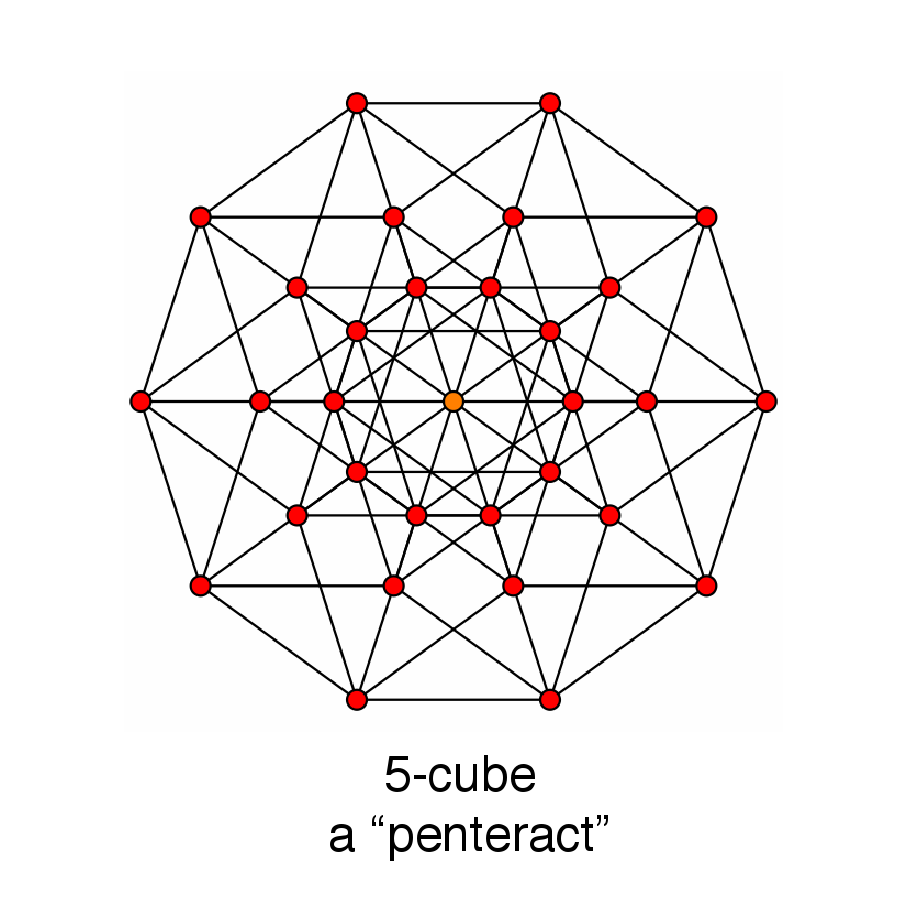
As we continue to add dimensions, the orthogonal hypercube projections that we're looking at here with each new dimension become increasingly ornate, and (dare I say it) more mandala-like.
Another eight-dimensional shape that we've looked at with this project is Garrett Lisi's E8 Rotation. Lisi created a huge stir in the physics world with a new proposal for what he calls An Exceptionally Simple Theory of Everything that uses "E8" - a complex, eight-dimensional pattern with 248 points.
As visually appealing as this shape (pictured below) might be, its implications are startling: Lisi has demonstrated that there is a way to place the various forces and elementary particles (including their possible quantum spin values) on E8's 248 points. Rotating Lisi's model in various ways reveals the explanation for a variety of interactions, some of which (like the clustering of quarks into families of three) are natural outcomes from this structure. Some points in his model are currently occupied by particles which have been theorized but which have yet to be seen, and there is hope that the Large Hadron Collider in Switzerland may some day reveal some of those particles.
Whether Garrett Lisi's theory proves the existence of higher dimensions or not is open to interpretation - Lisi himself says this geometric pattern, although it is based upon an 8 dimensional construct, could be fully realized within our 4D space-time without requiring additional dimensions. On the other hand, in a New Scientist magazine article, string theorist Sabine Hossenfelder (of the Perimeter Institute for Theoretical Physics) points out that this could be complimentary to string theory, which she says also uses E8 to describe the Calabi-Yau manifold, the extra-dimensional shape that string theorists says our universe is derived from.
Lisi also acknowledges that this is not a finished theory but a work in progress, and that there are still some deficiencies in his model that need further refinement. For me, this dimensional connection is fascinating because with this project I've insisted that you can't have any physical expressions of matter in anything beyond the 8th dimension.
Why Do We Need the 8th Dimension?
A commonly asked question about this project is, "if our universe and every other universe can be thought of as "points", or perhaps "positions" within a multiverse landscape, and in this way of visualizing the dimensions we get to that landscape by the time we're at the seventh dimension, then why do we need to think about any more dimensions beyond that?
To my way of thinking, you can express the same concern about every definition of every single dimension, and the arguments have to keep coming back to "what are we missing within this current dimension?".
For instance, people say that the third spatial dimension is really all you need, because no matter what other universe you imagine it should have a third dimensional expression.
Or there are people who say all we need is space-time, because by the time you have the third dimension plus time, which gives the third dimension a way to change from state to state, then you can imagine every single possible universe strung end to end within infinite space-time, and because that string of possible states is infinite you will eventually get to every possible universe.
Or you can have people who say space-time plus its probabilistic outcomes (which Everett's Many Worlds Interpretation says are "orthogonal" or "at right angles" to space-time, leading to my conclusion that these branches are in the fifth dimension) gives you everything you need to imagine every possible universe.
From there, I've proposed that the branches for our universe which no amount of chance or choice will allow us to select (like the branches where dinosaurs never became extinct or the ones where I died in a car accident last year) are in the sixth dimension, and this uses the same logical reasoning that defines any spatial dimension - there always needs to be a "new degree of freedom" added for us to be able to call what we're talking about a new dimension, and the new dimension allows us to get to something that was unavailable from the previous dimensions.
Likewise, I've proposed that those other universes with different basic physical laws are located in other positions within the seventh dimension and above, and this is why our universe, constrained at its position within that multiverse landscape never "wanders off" into one of those other universes.
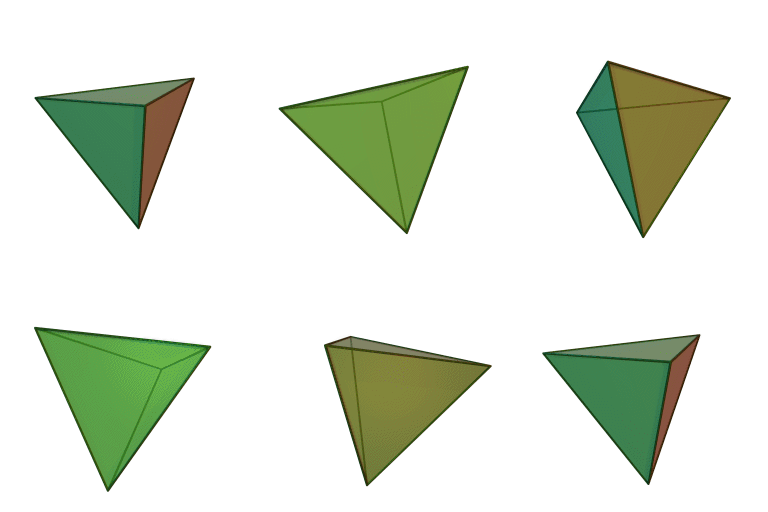
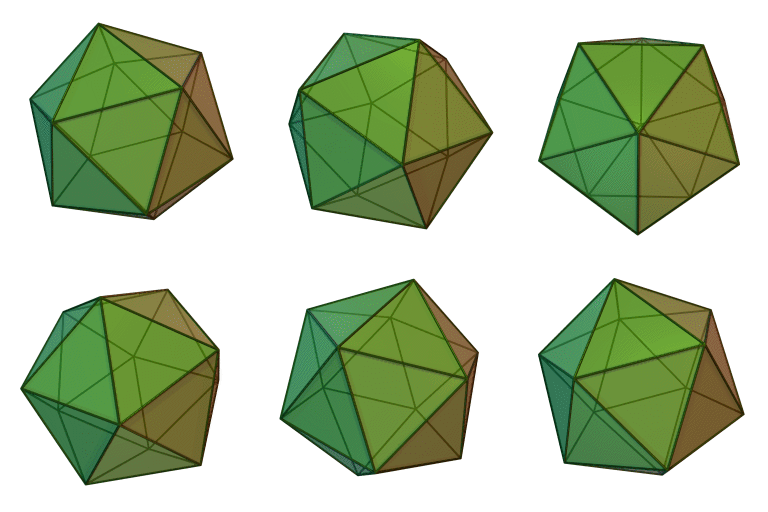
(The rotating shapes below are known as the Platonic Solids. Pictured here are the tetrahedron, the cube or hexahedron, the octahedron, the dodecahedron, and the icosahedron. We'll talk about these shapes later on in this entry.)
So, why isn't the seventh dimension as far as we need to go? We have to continue with the logic we've used from the outset. Imagine a point of infinite size in the sixth dimension, and it's much the same as imagining the indeterminate point we started from with our thought experiment - the point encompasses the whole dimension. If we can think of a different point that is not subsumed by the first point, then the point-line-plane postulate tells us we've found a way to get to the "next dimension up": those two points define a line in the seventh dimension.
What if the second point we just imagined represents a universe where the strength of gravity is different from ours? Then the line that passes through those two points is like a one-dimensional line, and that line extends through all possible values for gravity. Different positions on that line would include "impossible" universes which could not have come into existence because the strength of gravity was above or below a certain threshold needed to allow a physical universe to express itself, and such imaginary universes might be at many places along the line, interspersed with universes that were able to cohere into more organized states.
What about a universe with a different value for the speed of light (or whatever physical constant you care to imagine)? That's not on the line we just drew. We could erase the other point we drew, then place a new point for a universe with a different speed of light, and the new line that passes through those two points would be all possible realities resulting from different values for the speed of light.
But what if I want to consider both lines simultaneously? It can't be done without entering the next dimension up, the eighth dimension. So with the logic of the point-line-plane postulate we have a way of thinking of the eighth dimension as being like a plane, and our universe can be viewed as a point in the eighth dimension with those two lines or any other lines representing other different-initial-conditions universe passing through our point within that plane.
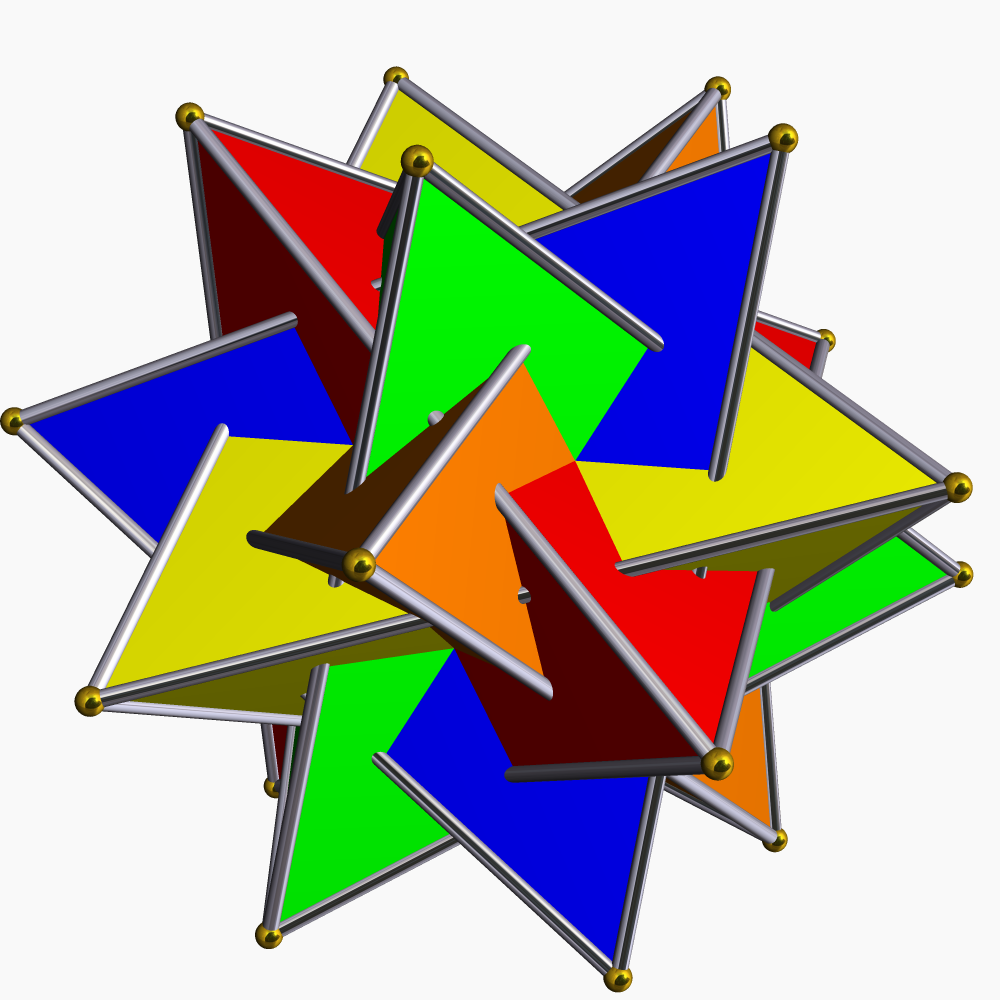
Remember this: with the point-line-plane postulate, the point you start from is in dimension x, the line to a different point is in dimension x+1, and the plane defined by a third point not on that line is in dimension x+2. Having worked through three dimensions, nothing moves or changes about the first point, we are just adding dimensions that allow us to view that starting point from different perspectives. Thinking of our universe as a "largest possible point" encompassing the phase space of the sixth dimension, then, doesn't mean that we can't view that unchanging point from the widening perspective of the seventh or eighth dimension. Quite the contrary: this logic is the accepted approach to visualizing spatial dimensions. Likewise, the idealized shapes we've started each of these entries with (like the octeract at the start of this entry) have an underlying symmetry, where each of the points are equidistant to their adjacent ones in the same way that the adjacent points of a 3D cube are equidistant when viewed within the third dimension. This means that the 8D octeract, like any of the other hypercube shapes, can be placed within a hypersphere with the same number of dimensions, and the outer points of the hypercube are pushed apart from the center of the hypersphere symmetrically: the point of indeterminate size can become a sphere occupying as little or as much of the dimension it's placed within. At its largest possible expression, this point becomes a finite but unbounded hypersphere occupying the entire phase space of the dimension it's within. We can also look at the other Platonic Solids we've been looking at here with this same idea of symmetric points pushed out from a central position in mind, and this includes shapes like the nested tetrahedra we see below left, which can be used to create the dodecahedron at the right.
.
Speaking of phase space, here's a link to a recent New Scientist article about a new paper published by Lee Smolin and others at arxiv.org, proposing that all possible universes could be contained within an eight-dimensional phase space. To follow the logic we've been pursuing here, the six-dimensional phase space for our own universe (or any specific universe with locked-in physical laws) would be a subset of an eight-dimensional phase space that encompasses all possible universes. Likewise, it's worth noting that Everett didn't limit his Theory of the Universal Wavefunction to just our unique universe: so while the phase space of a unique different-initial-conditions universe such as ours could be encompassed by the sixth dimension, the logic we've followed here shows us that Everett's theory ultimately should be considered from the phase space of the eighth dimension to include the wave function of all those other possible universes.
So what's beyond the eighth dimension? The simplest way to take our thought experiment to the next dimension up now is to ask this: how would you jump from the universe with a different value for gravity to the universe with the different speed of light without passing through the intermediate possibilities? To get to that addition degree of freedom, you need the next dimension up. For our 2D flatlander ant, that was the third dimension. For our fly in the fifth-dimensional garden hose analogy, that freedom to flit from location to location was in the sixth dimension. And for all these different universes considered from the eighth dimension, where do you think we'd achieve this additional degree of freedom?
"The further back one looks, the further ahead one can see"
- a 'fifth dimensional' way of viewing reality commonly attributed to Winston Churchill, for more about this idea check out entries like You Are the Point and Being More Fifth-Dimensional
We keep returning to this idea - every time we add a spatial dimension, we need to find a way to think about how the new dimension is at right angles to the ones that have come before. Another word for this concept is that each new dimension is orthogonal to the previous ones. Here's the definition of that word from the Merriam Webster online dictionary:
Orthogonal
a : intersecting or lying at right angles
b : having perpendicular slopes or tangents at the point of intersection
Last entry we looked at how it makes the most sense to say that the fourth dimension is space-time, a dimension which enfolds length, width, depth, and duration, and to accept that the fourth dimension is spatial. Yes, as creatures who get their energy from chemical processes that obey the thermodynamic laws of entropy, we appear to be moving in only one direction within that dimension, a direction which we call "time". But the evidence is strong that the opposite direction, anti-time, is just as valid and just as real, and having two opposing directions is one of the basic attributes added by any additional spatial dimension.
"One can think of ordinary, real, time as a horizontal line. On the left, one has the past, and on the right, the future. But there's another kind of time in the vertical direction. This is called imaginary time, because it is not the kind of time we normally experience. But in a sense, it is just as real, as what we call real time."
And it's interesting to think about this: one of the central ideas to this project's approach to visualizing the extra dimensions is Everett's Many Worlds Interpretation of quantum mechanics, which explains how every possible outcome for our universe is equally real, but as observers we can only see one of those universes at a time. According to Everett's "Theory of the Universal Wave Function", the reason we can't see any of the other universes is because they exist within a subspace which is orthogonal to the one we are are observing at any particular instant.
But even though Hawking has talked about another kind of time which is at right angles to our space-time, and Everett has talked about the other parallel universes being orthogonal (at right angles) to the version of the universe any one of us is observing right "now", neither of them have said that these additional realms are in the fifth dimension. Why is that? Is this a failure of imagination from two of the most brilliant minds of the twentieth century? Or is this a free will discussion?
Both Hawking and Everett have said they believe free will is an illusion. From Hawking's viewpoint, free will is a convenient fiction, only useful in recognizing how complex the factors are that cause one inevitable outcome or another to occur. Everett's viewpoint was similar - because an observer can only see one outcome, even acknowledging the existence of the other outcomes makes no difference to any one observer - because within the world line that they occupy, stretching from the beginning to the end of the universe, only one outcome could possibly have occurred. And Everett's viewpoint was that for a different version of the same person, within their parallel universe where they observe a different set of outcomes, those would be equally as inevitable! In either case, the other possible outcomes become part of a set of universes which are inaccessible, or decoherent, to the one being observed.
Is it easier to believe that free will is an illusion if there's nothing beyond space-time? And even when great minds like these are talking about versions of our universe which are at right angles to our space-time, is that why they continued to portray these as being part of the fourth dimension? Perhaps that's a philosophical rather than a scientific question. If so, then my philosophy is that the fifth dimension exists, and that's where each of us have the free will to navigate through the branching possibilities that Everett's Many Worlds Interpretation tells us really do exist.
Last entry we talked about how envisioning 3D space in its largest possible state is a way to think of a "quantum frame", and thinking about 4D space-time in its largest possible state encompasses an entire "world line" for our universe, extending from its very beginning through its very end. But you and I are not infinitely large within 3D space or 4D space-time, and what we're trying to visualize here is how those dimensions can have an additional degree of freedom that allows those connections to occur. This is where my project's line-branch-fold concept for imagining dimensions becomes particularly useful: the 5th dimension, by virtue of being at right angles to all of the dimensions that have come before, gives us a way to get to those other connections of the quantum world and Everett's Many Worlds that might seem unimaginable from the viewpoint of someone who believes there's nothing more than 4D space-time.
I have a lot of respect and admiration for physicist David Deutsch, so you can imagine how excited I was to receive an email from him about this project back in 2007. David wrote to say he enjoyed my animation but thought it made no sense past the fourth dimension, and he added this explanation: "the multiverse is simply not a manifold, or space, whose 'points' are universes, nor are the universes 'stacked' or 'clustered', with a notion of near and far, adjacent etc". My question back to him was this:
"As I understand it, the term "multiverse" has two aspects to it: there is the multiverse represented by the bush-like branching structure of a potentially observed wavefunction for our own universe from instant to instant, and there is the multiverse of other universes with different basic physical laws. As our own universe makes its selections from the quantum wavefunction, it never wanders off into those other different-initial-conditions universes, even though those other universes are just as real as our own. If there is no near/far/adjacent within the probability space of the "next available set of choices" at the quantum and physical levels for our universe, then what constrains those choices to keep us from jumping around in the multiverse with no logical progression, no coherent experience? This is what I like about the idea of our limited fourth-dimensional "line of time" actually being selected from within a bush-like branching structure of fifth-dimensional paths, that are still constrained by their "position" within the multiverse. It also gives us a way to see how the past is just as fluid as the future - as per Feynman's sum over paths, there are many ways we could have gotten to this instant in time that we call "now"."
David Deutsch has long been a strong supporter of Everett's Many Worlds Interpretation. What I was trying to get him to discuss with me is how the many universes of Everett's Relative State Formulation (and the ten to the power of 500 other universes with different basic physical laws potentially described by string theory) exist out there within the timelessness that a number of the great minds of the twentieth century have told us we should imagine as "really existing, in the same way that space really exists" (to use a phrase from Brian Greene's The Fabric of the Cosmos).
Dr. Deutsch never responded to that question, I'm sure he's a very busy man and I'm grateful that he took the time to write me at all. My own answer would be that ultimately we're talking about an underlying structure where all those universes exist not sequentially, but simultaneously, within an underlying state that everything we are witness to (and not witness to!) comes from. So the universe where I got up five minutes earlier this morning is not in some other part of an infinitely large 4D plane (even though that is the way some cosmologists describe it): as I say in my song The Unseen Eye, that other universe is "just around the corner in time", accessed via the fifth dimension. And I contend that those other universes with different physical constants from ours (each with their own unique set of all possible states within the lower dimensions) can only be accessed by moving in a higher dimensional multiverse landscape which is well beyond the fifth dimension.
In 2007, a team of scientists at Oxford under the direction of David Deutsch published a new proof equating Everett's MWI with the probabilistic outcomes at the quantum level and the parallel universes resulting from chance and choice, and New Scientist magazine declared this to be one of the top science news story of the year. In 2010, a team of scientists at Oxford participated in a speculative art project created by Jon Ardern and Anab Jain as "Superflux": "The Fifth Dimensional Camera Project". David Deutsch acted as one of the consultants on this project too, but of particular note is the following video featuring Dr. Simon Benjamin, who is from the QIP IRC (Quantum Information Processing Interdisciplinary Research Collaboration), based at Oxford University. If you jump to the 5:43 mark, you will see he shows a diagram very similar to the ones from my project, of branching timelines resulting from chance and choice, and he suggests that these are occurring at the fifth dimension. Jon and Anab did show my tenth dimension animation to these scientists, so this is not just a coincidence. Is my idea of the fifth dimension as our probability space catching on with the mainstream? Inch by inch, it would appear to be so.
Einstein, another of the great minds of the twentieth century, accepted the existence of the fifth dimension. He did take a while to get used to the idea, but in 1921 he eventually gave his approval to Theodor Kaluza's proposal that the field equations for gravity and light are resolved for our space-time when they're calculated at the fifth dimension. The fifth dimension, then, becomes a way to combine Einstein's theory of general relativity with Maxwell's equations describing electromagnetism. A few years later, with Oskar Klein's additional input, the resulting Kaluza-Klein theory would eventually become the starting point for string theory.
But if we're talking about something that is at right angles to space-time, why can't we see it? Well, we've already talked about our mythical 2D flatlanders, who would be unable to perceive "up and down" because it was outside of the length and width of their 2D world. And we've also discussed that although we've been taught that the world around us is 3D, the startling fact is that the time it takes for light to travel to our eye means it's impossible for us to see the third dimension by itself. So asking why we can't see the fifth dimension may be like asking why we can't see the other side of a building as we stand in the middle of a street: it's not that the back of the building isn't there, or that it's impossible to see, it's just that we can't see it from our current reference frame.
But the standard explanation for why we can't see the fifth dimension (and beyond) is because it's compactified, or "curled up at the planck length". Since we've already established that our 4D space-time is not continuous, but is divided into 3D frames, or quanta, I have proposed that it follows that our physical "window" into the fifth dimension is only one planck frame wide, and that various aspects of our awareness can, as we saw in our opening quote from Winston Churchill, connect into the fifth dimension more fully.
Make no mistake about it: with this project I am insisting that we are really not in the third dimension, or even the fourth dimension. Our "now" is a moving point within a fifth dimensional probability space, and I believe the more that people embrace this idea the deeper their understanding of our reality will become.
The analogy often used in string theory is to think of the fifth dimension as being like a garden hose stretched out on the ground. From a distance, the hose looks like a line. But up close, we can see that the walls of the hose are curled up on themselves, so that if an ant were to walk inside that hose, it could go from one end to the other (the "straight line" of the fourth dimension), but be moving in a second dimension as well as the first.
In my Imagining the Tenth Dimension animation, I showed a Möbius strip, and asked people to think about how a flatlander moving on this strip would feel like they were traveling in a straight line, but in reality they would be twisting and turning in the dimension above. This is useful as a way to think about the fifth dimension, but the garden hose analogy adds one further wrinkle - what if a fly were to enter our hose? Unlike the ant, the fly would be able to travel not just in a second dimension but a third: so if our hose were 4D space-time, the ant would be moving in the fifth dimension and the fly would be moving in the sixth!
You and I, it appears, are ants rather than flies. But next entry we'll talk about how that's a good thing, as we move on to Imagining the Sixth Dimension.
Before we finish though, I want to mention one final thing: some critics of this project say I mistakenly try to combine unrelated ideas: that Everett's Many Worlds Interpretation is not related to string theory, that general relativity doesn't require extra dimensions, that anyone willing to consider discussions of the more metaphysical or spiritual ramifications of all this should be immediately dismissed as a lunatic. On the other hand, every day I receive positive feedback from people who see ways in which my approach to visualizing the extra dimensions connects to their own ideas about how reality fits together, and in this blog I have tracked scientific developments that connect to my "new way of thinking about time and space". Needless to say, I was thrilled to read recently that well-known physicists Leonard Susskind and Raphael Bousso have published a proof equating the branching probabilistic outcomes of Everett's Many Worlds with the string theory multiverse. Here's a link to Sean Carroll's blog entry about the new proof, and here is a link to the paper as it was published at arxiv.org. And while we're looking at links, here's a Discovery channel blog entry about a new theory analyzing black holes from the perspective of the same compactified fifth dimension we've been talking about in today's entry.
P.S. - After publishing this entry I forwarded it on to David Deutsch to see if he had softened his position on this concept of the "fifth dimension as a representation of the probability space of Everett's Many Worlds". He did reply, and his answer was short and to the point: " 'Fraid not.". Oh well!
"The division between the quantum and classical worlds appears not to be fundamental. It is just a question of experimental ingenuity, and few physicists now think that classical physics will ever really make a comeback at any scale. If anything, the general belief is that if a deeper theory ever supersedes quantum physics, it will show the world to be even more counterintuitive than anything we have seen so far."
- from an article in the June 2011 issue of Scientific American, "Living in a Quantum World" by Vlatko Vedral
Poll 82 - "Information Equals Reality". Poll ended June 16, 2011.
68.5% agreed, while the remaining 31.5% did not.
One of the claims I've made from the outset of this project echoes Vlatko Vedral's statement quoted above. How great it is to see this idea has now officially moved into the mainstream! Five years ago when my book was published, this was one of the ideas that critics said proved I was a crackpot. As I said in Chapter Two, The Quantum Observer:
...the difficulties in determining where the dividing line between the quantum world and the macro world lies stem from the fact that it really is all part of the same continuum. Therefore the observer is functioning at both the quantum level, and as part of the physical world we see around us. This means that each of us is an observer, and each of us is creating our own unique reality, while we continue to participate in a shared consensus reality where the basic physical laws of our universe remain unchanged.
Which takes us to these words: "information equals reality". This is a highly useful phrase which I had not come across when I finished writing my book in 2006, but since then I've used it extensively in this blog. In 2009 when I created the pdf version of my book (available for download at www.tenthdimension.com/digital) I did add some addenda items to the end of each chapter to outline the progress that had been made in my ideas becoming less "out there" than they seemed at first. Here's a paragraph I added near the end of Chapter Two which helps to explain this concept:
Quantum mechanics is often portrayed as being completely unimaginable and supremely mysterious. I would propose that the way of imagining reality we are exploring here–which takes the indeterminate nature of subatomic particles and equates that idea with the simultaneously branching possibilities that we select from the probability space of the fifth dimension to create our fourth-dimensional reality–helps us to understand how both can be part of the same idea. When quantum physicist Seth Lloyd, in his book “Programming the Universe”, talks about information and reality being interchangeable, I feel a strong resonance between that statement and what we’re exploring in these pages: we are all navigating a sea of information, which from some perspectives may seem random and inexplicable. But within that sea of information we can find patterns and shapes, fractals and chaos, parts that start and parts that stop, all encoded within the underlying fabric of our observed reality.
There are numerous popular films that explore the idea that our reality equals information. We talked about some of those not long ago in my entry Poll 77 - What if the World's a Simulation?. A recent film about this idea, and it's one that I really loved, is Source Code. If you'd like to read an analysis of this film from a quantum physicist's perspective, here's a link from the Discover Magazine "Cosmic Variance" blog. Just a warning though, in order to discuss the underlying theories behind this movie the link I'm giving you has to reveal the surprise ending. Now that's okay, I suppose, if you've never seen the film and have no intention of doing so, but if you are thinking of watching it I'd really recommend you do so before reading this analysis.
Finally, here's a link to an exciting article published June 1st 2011 in New Scientist, which gives the seal of approval to a new paper published by Raphael Bousso and Leonard Susskind. This paper provides a formal proof for how the string theory multiverse and Everett's Many Worlds are directly equivalent. As I've admitted elsewhere, I've talked so much about this idea for the last five years that it seems a bit strange to have mainstream scientists only starting to accept it now, but once again I'm thrilled to see ways in which the "crazy" ideas I've been promoting with Imagining the Tenth Dimension are continuing to move closer and closer to the accepted mainstream. How cool is that?
Here's a new paper announced at Cornell Universeity's arxiv.org which has just been published by two highly respected physicists: Leonard Susskind and Raphael Bousso. It confirms an idea I've been promoting for so long that it feels a little strange to me to see them discussing this as something new, but nonetheless this is exciting news. Over at MIT's Technology Review site, here's a link to an article published today about Bousso and Susskind's paper: it's titled Multiverse = Many Worlds, Say Physicists.
The illustration at left is shown in that article, no explanation is attached but the name of the picture is "Multiverse QM". QM, of course, is quantum mechanics, and as it turns out the illustration comes from page 22 of Bousso and Susskind's paper. The idea shown here, that our reality is constantly branching, and that those branches are causally interconnected in multiple ways, has always been an important part of my approach to visualizing the dimensions.
What is still notably missing from this new paper is the acceptance that these branches are occurring at the fifth dimension, where the field effects for gravity and light are resolved. Until that idea moves into the mainstream, there will still be disagreement as to the relevance of my approach to visualizing the extra dimensions... but this paper certainly helps my project's inch by inch progress from the lunatic fringe towards the accepted picture of the underlying "information equals reality" nature of our universe or any other.
Today, Leonard Susskind at Stanford University in Palo Alto and Raphael Bousso at the University of California, Berkeley, put forward the idea that the multiverse and the many worlds interpretation of quantum mechanics are formally equivalent. But there is a caveat. The equivalence only holds if both quantum mechanics and the multiverse take special forms.
They call this new idea the multiverse interpretation of quantum mechanics.
That's something worth pondering for a moment. Bousso and Susskind are two of the world's leading string theorists (Susskind is credited as the father of the field), so their ideas have an impeccable pedigree.
...what this new approach does have is a satisfying simplicity-- it's neat and elegant that the many worlds and the multiverse are equivalent. William of Ockham would certainly be pleased and no doubt, many modern physicists will be too.
"A satisfying simplicity... neat and elegant": that's also what people like about my approach to visualizing the dimensions. I'm always excited when I see ways in which the ideas I arrived at through intuition and imagination are now being confirmed with proofs by great minds such as these. As I've said all along, I believe there's an underlying truth which connects these many schools of thought together, and today is an important step in that journey.
To recap: these songs were written for a live theatrical show which toured the high schools of Saskatchewan back then, and the subject of this particular song speaks to the eternal problem of being a teenager and trying to figure out where you fit in. Using alcohol or other drugs as a means to escape the pressures of life? Our hero becomes the victim in this song.
Also to recap: these songs feature my friends Cal Harle on drums and Jack Semple on guitars and bass. Since we were recording this in our basements and living rooms using a Tascam 244 and a Tascam 144 four-track cassette machine back in the pre-midi, pre-ProTools world of 1983, creating a song with this many individual parts and only four audio tracks was a time-consuming process involving lots of sub-mixing and bouncing: both Cal and Jack went above and beyond the call of duty to help me create this album, and Jack and I spent many many hours working on the overdubs for songs like this one.
As I mentioned last time, Cal continues to work as a professional drummer, and also works for my studio as a foley artist. His experience and natural feel make him one of the best in the business at both of those jobs. Jack has become a nationally known guitarist, his main focus has been on R&B, but he's proficient at a great many styles: you'll see what I mean if you check out his music for sale on his website.
With Trying to Escape, we never discover the fate of the song's central figure, a boy named Jimmy Smith. Last time, with Just a Shy Guy, we talked about how these songs relate to the idea of our fifth-dimensional probability space, which is a way of thinking about the quantum superposition of different outcomes that are pre-supposed by Everett's Many World Interpretation. Is Jimmy Smith like Schrödinger's cat, neither dead nor alive but both simultaneously, until we observe him? The truth for that famous cat is artificially simple. For Jimmy Smith and all of us, the possible outcomes from any particular moment are immense, and understanding that none of us are trapped into a single path is the power of this approach to visualizing the dimensions.
TRYING TO ESCAPE
- words and music by Rob Bryanton (SOCAN)
He was trying to escape
Any chance he would take
To get to something new
Nothin he wouldn’t do
He was trying to escape
Jimmy Smith was a young boy
Never did so good at school
You know his momma always told him
“Jimmy boy, life is cruel
It’s push and shove and give and take but mostly it’s just give
All it takes is one mistake so careful how you live”
Folks in town started talkin when he went to the doctor
Doc said he could see what the problem was
He was trying to escape…
Jimmy Smith at a party
He was like a boy possessed
He would drink down a twelve-pack
You know his momma never guessed
All the jocks never liked him much cause sports just weren’t his thing
Didn’t fit in with the stoners cause he just liked to drink
Sometimes it felt like he was caught in the middle
Sometimes he felt there was nowhere to go
He was trying to escape…
Whadaya think he was thinking of
What was goin through his head
The night he went out on the highway
When he left the road he was goin a hundred and ten…
He was trying to escape
Any chance he would take
To get to something new
Nothin he wouldn’t do
He was trying to escape
He was trying to escape
He was trying to escape
When Hugh Everett III first came up with his Many Worlds interpretation in 1957, he made an important distinction: when we observe one outcome or another, we are not really collapsing the quantum wave function, we are merely observing it in a particular state. The other potential states continue to exist, just as real as the one we're observing. Whether we call it "observing" or "collapsing" doesn't change what we see, but it can change the implications of whether there are actually other equally real parallel universe versions of our reality, or whether those parallel universes are just an imaginary outcome of a thought experiment.
Everett's thesis, despite support from John Wheeler (one of the greatest physicists of the twentieth century) was met with indifference and in some cases derision from the physics community. So, instead of becoming a physicist upon his graduation, Everett took a job as a defense analyst with the Pentagon. Hugh Everett III has been credited with developing the infamous Cold War policy of Mutual Assured Destruction: the idea that if every nuclear power has enough atomic bombs to destroy the world, then no one should be tempted to start a war. Isn't it interesting to think about this policy, abbreviated appropriately enough as MAD, in the context of the Many Worlds Interpretation?
So. If each of us is observing the wave function of the universe in a particular state, we are each a unique Quantum Observer. Should that make each of us feel isolated, or connected? Gevin Giorbran called this the Quantum Isolation Problem. With my 2011 entries I've been showing a way of thinking about how our quantum world is connected to the fourth dimension, and our "duration" is in the fifth, but how really both are interchangeable: this means that which label you assign to any particular spatial dimension depends upon your frame of reference established by the previous ones.
Last time, in Timelike Entanglement, I quoted a paragraph from my book and mentioned that the next paragraph was about The Quantum Observer, a topic that comes up a number of times with this project. Here's that paragraph now:
A particular meme-set, when it is attached to a physical body, is the quantum observer for that person, collapsing the wave of possibilities along the arrow of time and experiencing life as we know it. However, since that set of memes can also be thought of as existing completely separately from a physical body, there are many other ramifications to this.
Some of those ramifications get quite metaphysical, but this time let's look at some new articles that have come out recently to show how the quantum world connects to the fourth dimension, birds as quantum observers, and life as a subset of a quantum wave function.
Here's a link to a paper published at Cornell University Library's arXiv.org demonstrating the math behind Quantum Mechanics in Four Dimensions. Then, check out this new article at New Scientist magazine, "Quantum States Last Longer in Birds' Eyes". It reveals that birds are able to maintain electrons in an entangled state longer at the back of their eyes than any scientist working in a lab under carefully controlled conditions has been able to do so far. The birds, it appears are able to use the information gleaned from these entangled electrons to aid in their navigation abilities.
Finally, Micheal Brooks published a wonderful summation of the many interpretations of what it means to be a quantum observer last week in New Scientist: the article is called "Quantum Reality: The Many Meanings of Life". Here's some paragraphs from that article:
A CENTURY, it seems, is not enough. One hundred years ago this year, the first world physics conference took place in Brussels, Belgium. The topic under discussion was how to deal with the strange new quantum theory and whether it would ever be possible to marry it to our everyday experience, leaving us with one coherent description of the world.
It is a question physicists are still wrestling with today. Quantum particles such as atoms and molecules have an uncanny ability to appear in two places at once, spin clockwise and anticlockwise at the same time, or instantaneously influence each other when they are half a universe apart. The thing is, we are made of atoms and molecules, and we can't do any of that. Why? "At what point does quantum mechanics cease to apply?" asks Harvey Brown, a philosopher of science at the University of Oxford.
Although an answer has yet to emerge, the struggle to come up with one is proving to be its own reward. It has, for instance, given birth to the new field of quantum information that has gained the attention of high-tech industries and government spies. It is giving us a new angle of attack on the problem of finding the ultimate theory of physics, and it might even tell us where the universe came from. Not bad for a pursuit that a quantum cynic - one Albert Einstein - dismissed as a "gentle pillow" that lulls good physicists to sleep.
Unfortunately for Einstein quantum theory has turned out to be a masterpiece. No experiment has ever disagreed with its predictions, and we can be confident that it is a good way to describe how the universe works on the smallest scales. Which leaves us with only one problem: what does it mean?
Physicists try to answer this with "interpretations" - philosophical speculations, fully compliant with experiments, of what lies beneath quantum theory. "There is a zoo of interpretations," says Vlatko Vedral, who divides his time between the University of Oxford and the Centre for Quantum Technologies in Singapore.
No other theory in science has so many different ways of looking at it. How so? And will any one win out over the others?
Take what is now known as the Copenhagen interpretation, for example, introduced by the Danish physicist Niels Bohr. It says that any attempt to talk about an electron's location within an atom, for instance, is meaningless without making a measurement of it. Only when we interact with an electron by trying to observe it with a non-quantum, or "classical", device does it take on any attribute that we would call a physical property and therefore become part of reality.
Then there is the "many worlds" interpretation, where quantum strangeness is explained by everything having multiple existences in myriad parallel universes. Or you might prefer the de Broglie-Bohm interpretation, where quantum theory is considered incomplete: we are lacking some hidden properties that, if we knew them, would make sense of everything.
There are plenty more, such as the Ghirardi-Rimini-Weber interpretation, the transactional interpretation (which has particles travelling backwards in time), Roger Penrose's gravity-induced collapse interpretation, the modal interpretation... in the last 100 years, the quantum zoo has become a crowded and noisy place.
I liked this article because it points to a claim I've been making since my project began: that the Many Worlds Interpretation is seeing increasing acceptance from mainstream science. But as we've seen here, it's not the only game in town! Later on in the article, it offers further explanation for the rising popularity of Many Worlds.
Considering the nature of things on the scale of the universe has also provided Copenhagen's critics with ammunition. If the process of measurement by a classical observer is fundamental to creating the reality we observe, what performed the observations that brought the contents of the universe into existence? "You really need to have an observer outside the system to make sense - but there's nothing outside the universe by definition," says Brown.
That's why, Brown says, cosmologists now tend to be more sympathetic to an interpretation created in the late 1950s by Princeton University physicist Hugh Everett. His "many worlds" interpretation of quantum mechanics says that reality is not bound to a concept of measurement.
Instead, the myriad different possibilities inherent in a quantum system each manifest in their own universe. David Deutsch, a physicist at the University of Oxford and the person who drew up the blueprint for the first quantum computer, says he can now only think of the computer's operation in terms of these multiple universes. To him, no other interpretation makes sense.
He and Brown both claim that many worlds is already gaining traction among cosmologists. Arguments from string theory, cosmology and observational astronomy have led some cosmologists to suggest we live in one of many universes. Last year, Anthony Aguirre of the University of California, Santa Cruz, Max Tegmark of the Massachusetts Institute of Technology, and David Layzer of Harvard University laid out a scheme that ties together ideas from cosmology and many worlds (New Scientist, 28 August 2010, p 6).
I know it looks like I've quoted a lot here, but there's still much more to the full article and I invite you to follow the link and read the whole thing.
So, if we're each moving through a probability space of possible universes, are we causing reality to occur, or is reality simply happening to us as we helplessly observe one outcome after another? We'll return to this ongoing discussion of how much control do we really have as we navigate through the information that becomes reality, with an entry next week called Changing Your Brain. But right before that, let's look at this question: "What Is Reality?".
The above video accompanies my previous blog entry Just Six Things, which was published earlier this year. It connects to the video we looked at last time in Bees and the LHC, in which we considered the possibility that bees can somehow perceive the sixth dimension (as has been proposed by a scientist analyzing the "waggle dance" they perform to communicate to each other), and the controversial leap I made that perhaps the declining bee population of the world is connected to their sixth-dimensional perception.
In entries such as Just Six Things, I've been relating the quantum mechanics concept of there being a wave function of all possible states for our universe to my way of describing the sixth dimension, the entirety of which then becomes a point in the seventh dimension, which gives our universe a certain location within the multiverse landscape. Thinking that there is a set of all possible states that already exists for our universe leads some back to the idea that free will is an illusion, since within that wave function we can see that everything that can happen already has happened from the perspective of timelessness.
Everett's "Theory of the Universal Wavefunction" (also referred to as "Many Worlds") is the way out of this quandary, which brings us to today's topic.
A YouTube user named Lee Ann recently asked me a question about time travel paradoxes, and here's how I responded to her:
Hi Lee Ann, that's a great question.
I subscribe to Everett's Many Worlds Interpretation of quantum mechanics, because it allows a logical consistency to such discussions, and avoids the Grandfather Paradox issues. I presume you're familiar with the Grandfather Paradox where someone goes back in time, kills their grandfather, which means they were never born, so the grandfather is not killed, so the person is born and goes back and kills the grandfather, and so on?
Everett's interpretation makes more sense to me. So to answer your question specifically, assuming reliable time travel technology now exists it's December 2010 and you and your son climb into your time machine. There will be two main branches of you created now: the one where you go back in time (B) and the version that said "I choose not to go back in time" (A). Version A continues on with their life, no time travel occurred so things happen accordingly with their life from there on.
Version B goes back to 1992 and does something - carves their name in a tree, blows up their house, whatever you care to imagine. They could meet with and talk to themselves --the 18 years younger versions of themselves-- but in doing so they would be creating a new timeline, a version C of themselves who in December 2010 remembers that time 18 years ago when the time travelers appeared.
Does version A ever see the carving in the tree? No. Does version B become the 18 years younger version of themselves when they travel back in time? No. And as time travelers are they able to cause things to happen like causing their parents to never fall in love so they're not born (a la Back to the Future)? No.
In fact, here's a couple of paragraphs from my book on the Back to the Future question:
It should be clearer now that "Back to A Future" might have been a better title for this movie trilogy, since anyone who goes into their own past will never be able to get back to the present they had started from--because in that present time they started from they had never traveled to their own past. Their action of traveling to the past automatically puts them on a new timeline, the one where they had been in their own past, which might end up arriving at a present extremely similar to their original timeline, but is more likely to be completely different. Paradoxes such as this are built into any discussion of time travel--but agreeing that all possible pasts and futures really do exist is still easier to deal with than the alternative, which would be to imagine that there is only one real timeline and every aspect of the past and future is already carved into stone. If each of us is correct in our belief that we have free will, then the future must be filled with options, not just a single track.
There could be a whole other set of "Back to A Future" movies created where the inherent paradoxes are explored--for instance there is the plot where Marty travels to the new and improved future (the ending of the original movie), and discovers a family and friends who have lived a happy life with some other "timeline twin" of Marty, who we will call "New Marty". "Old Marty" realizes that "New Marty" must exist, because otherwise his new and improved family wouldn't have recognized him, and would have chased him out of the house as a stranger. So "Old Marty" has a gruesome task ahead of him: he must find and kill "New Marty" and dispose of the body before anyone finds out they both exist. The rest of the movie would entertain us with the hilarious slip-ups as "Old Marty" then tries to interact with his new and improved family despite never having shared any of their past years together.
Next time we're going to discuss one of my favorite blog entries of 2010, which finally has a new video up on YouTube: the entry will be called Gravity and Love.
I've been hearing lately from people who say they found The Grand Design, the new book by Stephen Hawking and Leonard Mlodinow, easier to digest because of the advanced concepts I had already eased them into through my writing. Thanks for your kind words, everyone!
At the end of our last blog entry, Extra Dimensional Geometry, we talked about how we could work the hard determinist viewpoint into the idea that we are ultimately each just navigating within extra-dimensional patterns that already exist. In The Grand Design, the authors suggest that free will is an illusion. They say that the system of inevitable cause and effect outcomes leading from the big bang to the creation of life to the evolution of humans to an individual such as you or I right "now" is so incredibly complex, saying that we have "free will" works as an effective interpretation, but is ultimately not the correct one. I think the authors are trying to have their cake and eat it too on this point, but we'll return to that thought in a minute.
The Grand Design is a summary of mainstream cosmologists' thinking about the nature of reality, targeted towards an audience with little knowledge of the subject. Some readers may be frustrated by the book's repeating references to M Theory as being the best candidate for the ultimate Theory of Everything, while spending comparatively little time explaining any more about M Theory other than to say that it combines the five other versions of string theory.
(Here's an amusing Venn Diagram example from flickr)
M Theory, which relies on ten spatial dimensions plus one of time, can be thought of as a Venn Diagram: draw five circles which overlap in various ways, they represent the different versions of string theory, and M Theory provides a framework for showing how these different theories fit together and overlap. Hawking and Mlodinow invoke the interesting concept of "model-dependent realism" in their book, which we can sum up like this: reality can be interpreted in a number of ways, and the frame of reference from which you describe reality can make one theory or another appear to be more relevant while your viewpoint is within that frame. One of the more often-quoted examples from this new book appears in Dwight Garner's New York Times book review:
They write about a city in Italy that, a few years ago, barred pet owners from keeping goldfish in curved bowls. Why? Because it is cruel, the city council argued, to give the fish “a distorted view of reality.” We’re quite similar to those goldfish, the authors suggest. Our perceptions are limited and warped by the kind of lenses we see through, “the interpretive structure of our human brains.” Digging deeply into quantum physics, they argue that our universe “doesn’t have just a single history, but every possible history, each with its own probability.”
Which is where I believe the authors are having their cake and eating it too. In my book and this blog, one of the keys to understanding the multiverse is Feynman's "sum over histories" or "sum over paths" concept. Hawking and Mlodinow also talk about this important idea: the wave/particle duality underlying our reality means that there are many many paths a particle could have traveled to get to its current position. When you add all those paths together, you get the path that is most likely, but that is not the path that was necessarily taken. Hawking and Mlodinow say free will is an illusion because of the existence of this "most likely path" for every particle in the universe, which contradicts Feynman's theories and the evidence provided by numerous double-slit experiments clearly showing that particles do indeed take all paths, not just the most likely one provided by Feynman's sum over histories.
(image from Wikimedia Commons) This double-slit experiment has shown that when a particle passes through a barricade having either one or two slits, when one slit is opened the resulting pattern shows (as you would expect) that only one path was taken. But when two slits are opened an interference pattern results: a particle is going through both slits simultaneously! Each particle interferes with itself as it passes through the two openings.
Now, the common objection to the relevance of all this is that the quantum world is completely separate from our classical reality. I've taken the opposing view, insisting that this is all part of the same continuum, and there really is no dividing line between the one layer of reality and the other.
Hawking and Mlodinow talk about how the double slit experiment has been successfully demonstrated with "buckyballs": molecules created from 60 carbon atoms. A buckyball passing through two slits simultaneously would already be moving uncomfortably far into our classical world for some people: but no more so than the "spooky action at a distance" entanglement experiments being demonstrated with increasingly large molecules over increasingly large distances that we've talked about in past entries.
I use the phrase "just geometry" in my book a number of times, here's an excerpt from chapter 8:
The idea of the moment you are experiencing at this instant as being “just geometry” means that there are multiple paths which could have caused you to arrive at this particular moment, and the path that you remember as being your personal history is only one of many which could have brought you to this present moment in time (as you will recall from the discussion of Feynman’s “sum over paths” theory which we first looked at in chapter four). The image of the extraordinarily extravagant multiverse that is inferred from this concept is something we discussed in the Introduction, as this ties directly to Everett’s “Many Worlds Theory” and “decoherence”, both of which have been enjoying renewed support in the last few years. And finally, we should always be mindful of the double-edged sword that is implied by the idea of the current instant of time being “just geometry”: while this means that the potential for this instant of time has always existed within the tenth dimension (as have all the potential moments to come and all the ones that could have already occurred), it does not mean that our path is somehow carved in stone and unavoidable. As creatures with free will, we are constantly moving through the fifth dimensional paths that are available to us, selecting one of those paths as our personal timeline. The path that we have been on makes the next possible choice the more likely one (and that would be the one predicted by the sum over paths method), but a life-changing decision or event that breaks old habits and old patterns will certainly direct a person’s life to a new trajectory, making other future paths more likely to be followed from that point on.
I hope that the concept of "model-dependent realism" shows another way that my own approach to visualizing the dimensions can be juxtaposed with other theories of reality: it works as a frame of reference, it has its uses because of that, but it is only one way of many systems for describing how our universe fits into the biggest picture of all. We're going to continue this exploration next time in an entry called "Thinking Biggest".
A direct link to the above video is at http://www.youtube.com/watch?v=FzGBDBEx_pI Not long ago the amazingly energetic Dr. Mark Filippi of somaspace.org invited me to attend the 2010 Coherence Conference, which took place at the University of Bridgeport in October 2010. Unfortunately, my schedule didn't allow me to participate, but there were four basic questions Dr. Mark asked everyone to consider prior to the conference, and I'd like to share my responses with you now. This conference focused on the burgeoning field of "Health 2.0", and brought together a wide range of speakers from various disciplines to discuss the importance of coherence as it relates to people's well-being. Since I'm not a health professional, I'm sure there would have been a lot of eye-opening discussions for me, but I'm also sure that my own approach would have added some new ideas to the discussion.
I'm particularly interested in the idea that our reality is shifting as people become more and more connected to each other: definitely a coherence-related concept! Here's the questions that Dr. Mark, as chair of the event, asked all participants to respond to:
1. Define coherence in your terms Here's how I first learned about the concept of coherence: our reality is constructed through constructive interference from a fifth dimensional probability space, which contains a wave function which can be thought of as the constantly evolving map of possible pasts and futures that connect each of us to our current "now". Those past and future paths are "coherent" with our current now, while the pasts and futures of the universe that are logically/causally incompatible are "decoherent".
Coherence, then, connects us to the multiverse as per Everett's Many Worlds Interpretation of Quantum Mechanics. Speaking philosophically, coherence as a goal is finding ways for each of us to better connect to the preferred versions of the universe that already exist within the underlying patterns of timelessness which, to avoid confusion with the multiple definitions of the word "multiverse", I've come to prefer to refer to as the "omniverse".
My project, Imagining the Tenth Dimension, has been an ongoing exploration of how we fit into these underlying patterns. I recently posted a video to YouTube called "Strength of Gravity, Speed of Light" which shows one example of how my project is about trying to find the common meeting ground between physics and philosophy, between science and spirituality.
A recent blog entry which goes even further out on a limb with these ideas is called "Love and Gravity". In that one I look at what would more commonly be called "new age" phrases and relate them to my approach to visualizing the extra spatial dimensions our reality comes from. Those phrases are:
The universe loves you.
Your body's natural inclination is to want to heal, to want to thrive.
There are forces outside of our reality which are trying to move us towards a better future.
2. What are the key applications of your definition? Understanding how each of us is at the center of our own unique version of the universe gives us a way of understanding our connectedness to the reality we are observing, and our connectedness to others we are interacting with as that reality is being observed. We each have more power than twentieth century science has traditionally taught us to believe, and the new science of epigenetics is a prime example of that. Who would have believed twenty years ago that studies could prove that changes in diet, lifestyle, and attitude can change which genes are expressed, and even influence what genes we pass on to our offspring? A YouTube video I posted at the end of August called "Placebos Becoming More Effective?" relates to this discussion.
3. What do you see as the major impact of your application within your field? I am a generalist, interested in exploring the common meeting ground between ancient spirituality and modern science. I'm always careful to point out that I'm not a physicist and I'm not pretending to be one, but my visual approach to understanding the ten spatial dimensions (plus one of time, but since I agree with the many physicists who say that ultimately "time is an illusion" I prefer not to count it as a dimension) that our reality comes from has fired the imaginations of millions of people around the world.
4. What do you see as the major impact of your application outside your field? "Outside my field"? Since I'm a generalist, that term's a bit hard to define. For persons who insist that spirituality has no place in science, or religious fundamentalists who say that science is delusion, or hard determinists who say free will is an illusion, my project will not likely convince them to change the conclusions they've already reached. Other than that it's difficult to pin down exactly what the phrase "outside my field" would mean, since the main goal of my project is to find ways to be as inclusive as possible in discussing where our reality comes from, and the significance of our individual roles as participants in that process.
For more about how my idea of our reality coming from a fifth dimensional probability space is receiving more mainstream consideration this year, please watch my video for "The 5th Dimensional Camera Project".
I've titled this entry "Global Coherence". Here's a link to a description of "The Global Coherence Initiative", something that Jack Canfield (famed author of the enormously popular Chicken Soup for the Soul series) describes as "perhaps the greatest experiment in the history of the world". Is the world changing for the better as more and more people become connected to each other, embracing the possibilities of shared intention? Check out the link if you'd like to know more.










 Posts
Posts


