a new way of thinking about time and space ~ ~ ~ ~ ~ ~ ~ ~ ~ ~ by Rob Bryanton
--author and research scientist David Jay Brown says: "one of the most brilliantly-conceived and mind-stretching books that I've ever encountered".
--science fiction author Greg Bear says: "a fascinating excursion into the multiverse - clear, elegant, personal and provocative"
Showing posts with label Nassim Haramein. Show all posts
Showing posts with label Nassim Haramein. Show all posts
(This picture was created by my Facebook friend Annamaria Paizs, a Hungarian born Dutch artist living and working in Breda the Netherlands. It's called "Whitehole". Click here for other examples of her work. Thanks Annamaria!)
This video accompanies a blog entry published earlier this year called Gravity and Free Will, which was tied together with a look at the results from four recent poll questions here at this blog.
Last entry, in Threes, we worked our way through the Three Becomes One concept we explored earlier this year, and we arrived at thinking about spin. "Spin" ties together with Triality, Twistor Theory, Garrett Lisi's E8 rotation, Dan Winter's fractal compression/decompression, Nassim Haramein's point-based physics, and Marko Rodin's Rodin Coil. Could all of these different approaches be related? Let's watch a couple of movies.
This YouTube movie is titled Infinite Division. It uses visuals from a number of other videos and presents the ideas of Nassim Haramein using clips from a live presentation of Nassim's from a few years ago.
Here's a second video: this one features Randy Powell, who has studied with Marko Rodin, and has been working on ways to visualize the spin-based vortex mathematics of Rodin's work. As you'll see, in this ten minute video Randy makes some astonishing claims about the importance of this work and his group's intention to turn this knowledge into an open source project with far-reaching implications for humanity! Does this make him sound like a crackpot? Of course it does. But if these claims are supportable by hard math, then we may be looking here at a way of harnessing the Information Equals Reality paradigm I've been promoting throughout the life of this project. What do you think about this ten minute presentation?
How does the concept of infinite division relate to my approach to visualizing the dimensions? The answer is encoded into the logo I created for my project: at the core of this is the point we start with (the zero) and the point we end with (the ten), and those are connected. All of the other dimensions represent ways of dividing up the information that becomes reality, and so are shown in this graphic to be revolving around or "outside" the conceptual line which connects those starting and ending points. Those points, by virtue of being of indeterminate size, are really equivalent, but it's helpful to think of the zero as representing the drive towards division down to the infinitesimally small, and the ten as representing the drive towards encompassing the infinitely large "point" of the Omniverse.
Ultimately all of that information exists as potential within the beautifully balanced symmetry state that exists both before and after our universe or any other information set. So, if all possible states already exist and we are each merely observing infinitely dividable "slices" from instant to instant, is it possible for us to sense the future? Next time we'll look at a new science experiment on that question, with an entry called "Evidence for Seeing the Future?".
Poll 71 Poll 71: "In the June issue of Scientific American, it said this: 'A function of space plays the role of time. So even though the system as a whole is timeless, the individual pieces are not'. Do you agree with this statement?" Poll ended Sept 14 2010 73.3% were in agreement, while the remaining 26.7% were not.
It's interesting to me that this phrase was accepted by such a large percentage of visitors to this blog, while similar or related proposals in past poll questions have appeared to be more contentious. This dichotomy between thinking of time as a direction, a way of describing change from state, within a larger realm of timelessness is at the center of my approach to visualizing the dimensions. Last week, in Bees and Tangential Thinking, we talked about Stephen Hawking's proposal that there is another kind of time that is at "right angles" to our spacetime. I agree with that idea but again and again I'm confronted with people who are confused about time, spacetime, and how that relates to the fourth spatial dimension. The word "time" has many interpretations! This Scientific American quote that we looked at in this poll question is one way to ease people into the idea that time is a direction, not a dimension, and that time's opposite direction, anti-time, is just as valid within the underlying fabric of reality.
As I like to say, thinking of time without anti-time is like thinking of up without down or forward without backward: you need to consider the two opposing directions to be thinking about a spatial dimension, and thinking about what's beyond the fourth spatial dimension requires tangential thinking.
Poll 72 Poll 72: "Simulism: would you live your life any differently if you knew the reality you're seeing around is really just a gigantic virtual simulation?" Poll ended October 3 2010. 59.4% said yes, and 40.6% said no.
Another completely different example of tangential thinking. People love to play with these "nested Russian dolls" concepts: what if my reality is a dream of some other reality? What if our universe comes from a black hole in another universe, which comes from another black hole, and so on?
In my blog entry on Nassim Haramein, we looked at similar recursive ideas. As part of one of his presentations, Nassim shows clips from a couple of movies: the opening sequence of "Contact", and the ending of "Men in Black", both of which give us graphic ways of visualizing a universe that is embedded in other universes. I've remarked in my book and my blog that the "universe embedded in a rose in an abandoned parking lot" idea from Stephen King's Dark Tower series is another interesting fictional portrayal of this recursive/fractal idea.
But with Simulism, we're generally talking about something that is a more deliberate construct, as opposed to something that just "happened" as a result of the naturally occurring fabric of reality. In chapter four of my book I said this:
From the binary viewpoint, the tenth dimension becomes like the hugest computer memory in the world, containing every possible “0” and “1” that could be combined together to describe every possible universe. The “holodeck” of Star Trek: The Next Generation fame started out as a “simple” virtual reality simulator, but as the writers developed the series, its power appeared to grow to the point where entire universes could be created within its walls. How would a person’s life inside such a world be different from a life in the real world? The somewhat confusing Matrix Trilogy started out with the same clear and profound concept–our experience inside a system capable of simulating every aspect of reality would, to our senses, be indistinguishable from the experience of actual reality.
Which leads us back to the poll question: if you were shown incontrovertible proof today that you are living in a simulation, a virtual world, would you change the way you behaved? 59% said they would change. Fascinating! I want to know more, so a new poll question is running here now to ask people how they would change.
Poll 73 Poll 73: "It turns out that in a certain way the 'Geocentric Model' really was correct - in a very real sense, each of us is an observer at the exact center of our very own version of the space-time universe." Poll ended October 24, 2010. 85.3% agreed, and only 14.6% disagreed.
Think about this question in terms of the previous poll question. If you are an observer, piloting your focused consciousness attached to this collection of atoms and molecules that you call your body as you ride the entropy-driven arrow of time, how much control do you have?
The answer, I hope you'll agree, is more than most of us have been trained to believe. In Changing Reality, we looked at some of the new scientific evidence to support this idea. Here's the video for that entry:
The above video is tied to a previous blog entry from last January of the same name, Dark Flow.
Last time, in Placebos and Biocentrism, we returned to the idea that so much of what we talk about with this project is tied to visualizing our reality from "outside" of spacetime, a perspective that many of the great minds of the last hundred years have also tried to get us to embrace. Here's a quote I just came across from Max Planck that I think is particularly powerful:
As a man who has devoted his whole life to the most clear headed science, to the study of matter, I can tell you as a result of my research about atoms this much: There is no matter as such. All matter originates and exists only by virtue of a force which brings the particle of an atom to vibration and holds this most minute solar system of the atom together. We must assume behind this force the existence of a conscious and intelligent mind. This mind is the matrix of all matter.
It's so easy to look at some of the phrases from this quote and imagine them on some new age site, where mainstream scientists would then smugly dismiss these ideas as hogwash from crackpots. Like me, folks like Dan Winter and Nassim Haramein also sometimes get painted with the crackpot brush, but they are both serious about the ideas they are exploring, and they are not far away from the ideas that Max Planck promoted above, or that I have been pursuing with my project.
On July 1st of this year, I published a well-received blog entry called Love and Gravity. It looked at some new age ideas about wellness and spirituality, and related them to some mainstream science ideas about extra dimensions, timelessness, and the fact that physicists tell us that gravity is the only force which exerts itself across the extra dimensions.
Last week Dan Winter forwarded me a link to a new web page of his which yet again seems to tie into the same viewpoint that I'm promoting: Dan is calling this new page "Gravity is Love". As usual, this page is a sprawling collection of graphics, animations, and articles, most of which are found on a number of Dan's other pages, but there's important new information here as well. Here's a few paragraphs excerpted from the page which will give you the flavor of what Dan is saying about this concept:
Love really IS the nature of gravity! First we discovered Golden Ratio identifies the change in pressure over time- of the TOUCH that says I LOVE YOU: goldenmean.info/touch Then we discovered (with Korotkov's help) ... that the moment of peak perception- bliss - enlightenment- was defined by Golden Ratio in brainwaves : goldenmean.info/clinicalintro Then medicine discovered: the healthy heart is a fractal heart. ( References/ pictures: goldenmean.info/holarchy, and also: goldenmean.info/heartmathmistake Then - I pioneered the proof that Golden Ratio perfects fractality because being perfect wave interference it is therefore perfect compression. It is my view that all centripetal forces- like gravity, life, consciousness, and black holes, are CAUSED by Golden Ratio in waves of charge. Nassim Haramein says that although he sees Golden Ratio emerge from his black hole equations repeatedly - he sees it as an effect of black holes/ gravity - not the cause... Clearly - from the logic of waves - I say the black hole / gravity is the effect of golden ratio and not the other way around! - although some might say that this is a chicken and egg difference - may be just semantics... at least we agree on the profound importance of Golden RATIO.../ fractality... AND love : perfect embedding IS perfect fusion IS perfect compression... ah the romance.
Dan Winter is a fascinating fellow, I hope you can spend some time following the links in the above quote. Next time we're going to look at another somewhat related approach to imagining the extra-dimensional patterns that link us all together, in an entry called Biosemiotics: Monkeys, Metallica, and Music.
Image from wikipedia: "Borromean Rings". With my approach to visualizing the ten spatial dimensions, I group three dimensions together, call that a "triad", and condense it into a single entity so that it becomes a point in the next dimension up. By the time I've done that three times, I arrive at ten, the same number which Pythagoras also defined as the ultimate number encompassing all possible expressions of our reality. Let's look at some of the ways that ancient wisdom ties into all this, starting first with this mystical insight from the current Grand Archdruid of the Ancient Order of Druids in America:
In a binary, though, every action is balanced by an opposite reaction, so thinking in binaries is very problematic if you want to foster change. If you’re a mage, you respond to dysfunctions of this sort by shifting numbers. The traditional rule here is that numbers always change in a specific order: one becomes two, two becomes three, and three becomes one and shifts to another level. (The reasons for this rule, again, are too complex to go into here.)
When I came across the above text I was struck by how strongly it seemed to relate to the triads from my approach. Here's another quote, this one from a site dedicated to Chinese martial arts:
Then the link between the qi of the earth and the qi of the sky can be formed, causing the practitioner to shape the unity of heaven, earth and person; three becomes one.
The Dynamics of Creation
In Strength of Gravity, Speed of Light, I summed up the dynamics of creation like this: "One thing pushes against another, and out pops a third thing". Is this a schoolboy description of sex? Sure, why not! Long before sex came along, there's been single-celled fission, mitosis, a dividing apart: that's one kind of creation, binary and asexual. The other is sexual reproduction, a more robust form of creation because it takes elements from two sources and combines them to create something new. Hegel's dialectic is often summed up in a similar way: thesis, antithesis, synthesis.
Monad, Dyad, Triad
Pythagoras taught that odd numbers are masculine and divine, and even numbers are earthly and feminine. While such a conclusion might seem misogynistic, it's worth noting that Pythagoras welcomed females into his discipline, and his wife and daughters were accomplished mathematicians. In chapter four of my book, "The Binary Viewpoint", I suggested that the desire to catalog things into yes/no, right/wrong (and so on) tends to be a more masculine approach, while the holistic "yin/yang/both together" tends to be a more feminine one. Does this mean I would disagree with Pythagoras and say that odd numbers are more feminine, because they're less dualistic, less binary? It's an interesting thought.
"One state/an opposing state/both simultaneous" is also, of course, the basis of quantum mechanics, science's most-proven description of the foundation of our reality, and something which I've insisted will eventually be shown to be just as connected to our macro reality as it is to the quantum: it's all part of the same continuum. The June issue of Scientific American has just published an article about the first demonstration of quantum superposition on an object large enough to be seen by the naked eye! This demonstration is a major leap forward: while scientists have previously demonstrated superposition with atoms and molecules, this new experiment shows quantum superposition in an object made out of roughly ten trillion atoms. Suddenly, Schrödinger's cat, usually portrayed as nothing more than a fanciful thought experiment, moves a little closer to being something connected to our actual physical reality.
The Law of Threes
So. Two is a dynamic push and pull, while three is more stable, more balanced. In jokes and in fairy tales, it seems more satisfying when something happens three times. Lots of superstitions gravitate to this number: good luck, bad luck, celebrities dying, and so on are seen to come in threes. Father, Son, and Holy Ghost - entire belief systems are built on threes. To be sure, the phrase "Law of Threes" means a number of things depending upon who you consult, but here's the most popular answer as provided by "Galeanda" at Answerbag.com:
The Law of Threes states "every whole phenomenon is composed of three separate sources, which are Active, Passive and Reconciling or Neutral. This law applies to everything in the universe and humanity, as well as all the structures and processes".
In the final chapter of my book, I reached the conclusion that three systems are interacting, all of which in their unobserved state can be assembled into the tenth dimension as a "point" of indeterminate size. Those three systems are 1) the physical world, 2) the quantum observer who through constructive interference is actively engaged in observing specific aspects of the other two systems, and 3) the "information equals reality" world of memes, patterns, or waveforms.
It's interesting to relate this to Popperian cosmology. Philosopher Karl Popper made a similar proposal that there are three worlds: the physical, the mind which observes, and mental patterns of information. And imagine my surprise to be told that there are branches of Kabbalah which also teach that we can divide our reality into three triads, which can be summed up as the material, the moral, and the intellectual.
Three Threes
Here's an interesting version of my approach to visualizing the dimensions, using ideas connected to the point-line-plane postulate: which, as we've said before, can be used to visualize any number of spatial dimensions.
Start with a point. Choose a second point. Join those two points with a line, you're in the first dimension.
How far away are those two points from each other? Now find an additional point that is the exact same distance away from those first two points but not on the line. What have you created? An equilateral triangle, and you're in the second dimension. The fact that such a triangle can be created with nothing more than a compass and a straight edge is well known to students of sacred geometry and the vessica piscis, concepts we've looked at before in this blog.
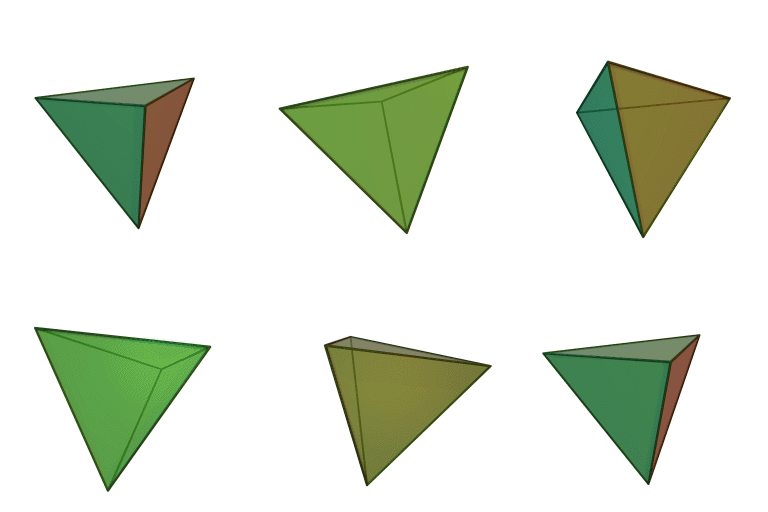
Now find an additional point that, again, is the same distance away as those first three points are from each other. What have you created now? This four-sided pyramid is called a tetrahedron. As you can see, it's made from four equilateral triangles, and now you're in the third dimension.
An article published last week in New Scientist magazine suggests that the tetrahedron is the most efficient shape for packing a large number of items into a 3D space. When we're thinking about how three becomes one, imagine collapsing this tetrahedron's outlying points towards any single point. This gives us a useful mental image for seeing how the underlying structures of our 3D space could be connecting to the fourth dimension, as we enfold all of our 3D universe in its current state -- its current "now" -- into a planck-length-sized frame which then becomes a "point" on our 4D line of time.
In Our Universe as a Dodecahedron, we looked at what happens when you rotate five superimposed tetrahedrons so that all their points are equidistant from each other, which took us to the discussion of the now-proven Poincaré Conjecture, and the proposal that the slight curve of our spacetime gives rise to the fifth-dimensional Poincaré Dodecahedral Space that our universe resides within. But once again, if you look at these beautiful symmetrical shapes, can you imagine how all of those points could easily be converged to a single central point?
In that same entry we talked about fascinating fellows like Dan Winter and Nassim Haramein who are showing us ways of visualizing how everything is connected through points or point-like structures. With "Three Becomes One", what we're trying to head towards is a way of imagining an underlying symmetry, and how that symmetry can be enfolded to eventually arrive at the unobserved whole, the big beautiful zero that our universe is moving towards and springing from within timelessness. Pull those points apart symmetrically and you get beautiful shapes like the vessica piscis, the triangle, the tetrahedron, and the dodecahedron. Allow the points to converge and you end up back where we started, at a point of indeterminate size.
Since gravity is the only force that exerts itself across the extra dimensions, that pushes or pulls, it must factor in here at a fundamental level. Let's continue to explore this idea more in our next two entries, Gravity and Free Will, and Gravity and Entrainment.
Enjoy the journey!
Rob Bryanton
P.S.: Pictured at left: diagram showing congruence of null lines from Twistor Theory.
Pictured at right: diagram of Marko Rodin's Rodin Coil.
According to the June issue of Scientific American, there's new excitement about
Twistor Theory and String Theory being united by the highly respected theoretical physicist Ed Witten. A number of people have asked me to talk about the work of Marko Rodin, I wonder what he would have to say about this latest development?
"We start with a point" - the first phrase of the animation that vaulted this project to worldwide popularity four years ago.
"We end with a point" - the conclusion that is reached at the end of the same animation. If the tenth dimension in its unobserved state is indeterminate, then it's just like the point we started from.
"You are the point": that was the title of a blog entry I published early this year. If our reality is defined across ten dimensions, then the fifth dimension would be the half-way point, the node of strongest harmonic resonance for all the vibrations and energy that combine together to create the unique "now" that we are each witnessing at this moment. As we've discussed in entries like The Holographic Universe and Holograms and Quanta, realizing that our reality is created through constructive interference at the fifth dimension is the key to understanding all of the wide-ranging ideas that we have been exploring with this project. Einstein believed our reality is defined at the fifth dimension. Do you?
By itself, a point is of indeterminate size and dimension. As we discussed not long ago in One to the Power of Infinity, it's important to realize that indeterminate is not the same as undefined: things that are indeterminate can also be thought of as being true for any value you care to assign to them. What does this mean?
By the time you use a point to indicate a position within a multi-dimensional space, as you imagine all the sizes that the point could be within its indeterminate range of sizes, a circle (2D) or a sphere (3D) is the shape it takes for anything between the infinitely large or the infinitesimally small versions of that point. This logic continues with the additional dimensions: but while we've spent some time in past blogs looking at rotating hypercubes (a hypercube being the 4D equivalent of a 3D cube), we've never looked at the 4D equivalent of a 3D sphere: the hypersphere. Check out these two mind-bending YouTube animations created by WildStar2002.
In entries like An Expanding 4D Sphere and Finite But Unbounded? we've talked before about these connections between hyperspheres and visualizing the extra dimensions of our reality.
Two entries ago, we discussed our universe within the omniverse, in which we looked at some new scientific theories advanced in the last couple of months suggesting that all possible universes are connected to each other by point-like black holes.
Then last entry we looked at our universe as a dodecahedron. In that blog we returned to the work of Dan Winter, and showed this simple animation from his gigantic goldenproof web page:
After I published my look at the dodecahedron last week, Dan sent me this note:
Nice to have a general intro there. Now you need to add this simple essential statement: after the limited number of axes of rotation which can be contained in cubic lattice (3D),the ONLY way rotating axes of charge can be superposed WITH the necessary constructive wave interference is the way a (5) cube rotates into a dodecahedron, the so called hypercube producing the golden ratio edgeis the ONLY next dimension... 4 there. Then by ratcheting that down a helix - precisely mapping dna you have the 5 axes of rotation superposed (5D). Recursive braiding adds spin axes superposed (and longer wavelengths) to that, where thus DNA is the only biologic structure with access to 10+ dimensions. See how 7 plus 5 makes 12 in dna: goldenmean.info/dnamanifesto The 7 / 5 spin is the essential symmetry recipe (slip knot) of hydrogen, heart muscle and solar core, as well as dna.
On Dan's goldenproof page, he ties the golden ratio in not just with the Poincaré Dodecahedral Space (which we looked at last time as the underlying shape of our universe), but with other topics we've looked at in the last year or two: Garrett Lisi's E8 rotation (pictured at left), which is a bold framework for showing how all the possible particles and forces of our universe are organized, and which Dan explains also incorporates the golden ratio. On the same page Dan also relates his work to the ideas of Nassim Haramein. I've remarked before that Nassim is fond of dismissing ideas of extra dimensions (including his insistence that the first and second dimension don't exist), which could seem to tell us that his ideas are completely incompatible with mine. Nassim tells us that there is only one dimension, and that our observed universe is connected by "points" to all other realities by fractal patterns that can be infinitely divided or infinitely expanded. Where would such an idea tie in to what we're talking about here? In the fifth dimension, which I've been saying all along is really where our reality is defined, one planck frame at a time, to create the fourth-dimensional "line of time" we look back upon from our vantage point as creatures made of 3D atoms and molecules.
One of the things I've been fond of saying is that "life is any process that is interested in what happens next". With Dan's idea of DNA being the only pattern that connects us to the extra dimensions, we have another interesting way of seeing how our "now" is not riding on the single, constrained train track of our linear one-way arrow of time, but is being created one point after another from a fifth dimensional probability space. Visualizing the extended possibilities of this "now" is something we're going to talk more about next week with something called the Fifth-Dimensional Camera Project.
This Wednesday May 12th I'm going to be interviewed by Kelly Howell on what has become the most downloaded self help podcast on iTunes: Theatre of the Mind. We'll talk more about Theatre of the Mind in our next entry.
Enjoy the journey!
Rob Bryanton
Edit: Here's some more info about WildStar2002, the creator of the above Hypersphere animations: his name is Burt Clawson, he's from Salt Lake City, UT, and he's a graphic and web design student. Because of his interest in higher-dimensional geometry, he figured out a way to do these Hypersphere animations using MaxScript in 3D Studio max. Thanks, Burt!
"Our observable universe is an expanding 3D sphere on the surface of a 4D hypersphere." Poll ended Oct. 3 2009. 74.6% agreed, while 25.4% disagreed.
I'm pleased to see how many visitors to my blog were willing to agree with this idea: I suspect a sampling of the general public would show a much lower acceptance of this mind-boggling concept. Imagining a 2D circle being mapped onto a 3D sphere is easy enough for us to do, but our brains tend to hit a conceptual roadblock when we take that up a dimension and try to imagine a 3D sphere being mapped onto a 4D hypersphere! We've talked about the Poincaré Conjecture a few times now, in entries like When's a Knot Not a Knot?, Why Do We Need More Than 3 Dimensions?, and An Expanding 4D Sphere.
In Aren't There Really 11 Dimensions, I suggested that the slight curvature of our 4D hypersphere is what creates the cosmological horizon, and I've talked many times now about how that relates to the fifth dimension. In my blog entry about Nassim Haramein, we looked at how fractals give us a way to visualize how an infinite number of recursions could be contained within a finite space. This time we're tying those two ideas together.
Extra-dimensional spheres are important to all this because they show how our universe could effectively be infinite, but in reality be finite but unbounded. In other words, with each of the dimensions we've been talking about, there are always certain restrictions to that dimension, and you need to move up to the next dimension to move beyond those restrictions. This idea was discussed most recently in What's South of the South Pole?. Here's the video for that entry.
Let me give you and example of what "finite but unbounded" means. If I were to start moving on the surface of the earth, I could keep moving forever, but every now and then I would end up back where I started again. If I had some kind of magic telescope that followed the curvature of the earth, then with sufficient magnification I should be able to look through that telescope and see the back of my head!
Those examples are from topology, where we are effectively thinking about a 2D surface on a 3D sphere. While we're on that 2D surface it appears that we can keep moving in any particular direction forever, but it's the slight curvature of that surface through the next dimension up that prevents us from being able to see that eventually we're going to end up back where we started. Moving those concepts up to each additional spatial dimension gets harder and harder to visualize, but the Poincaré Conjecture (which should now more correctly be referred to as the Poincaré Theorem since it was proved in 2006 by Grigori Perelman) shows that this logic works for 3D manifolds on 4D hyperspheres as well.
Does that mean that if there were some super-Hubble telescope I should be able to look out into space and see the back of my head? No, because the further we look out into space, the further back in time we're looking: in other words, that's not space we're looking at but space-time. If we really were able to look out into space without time being a factor, then we would be seeing that star that's a thousand light years away as it's going to look to us a thousand years from now! It's so easy to forget this important fact.
Which takes us back to the idea that the cosmological horizon, which prevents us from being able to see any further back into 4D spacetime than the cosmic microwave background, is directly equivalent to the horizon we see when we're in the middle of the ocean. Both are the result of a slight curvature. The ocean is effectively a 2D surface mapped onto a 3D sphere. Our 3D universe at this particular instant is mapped onto a 4D hypersphere which we call spacetime, and cosmologists generally agree that our universe is expanding at an accelerating rate so with each new planck length expression of our 3D universe it is slightly larger than it was one unit of planck time before.
With my project, we take that idea one further. Quantum mechanics and Everett's Many Worlds Interpretation tells us there are multiple "world lines" that could have been traveled to get to this moment, and there are multiple "world lines" that branch out from here. Why can't we see those multiple paths from here? Because our 4D hypersphere is moving on a 5D hypersphere, and just as with those other examples, those other possibilities are "just over the horizon" in the fifth dimension. We know those other world lines exist, and we can move towards the available world lines or recognize that there are multiple previous world lines we could have traveled to get to "now", but we can't see them from our current vantage point. Like the land that is just over the horizon as we're in the middle of the ocean, we know these fifth dimensional branches exist even though we can't see them from here, and it's the slight curvature of our 4D spacetime that gives us our small window into a much larger 5D reality. Why, then, do string theorists say that the fifth dimension is tiny? Because from our 3D/4D perspective it is, just as the ocean appears to be a relatively tiny circle that surrounds us when we're out in the middle of it.
Spheres within spheres, wheels within wheels. Branching possibilities that allow us to see the way out of loops that we want to change. Enjoy the journey!
Last October, Seed Magazine published a great article written by one of the two physicists who came up with that proposed number of ten to the power of 500 possible universes. Raphael Bousso is a theoretical physicist at The University of California, Berkeley. His article was called The Statistical Universe: please do check out the whole article. Here's a few paragraphs:
We cannot see farther into the universe because the big bang happened only 14 billion years ago and light from distant regions has not had enough time to reach Earth. Yet subtle clues are beginning to reveal some of the properties of the regions of space hidden beyond our cosmic horizon. Our world appears to be only a small part of a “multiverse,” an expanse vastly larger than the visible universe, and for the most part completely different from it.
The multiverse comprises a large number of distinct patches, each far bigger than our night sky. What observers see, therefore, also depends on where they find themselves. Most of the regions in the multiverse are inhospitable to life, and their properties will not be observed. But what exactly is life? In order to extract predictions from the multiverse, my colleagues and I have developed a statistical tool to find regions with observers: We look not for life itself but for the disorder left behind by the complex processes that its formation depends on. To understand the physical signatures of life in this way may help us finally to comprehend our own little corner of the multiverse.
String theory is the leading candidate for reconciling two very fundamental laws — gravity and quantum mechanics. But to accomplish this feat requires at least nine dimensions of space, when we see only three. In order for six dimensions to have remained undetected, they must be tied up into loops too small to see under our best microscopes. In physics there are fundamental laws and local laws, which depend on the environment. Iron and carbon are made from the same elementary particles but assembled differently. As a result local properties like density and conductivity differ widely. The fundamental laws of string theory also appear as different local laws, depending on how the extra dimensions are tied up. If we could open the knots and tie them differently, then supposedly “fundamental” phenomena, like neutrons or the electric force, would disappear and be replaced by an utterly different set of particles and forces.
Because extra dimensions need not be tied up the same way everywhere, physical laws may vary from place to place. Inflation makes each “legal district” much larger than the visible universe, giving us the illusion that particles and forces are the same everywhere. But beyond our cosmic horizon, inflation allows the universe to grow so enormous that it contains every set of possible laws that can be constructed from string theory. Eight years ago, Joe Polchinski and I estimated that the number of possibilities is truly enormous: a one with roughly 500 zeros behind it (10500).
Let's pause and point out the similarities between what Dr. Bousso is talking about and my approach to visualizing the dimensions. First of all, he states that there is a spacetime horizon to our universe, extending back almost 14 billion years, but the multiverse of other different-initial conditions universes lies beyond that horizon. In The Holographic Universe, I showed an animation visualizing how this is much like what happens when you're in the middle of the ocean - you see a horizon which is the same distance away no matter which direction you look, but there is still a much larger sphere beyond that horizon. Transferring that idea to 4D spacetime rather than 3D space is a mind-boggler, and I have been continuing to insist that this all makes more sense if you imagine that this 4D "spacetime horizon" shows how spacetime has a very slight curve to it. That curve moves through the fifth dimension (where Kaluza demonstrated to Einstein that the field equations for gravity and light are resolved), and the idea that our spacetime is a projection from a 5D hologram ties nicely to all this.
Next, he talks about the idea that many parts of the multiverse will be inhospitable and chaotic jumbles, but there will also be regions somewhat like our own where matter and energy are stable enough to allow some other kind of life to form. Since the basic physical laws of a universe within this other part of the multiverse would be different from our own, the life that arises there would almost certainly be very different from what we think of as life as well. We've talked about this idea recently in blog entries like Alien Mathematics and The Flexi-Laws of Physics, and we've looked at some scientific theories that take the "observer participation" idea to a logical extreme in The Biocentric Universe and The Biocentric Universe Part 2.
Thinking of this multiverse of universes as a probabilistic set of possible arrangements that lie outside of our spacetime has led me to talk about the concept of there being a "probability space" for the information that becomes our reality. I've talked about this in blogs like You Have a Shape and a Trajectory, Time in 3 Dimensions, Information Equals Reality, and The Fifth Dimension Isn't Magic. One question that is sometimes asked is why do we even need to imagine that there is a multiverse of other possible universes? Dr. Bousso offers a succinct explanation:
This may seem laughable, but without the multiverse our finest theories predict that empty space should contain about 10123 times more energy than it actually does. This is known as the “cosmological constant” or “dark energy” problem. It has been called the “worst prediction in the history of science” and the “mother of all physics problems.” And it was the main reason why Polchinski and I, building on work of Steven Weinberg and others, began studying the multiverse of string theory.
This is a densely-packed and well-written article which gets into a number of other areas: again, please do read the whole article. For instance, his discussion of the role of entropy ties nicely to our previous blog entry, The Quantum Solution to Time's Arrow.
Here's a great video from the TED Talks series featuring astrophysicist George Smoot talking about the structure of spacetime. Dr. Smoot won the 2006 Nobel Prize in physics (along with John Mather) and is a physicist at the University of California at Berkeley. There are some really stunning graphs and animations in this presentation, please do try to watch all 19 minutes. I'm impressed with how Dr. Smoot does such a good job of walking the same line I try to: if our universe sprang from a selection pattern that established some basic rules, some basic laws, and the universe sprang from all that, then what you call the selection pattern doesn't matter. In God 2.0 I talked about the well-known debunker and publisher of Skeptic Magazine, Michael Shermer, who (somewhat surprisingly) says he is quite willing to accept the argument for the existence of a selection pattern that some people call God when it is expressed in these terms.
I particularly liked the animation Dr. Smoot shows from about the 10:55 mark, because it visually ties so nicely to what we talked about in Nassim Haramein: there's a fractal, recursive, self-similar nature to the structures of our reality, and people who compare images such as those seen in this animation to pictures of the human brain's neural pathways do seem to be on to something very interesting.
If our incredibly fine-tuned universe that allows for the unlikely miracle of our existence is just one out of 10500 possible universes, then statistically speaking we have all hit the most unlikely jackpot imaginable just by virtue of our own existence. A few entries ago, in Poll 44 - The Biocentric Universe Theory, I mentioned the idea that we have new proof that life is a process which exists outside of spacetime. We'll tie these two ideas together next time in "Beer and Miracles".
Last blog, in "An Expanding 4D Sphere", we talked about how tricky it can be to imagine extra dimensions. I mentioned the recently proved Poincaré Conjecture (which would now more correctly be known as the Poincare Theorem), which says our universe is a 3D sphere on the surface of a 4D hypersphere! That's not an easy image to hold in the mind. These ideas and the above videos are all related to the study of topology: and since all of the extra dimensions are spatial, looking at topology as a way to help us imagine extra-dimensional shapes and patterns makes perfect sense.
The wikipedia article on Knot Theory takes these ideas about n-dimensional shapes and patterns even further, if you're interested in the explorations above please read that article.
For me, the point of looking at these extra-dimensional shapes is it helps us to imagine how extra-dimensional patterns representing memes, genes, and spimes could rise and fall in the same way that a hypercube would grow, mutate, and shrink as it passed through our 3D world. In one of my most-discussed blogs of all time, Hypercubes and Plato's Cave, I showed an animation of a rotating 4D hypercube, check that blog out if you're not familiar with those kinds of visualizations. How would our own reality look if you could see more than just 3D? Watch this interesting video and think about how similar it is to watching a rotating hypercube.
Have you got 10 minutes to just meditate on some interesting images that tie into these ideas about imagining shapes that are outside of our normal spacetime? This video was created by a youtube user called 77GSlinger, and it is related to Walter Russell's idea of twin opposing vortices that create our observed universe and its underlying patterns.
Imagining the rotating helix used for my project's logo as incorporating these ideas is something I talked about in my blog entry on Nassim Haramein: while the other dimensions are involved in the creation of more specific patterns, at the core of this image is a line joining the zero to the ten, and we can think of the zero as representing the drive towards the infinitely small and the ten as representing the drive towards the infinitely large. Everything else is just cross sections, interference patterns created by those two interlocking patterns. Though neither of these gentlemen are talking about extra dimensions, Nassim Haramein and Walter Russell appear to be talking about similar ideas to mine in that regard: and in The Holographic Universe, we took a look at an example of just how far this idea of our reality coming from interference patterns can be taken.
77GSlinger attaches the following note to the above video:
The physics of Russell's Cosmology also explains the Free Energy Implosion Technologies of the great Austrian Water Wizard, Viktor Schauberger. Schauberger invented Implosion Turbines in the 30's and 40's in Austria and Germany.
This implosion physics defies academic physics and makes academic theory provably obsolete and the professors pushing these socially engineered lies as well.
For a detailed account of the free energy technologies of Viktor Schuaberger and Walter Russell, Implosion Physics, Bio-mimicry, Scalar Mechanics and the many types of Free Energy Technologies currently in existence please see:
As regular readers of this blog know, I wrote 26 songs to accompany this project about ways of imagining how our reality is created. To finish, let's look at my most popular youtube music video: this one is about conspiracies, and the patterns that underlie our universe. As I've said elsewhere: when we're looking at these complex interactions, sometimes it can be hard to extricate what is really a conspiracy and what is "just a bunch of stuff that happened".
And likewise, sometimes it can be very difficult to say when a knot is not a knot. What's keeping you from getting to the best possible you that already exists within the multiverse?
We've talked in previous blogs about fractals, sacred geometry, water and its connection to life and inspiration, and how the "zero" and the "ten" in my way of visualizing the dimensions are really two complimentary ways of looking at the same thing: perceiving the underlying perfectly balanced symmetry state that our universe or any other springs from. One thing I've remarked upon before is that the "zero", as a point, represents the push towards the infinitely small, and the "ten" represents the push towards the infinitely large, but both are part of the same continuum (and are represented as such in the graphic created for this project - the zero and ten are on a line, and the other dimensions are "outside" of that line). Within my way of visualizing the dimensions, then, the zero and ten are of indeterminate size, and the other dimensions represent ways of slicing up infinity to get to more specific subsets of reality, including a universe such as our own.
A number of people have remarked to me that physicist Nassim Haramein has a Unified Field Theory which seems to connect in some interesting ways to the ideas I've been talking about. If you're in a hurry, start listening to the video below at about 7:45, because pretty well everything up to that point is preamble. At 7:45 he begins to talk about there being much more to our reality than what we see around us, and that he (like me) had an intuition about this at the age of seven which he became fascinated with.
By the end of this first clip, you can see him starting to describe the same way of visualizing spatial dimensions which I talk about in my original animation, and as I've remarked previously in entries like We Start With a Point, A Point Within the Omniverse, and Aren't There Really 11 Dimensions?, this is known as the point-line-plane postulate. In the following video, you'll see that he says the first and second dimension don't really exist, and then he says by that logic the third dimension doesn't exist, since it's made out of things that don't exist!
To solve this quandary, he goes back to the zero that we start from, the point of indeterminate size, and posits that the fractal nature of our reality tells us that everything is constructed from points, each point recursively/infinitely embedded within all other points, and therefore all points are connected to each other. He tells us that his theories are now being peer-reviewed at several American universities.
He points out that this idea may seem similar to the theory of the big bang, which says our universe sprang from a "dot" the size of Planck's length. But in Nassim's theory, all "dots" contain the potential for a universe, because they are all connected together. In the following video he shows clips from a couple of movies: the opening sequence of "Contact", and the ending of "Men in Black", both of which give us graphic ways of visualizing a universe that is embedded in other universes. I've remarked elsewhere that the "universe embedded in a rose in an abandoned parking lot" idea from Stephen King's Dark Tower series is another interesting fictional portrayal of this recursive/fractal idea.
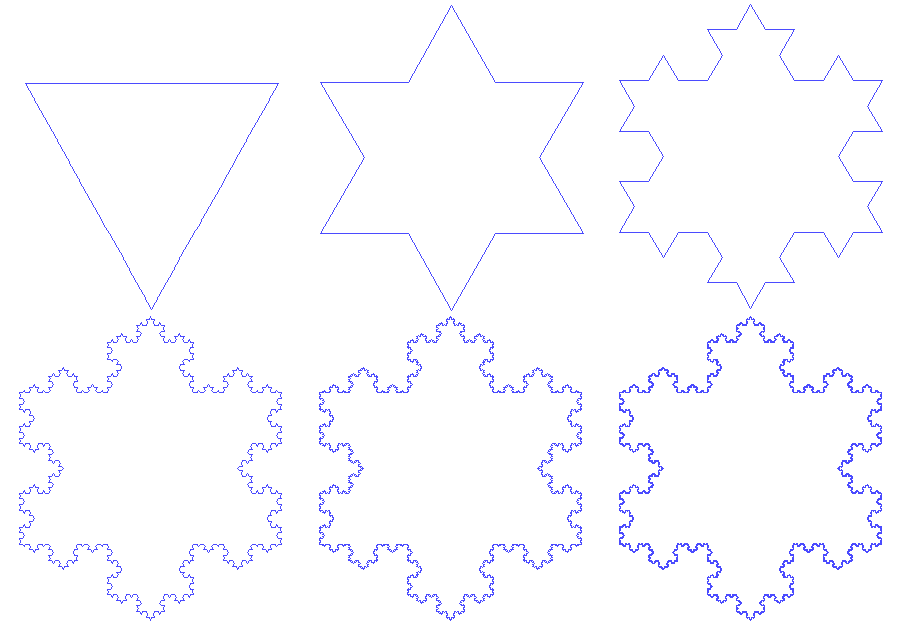
The universe is infinite. How do you fit infinity within a finite space? Fractals. In the above video he shows how this could possibly be imagined through infinite recursion, watch the video and you'll see what I mean. Or check out the following two animations from the wikipedia article on fractals: the object at the left is known as a Sierpinski Triangle, and to the right is a Koch Snowflake. If you were to imagine drawing a circle on a piece of paper, then fitting either of these shapes within that circle, you would see a very similar idea to what he's talking about here. Although both of these animations only show the first ten steps or less, in both cases the process we are seeing could be repeated forever, as each new step proceeds down to a smaller scale than the one before. In the following video he continues this idea:
.. and here's how he sums it up (I've edited him a bit here):
"Although I can place an infinite amount of triangles in a circle, I will never exceed the first boundary I made for myself. Never. I just showed you how infinity fits in a so-called finite space: because you can divide to infinity within a circle!
"What does that mean? Let me give an example for physics: we build faster and faster accelerators that cost billions of dollars, to get smaller and smaller. If we were to understand this principle of fractals, we would see very quickly that you can always keep dividing: so we would give up the search for some fundamental particle that's going to end the search. And we would start to understand that what we need to discover is the dynamic of the division, the dynamic of the quantization... rather than continuing to see how much further we can keep going down into infinity."
If you've followed him this far, you will now start to hear him say things about our connectedness, and our interface with reality that very strongly connects to the things I talk about regularly with my project. Here's one thing I want to make absolutely clear: Nassim is not promoting a worldview that comes from ten spatial dimensions, but he is promoting a very similar concept to what I portray as being the tenth dimension: an infinite "set of all possible states" that contains all possible expressions of matter and energy, all enfolded together into an underlying whole, a zero which is "full rather than empty" as Gevin Giorbran explained so well in Everything Forever. When you read blog entries like The Invariant Set, Imagining the Omniverse Addendum, Google and the Group Mind, Dreaming of Electric Sheep, and Why Do We Need More than 3 Dimensions?, you'll see fractals discussed from various approaches. The thing that we should all be clear about here is that fractals are often defined as having "non-integer" dimensions: and as you'll see if you read the wikipedia article on Hausdorff Dimensions, that Sierpinski fractal (which we looked at above) has a dimensionality of approximately 1.585. By the time we are imagining reality coming from ten dimensions but when those dimensions can contain any number of "fractional" dimensions, it really does seem like my description of the ten dimensions allows for us to include an infinite number of vectors within that set: as Nassim says, this is another way of thinking about how an infinite set could be contained within a so-called finite space.
The word "multiverse" has come to have multiple definitions. When someone uses that word, are they talking about the set of parallel universe outcomes for our own universe as described by Everett's Many Worlds Interpretation, or are they talking about the ten to the power of 500 universes with different initial conditions from our own universe which are predicted by string theory? Often, the definition of this word depends upon who you are talking to. Because my way of visualizing the dimensions provides a way to enfold and relate both of those concepts into a hierarchy, I have come to prefer to use the omniverse as the word that combines all of those possible states into one.
If you'd like to hear more from Nassim Haramein, please go to this youtube channel, iiisis2, where all forty-five videos that make up the presentation we're looking at here are posted.
 (This picture was created by my Facebook friend Annamaria Paizs, a Hungarian born Dutch artist living and working in Breda the Netherlands. It's called "Whitehole". Click here for other examples of her work. Thanks Annamaria!)
 How does the concept of infinite division relate to my approach to visualizing the dimensions? The answer is encoded into the logo I created for my project: at the core of this is the point we start with (the zero) and the point we end with (the ten), and those are connected. All of the other dimensions represent ways of dividing up the information that becomes reality, and so are shown in this graphic to be revolving around or "outside" the conceptual line which connects those starting and ending points. Those points, by virtue of being of indeterminate size, are really equivalent, but it's helpful to think of the zero as representing the drive towards division down to the infinitesimally small, and the ten as representing the drive towards encompassing the infinitely large "point" of the Omniverse.






 Posts


