Friday, December 7, 2007

Boredom and Consciousness Part One


A link to this video can be found at http://www.youtube.com/watch?v=ob6GmDriYGo


A link to this video can be found at http://www.youtube.com/watch?v=phn3mWSa584

At the tenth dimension forum, one of the subjects that comes up from time to time is synchronicity: the feeling many of us have experienced that information is coming at us from unconnected sources, yet it all seems to fit together somehow. Since our brains are all about finding and decoding patterns, there are no doubt going to be times when that information really is unconnected, and it is purely our brains that are building those connections. But these days, in a world of increasingly accelerated information input, there are also more and more times when those connections are real, and what we are viewing is really a map of the rapidly rising and falling memes that make up our combined consciousness.

Talking to the general public about consciousness in terms of the nature of reality is something that appears to make quantum physicists uncomfortable, particularly those who like their science to be completely separate from anything more than a purely atheistic viewpoint. With this project, which joyfully embraces such a multitude of ways of imagining reality, including ones which mainstream science doesn't endorse, we are part of a growing community of people around the world who think that there is a major shift of global consciousness approaching. And for those who say this is more "What the Bleep" nonsense, I would like to quote from a book I've talked about in this blog before. Written by two respected physicists from the University of California, Santa Cruz (Bruce Rosenblum and Fred Kuttner), the book is called "Quantum Enigma: Physics Encounters Consciousness":
"...in dealing with the mysteries of quantum mechanics, we walk the edge of a slippery slope.
A recent movie...informally called What the Bleep Do We Know?...provides a good illustration of the problem. ...The movie uses special effects to display quantum phenomena with macroscopic objects--for example, exaggerating the uncertainty of the position of a basketball. That's legitimate and is understood as hyperbole. The movie's allusion to mysteries in quantum mechanics being connected to the realm of consciousness is also valid. But then the movie blends over to "spiritual revelations" and to the implication of a quantum connection with the channeling of a 35,000-year-old Atlantis god named Ramtha and other such nonsense."

That slippery slope, then, is what I'm referring to when I say that consciousness and quantum physics are intimately tied together, and just where on that slope a particular physicist is willing to place themselves has a lot do with whether they believe there is any spiritual aspect to our reality or not. But even at the most atheistic viewpoint, we are still left with the mysteries of how matter can remain in indeterminate states until it is observed, and that is a very big mystery indeed.

A few weeks ago I published a blog entry suggesting one of those strange connections - that the accelerating expansion of our universe might be tied to the accelerating expansion of our consciousness, and that the first witnessing of dark energy and the launch of google, both in 1998, might be connected to the beginnings of a change. As crazy as that idea sounds to some, it appears I didn't go far enough: a few weeks later an article was published in New Scientist magazine which starts with these astonishing paragraphs:


Has observing the universe hastened its end?
- by Marcus Chown

Have we hastened the demise of the universe by looking at it? That's the startling question posed by a pair of physicists, who suggest that we may have accidentally nudged the universe closer to its death by observing dark energy, which is thought to be speeding up cosmic expansion.

Lawrence Krauss of Case Western Reserve University in Cleveland, Ohio, and colleague James Dent suggest that by making this observation in 1998 we may have caused the universe to revert to a state similar to early in its history, when it was more likely to end. "Incredible as it seems, our detection of the dark energy may have reduced the life-expectancy of the universe," says Krauss.
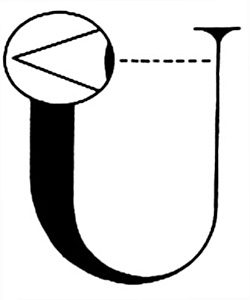
This reminds me of a simple cartoon drawn by famed quantum cosmologist John Wheeler, which shows a U-shape with an eyeball at one tip, which is looking at the other tip as a representation of the big bang (Rudy Rucker discusses the cartoon in this blog entry): the question Dr. Wheeler is asking with this cartoon is "Does looking back "now" give reality to what happened "then"? This relates to discussions we've had here: the startling implication of all this is that not only are there many branching possibilities from the "now" forward in time, but there are also many branching possibilities back to the beginning of time as we experience it. While in my book I ask the reader to only acknowledge that these branches exist both forward and back, and that the simple "line of time" we look back upon is only one of many that could have got us here, the implications from these quantum physicists is even stranger: they are indeed saying that not just the present, not just the future branches, but the past as well can be changed by observation!
This cartoon is also discussed in Quantum Enigma:

The provocative sketch has not lost impact. At the recent conference honoring Wheeler on his 90th birthday, a keynote speaker introduced his talk with Wheeler's sketch.
The anthropic implications of his diagram must have been a lot even for Wheeler to buy. After asking the above question, he immediately added the comment: 'The eye could as well be a piece of mica. It need not be part of an intelligent being.' "
My song The Unseen Eye talks about these same ideas:


And of course, my song The Anthropic Viewpoint talks about those implications contained within this sketch as well: to again quote from Quantum Enigma, "...the strong anthropic principle asserts the universe is hospitable to us because we could not create a universe in which we could not exist." Or as I put it in the tongue-in-cheek chorus to my song, "The reason we're here is because we're here":


Which leads back to the idea that memes rise and fall, and that synchronicity may or may not be the universe communicating memes to us, but in either case the connections that our wonderful pattern-oriented brains make are very real, because that's what brains are designed to do. Next blog entry I am going to talk about two magazines that arrived in my mailbox yesterday (another bit of synchronicity), and the connections that I see in those magazines and this project to the idea of "Boredom and Consciousness". My song "Automatic", which is about Julian Jaynes' theories of the bicameral mind, is also going to figure prominently into where we go with this discussion:


Enjoy the journey,

Rob Bryanton

Click here to continue on to Boredom and Consciousness Part Two

Thursday, December 6, 2007

Reviews of Imagining the Tenth Dimension

(Update: an additional blog entry listing more reviews from Amazon.com can be read in this May 2008 blog entry, and author/scientist David Jay Brown provided a very favorable review which you can read in this August 2008 entry.)

Despite a growing audience of visitors to the tenth dimension website (which is now at over two million hits per month!), this project continues to fly under the radar of the mainstream press. The only exception to that so far is the article several months ago in "What Is Enlightenment?" magazine by associate editor Tom Huston: here is a link to a downloadable pdf of that article.

Meanwhile, here in the world of the internet, millions of people have seen and enjoyed the introductory animation, which is based upon chapter one of the book. Since much of the book is based upon the concept of memes (ideas that rise and fall and connect across time and space) and how that relates to the reality we are experiencing, it's been interesting to track the memes that have risen and fallen over the last year and a half since this project vaulted to popularity as a result of a couple of thousand diggs in July 2006, and again in December 2006.

Here's a snapshot of the memes that have risen and fallen around this project since it was launched:
- July 2006 - website and book become popular around the world. Most common memes are "this is mind blowing", and "this is not what mainstream science teaches" (both of which I believe are valid)
- September 2006 - Lee Smolin's "The Trouble With Physics" and Peter Woit's "Not Even Wrong" become popular. In the mainstream press it becomes fashionable to dismiss any discussion of higher dimensions, since they are unimaginable and undetectable. Interest in this project plateaus for a few months.
- December 2006 - website becomes popular on digg a second time, audience for the project grows.
- February 2007 - John Brownlee, in his blog at Wired.com, calls our animation "absolutely fargin' incredible" (thanks John!). Interest in the book and the project take another leap forward.
- March 2007 - some negative reviews of the book appear at Amazon.com . This book, called "Imagining" the Tenth Dimension, "a new way of thinking" about time and space, and described in the accompanying text as "not about mainstream science, but rather a mind-expanding journey that will change the way you view the incredible universe in which we live", receives these negative reviews because it is not about the current teachings of mainstream science. Huh? Despite the book having at least as many positive reviews as negative, visitors to Amazon have given more "helpful" votes to the negative reviews (not surprisingly), so those are the ones you are now first shown by Amazon.
- April 2007 - the extremely positive review of this book and the project appears in the April-June issue of "What Is Enlightenment?" magazine.
- June 2007 - Clive Thompson, in his gaming blog at Wired.com, gives us a nice mention in an article about games that stretch reality. As with previous mentions by websites such as Entertainment Weekly, Network World, and Dvorak Uncensored, new people are introduced to the site.
- July 2007 - the project launches a new chat page which, after a month or two of experimentation, settles upon a format incorporating live or recorded video of the author and guests using UStream.tv, a chat room associated with UStream visitors, and a second Meebo chat room which includes the ability to share URLs and YouTube movies in a thumbnail-ordered viewer, with the text from the Meebo chat room being also added to the live or recorded video from UStream, using a wonderful (and free) program for the Mac called CamTwist. Persons wanting a simpler (non-interactive) experience can watch at tenthdimension.tv .
- August to December 2007 - month after month, the audience coming to the Tenth Dimension website grows. Due to popular demand, the project opens a Digital Items store, offering high-resolution versions of the animation which continues to blow minds around the world, plus mp3s of some of the songs associated with the project, plus a pdf of the book. All materials are released under a Creative Commons license: because, despite what the naysayers say, this project is not a scam to try to get you to buy a book or a t-shirt: it's about a new set of ideas that are rising in popularity around the world.

The animation speaks for itself - people love it (or hate it), but a growing number of people continue to be attracted to it. The songs are available as videos for free from revver.com or on youtube, or higher quality versions can be purchased as mp3s from our digital items store. The book, on the other hand, does not speak for itself so easily, despite being easily searchable on Google Books. Here, then, is a compendium of brief quotes from various places around the net about this book.

"A fascinating excursion into the multiverse--clear, elegant, personal, and provocative" - Hugo and Nebula award-winning author Greg Bear

"Brilliant and unexpected... written in an easy to read style... gets your mind expanding in all the most satisfying directions." D. Richards, review on Amazon.com

"It is refreshing to read a book that is about considering a variety of perspectives - 'scientifically proven' or not." LJB, review on Amazon.ca

"In an easily readable style he has boldly taken us past the fourth dimension through to the tenth employing an understandable logic based on geometric considerations. There is no mind-boggling mathematics and there is a distinct absence of the crank/crackpot style; each step along the way is carefully developed in a sequential manner accompanied by readily understandable diagrams." Richard Ruff, review on Amazon.com

"There are times when those in academia are right to be critical of poorly conceived ideas but there are also times when such criticism only inhibits new ways of seeing. This book conveys a very different and unique way of looking at the universe." Joseph Moore, review on Amazon.com

"the simplicity of Bryanton's ten-dimensional model is striking... purely speculative... but built on logical consistency..." Tom Huston, in What is Enlightenment? magazine

"Your view of time as the dimension above the one from which one is viewing is very compelling." Coert van Gemeren, on the tenthdimension.com forum

"Excellent structured bridge between geometry and metaphysics. Read it, it's good for ya." W. Kasper, review on Amazon.com

"an imaginative and strangely 'musical' way of imagining superimposed dimensions... it is also pleasurable to read." K. Flekkoy, review on Amazon.com

"I highly recommend this book to anyone that is interested in learning about some of the most complex concepts in modern science in a fun and revolutionary way. You will not be disappointed." David Levy, review on Amazon.com

"Without being too technical, he correlates properties of the unfolding dimensions with predictions and outcomes of modern physics, especially quantum mechanics. Philosophical implications are explored along the way." Richard Ruff, review on Amazon.com

"freshly imaginative, entertaining and challenging... caused me to move beyond my comfort zone..." David J. Zimmer, review on BarnesAndNoble.com

"Many people in academia initially shy away from this kind of new approach, but the way the dimensions expand then fold back inward into an indefinite point is consistent with holographic enfoldment ideas from people such as the famous physicist David Bohm and science writer Micheal Talbot." Joseph Moore, review on Amazon.com

"Imagining the Tenth Dimension is a wonderful book that helped me thinking 'outside of the box' and taught me many complex concepts in a fun and easy to understand way. Bryanton's way of thinking is easy to follow and his explanations make a lot of sense to to scientists, philosophers and to the average reader alike." David Levy, review on Amazon.com

"This book is excellent for a reader looking to expand their horizon on something more than what is in front of them. It gives you an opportunity to think of all the possibilities you have in life. " C. Leonard, review on Amazon.com

"...covers alternate dimensions/realities, interesting read, very smooth and eye opening." livejournal entry by spaminator3000

"If you are a practicing mainstream physicist this book may well be frustrating in its easy embrace of unconventional notions..." LJB, review on Amazon.ca

"it's expanding worldviews, blowing minds, and provoking plenty of philosophical and spiritual inquiry as well." Tom Huston, in What is Enlightenment? magazine

"Having just finished your book, I must say you have managed to present the material in a uniquely fresh way." Coert van Gemeren, on the tenthdimension.com forum

"For the more mathematically and physics-minded amongst you, the challenge is to subject Rob Bryanton's ideas to scrutiny - he has an excellent blog site for such feedback and discussion." Richard Ruff, review on Amazon.com

"a philosophical journey into what multidimensional space can mean to the 3 dimensional self... a book that will open your mind..." D. Richards, review on Amazon.com

"I just got done reading your book. I have to say it was awesome... parts literally made me stand up out of my chair." 16 year old Nick K, on the tenthdimension.com forum

"Bryanton appears to be one very scientifically and philosophically astute musician who knows a lot of stuff about a lot of things." LJB, review on Amazon.ca

"the method of synthesizing every conceivable universe into a final tenth dimension wields considerable strength." Joseph Moore, review on Amazon.com

"...manages to make sense out of more mysteries than any one theory should justly be able to handle." Tom Huston, in What is Enlightenment? magazine

"Imagining the Tenth Dimension: A New Way of Thinking About Time and Space has at long last provided a framework in which the bigger picture, for me at least, makes intuitive and scientific sense. Stick with the logic and you too should be rewarded with an "Ahah!" experience. I felt the dots were joined and the gaps filled in my own personal ponderings on higher dimensions and the sense of satisfaction was not just restricted to the scientific side of me. My background is in the physical sciences and having read the book twice, I am yet to find any weaknesses in the proposals." Richard Ruff, review on Amazon.com


Again, if someone is confused about whether I'm pretending to be a physicist after all this, then I'm afraid you're just not paying attention! I'm a composer, who has written a large number of songs and a book, all built around a "new way of thinking about time and space" which we're playing with in this project: and while there are many ideas taken from mainstream physics and cosmology, this is better thought of as a creative exploration that blends together science, philosophy, spirituality, and metaphysics. Part of its problem, I believe, is that it is such a wide-ranging exploration that it is hard for the mainstream press to decide how to describe what's happening here. Even just within the science world, it blends too many competing schools of thought together: for instance, David Deutsch doesn't believe his bush-like branching structure is in the fifth dimension, even though that fits so nicely with the "branching" idea from the fourth to the fifth dimension as I portray it. Quantum physics doesn't require higher dimensions, it just requires an unobserved fabric of "information", which is how I describe the tenth dimension in isolation from the others. String theorists don't believe our universe is a "point" in the seventh dimension, although they do say our universe is the result of a seven-dimensionsal brane interacting with a three dimensional brane. String theory doesn't equate the bush-like branching structure of probabilistic outcomes with the fifth dimension's "curled up at the planck length" description they use... again, even though imagining that our 4D line of time is being constructed from available branches one planck length at a time allows us to easily visualize how such a thing could be possible.

And of course, many mainstream scientists are dismissive of any way of describing reality that also incorporates other more metaphysical/spiritual ideas into the equation, which are the parts of this discussion we haven't even touched upon here.

In the meantime though, the internet continues to be its own universe, and the number of people being drawn to this site from around the world, through their connections to each other, through the ideas we're exploring here, and the growing feeling that our world is changing, is very exciting. Enjoy the journey!

Rob Bryanton
Imagining the Tenth Dimension

Friday, November 30, 2007

Music and the Dance of Creativity


A link to this video can be found at http://www.youtube.com/watch?v=DnanMfhwbdc


A link to this video can be found at http://www.youtube.com/watch?v=xIMsoZd76a8

As a composer, I create things for a living. Some people say "oh, I'm not creative." I say "everybody's creative!". The above video is of me chatting with one of my favorite musicians, Jack Semple, about some of the ideas that surround this blog entry, and the ideas I explore in my book.

Creativity is the one thing each and every one of us do every moment of our lives: our conversations are unscripted, our actions unchoreographed, it's all one big creative improvisation. And the process of chance, choice, and circumstance that moves our universe from the big bang to the enfolded end is, at its root, a creative process as well.

Here are two things I have been saying with this project: "life is any process that becomes interested in what happens next"; and "that which ceases to change ceases to exist". In a previous blog entry called "How to Make a Universe" we imagined starting from quantum indeterminacy, selecting a starting point and a successive series of quantum frames which become the line of time for a particular universe. Keeping in mind that for our universe, each quantum frame is a particular "now" that is one planck length away from the next, we can see how the patterns in the Information that becomes our Reality can have groupings and interactions, and places that those resulting interference patterns and shapes begin and end. Whether we're talking about vibrating superstrings, memes, or life itself, the moment that something stops changing/vibrating/interacting as we move from one quantum frame to the next, the thing that is represented by those motions ceases to become part of the timeline being created: which brings to mind an eternal dance of creativity, both at the quantum level and out here at the physical level as we navigate on our fourth dimensional line of time through the fifth dimensional probability space available to us, which is curled up down at the planck length for each successive "now".

In his wonderful and enlightening book, "This is Your Brain on Music", Daniel Levitin (as a neuroscientist and former rock musician/engineer/producer) reveals some startling things about the dance of information that is encoded into music. According to Daniel, in the majority of the world's languages, the verb "to sing" also means "to dance" - which shows us how intimately tied together music and the physical expression of emotion are for we human beings. He also reveals that scans of neural activity in people who are listening to, performing, or even composing music reveal that this is not a primarily-right-brain function as many had surmised: in fact, activities involving music appear to trigger activity in almost all parts of the brain that have been studied in Dr. Levitin's research.

As a composer, of course, I admit to a strong bias towards any research that shows how magical and fully engaging music can be, and any time that I am asked to create a piece of music I marvel at music's power to connect emotions across space and time, to entrain people's heartbeat or breath, to cause them to move in a joyful way or become agitated and fearful. All of this ties in to the ideas that we have been talking about here: we are all patterns in time and space, memes and spimes that are interacting to create life as we know it.

We are also part of really big picture memes, which are patterns in the highest dimensions that have caused our universe as it exists to be the one that we're in, and saying this is not necessarily invoking higher spiritual powers: it is a simple statement of fact to say that our universe exists as one out of many possible universes within the multiverse, and the patterns that organized the information that became our reality are part of the creativity, the grouping and symmetry, that is innate within any pattern, be that random or guided.

There's a great Google Tech Talks video featuring Dr. Stuart Hameroff, who says that modern consciousness research has been exploring how every instant that the brain interacts and processes the incoming data from the external world can be thought of as a "frame" of consciousness, and this is being referred to by researchers as a "bing". According to their studies the average human being is operating at somewhere between 30 and 90 "bings" per second. In my field, this seems significant because the lowest note on a piano is at 28 cycles per second, and video in North America historically has been shown at 29.97 frames per second: both numbers being just on the bottom edge of that "bings per second" range. In other words, for human beings any repetitive pattern that is above 30 cycles per second tends to be perceived as being continuous (musical notes and quantum frames of time, for instance), and vibrations or patterns that repeat more slowly than that begin to be perceived as individual events.

In Imagining the Tenth Dimension, we're playing with ways of visualizing reality that encourage us to think about the really big picture of the underlying structures and patterns that contribute to the universe we live in. In terms of memes as being ideas that are connected across time and space, music is one of the most powerful and flexible tools we have at our disposal for helping us to see how it all fits together in the dance of vibrations and patterns that are part of our beautiful and creative universe. This is probably why one of the reviewers for my book described it as a "strangely 'musical' way of imagining superimposed dimensions".

Whether we're talking about quantum physics or creativity, it all seems to keep centering on our role as conscious observers: our "bings per second" rate shows why, for us, everything above about 30 cycles per second begins to blur together into continuous waves, while everything slower than that dividing line is perceived as individual events. In musical terms, sliding through those more and more separated events would take us through rhythms, note durations, phrases, repeating structures within a composition, entire musical pieces, the other times that same musical piece was performed, the other times in history that elements from within the piece were used, and the connections that those elements have to the big-picture memes that give those elements their emotional or physical connection, again and again throughout the history of our world.

To sing is to dance, to be alive is to be creative, and our universe itself is a creative process. There is a sliding scale of vibrations that can exist within our universe --with the fastest wavelength possible being at the planck length and the slowest being the single cycle from the big bang to the end of the universe-- and with our consciousness right at the center point of that set of vibrations.

Now, here is a version of one of the 26 songs attached to this project which explores that idea: "Big Bang to Entropy". A previous blog lists the lyrics: this is a new version of the song performed by Ron Scott. While our consciousness tends to think of vibrations slower than 30 cycles per second as individual events, it's fun (and perhaps mind-blowing) to also think about expanding our perception to think of those much longer repeating patterns as also being notes and songs, that we really could hear if only we slowed down and expanded our conscious perception of the universe.

Enjoy the journey,

Rob Bryanton

Friday, November 23, 2007

E8 and the Semantic Web


A link to this video can be found at http://www.youtube.com/watch?v=bgB3GrcyutU


A link to this video can be found at http://www.youtube.com/watch?v=n_KsaOu3LBs

Last blog we imagined the "googleverse": ideas that have shapes and patterns across spacetime, and how this is another way of describing the concept of memes.

Some ideas seem to spring from nowhere, spread instantaneously, then eventually be overtaken by other ideas. The way of imagining reality that we've been playing with here says there is a universe of spimes (things that have a shape in spacetime, which is made of energy and matter), memes (ideas and patterns that have a shape in spacetime), and life (the interference pattern that happens when memes and spimes interact).

The imagining-the-tenth-dimension meme, then, has survived and flourished not because it's the scientifically approved Theory of Everything, but because it's a mind-expanding way of holding in your mind what most people would have thought is unimaginable - the underlying fabric of reality. Like other visualization tools, it has its strengths and weaknesses, but it's still a fun way of getting people started thinking about those "really big picture" ideas.

As I've described it, the tenth dimension is equivalent to the unobserved fields of quantum mechanics, and the ninth dimension can contain the ways of beginning to organize those fields that can't be expressed as physical matter: the "really big picture memes" that express a preference for one way of organizing reality over another, but which are too broad or too contradictory to create a physical expression. This means that according to my way of visualizing reality, the 8th dimension would be the highest dimension for a reality to spring from.

http://www.arxiv.org/abs/0711.0770

Now we have Garrett Lisi, who is creating a huge stir in the physics world with a new proposal for a Theory of Everything that uses "E8" - a complex, eight-dimensional pattern with 248 points. Here's a youtube animation demonstrating some of the rotations that can happen within an E8 construct:


As visually appealing as this animation is, its implications are startling: Lisi has demonstrated that there is a way to place the various forces and elementary particles (including their possible quantum spin values)on E8's 248 points. Rotating Lisi's model in various ways reveals the explanation for a variety of interactions, some of which (like the clustering of quarks into families of three) are natural outcomes from this structure. Some points in his model are currently occupied by particles which have been theorized but which have yet to be seen, and there is some hope that the Large Hadron Collider in Switzerland may reveal some of those particles when it goes online next year.

Whether this theory proves the existence of higher dimensions or not is open to interpretation - Lisi himself says this geometric pattern, although it is based upon an 8 dimensional construct, could be fully realized within our 4D spacetime without requiring additional dimensions. In an article in this week's New Scientist magazine, string theorist Sabine Hossenfelder (of the Perimeter Institute for Theoretical Physics) points out that this could be complimentary to string theory, which she says also uses E8 to describe the Calabi-Yau manifold, the higher-dimensional shape that string theory says our universe is derived from.

As Einstein liked to say, our description of the universe should be "as simple as possible, but no simpler". That's why the idea that our entire 4D universe can be defined from a geometric projection like the one seen in the above video is so appealing. But whether our 4D universe is a lower-dimensional shadow cast by higher-dimensional patterns, or whether those higher dimensions are imaginary because we can't ever see them may really be nothing more than two different ways of thinking about the same idea.

Last blog we also looked at the idea that there is an acceleration happening in our world, as ideas seem to spread faster and faster. Tim Berners-Lee's Semantic Web project is a great example of the tools that are arising now to help keep us all from being buried under a sea of rapidly rising and falling memes, which threaten to become an incomprehensible and overwhelming white noise. Perhaps E8 and the Semantic Web will become useful as ways to organize and rotate through the information of the world?

As simple as E8 may be, I've been trying to visualize something even simpler here. Personally, I have long been a fan of the idea of helix shapes derived from stacked dodecahedrons, and the implied six degrees of separation concept within that idea.
I was surprised to learn from the article I'm referring to in New Scientist magazine, then, that Garrett Lisi has also been using G2 rotations, a hexagon-based system which is a subset of E8. Apparently G2 can be used, for instance, to describe the relationship between quarks, antiquarks, and gluons.

If the Semantic Web eventually allows us to understand the googleverse of ideas as being derived from the interrelationship of Just Six Things, will we have passed the threshold of "simple as possible but not simpler"? It's an interesting exercise: try to come up with the six categories under which you should be able to put everything about your life and everything you know. If the Semantic Web could ultimately be used to connect together our knowledge into something as simple as that, we would really have reached a seemingly impossible goal. But even E8 as an overlay might be a very useful tool in our desire to keep the accelerating meme-space we are swimming through from becoming too much to fathom.

Enjoy the journey,

Rob Bryanton

PS - for a more hands-on experience of where the Semantic Web could take us, sign up for an account at Twine.com.

Sunday, November 18, 2007

Tens, Google and the Expanding Universe

Are we approaching some sort of global shift in consciousness, and could that be triggered from higher dimensions?

2008 will be the tenth anniversary of the surprising announcement that the expansion of our universe is accelerating, an idea that seems counter-intuitive: if our universe started from high energy/high order (the big bang) and is moving towards low energy/low order (maximum entropy), that implies the image of a clockwork toy that is winding down, and that image does not fit with a universe of accelerating expansion.

This month's Scientific American features a great article about "branes" and how the accelerating expansion of the universe may be proof of the existence of higher dimensions (I propose this as a possible explanation in my book as well). The article, by Cliff Burgess and Fernando Quevedo, is called "The Great Cosmic Roller-Coaster Ride": please check it out.

2008 is also the tenth anniversary of Google, the search engine that has changed the way we interact with information more than any other invention in the history of mankind. "Don't be evil" is their unofficial motto, and that's a great one: the power of Google to inform and guide the general public's impression of what ideas are important and what ideas are popular is immense, and the on-going war from get-rich-quick scammers and spammers who try to manipulate Google's search results for their own profit is a huge part of that story.

The Imagining the Tenth Dimension way of visualizing reality can be used to tie all these ideas together. "Information Equals Reality" has been the prime focus for my blog entries in the last few weeks: this basic idea from quantum physics shows us how "everything fits together", and the desire to find a unity within a diverse range of ideas is what this project is all about.

If Information Equals Reality, then absolutely everything about our reality can be thought of as patterns and shapes in the information that is the underlying fabric of quantum indeterminacy. Subatomic particles, fractals, life, consciousness, and our observed universe are all patterns that result from the flip-book of third-dimensional "now"s that we are stringing together from one frame of planck time after another.

In the Imagining the Tenth Dimension animation, sound is an important part of the information being conveyed: for instance, no matter what dimension we are exploring there is the arrow sound effect representing a particular point, a scrape indicating lines being constructed from joining one point to another, and the card-riffling sound effect to show that anything we think of as a continuous line is actually being constructed one point at a time, if we can only look close enough.

Burgess and Quevedo's article explains how our universe might be the result of the interactions of a three-dimensional brane with a seven-dimensional brane, with the ends of certain superstrings constrained by branes they are sliding around within. To use my flipbook analogy, then, we can see how the illusion of continuous reality that we are experiencing is actually a series of 3D states for our 3D universe interacting with a 3D brane, and each observed state is one planck length away from the next: each observed state can be thought of as a page in a gigantic cosmic flipbook. The flipbook from the big bang to "now" appears to be one specific set of flipbook pages (which we think of as the 4D line of time), but each "next available now" page that could possibly be selected for our flipbook comes from a fifth dimensional probability space, and the fifth dimension is where Kaluza proved our reality is defined. Every parallel universe that could have resulted from our big bang, whether it is observed or not, exists as a potential "flipbook" in the sixth dimension, and all of those possible states are locked together by the seventh-dimensional brane our universe is also interacting with.

The idea I advance of our universe's basic physical laws being a result of our specific "location" in the multiverse (as a "point" in the seventh dimension, or as a result of our interaction with a 7D brane), then, can be tied into this concept. As usual, though, I will take pains here to caution readers that I am not claiming my way of visualizing the dimensions is the explanation for string theory, any more than it is the explanation of Kabbalah, zero-point field theory, Japanese anime and videogame plots, metaphysics, or any of the other diverse range of belief systems which fans of the tenth dimension project keep pointing me towards as having interesting resonances with my way of visualizing reality.

From moment to moment, day to day, Google has been tracking the information that makes up our reality for almost ten years. Ideas that can be tracked across time and space are known as "memes", and physical objects that can be tracked across time and space are known as "spimes": which means that the flipbook of "now"s we have imagined from the big bang to today can be thought of as a spime that represents the story of our current universe from its inception... and that idea is a very powerful meme.

I've always marveled at the audacity of Google's "I'm Feeling Lucky" button: the idea that out of all the information in the world, Google might be able to show you the very best link of all still seems like mysterious magic to me, and I admit to never wanting to use that button because I like to have choices. Still, the Google toolbar's Suggestions window is a great example of the accelerating information space we live in now: try typing in just the letters of the alphabet one after another into that window, and read the top ten suggestions (there's that number again!) that come up for each. This gives you a snapshot in time of what is important, what is talked about, what is the dominant set of memes within our culture right now. Both memes and spimes are multi-dimensional shapes, each with a beginning and an ending someplace out there in the timeless multiverse.

The feeling that we live in times that are accelerating towards something larger, as a result of the rapidly accelerating meme-space we live in, might be connected to the same higher-dimensional effects that are causing our universe to accelerate its expansion as well: I believe both are eventually going to be shown to be the result and the proof of higher dimensions in the information that is creating our reality.

Enjoy the journey,

Rob Bryanton

Wednesday, November 14, 2007

Is God in the Seventh Dimension?

The tenth dimension site is averaging two million hits a month now. The meme that was set in motion since this project was launched in the summer of 2006 keeps growing, as people continue to view the animation, read the book, and discuss these ideas around the world.

By far the most-viewed and most-discussed question at the tenth dimension forum has been this: "Is God in the Tenth Dimension"? Other topics rise and fall in popularity from week to week (as memes often do), but this deep question is the one that people keep coming back to with their own unique views on the matter. I have put my own two bits in from time to time but the discussions there have been passionate and widely varied, and that is all I am interested in doing here: promoting the discussion of ideas.

Regular visitors to this blog or the forum will know that this is the idea I advance in my book: if we are imagining that our universe comes from an indeterminate quantum state, and that (as quantum physicists say) "information equals reality", then everything is just patterns in that information. What's wrong with giving those patterns a name? But the corollary to that idea has to be to accept that calling what we're thinking about "God" makes some people uncomfortable. Giving the exact same thing a name that they are comfortable with doesn't change what we're talking about, it just changes the name. Since I'm such a fan of Richard Dawkins, I say this knowing full well that what I am proposing here flies directly in the face of his book "The God Delusion": sorry about that, Dr. Dawkins.

Ultimately, asking if God is specifically in the Tenth Dimension is not the point of these discussions: what we're really talking about is whether there is a way for the ideas of spirituality and science to co-exist, each acknowledging that ultimately they are talking about the same thing. But this time, let's work through the framework for discussion that I've advanced for how to visualize the dimensions and see where "God" works as a name for the pattern that created our universe.

The tenth dimension as I have portrayed it is the timeless void of quantum fields, the unobserved whole that is "outside the system", and therefore unimaginable to us from within the system. Seems like a good place for an omnipotent being, and in the sense that God can be all things to all people, and that God can be thought of as the summation of everything that is and ever shall be, this is an obvious place to start. The only fly in the ointment here, I think, is that any attempt to observe any aspect of the tenth dimension spills us into the reality of the dimensions below. So, if we leave God up in the tenth dimension exclusively, I would say we're imagining a God who never actually does anything... as I've said before, imagining the "all-vibrations-simultaneously/white light" of the tenth dimension by itself is really the most boring part of the discussion.

Another discussion that has happened recently at the forum is whether the tenth dimension as I've portrayed it should be called a dimension at all, since what I'm really saying is that the tenth dimension can be thought of as the entirety of the ninth dimension, but viewed as a single point of indeterminate size. A visitor named "Alyssa" argued that this is deceptive, and other visitors to the forum then suggested that she think of dimensions 1 through 9 as each being an additional layer of an onion; to which I added the Zen-like idea that we could think then of the ninth dimension as being what happens when you look at the entire onion, and the tenth as being what happens when you don't look at the onion. Clearly, imagining something that is unobservable is tricky whether you're talking about the indeterminate fields of quantum mechanics, or whether you're talking about God. But if we're portraying a God who causes absolutely everything to happen, then the ninth dimension would certainly be a place for Him/Her to be.

My way of visualizing the dimensions suggests that the ninth, eighth, and seventh dimensions show us how to imagine the big-picture memes that organize the information that eventually becomes reality. From the ninth down to the seventh, the ways of expressing energy/mass are gradually narrowed down, until we arrive at our unique universe as an unwavering point in the seventh dimension. In my previous blog entry ("How to Make a Universe") I touched on one of the ideas from my book: if the multiverse contains 10 to the power of 500 other universes (a possibility inferred from string theory), some of those other universes would be much less stable than our own, instantly exploding into nothingness or collapsing back in upon themselves. So here's another possible location for God: we might be imagining that out of all the possible universes, God chose to create the one we're in because He/She prefers creativity over destruction, life over no life, order over disorder, and so on. Are those phrases also big-picture memes, ways of organizing the information that becomes our reality? Sure. But the question then becomes, if those other less productive universes do really exist out there within the multiverse, did our God create them? Or are there other Gods out there who created those other universes, because of their own preference for a different kind of universe than the one we live in? A pantheon of Gods both benevolent and malevolent spring to mind then, a distasteful idea to some, an appealing idea to others.

What about the fifth dimension? If our universe of spacetime is being constructed one frame at a time, by quanta that are each one planck length away from the next, then I have proposed that the probability space of the "next available branches" is contained within the fifth rather than the fourth dimension. This means that as we are constructing what feels like a fourth dimensional line of time, we are actually twisting and turning in the fifth dimension, which gives us a way to imagine how the fifth dimension and above could appear to be curled up down at the planck length for us, and yet those higher dimensions could also contain the astonishingly large concept of the multiverse-filled-with-universes which we have come to imagine.

If everything from the beginning of time within our specific universe is the result of an observation of the quantum wave function, then the fifth dimension looks like a great location to place God, and to see how we are all connected together though the consensual reality that we share, each as our own quantum observer. In other words, the combined quantum observer effect that creates our universe right from the Big Bang to "now" could be God. As I say in my book:


The reader may notice here that it would be very easy to substitute “God” or “The Creator” in place of “the observer” in the above paragraphs. In fact, if the reader is comfortable with the concept of each of us being an expression of God, “created in His/Her image”, each with a holy spark within, then the two viewpoints are quite compatible. On the other hand though, the image of a God who is separate from, standing in judgement of, and meting out punishment to us all is much less compatible. What we are describing here is a reality where each of us is creating an expression of a specific aspect inferred within the “white noise” of the tenth dimension through our individual roles as quantum observers. If the reader finds it easier to accept the phrase “I am an aspect of God” than they do the previous sentence, then they should feel free to use that as their jumping off point instead. As we discussed before, the tenth dimension as we are conceptualizing it here is really the boring part of our discussion, because it simultaneously contains all possibilities. If we choose to imagine a Creator-God who is manifesting Himself/Herself through each one of us, we are imagining an observer who is cutting cross-sections out of the tenth dimension to examine the much more interesting and highly detailed subsets of reality which are contained within the dimensions below.


People who say that God works in mysterious ways, and that what feels like bad luck may actually be part of God's master plan, would be fine with leaving God in the fifth dimension. Personally, here's where I stand with that idea: try as I might, I can't imagine a God who has deliberately created a world that allows evil and inequity to exist as part of His/Her plan. Is there a force for destruction and selfishness and chaos that helps to make our world less beautiful than it could be? For any specific universe, I have placed all the timelines that could potentially have existed (but some of which are now unavailable because of what has come before or what comes after) out in the sixth dimension, and if we are going to imagine that there are forces doing battle to create the world we live in, then that battle must be raging in the sixth dimension. The good guys don't always win, and bad luck happens to the best of us: which would mean the chaos and deliberately chosen paths that cause one part of our world to prosper while so many others suffer is part of the temptations and bad choices that each of us have to acknowledge exist out there in the sixth dimension for our specific universe.

Which leads me back to the seventh dimension. If God is the pattern that created the world and the universe we live in, I think that's the best place to find Him/Her. But I can see arguments for placing God in other dimensions, including the tenth, or even across all dimensions, depending on your own point of view.

I'm attaching two videos that are relevant to this discussion, both of which are in previous blogs which include their lyrics. One is called "The Unseen Eye": if our reality is created by a quantum observer, then there is an Unseen Eye which began collapsing the wave function right from the Big Bang. The other is "What Was Done Today": if the fifth dimensional probability space we are navigating through has been defined by what has already come before, then there are possible futures we can no longer get to because of chance and circumstance, and deliberate choices that have already been made.


A link to this video can be found at http://www.youtube.com/watch?v=oK29fTLXEf0


A link to this video can be found at http://www.youtube.com/watch?v=2Ikj7ozGMQM

Enjoy the journey,

Rob Bryanton

Monday, November 12, 2007

How to Make a Universe


A link to this video can be found at http://www.youtube.com/watch?v=BqsmKfh4loY


A link to this video can be found at http://www.youtube.com/watch?v=QCLv9ncGG7U

We start with the unobserved quantum wave function: this is where (as quantum physicists say) information and reality are equivalent. Although quantum physics has no specific requirement for there to be ten spatial dimensions in order for us to imagine this unobserved state, what we are talking about here is the multiverse (or even "the omniverse"): the timeless place where the potential for all possible and impossible universes exists simultaneously.

Now we make our first observation. Quantum computing expert Seth Lloyd, in his book Programming the Universe, suggests that we can think of the big bang as the very first yes/no, and that is what we are thinking about here. Out of all potential expressions of reality contained within the timeless multiverse, we place the very first point, which begins the creation of a universe.

Physicists tell us the only force that exists across all dimensions is gravity. So one of the things that we are likely to have already done with that very first yes/no point of entry is to choose a value (or at least define a range of values) for what gravity is going to be in the universe we are planning to make.

Let's call that first point the beginning of time. With our first point, we are narrowing down what the force of gravity can be for the universe we want to create. But before we can define a second point, we need to choose a value for the speed of light.

No matter what dimension we are thinking about, or how many dimensions we are imagining, "time" is the way that we change from one state to the next. But time is not a continuous line, it's actually a series of points, one after the other. For our own universe, those points are each one planck length away from the next: so, much the same as a movie is made up of frames that are being shown at a certain number of frames per second, we know that our universe is also being observed at a certain number of frames per second, and in quantum physics those frames are called quanta. The length of time between those frames is entwined with the specific speed of light for our universe, and the idea that our universe is being created one frame at a time at the speed of light gives us a way to explain why it's impossible to exceed the speed of light within our universe. This also explains why it's impossible to observe anything smaller than the planck length, which is about 1.6 times 10 to the minus thirty-five metres: attempting to do so puts us back to where we started, between those frames of time and back into indeterminacy and the timeless multiverse landscape.

Back in 1919, Kaluza sent a startling proof to Einstein, stating that the field equations for gravity and light can be resolved if they are calculated in the fifth dimension. Einstein ruminated on this idea for two years, then gave it his full endorsement. Here's what this tells us about our own universe then: it is being defined at the fifth dimension by the specific values it has for the strength of gravity and the speed of light.

What if we wanted to create some other universe that had a different value for gravity and the speed of light? We would back all the way out to the indeterminate quantum field, choose a different point of entry, and choose a different frame rate for some other universe to be observed. We could even try making universes that had gradually changing, or oscillating values for gravity and the speed of light, although most of those universes would not be nearly as stable as the one we live in.

There could be other values that are also being determined by our point of entry, but just how many of the finely tuned constants that create any specific universe and its specific distribution of matter are a result of nothing more than the push and pull between the strength of gravity and the speed of light, and how many of those other constants are not related to these two basic values is a debate better left to the experts. Still, this leads us to an important question: how did we get so lucky as to be in a universe specifically tuned to create life as we know it? String theory is sometimes criticized because it can be used to explain not just the universe we live in, but ten to the power of 500 other universes as well, each with their own collection of particles and forces. But if all those possible universes we're imagining really do exist out there in the multiverse, just as real as the one we're living in, then there are no doubt organized collections of information or expressions of matter in some of those other universes that are asking themselves the very same questions. In any particular universe, we can imagine "life" as being the stuff that becomes interested in "what happens next" as their universe is moving along its own line of time, being created one quantum frame after another: and that leaves us with a very open definition of life that works well for our own universe, but allows us to imagine a great many other things that also could be called life in those other universes.

In September 2007, a team of scientists at Oxford University, under the leadership of physicist David Deutsch, published a proof equating the bush-like branching structure of possible quantum states with the branching choices that each of us within our own physical universe are making as we move through time. This means that whether we realize it or not, at both the quantum level of frames that are one planck length away from each other, and out here in our physical reality, the actions of chance, choice, and circumstance are moving us down what we think of as a fourth dimensional line of time. But curled up down at the planck length, we are actually twisting and turning through the available paths that the Deutsch team have proved really do exist. Imagining that there are parallel universes where each of us make decisions that are different from the ones we make in this one is the outcome of that proof that some physicists are simply not comfortable with, but it is an implication that I have been promoting since I first came up with this way of imagining the dimensions twenty years ago.

In my book Imagining the Tenth Dimension, I have suggested a way to blend the concepts of the multiverse, quantum indeterminacy, Kaluza's idea that we are in the fifth dimension, and the M-theory idea that our reality comes from ten spatial dimensions plus one of time. Mainstream physics tends to keep these ideas separate from each other, so my idea of mashing them up into one big concept is not what you would be taught in a university physics class. That's why I call my book "Imagining" the Tenth Dimension, subtitle it "a new way of thinking" about time and space, and say in promotion for the book that it is "not about mainstream physics".

What I do say about my new way of thinking though, is that it's "a mind-expanding journey that could change the way you view this incredible universe in which we live". And a great many people around the world seem to agree: the tenth dimension website, launched in July 2006, continues to grow in popularity, and at the end of 2007 is now averaging 2 million hits a month.


"Let there be light!": it's fun to think about all of the possible universes that started from a point in the void, then defined a value for the speed of light and that's what caused those universes to spring into existence. While it's true that the echoes of these ideas in ancient philosophy and spirituality may be coincidence, I believe this is showing us that human beings have intuitively believed basic truths about the nature of reality long before modern science was able to demonstrate their inner workings. This is why my book deals with so many more "out there" topics that most scientists are not comfortable with, but the general public are more willing to embrace: this includes ideas about consciousness and spirit, memes and creativity, conspiracies and the end of the world, and so on. Since I'm a composer, not a physicist, I also have 26 songs about the nature of reality attached to the project, most of which are now available as videos on youtube and revver.com .

By the time you have this way of imagining the dimensions in mind, you have a way to see how everything fits together within the timeless multiverse. People who have worked through this set of ideas most commonly call it "mind blowing", which is flattering. For those purists who dislike any blending of disciplines outside your own area of interest, I appreciate your criticism but that is not what we are pursuing here... and despite the best efforts of those critics, my tenth dimension meme that was set in motion in the summer of 2006 is continuing to grow as a result of the increasingly connected world that we live in.

No matter what universe we imagine ourselves making, it has the potential to be expressed in unique ways from the tenth dimension down to the first, with a "point" moving through it that we can think of as time, or the quantum observer. Let's work through the hierarchy of dimensions as I've portrayed them, this time moving from the "top" down:

10. The timeless multiverse/quantum indeterminacy/the unobserved quantum "information" that is potentially energy and mass
9. Big-picture memes, ways of organizing/grouping/subdividing the "information", including those which cannot be expressed as physical realities
8. Ways of expressing mass/energy that encompass multiple fine structure constants
7. Ways of expressing mass/energy that encompass only one sliding variable (the seventh dimension as a line), or ways of expressing mass/energy where all fine structure constants are locked in (which would be the seventh dimension as a point, with our universe being one example). When we say that our universe is "locked in" at the seventh dimension then (one of the ideas that are unique to this way of imagining the dimensions), we are also saying that it is locked in from the seventh dimension all the way up to the tenth. The fact that string theory says our universe is created by the interaction of a seven dimensional brane interacting with a three dimensional brane within a Calabi-Yau manifold is probably just a coincidence, but an entertaining sidebar to this discussion.
6. All possible timelines for the universe we have created, including ones that may never actually be observed but which remain as potential.
5. All branching timelines both forward and backward from the particular point that we call "now". Thinking back to how we created our universe, the branches from the very first "point", then, would be the same in both the fifth and sixth dimension, but for every other quantum frame the fifth dimension would not be able to include every possible expression contained within the sixth because of the limitations introduced by choices that had already occurred.
4. One very specific set of frames, from the big bang to "now", or in the biggest picture of all, one very specific timeline out of all of the possible timelines from the beginning to the end of the universe we created.
3. A specific expression of the 3D space that is a quantum frame as per our description above.
2. A specific expression of one of the 2D planes that can be contained within the quantum frame we're examining.
1. A specific expression of one of the 1D lines that can be contained within the quantum frame we're examining.
0. Not a dimension, but a point of indeterminate size, which could be infinitely small as in geometry, or could be infinitely large, encompassing in the most extreme case all of the dimensions. Some people like to think of the "0" as time, some like to call it the quantum observer, some people like to think of it as being nothing more than the way that you move to a specific subset of the dimensions below the tenth. All of these, I believe, are different ways of expressing the same idea.

Each additional dimension adds a degree of freedom, and each additional dimension is only a subset of the remaining ones above it. So a 1D line can be drawn within any dimension, a 2D plane can be a slice out of the other dimensions but can't exist within the first, a 3D space can be part of the probability space of the 4D line of time and above but can't be expressed in the first and second, and so on. The logical hierarchy of what is being imagined here is what keeps people wanting to explore these ideas, and for that I am very grateful.

Enjoy the journey,

Rob Bryanton

Tenth Dimension Vlog playlist