A direct link to the above video is at http://www.youtube.com/watch?v=8lMsPnYKFjc Poll 41: "Life uses quantum physics effects such as tunneling and entanglement to engage with reality 'outside' of spacetime, and this is true of all creative processes". Poll Ended June 10 '09, 83.2% agreed while 16.8% disagreed.
I suggested the wording for this poll in my blog entry accompanying "Poll 36 - Do Plants Use Quantum Effects?". Both this current poll question and that previous poll 36 are connected to my blog entry Creativity and the Quantum Universe. I will post the videos for both of those down below. In those entries I talked about the scientific experiments that have shown ways in which life is engaged with more than the "now" of our 4D spacetime. This time around, I'm going to talk mainly about creativity.
Here's a video from the TED Talks series featuring author Amy Tan (best-selling author of The Joy Luck Club). Amy takes us on a similar exploration to the areas my project regularly delves into, blending ideas from quantum mechanics and cosmology with her own thoughts on free will, chance, and creativity. This presentation is light and fun, but underneath Amy is dealing with some heady concepts.
A direct link to the above video is at http://www.youtube.com/watch?v=8D0pwe4vaQo
There continues to be mounting evidence that we operate "outside" of the limited little window we call "now". Here's some articles about recent research that shows there are processes which let us decide what we're about to do before we are consciously aware of the decision:
http://www.twine.com/item/126p14182-jk/unconscious-thought-precedes-conscious-incognito-the-economist
http://online.wsj.com/article/SB124535297048828601.html
Here is another author speaking at Ted Talks about creativity: this is Elizabeth Gilbert, author of Eat, Pray, Love. Elizabeth has some very wise things to say about the negative connotations sometimes attached to the role of being a creative person: the myth that creative people have to suffer for their art is dangerously destructive. Last entry, in "When's a Knot Not a Knot?", I ended by asking that we think about loops and knots, and that we ponder the loops and knots that keep us from our goals. My song Addictive Personality is about those same patterns that we can let ourselves be trapped into, and Elizabeth adds some very important points to this conversation.
A direct link to the above video is at http://www.youtube.com/watch?v=86x-u-tz0MA
Here's videos for those previous blog entries I mentioned above. "Poll 36 - Do Plants Use Quantum Effects?":
A direct link to the above video is at http://www.youtube.com/watch?v=ODAjIzHyzhk
"Creativity and the Quantum Universe":
A direct link to the above video is at http://www.youtube.com/watch?v=lBNv8LMbEPA
Addictive Personality:
A direct link to the above video is at http://www.youtube.com/watch?v=ZFvsd6IUoH4
Enjoy the journey!
Rob Bryanton
Next: Tenth Dimension on boingboing
Thursday, August 20, 2009
Polls Archive 41 - Is Creativity a Quantum Process?

Monday, August 17, 2009
When's a Knot Not a Knot?
A direct link to the above video is at http://www.youtube.com/watch?v=vVA871NjJ0k
Have you got 16 minutes? Then take a look at the following movie, divided into two parts.
A direct link to the above movie is at http://www.youtube.com/watch?v=AGLPbSMxSUM
A direct link to the above movie is at http://www.youtube.com/watch?v=MKwAS5omW_w
Last blog, in "An Expanding 4D Sphere", we talked about how tricky it can be to imagine extra dimensions. I mentioned the recently proved Poincaré Conjecture (which would now more correctly be known as the Poincare Theorem), which says our universe is a 3D sphere on the surface of a 4D hypersphere! That's not an easy image to hold in the mind. These ideas and the above videos are all related to the study of topology: and since all of the extra dimensions are spatial, looking at topology as a way to help us imagine extra-dimensional shapes and patterns makes perfect sense.
The wikipedia article on Knot Theory takes these ideas about n-dimensional shapes and patterns even further, if you're interested in the explorations above please read that article.
For me, the point of looking at these extra-dimensional shapes is it helps us to imagine how extra-dimensional patterns representing memes, genes, and spimes could rise and fall in the same way that a hypercube would grow, mutate, and shrink as it passed through our 3D world. In one of my most-discussed blogs of all time, Hypercubes and Plato's Cave, I showed an animation of a rotating 4D hypercube, check that blog out if you're not familiar with those kinds of visualizations. How would our own reality look if you could see more than just 3D? Watch this interesting video and think about how similar it is to watching a rotating hypercube.
http://www.youtube.com/watch?v=5yPkGJMizOY
Have you got 10 minutes to just meditate on some interesting images that tie into these ideas about imagining shapes that are outside of our normal spacetime? This video was created by a youtube user called 77GSlinger, and it is related to Walter Russell's idea of twin opposing vortices that create our observed universe and its underlying patterns.
A direct link to the above video is at http://www.youtube.com/watch?v=UsPrudLFGZk
 Imagining the rotating helix used for my project's logo as incorporating these ideas is something I talked about in my blog entry on Nassim Haramein: while the other dimensions are involved in the creation of more specific patterns, at the core of this image is a line joining the zero to the ten, and we can think of the zero as representing the drive towards the infinitely small and the ten as representing the drive towards the infinitely large. Everything else is just cross sections, interference patterns created by those two interlocking patterns. Though neither of these gentlemen are talking about extra dimensions, Nassim Haramein and Walter Russell appear to be talking about similar ideas to mine in that regard: and in The Holographic Universe, we took a look at an example of just how far this idea of our reality coming from interference patterns can be taken.
77GSlinger attaches the following note to the above video:
The physics of Russell's Cosmology also explains the Free Energy Implosion Technologies of the great Austrian Water Wizard, Viktor Schauberger. Schauberger invented Implosion Turbines in the 30's and 40's in Austria and Germany.As regular readers of this blog know, I wrote 26 songs to accompany this project about ways of imagining how our reality is created. To finish, let's look at my most popular youtube music video: this one is about conspiracies, and the patterns that underlie our universe. As I've said elsewhere: when we're looking at these complex interactions, sometimes it can be hard to extricate what is really a conspiracy and what is "just a bunch of stuff that happened".
This implosion physics defies academic physics and makes academic theory provably obsolete and the professors pushing these socially engineered lies as well.
For a detailed account of the free energy technologies of Viktor Schuaberger and Walter Russell, Implosion Physics, Bio-mimicry, Scalar Mechanics and the many types of Free Energy Technologies currently in existence please see:
http://www.feandft.com/
And likewise, sometimes it can be very difficult to say when a knot is not a knot. What's keeping you from getting to the best possible you that already exists within the multiverse?
Enjoy the journey!
Rob Bryanton
Secret Societies:
A direct link to the above video is at http://www.youtube.com/watch?v=1Br3lpVmids
Next: Polls Archive 41 - Is Creativity a Quantum Process?
Thursday, August 13, 2009
An Expanding 4D Sphere
A direct link to the above video is at http://www.youtube.com/watch?v=ZKh2y93hwa4
How old is the universe? Most scientists currently peg it at around 13.7 billion years. A light year, of course, is the distance light travels in one year. If I look through a telescope, then, what's the furthest I should be able to see? Intuitively, we would presume it to be no more than a distance of 13.7 billion light years. Here's a video that explains how cosmic expansion complicates this: because everything is moving away from everything else as the universe expands, currently observable particles can theoretically be as far away as 42 billion light years in any direction, and early stars can be as much as 36 billion light years away in any direction.
A direct link to the above video is at http://www.youtube.com/watch?v=zO2vfYNaIbk
In The Holographic Universe, I showed a way of visualizing how our spacetime is not completely flat, but instead has a very slight curve to it. It's easy to confuse this statement to think we're saying that space has a slight curve to it, and this can be the start of some confusion. In the above video we see that we're at the center of a 3D sphere with a radius of as much as 42 billion light years. If we're thinking about 4D spacetime, though, we're thinking about how that 3D sphere is on the surface of a 4D hypersphere (this relates to the recently proved Poincare Conjecture, which we talked about in "Why Do We Need More Than 3 Dimensions?"). In the video for The Holographic Universe, I showed how this slight curvature could create the observable universe horizon that we're talking about above - if time has a slight curve to it, then it's like we're in the middle of the ocean, and the horizon we see around us is the furthest distance back in time we're able to see. In the wikipedia article on The Cosmological Horizon, it says this:
it has been said that the observable universe is many orders of magnitude smaller than the greater universe that lies beyond the limits of our perception.If this is really the scale of curvature we're talking about here, then spacetime for our purposes is flat: if our universe were the size of a quarter and its curvature was the equivalent of the curvature of the earth's surface, imagine how sensitive a measurement you would have to make to be able to register that curvature! But spacetime does indeed have a slight curve to it, and that's an important piece of the puzzle we're putting together.
Imagine that the entire cosmological horizon is modeled by a sphere that is the diameter of a quarter (24.26 mm in diameter). If Alan Guth's inflationary model of early era cosmology is correct, the universe that lies beyond this “quarter-sized” horizon would conservatively be a sphere as large as the Earth globe itself.
A direct link to the above video is at http://www.youtube.com/watch?v=hMLVjFrtq6Q. You can watch the video from about 5:50 if you want to jump to the section where I show a way of visualizing how our spacetime is curved.
In What's South of the South Pole? and The Map and the Territory, we looked at how tricky it can be to create useful visualizations of concepts like these. Visualizing a 3D sphere on the surface of a 4D hypersphere boggles the mind. The beauty of the approach I'm using with this project is that these are all really spatial dimensions that we're talking about: this means that as per the point-line-plane postulate, which can be used to visualize any number of spatial dimensions, we can simplify this concept to imagine that our 3D universe is a point, moving on the surface of an expanding 4D plane, and that plane has a slight curvature to it which takes it into the fifth dimension. That slight curvature gives us the impression that our universe has a certain size, but that size is an illusion - like the boat in the middle of the ocean, looking at a horizon all around them, we have to understand that there is still much more beyond that horizon which exists -- even though we can't see it from our current point of observation.
In Where Are You? I made the point that each of us is right at the center of our own version of the universe, and as metaphysical as that may sound, the above discussions show a scientific reason for why this is so.
Enjoy the journey,
Rob Bryanton
Next: When's a Knot Not a Knot?
Monday, August 10, 2009
Norway's "Reverse Deja Vu"
A direct link to the above video is at http://www.youtube.com/watch?v=pddxV_3RZbw
A direct link to the above video is at http://www.youtube.com/watch?v=QGAmV4V4By4
A youtube user from Norway calling themselves BlueSkyFish sent me some interesting information about a phenomenon that is part of that country's folklore: the "Vardauger", which is also spelled "Vardøger". Here's an excerpt from the vardauger article in wikipedia:
Stories typically include instances that are nearly déjà vu in substance, but in reverse, where a spirit with the subject's footsteps, voice, scent, or appearance and overall demeanor precedes them in a location or activity, resulting in witnesses believing they've seen or heard the actual person, before the person physically arrives.How's your Norwegian? There's a much more extensive entry about this subject in Norway's version of wikipedia.
Last entry, we looked at Roger Ebert's take on quantum mechanics, and what the ramifications are if all possible versions of our universe already exist simultaneously within a timeless underlying fabric. Just prior to that, in Just Six Things: The I Ching we looked at an ancient Chinese system as a possible way of tracking our trajectories, seeing where we are right now in the multiverse and what possible parallel universes from Everett's Many Worlds might be approaching... and this was an extension of the preceding blogs to that one, The Map and the Territory and What's South of the South Pole?.
The vardauger seems like an easy concept to tie into all this - if some people are more sensitive to the possibilities coming towards us from our fifth dimensional probability space, then a foreshadowing of an approaching person's form might be one of the ways this sensitivity could express itself. In entries like Are Animals and Kids More Fifth-Dimensional? and Magnets and Souls, we've talked about the work of biochemist Rupert Sheldrake and his book Dogs That Know When Their Owners Are Coming Home. Could these animals be sensing a vardauger of their owners, a reverse deja vu of their impending arrival? Interesting thought.
Here's a Google Tech Talks presentation featuring Rupert Sheldrake, as he makes an almost two hour long presentation on "The Extended Mind - New Experimental Evidence".
A direct link to the above video is at http://www.youtube.com/watch?v=JnA8GUtXpXY
BlueSkyFish had some other interesting information for us as well: she tells us that interest in psychic phenomena has become much more mainstream within the last few years in Norway.
Click here to read a BBC new story about Norway's Princess Martha Louise, fourth in line to the throne, who says she has psychic powers and can teach people to communicate with angels. Or click here to read a story from earlier this year about Norway's health minister, Bjarne Håkon Hansen, who has gotten a lot of media attention for promoting a psychic healer who calls him Snåsakallen (the "snåsa man"), stating that the snåsa man healed the health minister's baby son from colic over the phone. According to this same article, many Norwegian politicans share minister Hansen's belief in alternative medicine, among them half of the members of the committee of Health and Care Services. And finally, here's an article from late last year about Saera Khan, one of Norway’s members of parliament, who ran up huge phone bills calling clairvoyants, not just for personal advice, but also for advice on political matters.
I find it very interesting that my book has sold well in the Scandinavian countries, which include Denmark, Sweden, and Norway: perhaps BlueSkyFish is pointing us to one of the reasons for why this could be? I 've wondered before what our world would be like if other industrial and political leaders of the world were to openly embrace a more metaphysical perspective: in my blog entry News From the Future (the video for which we saw at the start of this entry), I showed a possible future when major corporations will change their approach, when it becomes apparent that there are patterns which exist outside of our observed reality which connect what we each think of as our unique "soul" to a larger whole.
In entries like Creativity and the Quantum Universe, Our Non-Local Universe, and Where Are You? we've looked at other ways of thinking about how our reality is inter-connected in ways that are "outside" of our 4D spacetime, and with my project I continue to suggest that these "spooky" ideas (as Einstein referred to them) make much more sense when we realize that our "now" is not in the fourth dimension, but the fifth.
Enjoy the journey!
Rob Bryanton
Next: An Expanding 4D Sphere
Thursday, August 6, 2009
Roger Ebert on Quantum Reincarnation
A direct link to the above video is at http://www.youtube.com/watch?v=w4wvShQBi-I
First, go read Roger Ebert's blog entry published a couple of weeks ago, called "The Quantum Theory of Reincarnation":
http://blogs.suntimes.com/ebert/2009/07/everymans_guide_to_quantum_the.html
Mr. Ebert gets an awful lot of things right here, and in ways very similar to what I've been saying with my project since it launched over three years ago. I wonder how he would react to my original animation about how to imagine ten spatial dimensions? Or to the amusing College Humor satire published last month blending my way of visualizing the spatial dimensions with a movie trailer?
Over at YouTube, my most popular video blog entry is currently "Aren't There Really 11 Dimensions?", which helps to solidify some of what Mr. Ebert is talking about: if, in the underlying structures of reality, time has no meaning and everything happens simultaneously, then the additional dimensions all have to be spatial rather than temporal for extra dimensions to make sense.
A direct link to this video is at http://www.youtube.com/watch?v=UfhOBevrN2U
As Mr. Ebert mentions, our reality is not continuous, despite what our senses tell us. Rather, it's sliced up into planck-unit-sized pieces of not just space, but spacetime. In The Holographic Universe, I expanded upon this idea further with an exploration of the growing mountain of scientific evidence that our particular reality comes from the fifth dimension rather than the fourth:
A direct link to the above video is at http://www.youtube.com/watch?v=hMLVjFrtq6Q
Coincidentally, a week or so before Mr. Ebert's blog entry went up I published a video blog at YouTube called "Could I Meet My Incarnation?", which explores very similar territory: what is it that makes each of us unique, and what is it that connects us all together?
A direct link to the above video is at http://www.youtube.com/watch?v=OD-LRUptxFU
My most popular blog entry of all time was published earlier this year, and it also relates to Mr. Ebert's exploration of how the quantum world relates to the reality we see around us: "Creativity and the Quantum Universe". Here's the video for that entry:
Roger Ebert is one of the most widely read columnists on the planet. With his blog entry we looked at here today, he shows us he is part of a growing surge of interest in these ideas, and as I approach five million unique visitors who have been to my tenth dimension website, I'm so very pleased to have played my own small part in helping to move people towards this new understanding. Bravo, Roger Ebert!
Enjoy the journey,
Rob Bryanton
Next: Norway's "Reverse Deja Vu"
Wednesday, August 5, 2009
Just Six Things: The I Ching
A direct link to the above movie is at http://www.youtube.com/watch?v=EbplSTSK3mY
In Alien Mathematics, we talked about the work of cosmologist Martin Rees, who proposed that there are only six basic structures underlying our reality. A few entries later, in The Map and the Territory, we looked at the difficulties in trying to map the extra dimensional patterns that create our reality, because a map becomes less useful when it tries to represent too much. A map with a scale of 1 to 1, for instance, should be able to faithfully capture absolutely every detail about a landscape, but a much smaller map is going to be significantly more useful as a guide.
Think about this, then. What if there were an ancient mapping system which boiled down our current position within the multiverse to only six parameters? This takes us, tangentially, to a territory that some readers of this blog won't be comfortable with, but which has enough connections to the big picture ideas we've been playing with that I believe it's worthy of consideration: this ancient system of mapping our reality is called the I Ching. Victor Robin, a student of the I Ching from California, explained it to me this way:
This is the Ancient Chinese way of viewing the Universe as energy, or Qi, moving through us and everything around us. (sounds familiar, huh?)Here's a few quotes from the wikipedia article on this subject:
The Yi Jing (I Ching) is a compilation of centuries of ascetic observation put into a format that intentionally invites the participation of present timespace. The most common way people use the Yi Jing is by tossing coins to determine which verses are appropriate for the user to read at his point in "time." The user prepares to throw the coins by mentally focusing on a "question" for the Yi Jing to "answer."
I love how those three ideas sum up trying to think of our universe of genes, memes, and spimes from a perspective which is "outside" of our spacetime, a running theme in this project (see Information Equals Reality, You Have a Shape and a Trajectory, and The Big Bang is an IllusionThe I Ching is a "reflection of the universe in miniature." The word "I" has three meanings: ease and simplicity, change and transformation, and invariability. Thus the three principles underlying the I Ching are the following:
- Simplicity - the root of the substance. The fundamental law underlying everything in the universe is utterly plain and simple, no matter how abstruse or complex some things may appear to be.
- Variability - the use of the substance. Everything in the universe is continually changing. By comprehending this one may realize the importance of flexibility in life and may thus cultivate the proper attitude for dealing with a multiplicity of diverse situations.
- Persistency - the essence of the substance. While everything in the universe seems to be changing, among the changing tides there is a persistent principle, a central rule, which does not vary with space and time.
for a few examples). The I Ching also fits nicely with another subject we've touched on in this blog a number of times, sacred geometry. Here's more from that wikipedia article:
Thinking of the I Ching as a road map of our available probability space, then, leads to its use for divination:Richard S. Cook reported that that the I Ching demonstrated a relation between the golden ratio (aka the division in extreme and mean ratio) and "linear recurrence sequences" (the Fibonacci numbers are examples of "linear recurrence sequences") :
...the hexagram sequence, showing that its classification of binary sequences demonstrates knowledge of the convergence of certain linear recurrence sequences ... to division in extreme and mean ratio... that the complex hexagram sequence encapsulates a careful and ingenious demonstration of the LRS(linear recurrence sequences)/DEMR (division in the extreme mean ratio relation), that this knowledge results from general combinatorial analysis, and is reflected in elements emphasized in ancient Chinese and Western mathematical traditions.
The I Ching has long been used as an oracle and many different ways coexist to “cast” a reading, i.e., a hexagram, with its dynamic relationship to others. In China the I Ching had two distinct functions. The first was as a compendium and classic of ancient cosmic principles. The second function was that of divination text. As a divination text the world of the I Ching was that of the marketplace fortune teller and roadside oracle. These individuals served the illiterate peasantry. The educated Confucian elite in China were of an entirely different disposition. The future results of our actions were a function of our personal virtues. The Confucian literati actually had little use for the I Ching as a work of divination.
 John Thomas Bryant (who you will recall from his fascinating Astrotometry project), pointed out this hexagram, number 24, to me. Here's one version of the descriptive text for that hexagram: "A movement is accomplished in six stages and the seventh brings return".
The idea that our universe has six degrees of freedom, which are then constrained at the seventh dimension, seems very related to all this. There are, of course, many other systems of divination, and I realize how easy it is for people to dismiss all this as superstition. Like many other aspects of Imagining the Tenth Dimension, though, I'm willing to entertain the possibility that ancient wisdom may have figured some things out about our reality which science has yet to catch up to. As more and more physicists embrace the idea of a multiverse, and as Everett's Many Worlds Interpretation of quantum mechanics also sees increasing support, we see that ultimately everything about our universe exists simultaneously as a wave function that is outside of space and time. If so, then connections such as those explored thousands of years ago by Chinese scholars may not be as much of a stretch after all.
Have you ever had your palm read, or a tarot card reading, or a personal astrology analysis done? Was it all absolute bunk? If so, then the rest of this blog will be of no interest to you. On the other hand, if you have ever had the experience that many people around the world have had, where the reader seemed to know things, have insights, even specific knowledge that surprised you with its details, then you may be willing to consider that this is more than just lucky guesses that we're talking about here. Clearly, some people who do readings like these have strong intuitive capabilities, and regardless of the system of divination they use, that intuition helps them to be more effective at telling people's futures. I would say, then, that dismissing such events as coincidence, or worse still the deliberate deceptions of scam artists is too harsh a judgment: if we really are navigating our way through a probability space of unique outcomes that are available from our current "now", and those outcomes already exist within a timeless set of states that exist outside of our spacetime, then I don't think it's that hard to imagine that some people are more able to intuitively "see" the map of that upcoming information space than others.
We'll continue even further with this discussion about divination and superstition in an upcoming blog where we look at some fascinating reports from Norway, that entry will be called Norway's "Reverse Deja Vu". To close, here's a video for one of the 26 songs that go along with this project, a song about our ongoing quest to figure out the secrets of the universe: "What I Feel For You".
A direct link to the above video is at http://www.youtube.com/watch?v=w06IRgChaMY
Enjoy the journey,
Rob Bryanton
Next: Roger Ebert on Quantum Reincarnation
Related blogs:
Poll 40 - Now vs. the Future
The Holographic Universe
Predicting the Future (Here Come the Aliens)
Dr. Mel's 4D Glasses
We're Already Dead (But That's Okay)
Unlikely Events and Timelessness
Poll 12 - Possible and Impossible Outcomes
Poll 7 - Can We Predict the Future?
Your Sixth-Dimensional Self
What Do You Want to Change?
Intuition
Remembering the Future
Saturday, August 1, 2009
The Map and the Territory
A direct link to the above movie is at http://www.youtube.com/watch?v=7OR7meRm71w
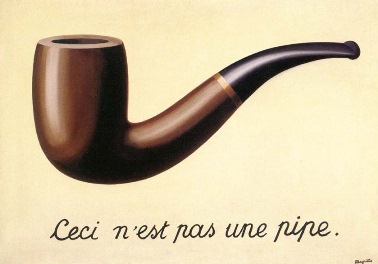 Image from wikipedia: René Magritte's famous painting, subtitled "This is not a pipe"
Chuck Salyers pointed me towards a fascinating wikipedia article on "The Map Territory Relation". Here's a few excerpts from the article, but please do read the whole thing:
The expression "the map is not the territory" first appeared in print in a paper that Alfred Korzybski gave at a meeting of the American Association for the Advancement of Science in New Orleans, Louisiana in 1931:Last blog, in "What's South of the South Pole?", we discussed the difficulty of envisioning things that are not part of the system we are within. With "the map and the territory", we have a way of thinking about how any representation of the system we are within is more useful if it finds ways to distill the elements, to avoid the uselessness of a map drawn to a scale of 1 to 1.
- A) A map may have a structure similar or dissimilar to the structure of the territory...
The Belgian surrealist artist René Magritte illustrated the concept of "perception always intercedes between reality and ourselves" in a number of paintings including a famous work entitled The Treachery Of Images, which consists of a drawing of a pipe with the caption, Ceci n'est pas une pipe ("This is not a pipe").
- B) A map is not the territory.
This concept occurs in the discussion of exoteric and esoteric religions. Exoteric concepts are concepts which can be fully conveyed using descriptors and language constructs, such as mathematics. Esoteric concepts are concepts which cannot be fully conveyed except by direct experience. For example, a person who has never tasted an apple will never fully understand through language what the taste of an apple is. Only through direct experience (eating an apple) can that experience be fully understood.
Lewis Carroll, in Sylvie and Bruno Concluded (1893), made the point humorously with his description of a fictional map that had "the scale of a mile to the mile." A character notes some practical difficulties with such a map and states that "we now use the country itself, as its own map, and I assure you it does nearly as well."
In a sort of counterpoint to Lewis Carroll, the University of Cambridge economist Joan Robinson (1962) emphasized the disutility of 1:1 maps and other overly detailed models: "A model which took account of all the variegation of reality would be of no more use than a map at the scale of one to one."
This is the power of the way of visualizing our reality as coming from ten dimensions as I've been portraying them - we have an intuitive way of encapsulating concepts that are much too big, much too all-encompassing, for us to be able to process without using representational maps. Which is not to say there is no value to the calculations physicists use to prove how our reality comes from the fifth dimension (as we explored in "The Holographic Universe"), or to deny the string theory idea that the potential for 10 to the power of 500 possible universes is contained within ten spatial dimensions (see "Does the Multiverse Really Exist?"): but rather, to return to the quote we've looked at before (in "Aren't There Really 11 Dimensions?") from physicist Michio Kaku:
In science, a physical picture is often more important than the mathematics used to describe it.As we've said before, in recent entries like Logic vs. Intuition, Computers and Consciousness, Do Shamans See Other Dimensions?, and Our Non-Local Universe: with Imagining the Tenth Dimension, we are using intuition to hold concepts in our mind that by all rights are really much too large to fit. Using Alfred Korzybski's analogy, we can say that's because this project is looking at an abstract representation: and looking at a map can be much more productive than looking at this unfathomably large territory that we're exploring.
- Michio Kaku, in his book Physics of the Impossible
Enjoy the journey,
Rob Bryanton
Next: Just Six Things: The I Ching


 Posts


